

- How We Compared Sales Coaching Software
- Top Sales Coaching Software Picks
- More Sales Coaching Software Worth Considering
- What the Best Sales Coaching Software Should Help You Improve
- How to Match Sales Coaching Software to Your Team
- How to Roll Out Sales Coaching Software for Measurable ROI
- Frequently Asked Questions
- Conclusion
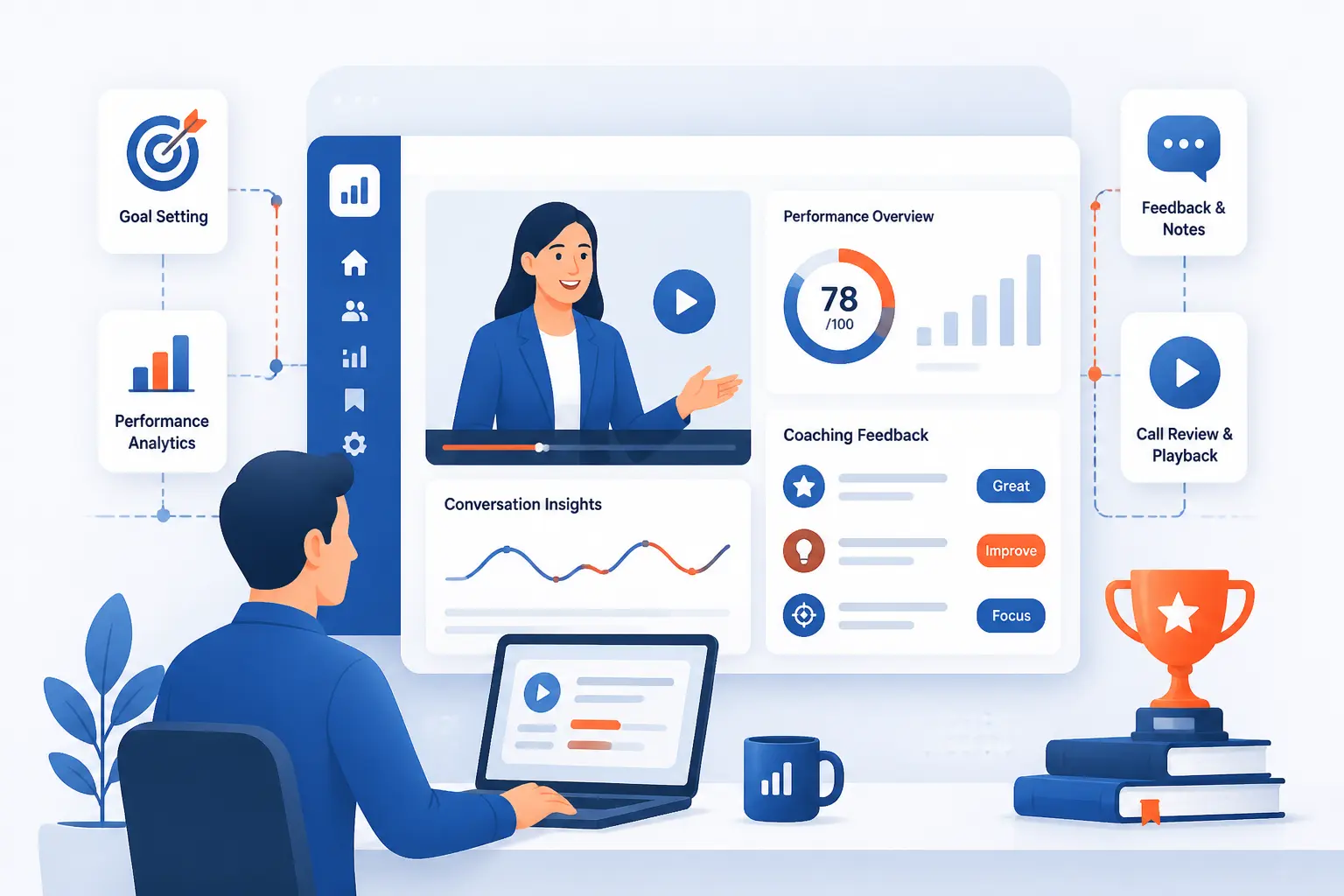
The best sales coaching software usually falls into one of two buckets, conversation intelligence tools that coach from real calls, and broader enablement platforms that add training, role play, and readiness. For most B2B teams, the shortest shortlist starts with Gong, Mindtickle, Revenue.io, and Avoma. Gong is the strongest enterprise pick for deep call analysis and coaching at scale, Mindtickle stands out when enablement is the center of the strategy, Revenue.io fits Salesforce-first teams that want live guidance, and Avoma is the most accessible option here if you want public pricing. The rest of this roundup is built to help you choose the right fit without bouncing between product pages all afternoon.
How We Compared Sales Coaching Software
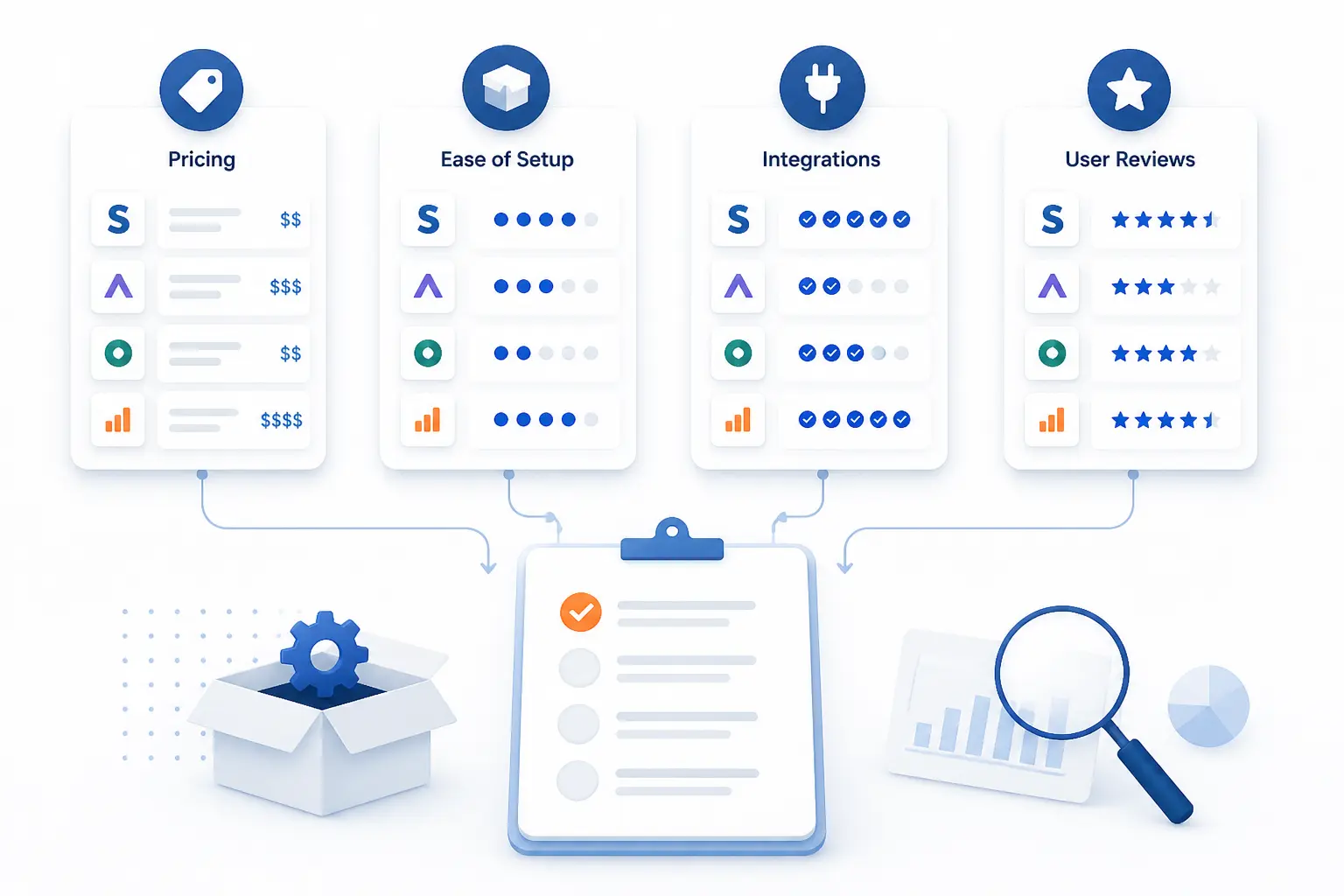
We compared these platforms the way a buyer actually shops, by checking what each vendor says it does, how pricing is packaged, what implementation looks like, and whether independent reviewers broadly confirm the pitch. The quick answer is that the market is not one-size-fits-all. Some tools are better at manager-led call coaching, some are better at structured readiness programs, and a few are much better for teams that want real-time guidance during calls. That difference matters more than long feature lists.
FURTHER READING: |
| 1. 15 Best AI Demand Forecasting Tools for Teams |
| 2. 15 Best SMTP Servers for Reliable Email Sending |
| 3. 15 Best Cloud Based Phone Systems for Small Business in 2026 |
Quick Comparison of the Best Sales Coaching Software
| Name | Best For | Ease of Use | Pricing | Score |
|---|---|---|---|---|
| Gong | Enterprise teams that want deep call coaching and deal inspection | Moderate | Custom quote, per-user licenses plus platform fee | 4.9 |
| Chorus by ZoomInfo | Teams that want conversation intelligence tied to CRM and market data | Moderate | Custom quote | 4.7 |
| Mindtickle | Enablement-led organizations that want coaching plus readiness | Moderate | Custom quote | 4.8 |
| Jiminny | Mid-market teams that want cleaner seat-based pricing | Easy | Recording seats from $83 per month | 4.6 |
| Revenue.io | Salesforce-first teams that need live call guidance | Moderate | Custom quote, built for 15+ seats | 4.7 |
| Spekit | In-workflow enablement and just-in-time coaching | Easy | Custom quote | 4.5 |
| Allego | Large enablement programs spanning learning, coaching, and AI role play | Moderate | Custom quote, annual per-user pricing | 4.6 |
| Clari Copilot | Forecast-driven teams that want coaching inside a revenue platform | Moderate | Custom quote | 4.6 |
| Salesloft Conversations | Salesloft users who want coaching inside rep workflows | Easy to moderate | Custom quote | 4.5 |
| Avoma | Small and mid-sized teams that want strong value and public pricing | Easy | From $19 per recorder seat monthly | 4.7 |
How We Researched and Evaluated Each Platform
We looked for the same things most revenue leaders care about, can this tool coach better, fit the current stack, and justify its cost. We also checked independent review volume and packaging detail, because buying an enterprise platform is easier when the vendor is clear about seat models, onboarding, and rollout expectations. For category context, we also reviewed the structure used in this market report.
- Capability fit: we scored whether the platform can realistically support the coaching style implied by this category, including scorecards, call review, role play, readiness, or live guidance.
- Coaching workflow: we favored tools that show a clear path from captured calls or practice sessions to manager feedback, rep follow-up, and measurable improvement.
- Data context: we looked closely at CRM syncing, forecasting tie-ins, and seat models because coaching is far more useful when it lives inside normal selling workflows, as shown in this Gong admin guide.
- Pricing clarity and scalability: public prices scored well, but enterprise-only products could still rank highly if packaging, minimums, or onboarding expectations were clearly explained.
- Review sentiment: we used third-party review pages to spot recurring strengths and recurring complaints, especially around transcription quality, search, usability, and implementation friction.
Those criteria shaped the editorial scores below. They are our judgments from this research, not copied from any review site.
Top Sales Coaching Software Picks
If you want the short version, Gong is the best all-around choice for large revenue teams, Mindtickle is the best coaching-plus-enablement platform, and Avoma is the most budget-friendly serious option with public pricing. The rest of the top 10 matter because teams coach in different ways. Some need real-time prompts during calls, some need onboarding and certification, and some need cleaner CRM context for deal reviews. That is where the ranking starts to separate.
1. Gong
- Category: Revenue AI and conversation intelligence
- Best for: Enterprise B2B revenue teams
- Ease of use: Moderate
- Pricing: Custom quote
- Standout feature: Coaching inside a broader revenue platform
When a team wants coaching tied directly to deal execution, Gong is still the clearest benchmark. It sits at the top of this list because the platform is not only about recording calls. The product pages and admin docs show a broader system that connects call capture, forecasting, enablement, automation, and CRM context. That makes Gong especially strong for organizations that want coaching to change pipeline behavior, not just create a nicer call library.
How Gong works
Gong’s setup starts with a core license and then expands with application seats. Its admin documentation describes a Gong Foundation platform, plus add-on applications such as Enable Essentials, Forecast Essentials, Gong Forecast, Gong Engage, and Data Cloud. In practice, that means a team can begin with call capture and rep visibility, then layer on coaching or forecasting as the motion becomes more formal. Gong also makes a distinction between paid seats and free collaborator access, which matters when you want leaders or adjacent teams to review calls without buying full licenses for everyone.
On the product side, Gong positions the platform around a Revenue AI OS. The main site highlights Gong Enable for coaching tied to real customer interactions, Gong Forecast for pipeline visibility, Gong Engage for outreach, and Gong Agents for follow-ups, pipeline edits, and enablement triggers. In plain terms, the workflow is capture the interaction, surface patterns, coach to the pattern, and then push the next action back into the revenue process. That is a big reason it ranks first here.
Who is Gong for?
Gong fits mature B2B sales organizations, especially multi-manager teams running structured deal reviews, forecast calls, and method-based coaching. It also suits RevOps-heavy organizations that want one source for call insight, coaching evidence, and pipeline context. If your sales motion is complex, cross-functional, and measured hard, Gong makes a strong case.
Smaller teams should look elsewhere if they mainly want affordable note-taking, simple scorecards, or lightweight onboarding. Gong can do a lot, but the value case makes more sense when coaching is tied to a larger revenue operating model.
Gong pricing
- Custom quote: priced per user, includes a platform fee based on the number of users supported, and lets you integrate your existing tech stack at no extra charge.
- Gong Foundation platform: core license model that can be expanded with applications like Enable Essentials, Forecast Essentials, Gong Forecast, Gong Engage, and Data Cloud.
Gong does not publish list prices, but it does explain the seat-based structure and platform fee in this pricing page.
Pros and cons
Pros
- Core plan model is clearly documented, including free collaborator access.
- Coaching can be connected to forecasting, outreach, and CRM data instead of living in a silo.
- Strong enterprise packaging, with application-level expansion rather than one flat bundle.
- Very large public review footprint, which gives buyers more signal than most rivals.
Cons
- No public price list, so budgeting requires a sales conversation.
- Best value shows up in larger, process-heavy organizations rather than small teams.
- The platform breadth can be overkill if you only want lightweight call coaching.
Gong rating and reviews
- G2: rated 4.7/5 across 6,593 reviews.
Our take is simple, if you want coaching software that can become a system of record for seller behavior and deal inspection, Gong is the one to beat. It is not the cheapest route, but it is the most complete one in this roundup.
2. Chorus by ZoomInfo
- Category: Conversation intelligence
- Best for: Teams that want call coaching plus account and market context
- Ease of use: Moderate
- Pricing: Custom quote
- Standout feature: Strong link between conversation data and relationship visibility
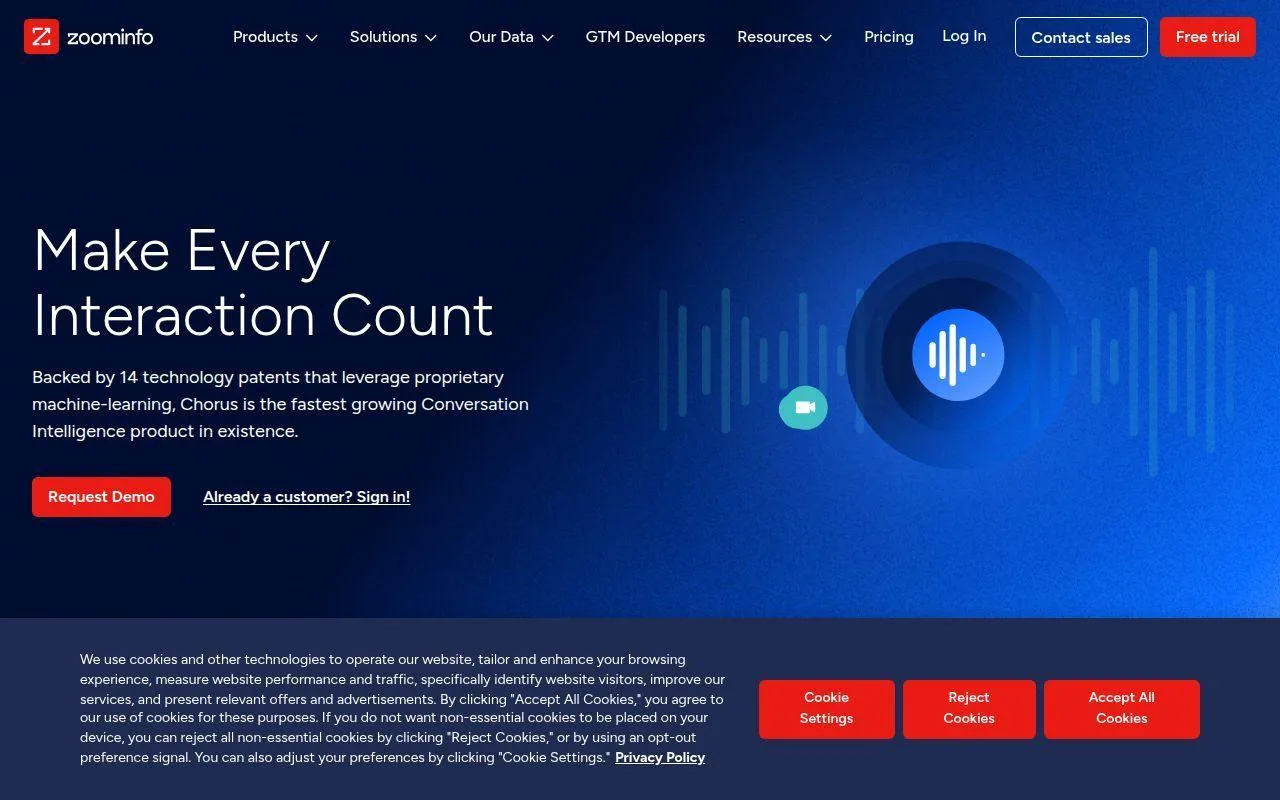
Chorus by ZoomInfo earns this spot because it stays focused on the coaching and deal-review side of the problem while still reaching into CRM and account visibility. The official product page frames the tool around customer calls, meetings, and emails, then extends that into team performance, deal intelligence, and market intelligence. That is a good combination for teams that need better coaching, but do not want coaching separated from what is happening inside the pipeline.
How Chorus by ZoomInfo works
The product page lays out a fairly clean workflow. First, Chorus captures and analyzes customer calls, meetings, and emails. From there, it feeds four practical use cases, sales call analysis for transcriptions and insights, onboarding and sales enablement for winning behaviors and methodology adherence, deal intelligence and relationship management for CRM visibility and account momentum, and market intelligence for customer language, competitor mentions, and trends that affect deals.
That structure matters because it explains how coaching is supposed to happen. Managers can review interactions, identify patterns in rep behavior, and use scorecarding or snippets to coach to real moments. Meanwhile, the same data helps with forecast confidence and relationship mapping. In other words, Chorus is not just a replay tool. It is trying to make conversation data operational for managers, RevOps, and leadership.
Who is Chorus by ZoomInfo for?
Chorus is a good fit for B2B revenue teams that already care about pipeline inspection, relationship management, or ZoomInfo’s broader ecosystem. It should appeal to managers who want coaching evidence tied to real deals and to teams that want competitive and customer-language insights from calls.
Teams looking for simple, self-serve pricing or a lighter SMB-style onboarding experience should keep shopping. Chorus looks strongest when it is part of a larger revenue stack, not a single-purpose bargain tool.
Chorus by ZoomInfo pricing
- Custom quote: no public list pricing is shown on the product page, and buyers are pushed toward Request Demo or Contact Sales for packaging.
Pricing is quote-based, so you will need to talk with sales rather than build a budget from a public calculator.
Pros and cons
Pros
- Official workflow is easy to follow, from call capture to coaching, deal visibility, and market insight.
- Useful balance of coaching features and CRM relationship intelligence.
- Supports methodology adherence and onboarding use cases, not just post-call playback.
- Independent reviews show a sizable footprint for a specialist tool.
Cons
- No public pricing.
- Less appealing if you do not need the broader account and market context.
- Some third-party reviewers mention bugs and inconsistent AI search, which is worth checking during a trial or demo.
Chorus by ZoomInfo rating and reviews
- TrustRadius: rated 8.3/10 across 459 reviews and ratings.
We like Chorus most for teams that want better coaching without losing sight of relationships, account momentum, and competitive trends. It is a practical second choice when Gong feels like too much platform, but you still want serious conversation intelligence.
3. Mindtickle
- Category: Revenue enablement platform
- Best for: Coaching programs tied to onboarding, practice, and readiness
- Ease of use: Moderate
- Pricing: Custom quote
- Standout feature: Coaching forms and role play inside one enablement stack
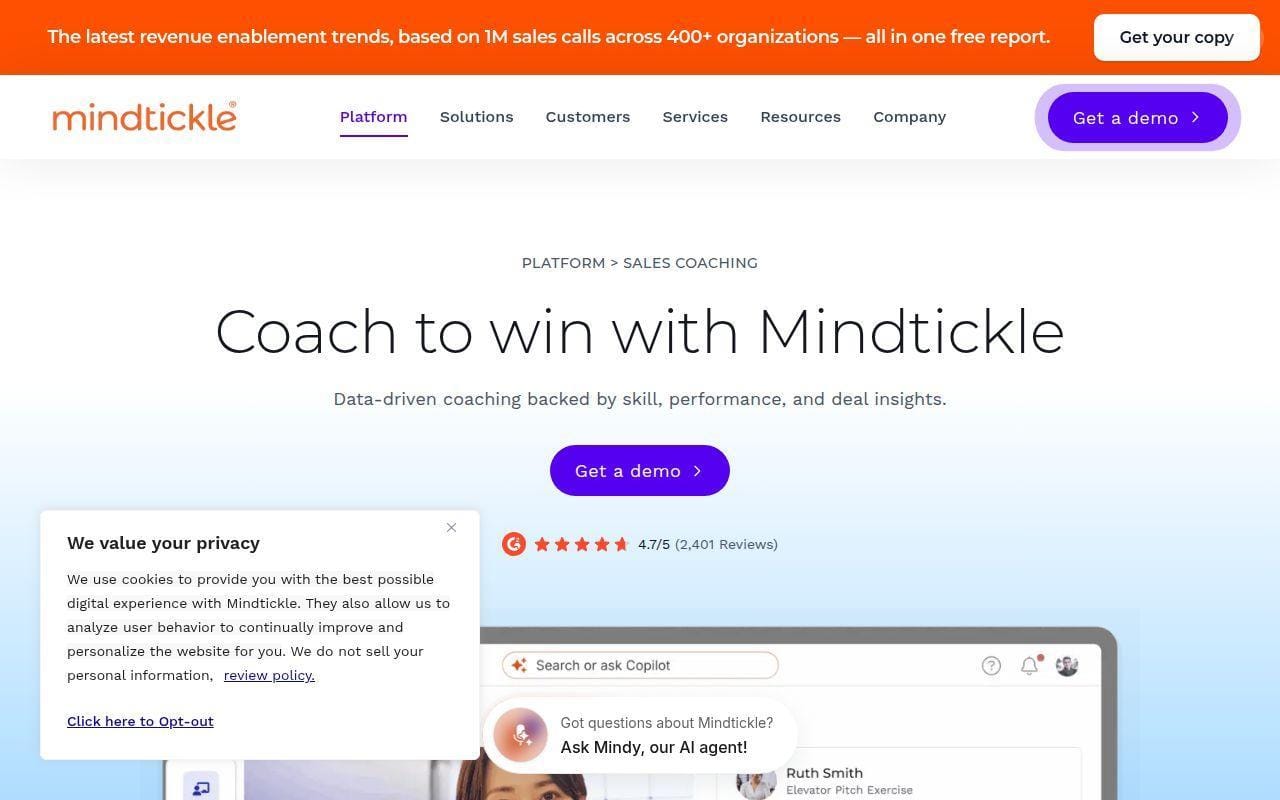
Mindtickle is the best fit here when coaching is only one part of a broader readiness program. The product page is explicit about that. Instead of selling itself as a pure call-review tool, it positions coaching alongside skill insights, performance insights, deal insights, call coaching, reinforcement, and AI role-plays. That makes it especially attractive for enablement teams that own onboarding, certification, and manager coaching standards in one place.
How Mindtickle works
The workflow starts with formalized coaching rather than ad hoc feedback. Mindtickle highlights coaching forms and templates to avoid blank-slate manager sessions, then adds call coaching for immediate feedback based on real interactions. It also includes pitch practice through AI-powered role-plays, which is a key difference from tools that only analyze live calls after the fact.
What we found especially practical is the loop Mindtickle describes after coaching. Managers can identify gaps like weak discovery skills, automatically recommend training content, and assign AI role-plays to reinforce the issue. The sales reps side of the page emphasizes individualized coaching, extra training for skill gaps, and practice to perfect new skills. That gives the platform a more closed-loop design than most call intelligence tools.
Who is Mindtickle for?
Mindtickle is built for revenue enablement teams, larger sales organizations, and companies that want formal coaching programs with templates, certifications, and role-based development. It is also a strong pick for organizations that need coaching to feed into onboarding and ongoing readiness, not just manager note-taking.
If you mainly want inexpensive call summaries, quick clip sharing, or a light-weight AI note taker, there are simpler options on this list. Mindtickle shines when coaching is a designed program, not a side task.
Mindtickle pricing
- Custom quote: pricing depends on company size and team structure, with sales-led packaging rather than public monthly plans.
- Support packaging: standard support is included in platform subscription fees, while premium support adds a designated customer success manager, faster response times, live chat for admins, and 24/7 critical support.
Mindtickle keeps pricing private, but the vendor does explain the quote-based model in this AI role-play FAQ.
Pros and cons
Pros
- Very clear coaching workflow, from forms to call review to reinforcement.
- AI role-play is built into the coaching story rather than bolted on later.
- Good fit for enablement leaders who need structure and repeatability.
- Support tiers are more clearly described than many enterprise rivals.
Cons
- No public pricing.
- Probably too much system for teams that only need meeting summaries and clips.
- Reviewers on G2 do mention a learning curve and occasional performance issues.
Mindtickle rating and reviews
- G2: rated 4.7/5 across 2,223 reviews.
If your buying decision starts with enablement and ends with coaching, Mindtickle is one of the strongest options in the category. We would put it ahead of many pure conversation tools for organizations that care deeply about ramp, certification, and readiness measurement.
4. Jiminny
- Category: Revenue intelligence and conversation intelligence
- Best for: Mid-market teams that want clearer pricing and CRM syncing
- Ease of use: Easy
- Pricing: From $83 per recording seat monthly
- Standout feature: Straightforward seat model with a free listener tier
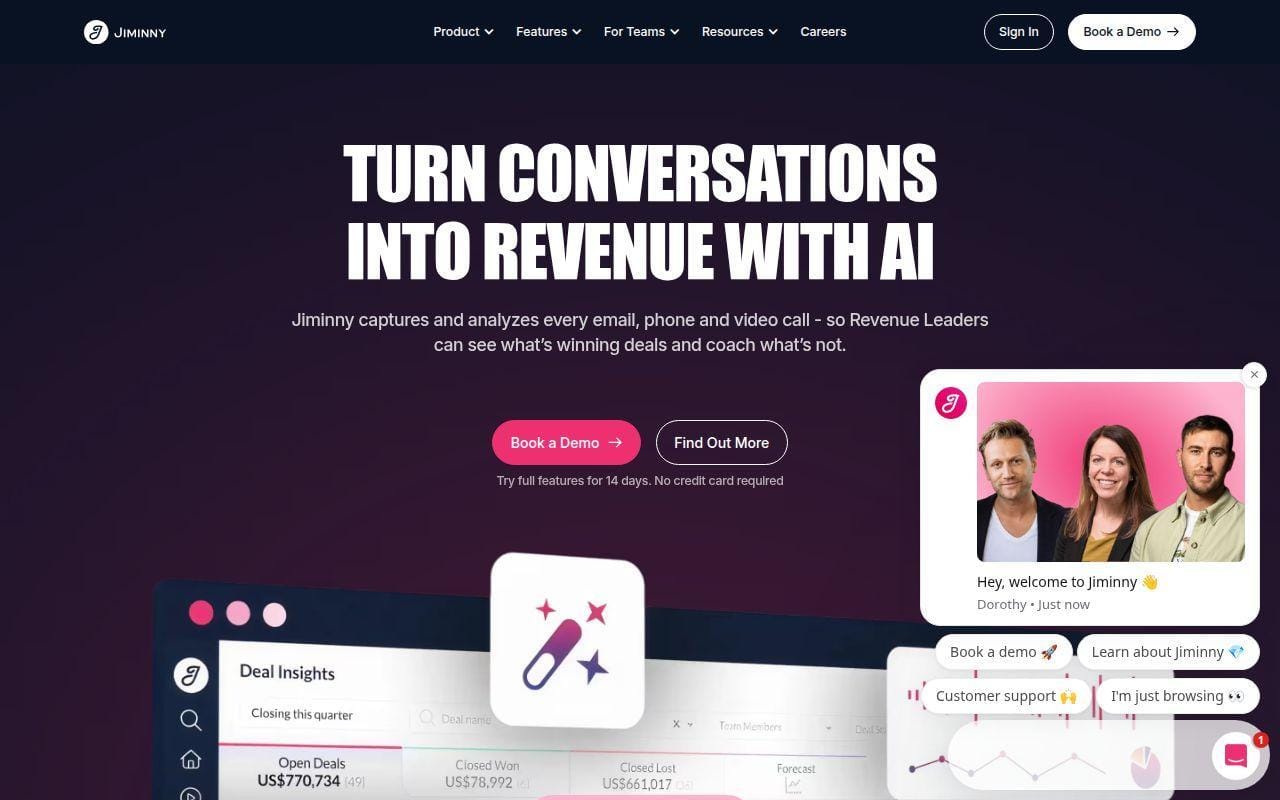
Jiminny stands out because it looks simpler to buy and simpler to explain than most enterprise-heavy rivals. The homepage presents a direct four-step story, record every interaction, let AI extract insights, sync those insights to CRM, and use the result to improve conversion and revenue. That clarity carries into pricing too, which is unusual in this market.
How Jiminny works
The official homepage is refreshingly direct. Step one is recording every interaction. Step two is AI extracting insights. Step three is syncing those insights to CRM. Step four is using the improved visibility to raise conversion rates and revenue. The site then maps value to executives, managers, and reps, which tells you the product is designed for more than just top-down dashboarding.
For managers, Jiminny emphasizes pipeline visibility, coaching tools, and AI efficiency. For reps, it focuses on reducing admin, spotting deal risks early, and learning from every call. That mix suggests Jiminny is strongest when a team wants coaching and insight without adopting a sprawling enablement platform. It also offers a 14-day trial with full features and no credit card, which lowers the barrier to an initial evaluation.
Who is Jiminny for?
Jiminny fits growing sales teams that want better coaching discipline, cleaner CRM context, and pricing they can understand quickly. It also makes sense for leaders who want different seat types for reps, managers, and read-only users instead of buying the same expensive license for everyone.
Large enterprises that want a deeply layered enablement suite or heavy customization may find other tools more expansive. Jiminny feels strongest in teams that value speed, clarity, and a practical rollout.
Jiminny pricing
- Recording Seat: from $83 per month, for reps who join and record calls.
- Insights Seat: from $42 per month, for managers or coaches who review and act on the data.
- Listener Seat: $0 per month, for users who only need access to transcripts and summaries.
- Contract terms: minimum 12-month contract, billed monthly or annually, plus a one-time setup fee and no platform fee.
Those seat types are spelled out on this FAQ page.
Pros and cons
Pros
- Public seat pricing is much clearer than most tools in this category.
- Free listener seats are genuinely useful for wider call access.
- The product story is easy to follow, from recording to CRM sync.
- 14-day full-feature trial lowers buying friction.
Cons
- 12-month minimum contract still makes it a committed purchase.
- One-time setup fee adds a cost layer beyond monthly seats.
- Reviewers on G2 mention occasional bugs and less-than-perfect external sharing workflows.
Jiminny rating and reviews
- G2: rated 4.6/5 across 925 reviews.
Jiminny is one of the easiest platforms here to shortlist quickly. If Gong and Clari feel too enterprise-heavy, this is a sensible middle path that still covers recording, coaching, and CRM sync well.
5. Revenue.io
- Category: Salesforce-native revenue execution platform
- Best for: Salesforce teams that want real-time coaching during calls
- Ease of use: Moderate
- Pricing: Custom quote, built for 15+ seats
- Standout feature: Live guidance inside Salesforce
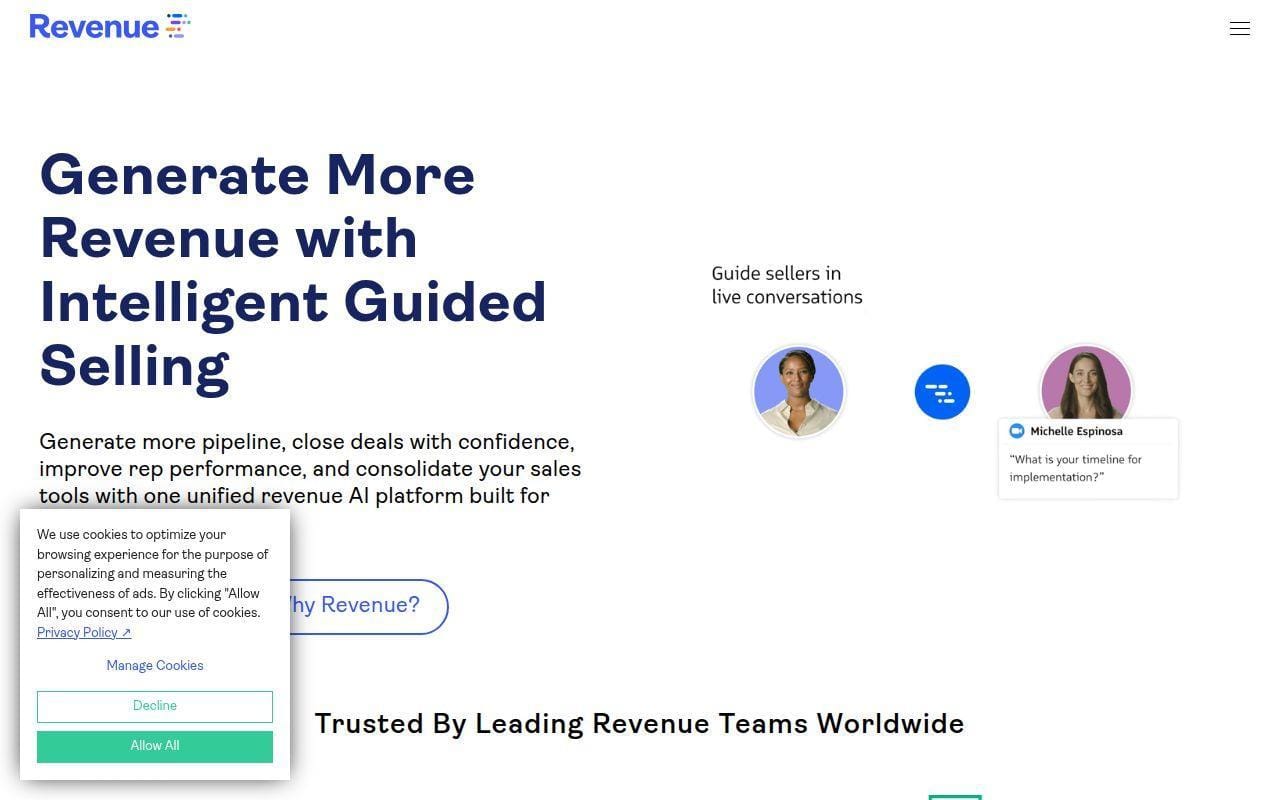
Revenue.io earns a high ranking because it approaches coaching as an in-the-moment execution problem, not just a post-call review problem. The official site is explicit about this. Its platform unifies dialing, engagement, conversation intelligence, real-time coaching, and AI inside Salesforce. That is a big deal for organizations that are tired of bouncing between separate dialer, call review, and enablement tools.
How Revenue.io works
The product page divides the platform into Engage, Coach, and Automate. The coaching layer is the most important part for this list. Revenue.io highlights Real-Time Coaching, AI Methodology Coaching, AI Scorecards, AI Sales Roleplay, and Ask Revenue AI. The pricing page then shows how that capability is packaged across Activate, Engage, and Orchestrate.
Activate is the Salesforce-native dialer tier with real-time, stage-specific coaching. Engage adds call, email, and SMS sequences plus auto-transcribed and summarized calls. Orchestrate adds Ask Revenue AI, AI scorecards, automatic coaching feedback, Deal Health Scores, pipeline management, in-person sales intelligence, and AI conversation agents. The practical workflow is clear, reps call from Salesforce, get battlecards and coaching live, complete the interaction, and keep the intelligence inside the CRM with no shadow data layer.
Who is Revenue.io for?
Revenue.io is for teams that are all-in on Salesforce and want coaching to happen in the flow of selling. It is especially appealing for inside sales teams, phone-heavy teams, and managers who want scorecards, methodology checks, and live prompts tied to specific stages.
If you do not use Salesforce as the center of your GTM motion, the product loses some of its sharpest advantage. Non-Salesforce organizations should probably favor a more neutral platform.
Revenue.io pricing
- Activate: custom quote, includes dialing from Salesforce, real-time coaching, local numbers in 40+ countries, recording, routing, SMS, and a mobile app with Hot Lead alerts.
- Engage: custom quote, includes everything in Activate plus playbooks, automatic sequences across call, email, and SMS, analyzed and summarized calls, and automatic email follow-ups.
- Orchestrate: custom quote, includes everything in Engage plus Ask Revenue AI, AI scorecards, automatic coaching feedback, Deal Health Scores, pipeline management, and in-person sales intelligence.
The vendor lays out those plan differences on this pricing page.
Pros and cons
Pros
- One of the clearest live-coaching stories in the category.
- Pricing page openly explains feature differences between plans.
- Built natively on Salesforce, which simplifies data flow for the right buyer.
- Includes AI roleplay and AI scorecards within a broader execution stack.
Cons
- Best fit is narrow if your CRM strategy does not revolve around Salesforce.
- No public list pricing.
- Vendor says the sweet spot starts at 15 seats, so tiny teams are not the target.
Revenue.io rating and reviews
- G2: rated 4.7/5 across 574 reviews.
Revenue.io is one of the smartest picks for teams that want coaching to shape the call while it is happening. If live guidance matters more to you than sprawling enablement features, it deserves a hard look.
6. Spekit
- Category: Revenue enablement platform
- Best for: In-workflow coaching and knowledge delivery
- Ease of use: Easy
- Pricing: Custom quote
- Standout feature: AI Sidekick in the flow of work
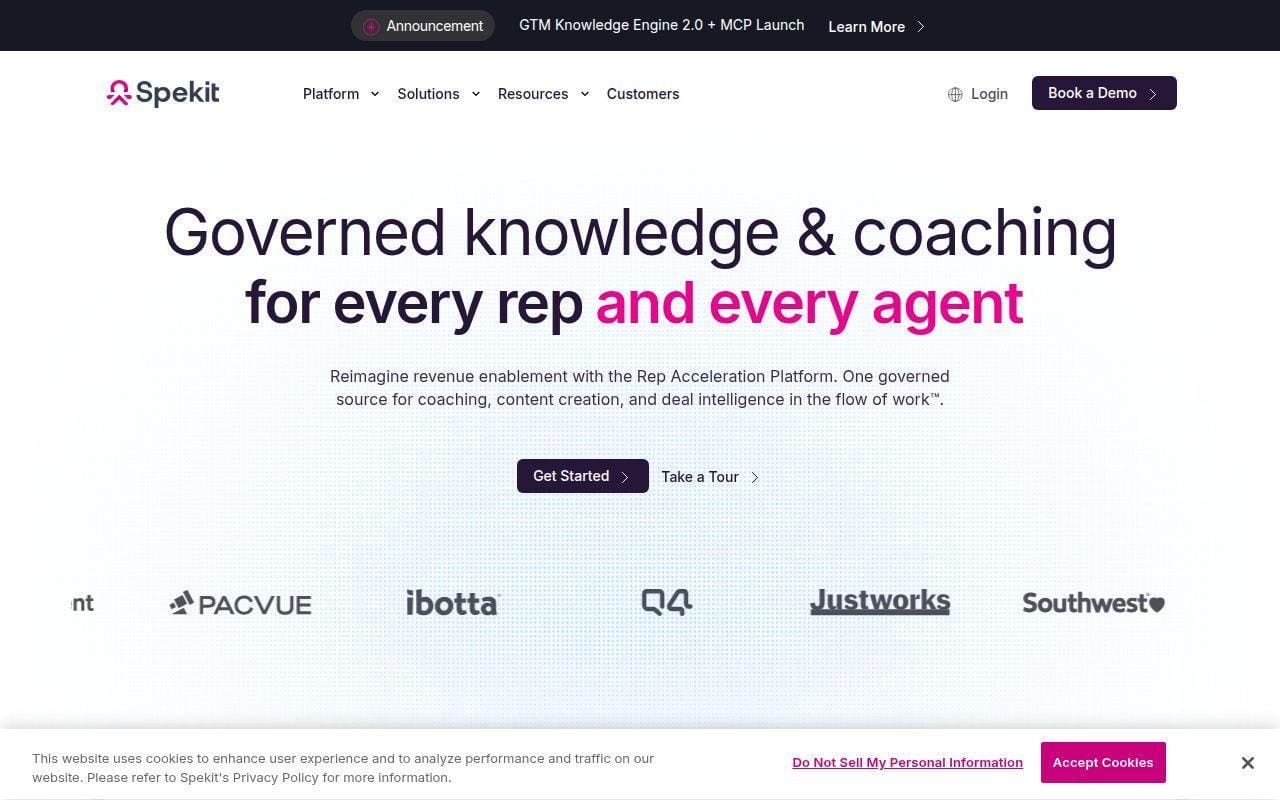
Spekit makes this list because it comes at coaching from a different angle. Instead of leading with call analysis alone, it focuses on governed knowledge, embedded enablement, deal context, and an AI coach that appears inside the rep workflow. That will not be the right answer for every team, but it is a very good answer for organizations where reps miss messaging, process, or content because the help is never where the work happens.
How Spekit works
The homepage describes Spekit as a Rep Acceleration Platform with four core pieces, a Knowledge Engine, Agentic Coaching, Unified Deal Context, and Buyer Experience. More concretely, the product menu lists Spekit Content Hub, AI Content Creation, AI Sidekick, Deal Rooms, Learning Paths, Embedded Enablement, Analytics, and Integrations. The core idea is that one governed source of GTM truth feeds learning and coaching right where reps sell.
AI Sidekick is the star here. Spekit says it delivers the right guidance, content, or action in the moment, with coaching personalized to each deal and automated follow-up work after that. On the pricing overview page, Spekit also highlights Spotlights for in-app alerts, Dynamic Playlists for guided training journeys, and a Chrome Extension that delivers content and answers in tools like Salesforce, Gmail, and Gong. So the workflow is less about grading calls after the fact and more about keeping reps on-message during day-to-day execution.
Who is Spekit for?
Spekit is best for enablement teams, product marketing teams, and revenue leaders who want less portal-hopping and more in-context guidance. It is also a strong option for fast-changing GTM teams where messaging, process, and product knowledge update constantly.
If your buying priority is heavy forecast coaching, call scorecards, or deep call analytics as the center of the system, other tools on this list go further. Spekit is better when coaching and knowledge delivery need to be inseparable.
Spekit pricing
- Custom quote: Spekit lists one pricing edition and directs buyers to request a demo for custom pricing options.
- Included highlights: pricing overview names AI Sidekick, Spotlights, Dynamic Playlists, and the Chrome Extension as core packaged capabilities.
The clearest public packaging summary we found is on this pricing overview.
Pros and cons
Pros
- Different and practical approach to coaching, built around in-workflow guidance.
- Knowledge governance, learning, and deal context are tightly connected.
- The Chrome extension and contextual delivery model should appeal to reps.
- Review sentiment is strong for usability and integration into day-to-day work.
Cons
- Public pricing is still not truly transparent.
- Less obviously built for manager-led call grading than Gong or Salesloft Conversations.
- Teams that prefer formal LMS-style structure may need to check fit carefully.
Spekit rating and reviews
- G2: rated 4.7/5 across 282 reviews.
Spekit is one of the more distinctive options in this roundup. We would shortlist it when coaching breaks down because the right help never reaches reps at the moment they actually need it.
7. Allego
- Category: Revenue enablement platform
- Best for: Enterprises combining learning, coaching, content, and AI role play
- Ease of use: Moderate
- Pricing: Custom quote
- Standout feature: Broad platform scope with AI included
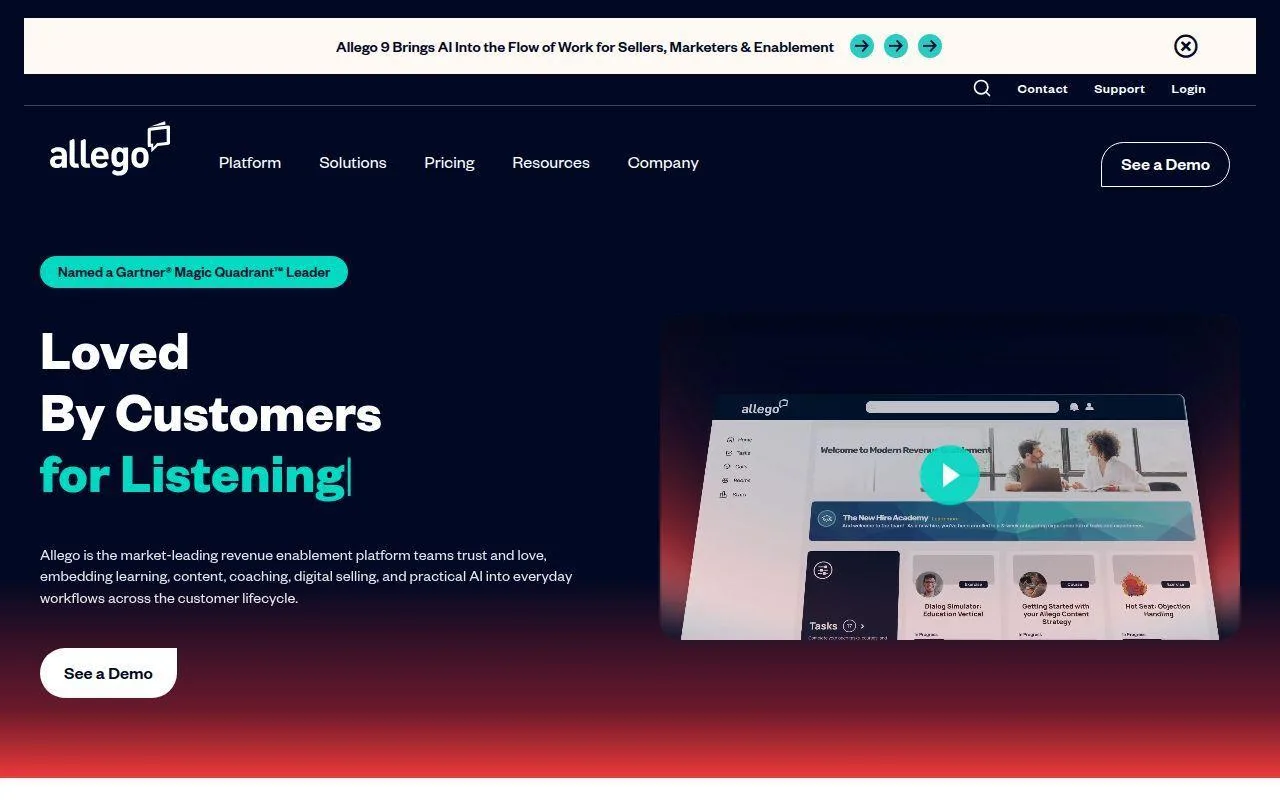
Allego ranks well because it treats coaching as one piece of a larger readiness and execution system. The homepage and pricing page both make that plain. The platform bundles content management, modern learning, AI role play and coaching, digital sales rooms, conversation intelligence, and practical AI agents. That breadth is useful when an organization wants fewer tools, not another point solution.
How Allego works
On the product side, Allego organizes itself around content, learning, coaching, digital selling, and AI. The site highlights AI Role Play & Coaching for practicing real selling scenarios with instant feedback, Conversation Intelligence for revenue teams across industries, and Learning & Readiness for onboarding through ongoing skill development. Practical AI Agents are presented as assistants that automate tasks, surface insights, and guide sellers toward the right action at the right time.
The pricing page adds a clearer picture of the functional packages. It breaks out Modern Learning + Conversation Intelligence, AI Role Play, Content Management, and Digital Rooms + Deal Navigator as packaged capability areas. For buyers, that means Allego is not only about call review. It can cover onboarding, reinforcement, role play, content discovery, buyer rooms, and coaching inside one system, which is why it outranks narrower tools for enterprise enablement use cases.
Who is Allego for?
Allego is for large organizations that want one enablement platform to cover multiple jobs, especially training, readiness, coaching, role play, and content delivery. It also fits teams that need a lot of support around rollout, integrations, and ongoing success management.
Smaller teams or teams that only need conversation intelligence will probably find Allego heavier than necessary. This is a platform buy, not a quick plugin.
Allego pricing
- Custom quote: priced per user per month and billed annually upfront, with price points based on seat count and contract length.
- Contract terms: typical contract length is 3 years paid annually, with 2-year and 1-year options available.
- Included support: AI capabilities and customer support are included, and each deployment includes Premium Success Services.
Allego explains that structure on its pricing page.
Pros and cons
Pros
- Very broad platform that can replace several adjacent tools.
- AI is included rather than sold as a separate add-on.
- Pricing page is more informative than many enterprise vendors, even without list prices.
- Premium Success Services are packaged into deployments.
Cons
- No public per-seat numbers.
- Typical 3-year term is a serious commitment.
- Overbuilt if your only goal is post-call coaching.
Allego rating and reviews
- G2: rated 4.6/5 across 690 reviews.
Allego is a strong enterprise choice when you want to consolidate training, coaching, and buyer-facing enablement into one platform. It is less compelling for small teams, but very credible for bigger programs.
8. Clari Copilot
- Category: Conversation intelligence and coaching
- Best for: Forecast-driven teams that want coaching tied to revenue context
- Ease of use: Moderate
- Pricing: Custom quote
- Standout feature: Buyer signals pushed into the Clari revenue process
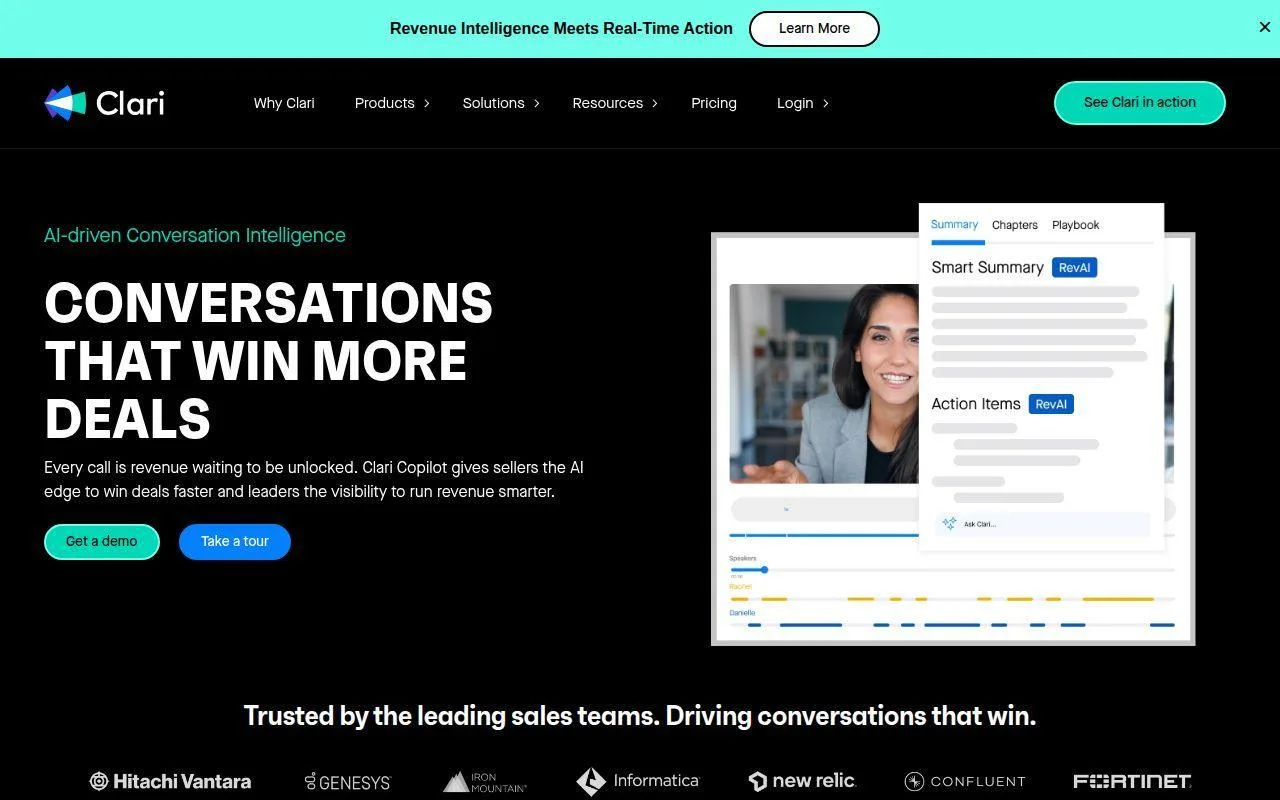
Clari Copilot is most appealing when coaching cannot be separated from forecasting and revenue inspection. The official page makes that point repeatedly. Copilot does not just record and transcribe calls. It feeds buyer signals directly into the wider Clari revenue process, captures intent and next steps in CRM, and supports managers with battlecards, playbooks, and gametapes. That is why it lands in the top 10 rather than the middle of the pack.
How Clari Copilot works
The product page describes Copilot as AI-driven conversation intelligence. It transcribes in real time, uses live battlecards during calls, captures buyer signals that sharpen forecasting and pipeline inspection, and automatically records intent, objections, contacts, and next steps in CRM. After the call, the same data flows into Clari’s broader Revenue Orchestration Platform for pipeline and forecast visibility.
For coaching, Clari emphasizes three named assets, Battlecards for real-time rep guidance, Playbooks for call consistency, and Gametapes for onboarding through proven winning moments. That makes the workflow fairly easy to picture. Reps get live cues during the conversation, leaders get better post-call review material, and RevOps gets cleaner revenue context across the funnel.
Who is Clari Copilot for?
Clari Copilot is for organizations where forecast quality, pipeline hygiene, and call coaching are tightly linked. It should especially appeal to sales leaders and RevOps teams already considering Clari as a wider revenue platform.
Teams that simply want affordable recording, simple call libraries, or standalone AI note taking can find cheaper and lighter tools. Copilot works best when you want its call data to influence the rest of the revenue system.
Clari Copilot pricing
- Custom quote: Clari positions its platform as tailored to your use case, with no public list pricing.
- Included platform elements: the pricing page highlights RevAI, RevDB, integrations, continuous support, and expert revenue insights as part of the broader package.
Clari keeps pricing sales-led, with package details summarized on this quote page.
Pros and cons
Pros
- Strong connection between conversation intelligence and forecast execution.
- Live battlecards and CRM capture make the coaching loop practical.
- Good fit for teams that want buyer signals to improve deal inspection.
- Large public review base after the Clari and Salesloft combination.
Cons
- No public pricing.
- Best value is tied to broader Clari adoption, which can raise total scope.
- Buyers should confirm whether they want a coaching tool or a revenue platform commitment.
Clari Copilot rating and reviews
- G2: rated 4.6/5 across 5,597 reviews.
Clari Copilot is a strong shortlist option when leaders care as much about forecast quality as rep development. If that is your buying frame, it will likely make more sense than simpler coaching tools.
9. Salesloft Conversations
- Category: Conversation intelligence
- Best for: Salesloft users who want coaching inside seller workflows
- Ease of use: Easy to moderate
- Pricing: Custom quote
- Standout feature: AI-assisted scorecards in manager workflows
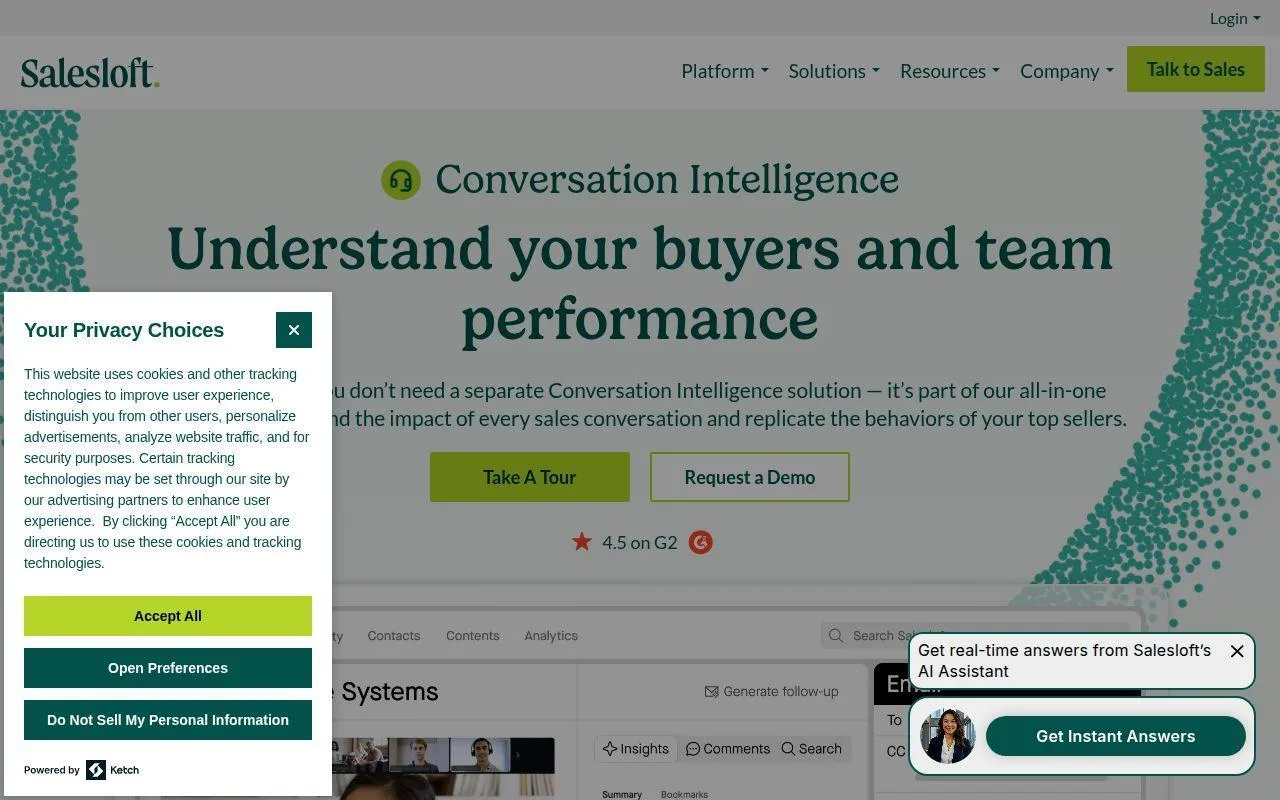
Salesloft Conversations belongs on this list because it does a good job of keeping coaching close to the rep workflow. The official page focuses on coachable moments, AI-assisted scorecards, summaries and action items, key moments, tracker trends, and call recording with transcription. That is a pretty practical feature set for managers who want targeted feedback without living in a separate system all day.
How Salesloft Conversations works
The product flow is built around captured conversations and AI-surfaced coaching opportunities. Salesloft says AI agents highlight where managers need to spend time coaching sellers. Its AI Scorecard agent pre-populates manager scorecards by analyzing conversation transcripts, and those scorecards are surfaced as action items inside Rhythm. That last part is important. Coaching does not sit off to the side. It becomes part of the manager workflow.
Beyond scorecards, the page lists Summaries + Action Items, Conversation Key Moments, Tracker Trends, and Call Recording & Transcription. That gives managers several ways to review calls quickly, see what mattered, and turn insights into rep follow-up. For teams already using Salesloft for engagement, this packaging is especially coherent.
Who is Salesloft Conversations for?
Salesloft Conversations is best for teams already leaning into Salesloft’s broader platform. It is a good pick for managers who want AI-assisted scorecards and workflow-based coaching rather than a separate review destination.
Teams looking for public pricing or a tool that stands entirely on its own may find other products easier to buy. The fit is strongest when Salesloft is already central to the GTM stack.
Salesloft Conversations pricing
- Custom quote: Salesloft does not publish line-item prices and directs buyers to contact sales.
- Platform capabilities included in packaging: the pricing page highlights bi-directional CRM sync, coaching, reporting and analytics, security, governance, and AI-powered workflows.
Salesloft keeps package detail high and list pricing private on its pricing page.
Pros and cons
Pros
- AI-assisted scorecards are clearly described and tied to manager workflow.
- Useful set of post-call coaching tools, including key moments and action items.
- Should feel natural for organizations already invested in Salesloft.
- Large review volume gives buyers a lot of outside feedback to read.
Cons
- No public pricing.
- Best fit is narrower if you are not already a Salesloft shop.
- Reviewers on G2 often praise usability but also mention limits around dialing and some integrations.
Salesloft Conversations rating and reviews
- G2: rated 4.5/5 across 4,287 reviews.
Salesloft Conversations is easy to recommend inside an existing Salesloft environment. Outside that context, it is still good, but the value case gets a bit less obvious than some rivals above it.
10. Avoma
- Category: AI meeting assistant and revenue intelligence
- Best for: Small and mid-sized teams that want strong value with public pricing
- Ease of use: Easy
- Pricing: From $19 per recorder seat monthly
- Standout feature: Transparent pricing with useful add-ons
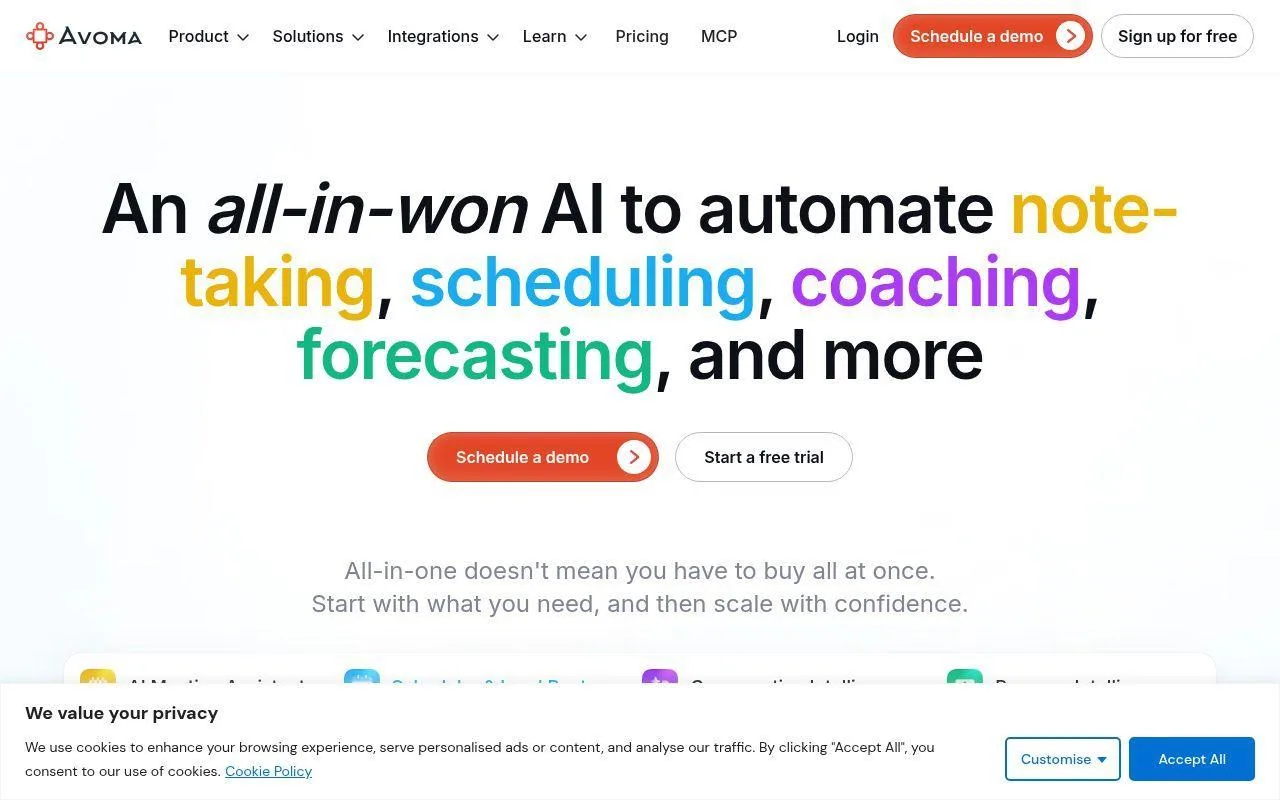
Avoma is the most buyer-friendly option in the top 10 if you want real pricing, flexible packaging, and a tool that does more than transcribe meetings. The homepage and pricing page show a broader system than some buyers may expect. Avoma spans AI meeting assistance, scheduling, conversation intelligence, revenue intelligence, and lead routing, with paid add-ons for deeper coaching and deal analysis. For smaller teams in particular, that is a strong mix.
How Avoma works
Avoma’s product flow begins with AI Meeting Assistant. The site lists real-time transcription, AI-generated note taking, Smart Chapters, AI-generated follow-up emails, automatic CRM data entry for frameworks such as MEDDIC and SPICED, and an Ask Avoma AI Copilot. That alone handles a big chunk of rep admin.
The platform then branches into Scheduler & Lead Router, Conversation Intelligence, and Revenue Intelligence. On the pricing page, Avoma breaks out base plans for recorder users and separate add-ons for Conversation Intelligence, Revenue Intelligence, and Lead Router. That lets teams start with meeting capture and add coaching or deal-risk tooling later. It is a tidy packaging model, and a rare one in a category full of quote-only products.
Who is Avoma for?
Avoma is a smart fit for startups, small teams, and mid-market organizations that want a serious coaching-adjacent platform without enterprise-only buying friction. It also works for teams that want meeting help, call review, and CRM capture before they commit to a heavier revenue stack.
Very large enterprises with deeply specialized enablement programs may still prefer Gong, Mindtickle, Allego, or Clari. Avoma wins more on value, usability, and packaging clarity than on maximum platform depth.
Avoma pricing
- Startup: $19 per recorder seat monthly when billed annually, includes unlimited AI Meeting Assistant, up to 25 paid seats, unlimited view-only seats, unlimited 1:1 scheduling, automatic video recording, unlimited transcription, AI summary notes, Ask Avoma for a meeting, and CRM note saving.
- Organization: $29 per recorder seat monthly or $24 monthly on the annual view shown, includes everything in Startup plus up to 100 paid seats, custom AI topics and templates, group and round-robin scheduling, limited conversation intelligence, Smart Playlist and AI automations, API integration and webhooks, and a customer success manager.
- Enterprise: $39 per recorder seat monthly, billed annually only, includes everything in Organization plus a 10-seat minimum, Global Ask Avoma, concierge onboarding and training, quarterly business reviews, team-specific access controls, SSO, data retention policies, and HIPAA compliance.
- Conversation Intelligence add-on: $29 per seat monthly billed annually, includes AI coaching recommendations, AI call scoring, Smart Trackers, and Global Ask Avoma.
- Revenue Intelligence add-on: $29 per seat monthly billed annually, includes AI deal risks, a sales methodology tracker, AI win-loss analysis, and forecasting.
The full pricing breakdown lives on this plans page.
Pros and cons
Pros
- Public pricing is far clearer than most rivals here.
- Recorder-seat model with free viewers is easy to budget.
- Add-ons let buyers start smaller and expand into coaching or revenue intelligence later.
- Supports MEDDIC and SPICED field capture in CRM workflows.
Cons
- Conversation intelligence and revenue intelligence cost extra.
- Enterprise plan requires a 10-seat minimum.
- G2 reviewers do mention occasional transcription and AI accuracy issues.
Avoma rating and reviews
- G2: rated 4.6/5 across 1,359 reviews.
Avoma closes the top 10 as the best value-conscious choice for many smaller teams. If you want transparency, a modern feature set, and less enterprise purchasing theater, it is an easy tool to shortlist.
More Sales Coaching Software Worth Considering
The next five tools are still good options, but they each serve a narrower use case or sit a bit further from the center of this category. That does not make them weak. It just means they are easier to recommend for a specific situation than as a default pick. If one of the descriptions below sounds exactly like your team, that is usually a good sign.
11. Second Nature
- Category: AI role play and coaching
- Best for: Practice-heavy onboarding and certification
- Ease of use: Moderate
- Pricing: Custom quote or trial-based
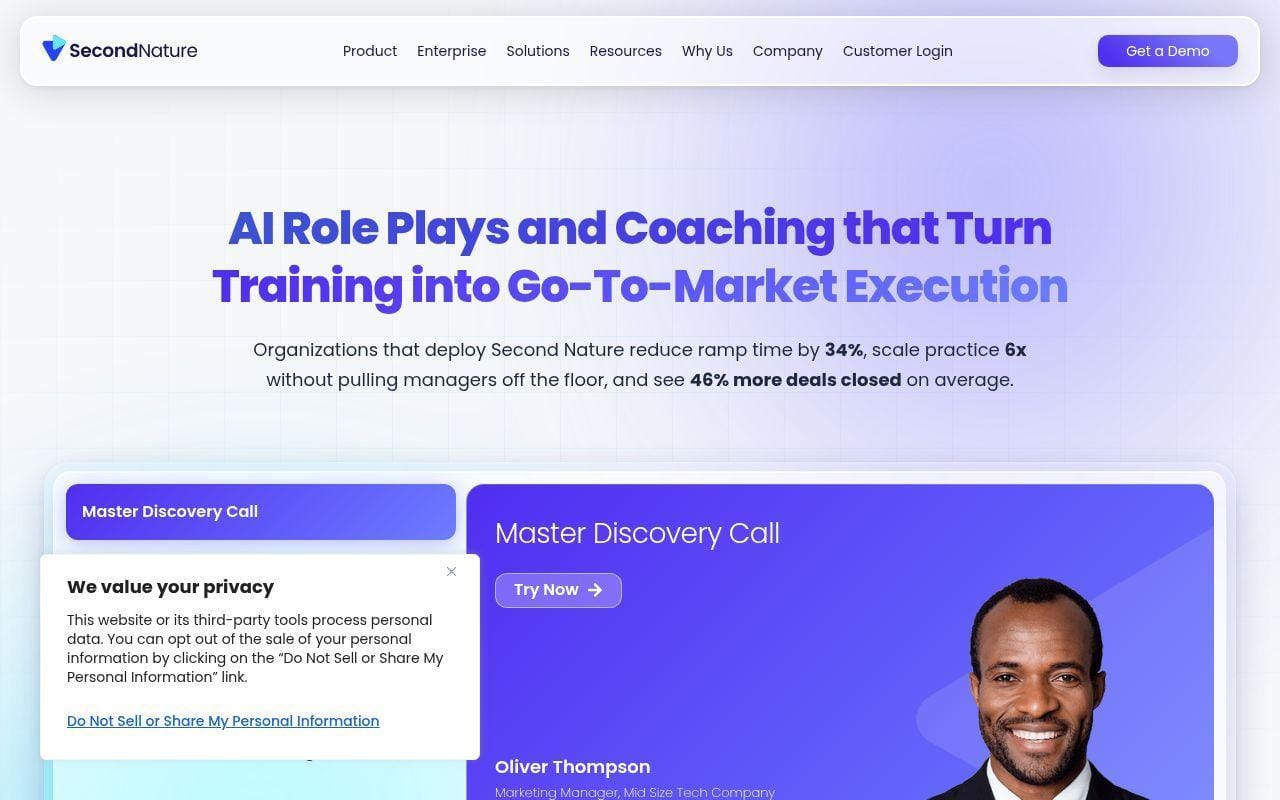
Second Nature is the specialist pick when live practice matters more than post-call analysis. Its homepage is built almost entirely around AI role plays, coaching, and training execution, which makes it more focused than broader conversation intelligence platforms.
The product stands out by offering role-play scenarios such as discovery calls, cold calls, objection handling, and multi-persona meetings, then extending that into what it calls Deal Coach for live-deal guidance. That is a strong combination for enablement teams that want reps to practice before they are on real calls, not just get feedback after the fact.
The site also emphasizes compatibility with LMS platforms via SCORM or LTI, plus CRM, SAML, and conference tool integrations. That gives it a cleaner path into existing training stacks than some AI role-play upstarts. On the commercial side, the vendor offers free trials and says subscription fees are set in the site or order form, but it does not publish a public price list.
If your biggest coaching gap is confidence and repetition, Second Nature deserves more attention than many broader tools above it. If your gap is forecast coaching, CRM hygiene, or post-call analytics, the top 10 options are generally a better fit.
Who is Second Nature for?
Second Nature is for onboarding-heavy teams, certification programs, and enablement leaders who want reps practicing discovery, objection handling, and pitch delivery before those mistakes hit live deals.
12. SalesHood
- Category: Sales enablement platform
- Best for: Teams that want coaching, content, and digital sales rooms together
- Ease of use: Moderate
- Pricing: Essential, Pro, and Unlimited plans
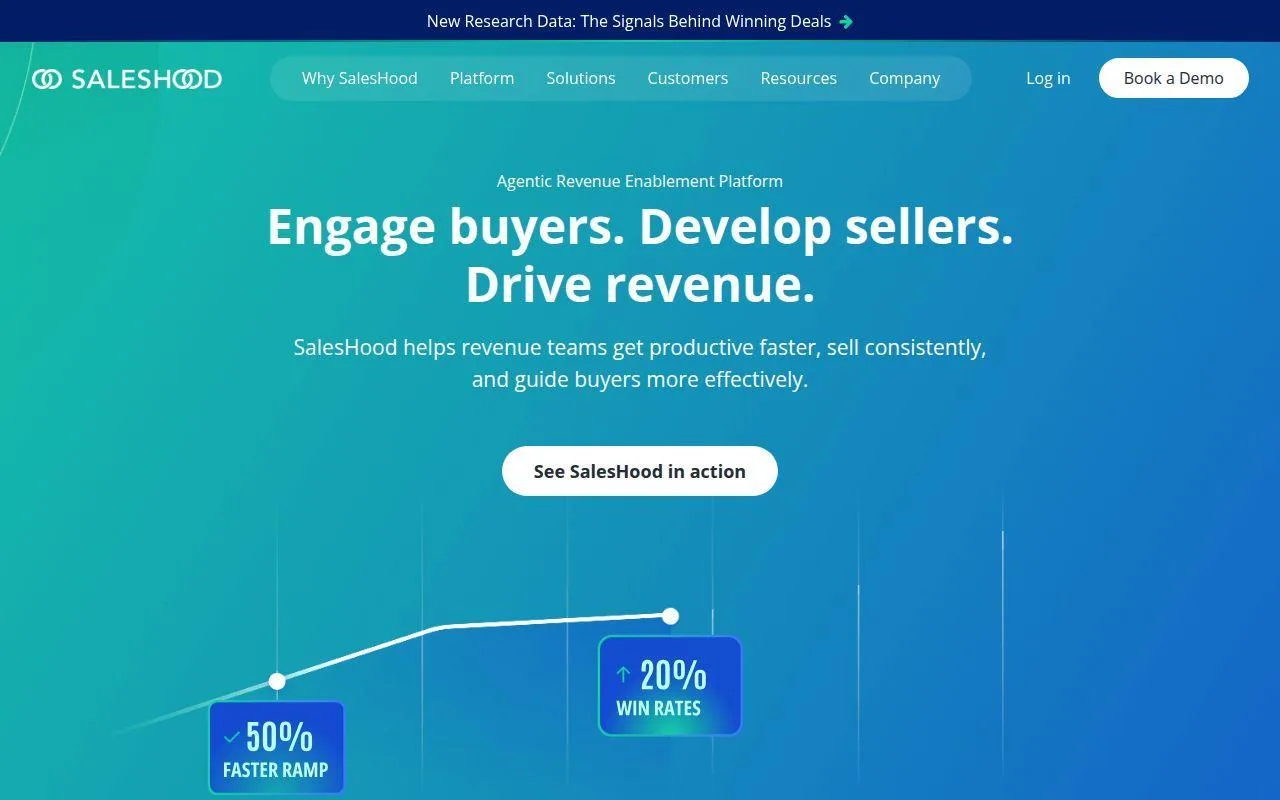
SalesHood is more enablement-first than most of the coaching tools above it. That is its main differentiator. The platform bundles revenue readiness, content management, digital sales rooms, playbooks, buyer engagement, and AI role play into one stack.
The pricing page is more detailed than average. SalesHood publicly lists three plan tiers, Essential, Pro, and Unlimited. Essential includes limited AI Pitch Practice and AI Role Play plus learning management and content management. Pro adds Digital Sales Rooms, Mutual Action Plans, AI Call Recaps, AI Answers, AI Content Writer, and broader reporting. Unlimited removes many usage caps and adds unlimited AI pitch practice, unlimited AI role play, unlimited languages, and premium customer success.
What SalesHood does better than many top-10 picks is connect seller coaching to buyer engagement. Its homepage repeatedly emphasizes deal momentum, digital rooms, and readiness together. That is appealing for revenue teams that do not want coaching separated from the assets buyers actually use.
The trade-off is that SalesHood can feel broader than teams that only want conversation intelligence really need. It earns a place in this roundup because that broader view will be exactly right for some organizations.
Who is SalesHood for?
SalesHood fits enablement-led organizations that want one platform for onboarding, role play, coaching, content, and buyer-facing sales rooms, especially when mutual action plans and guided buyer journeys matter.
13. Highspot
- Category: GTM enablement platform
- Best for: Large teams that want AI-powered buyer engagement with coaching
- Ease of use: Moderate
- Pricing: Custom quote
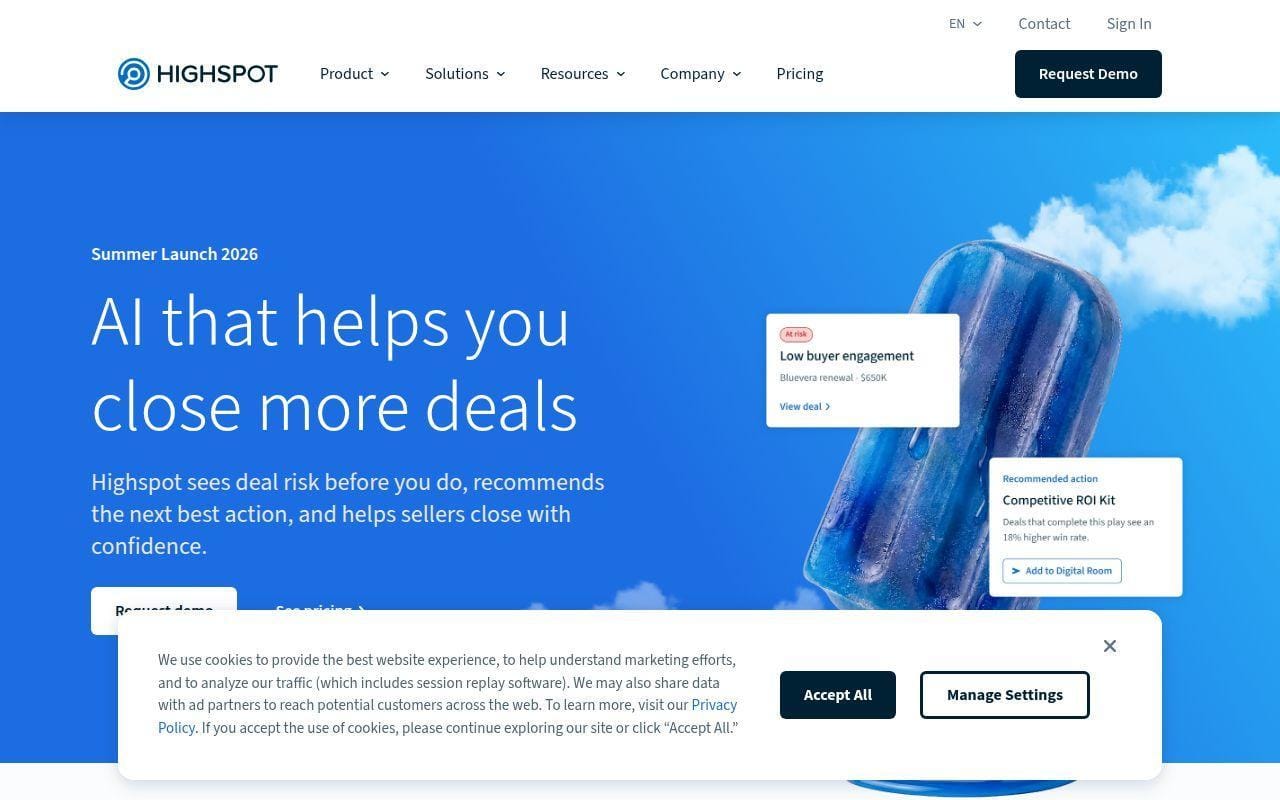
Highspot is worth considering if you want a very broad enablement platform and coaching is only one part of the buying case. The official site and pricing page place it squarely in the agentic GTM execution camp, with content, plays, buyer engagement, training, conversation intelligence, and AI role play all sitting under one umbrella.
Its pricing page is still quote-based, but the packaging is informative. The public description of the “Equip and engage” plan includes AI-supported content organization, AI-powered search and answers, content personalization, Sales Plays, Digital Sales Rooms, AI-generated knowledge checks, CRM integration, and analytics with scorecards. Highspot also says it does not charge extra for CRM integrations, which is a useful detail for larger platform evaluations.
What Highspot does better than many top-10 tools is connect enablement, buyer engagement, and enterprise support. It also promises 24/7/365 support and broader platform scale options such as Data Lake access and multi-CRM support. That makes it a serious enterprise contender, even if its coaching story is less front-and-center than Gong’s or Mindtickle’s.
The reason it sits just outside the top 10 is focus. Buyers specifically shopping for coaching often want a clearer coaching-first product story than Highspot gives them.
Who is Highspot for?
Highspot is for enterprises that want coaching inside a full GTM enablement platform, especially when buyer engagement, governed content, and large-scale support matter as much as manager scorecards.
14. Hyperbound
- Category: AI roleplay and coaching
- Best for: Fast practice loops and customizable role-play scorecards
- Ease of use: Easy
- Pricing: Free plan plus custom tier
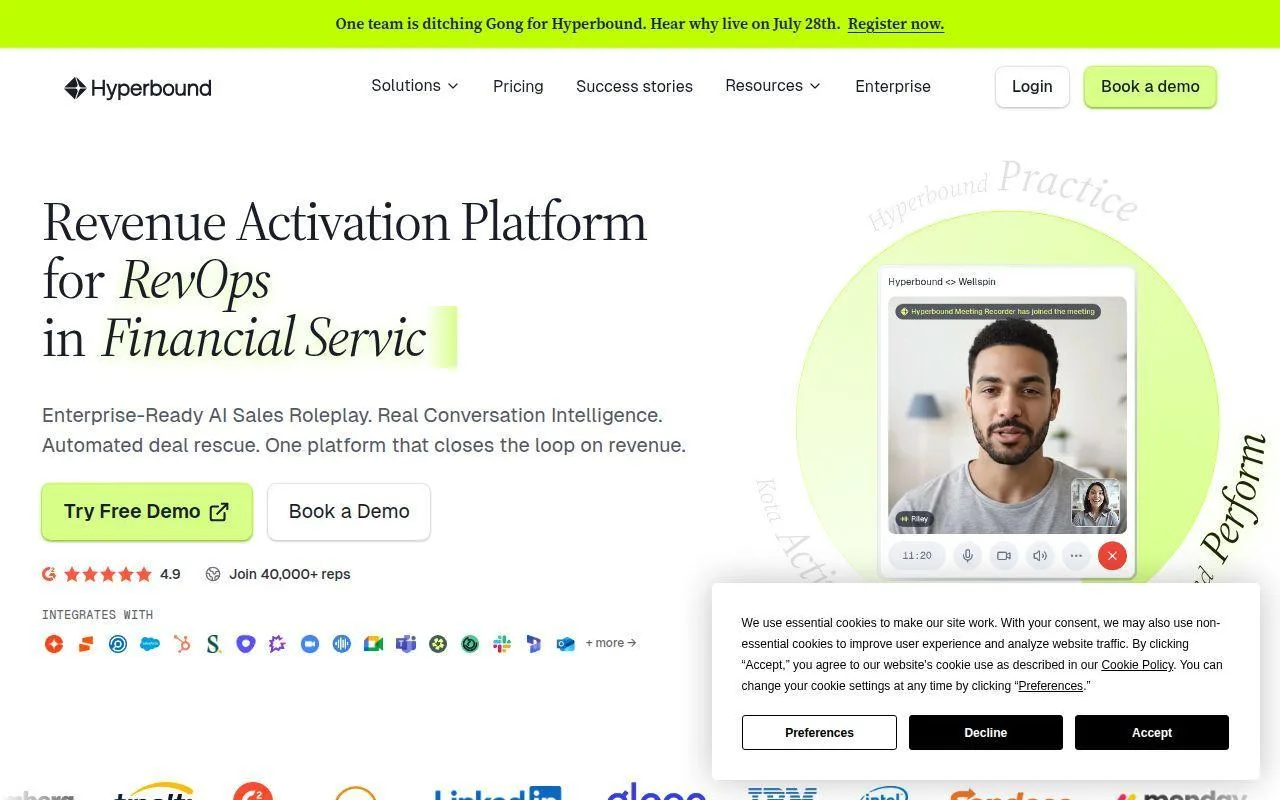
Hyperbound is the newcomer-style pick for teams that want AI practice fast. Its position in this roundup comes from focus and speed. The pricing page offers a Free plan with 9 AI roleplay bots, video calls, default AI scorecards, full transcription, AI coaching feedback, objection and question detection, and unlimited call time.
The paid option is a Custom tier that adds AI Scorecard Builder, unlimited custom AI scorecards, unlimited AI roleplay bots outside demo and post-sales exclusions, LMS or CMS integrations, AI real call scoring, multilingual support in 25+ languages, analytics, learning modules, SSO, and professional services. That is a healthy feature jump without making the product feel bloated.
What Hyperbound does better than many established platforms is onboarding speed. The vendor says building your first bot and scorecard takes less than 10 minutes, while fuller persona and real-call-score setup takes about two weeks. That is refreshingly specific. For lean enablement teams, speed like that matters.
The main reason Hyperbound is not in the top 10 yet is breadth. It is more focused on roleplay and coaching practice than on the wider revenue workflows some larger buyers want.
Who is Hyperbound for?
Hyperbound is for teams that want AI role play quickly, especially startups and growth teams that care more about practice reps and methodology scorecards than about large platform consolidation.
15. Cirrus Insight
- Category: Sales and CRM workflow platform
- Best for: Salesforce-centered teams that want modular coaching and meeting intelligence
- Ease of use: Moderate
- Pricing: Modular per-user and per-hour pricing
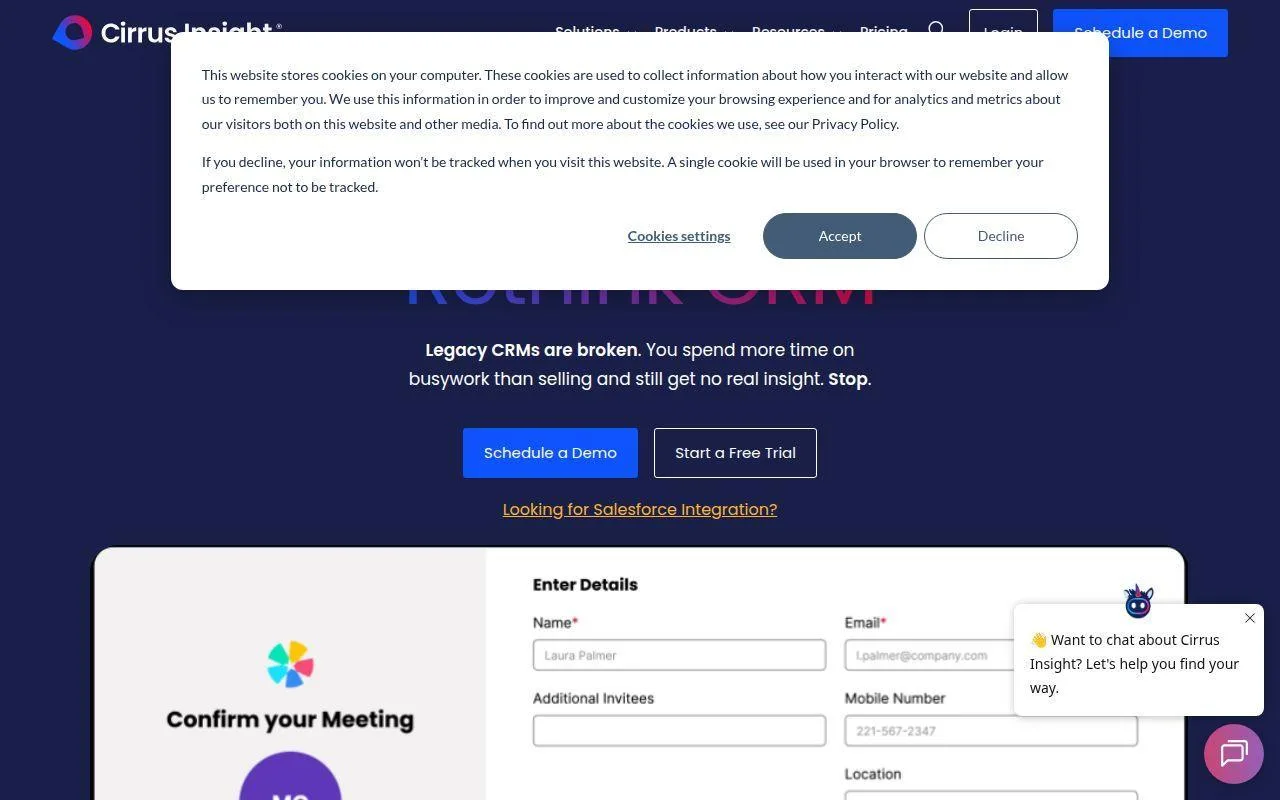
Cirrus Insight is the wildcard entry in this roundup. It is not a classic coaching platform first. Instead, it combines Salesforce sync, scheduling, buyer signals, meeting AI, conversation intelligence, live coaching, and related workflow tools into a modular build-your-own package.
That modularity is what makes it interesting. The pricing configurator lists components such as Salesforce Sidebar at $11 per user, Salesforce Email Sync at $5 per user, Calendar Scheduling at $7 per user, Meeting AI at $13 per user, Smart Scheduler at $20 per user, Meeting Transcription at $15 per hour, and Live Coaching at $40 per hour. For some teams, that is easier to justify than buying a large bundled platform.
The product page also frames its coaching layer in plain business language. Live Coaching gives real-time prompts during calls and meetings, while Meeting AI prepares meeting briefs with context and talking points. Buyer Signals tracks email opens, clicks, and replies, and Conversation Intelligence helps organize what was said. That makes Cirrus Insight especially practical for Salesforce-heavy teams that want coaching attached to inbox and meeting workflows.
The reason it lands at number 15 is category fit. This is a useful adjacent tool, but it is less of a pure coaching platform than the others above it.
Who is Cirrus Insight for?
Cirrus Insight fits Salesforce teams that want to assemble lighter coaching, meeting, and routing capabilities around existing workflows instead of buying one monolithic conversation platform.
What the Best Sales Coaching Software Should Help You Improve
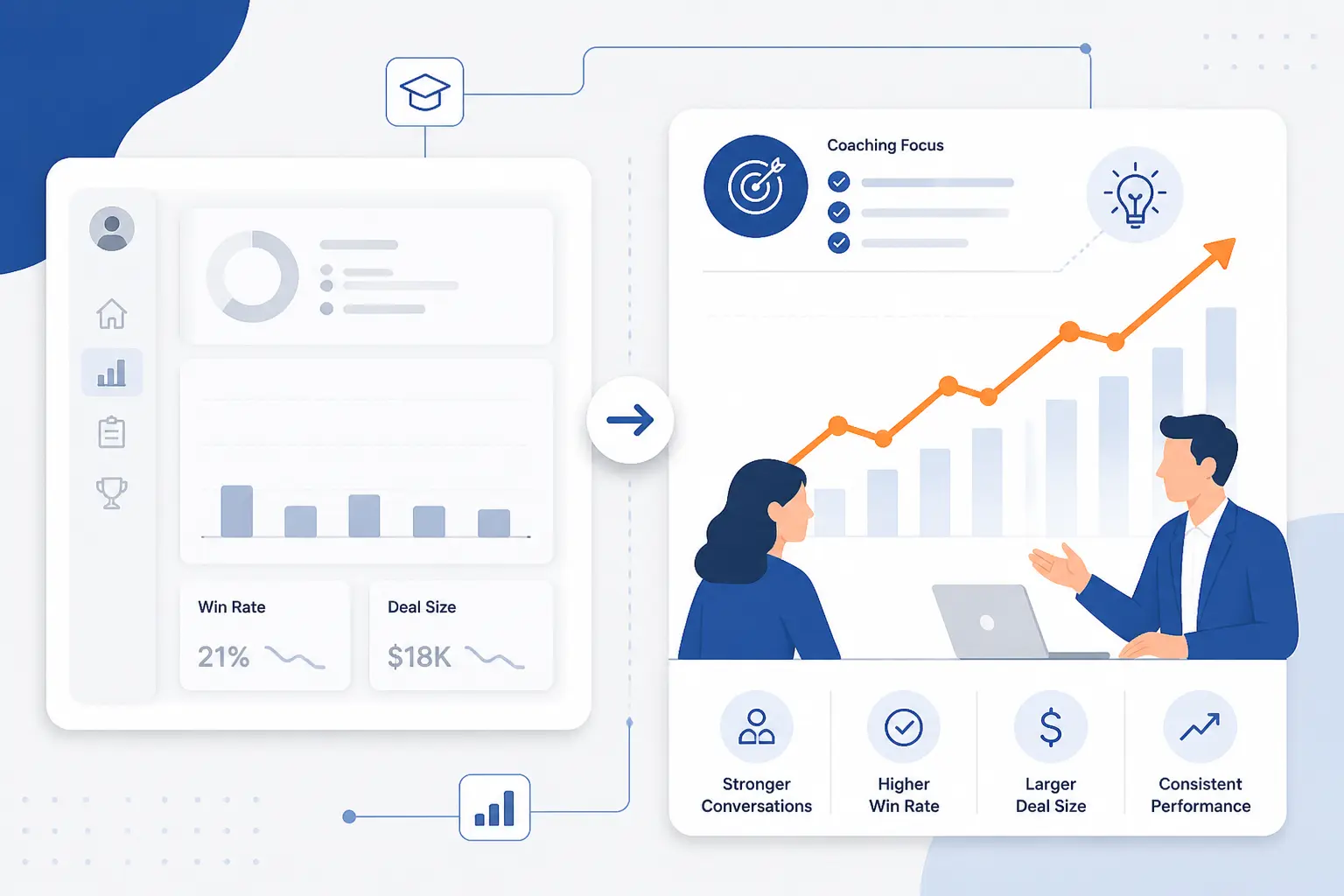
The best tools in this category should improve observable rep behavior, not just produce prettier dashboards. That usually means faster feedback, clearer scoring, better reuse of winning calls, and more context during deal reviews. If a platform cannot help managers coach more specifically and reps act more confidently, the feature count is mostly noise. These are the four improvement areas we think matter most.
Real-Time Guidance and Fast Feedback Loops
The strongest platforms do not make reps wait until the weekly one-on-one to learn what went wrong. Live prompts, real-time battlecards, and instant summaries shorten the feedback loop so coaching can influence the very next conversation. That is why so many of the higher-ranked tools lean toward in-call support or near-immediate post-call action.
For buyers, this is where feature differences become practical. Revenue.io bakes live stage-specific coaching into every plan, Clari Copilot pushes battlecards into active conversations, and newer role-play tools now let reps practice objections before live calls. Even the lighter tools are moving in that direction, with a Free plan and custom scorecards shown on Hyperbound’s pricing page.
Methodology Scoring, Scorecards, and Skill Benchmarks
A coaching tool should make your sales methodology more consistent, not merely easier to talk about. The best products here let managers score discovery, objections, next steps, or qualification against named frameworks and then turn weak spots into coaching plans.
This is one area where generic transcription tools fall short. Platforms built for coaching usually include formal forms, scorecards, or benchmark workflows so managers are not grading from memory. Mindtickle goes especially far with structured support packaging, training resources, and premium admin help detailed in this service description.
Playlists, Call Libraries, and Peer Learning
Top teams do not coach from scratch every time. They save winning moments, build call libraries, and reuse examples for onboarding, deal reviews, and peer learning. That turns coaching from a private manager-rep exchange into a repeatable team asset.
Some tools do this through saved calls and smart playlists, while others do it through gametapes, dynamic playlists, or learning paths. The important part is not the label. It is whether reps can find a relevant example quickly, see why it worked, and apply it in the next customer conversation. Highspot’s packaging makes that broader buyer-and-seller loop especially explicit on its pricing page.
Pipeline, Forecasting, and CRM Context
Coaching gets much more useful when it is attached to the actual deal, account, and forecast. That is why we ranked products higher when they clearly pushed call data into CRM workflows or revenue inspection, rather than leaving it in an isolated call archive.
In practice, that means buyer signals, next steps, objections, risk markers, and contact activity should show up where managers already inspect deals. Clari spells this out well in its call-recording guide, where call logs, keyword search, key moments, and CRM context are treated as one connected workflow instead of separate tasks.
How to Match Sales Coaching Software to Your Team
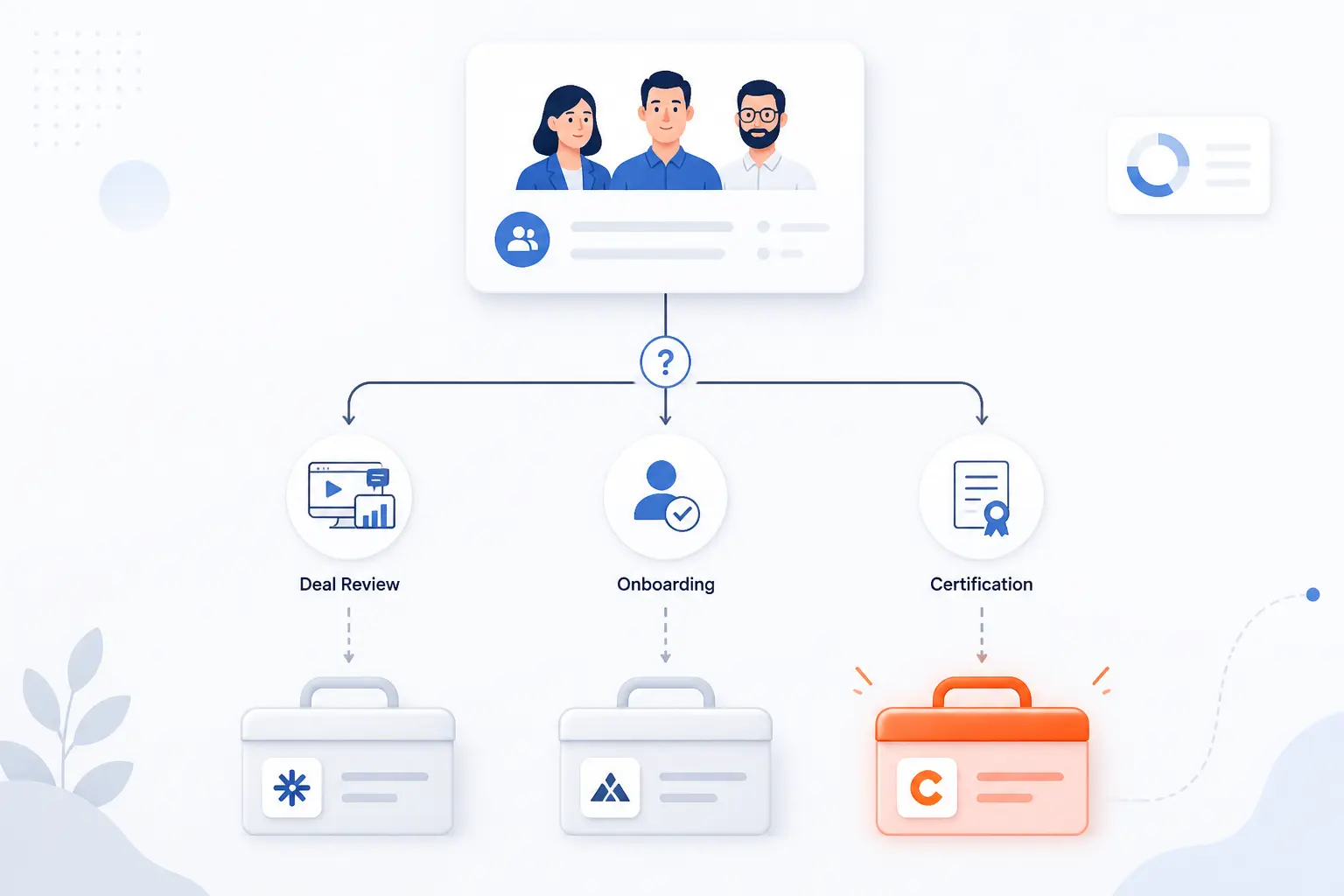
The right pick depends more on your coaching motion than on your headcount. Teams that run formal deal reviews usually need one type of platform. Teams that own onboarding and certification need another. If you match the software to how your reps learn and how managers coach, the shortlist gets much smaller very quickly.
Conversation Intelligence for B2B Deal Reviews
If managers coach mainly by reviewing live customer calls, you want a platform centered on recordings, transcripts, scorecards, and deal context. Gong, Chorus by ZoomInfo, Clari Copilot, and Salesloft Conversations are the most natural fits here. They all start from real interactions and turn them into coaching evidence.
This path tends to work best for AE teams, SDR teams, and sales leaders who already run forecast calls or pipeline reviews every week. It is less ideal when the real bottleneck is formal onboarding, message rollout, or practice time before live calls.
Revenue Enablement for Onboarding and Readiness
If your team is struggling with ramp time, certification, or keeping reps aligned on messaging, enablement-first platforms deserve more attention than pure conversation tools. Mindtickle, Allego, Spekit, SalesHood, and Highspot all give coaching a bigger training and content framework.
That broader frame usually matters when enablement owns onboarding, content governance, and manager coaching standards together. Buyers in this camp should pay extra attention to support models, program templates, and how easily the product delivers learning in workflow, not just to transcription quality.
Phone-Heavy and Compliance Sensitive Sales Motions
Teams that live on the phone need more than a nice recording archive. They need call guidance, routing, storage expectations, and a clear understanding of what usage and telephony limits look like. Revenue.io is particularly strong for phone-heavy Salesforce teams, and some lighter stacks can work well when call workflow matters more than broad enablement.
Jiminny is worth a look in this situation because the vendor is unusually direct about telephony usage. Its voice policy says plans include a per-user fair use allowance and then charge overages by the minute on this usage page, which is the kind of practical detail buyers often need before rollout.
AI Role Play for Practice Before Live Calls
If the team’s biggest problem is weak discovery, objection handling, or poor talk tracks on new messaging, AI role play can be a better first investment than deeper post-call analytics. Second Nature, Hyperbound, Mindtickle, Revenue.io, and Allego are the strongest fits when practice is the priority.
We would lean this way for new-hire onboarding, product launches, and teams trying to standardize one methodology fast. The simple test is whether reps need more live-call visibility, or whether they need more safe repetitions before the real call even starts.
How to Roll Out Sales Coaching Software for Measurable ROI

Most coaching platforms fail quietly when companies buy the software before they define the coaching habit. The product should support the process, not invent it. A strong rollout starts with clear coaching forms, a baseline from top performers, and a short list of outcome metrics. If you skip those steps, even a very good platform can become expensive shelfware.
Start With Clear Coaching Cadences and Forms
Before you automate anything, decide who reviews calls, how often they do it, what form they use, and how reps respond. That sounds basic, but it is where many rollouts wobble. The best tools can speed up coaching, but they cannot replace a missing operating rhythm.
Vendors that explicitly support this tend to be easier to roll out. Mindtickle, for example, emphasizes pre-built templates, hands-on workshops, and different support levels for customers in its support outline.
Benchmark Top Performers Before Automating Feedback
AI feedback is only as helpful as the standard behind it. Before managers rely on automated scorecards or suggested coaching, pull examples from top performers and define what good actually sounds like in your motion. That gives your forms, trackers, and scorecards real teeth.
Teams that skip this step often end up with a lot of activity and weak judgment. The software may spot filler words or competitor mentions, but it still needs a clear model of successful discovery, objection handling, and next-step discipline.
Reinforce Coaching With Training Paths and Practice
Feedback by itself rarely sticks. The strongest programs use call reviews to trigger training assignments, practice sessions, and refreshers, especially when the same weakness shows up across multiple reps. That is where enablement-first platforms usually separate themselves from lighter call intelligence tools.
SalesHood’s packaging is a good example, with tiered support for learning paths, AI role play submission limits, and digital buyer assets laid out on its pricing page. Even if you do not buy SalesHood, that is the right rollout mindset.
Track Ramp Time, Win Rates, and Coaching Adoption
You should track whether the tool changes rep behavior, not just whether people logged in. The most useful measures are usually ramp time, win rate on coached deals, completion of coaching tasks, adoption by managers, and time saved on summaries or note capture.
Modular tools can also make it easier to cost-justify a rollout step by step. Cirrus Insight, for example, prices pieces like Meeting AI, Buyer Signals, transcription, and live coaching separately in its configurator, which can help teams build a smaller initial business case.
Frequently Asked Questions
These are the questions we would expect most buyers to ask after narrowing the field. The direct answer is usually short. The practical answer takes a bit more nuance, especially because this category now overlaps conversation intelligence, enablement, AI role play, forecasting, and CRM automation.
What Is the Difference Between Sales Coaching Software and Conversation Intelligence
Sales coaching software is broader. Conversation intelligence usually focuses on recording, transcribing, and analyzing calls, while coaching platforms may add scorecards, role play, certifications, learning paths, and manager workflows. Some tools, like Gong, Clari Copilot, and Salesloft Conversations, sit in the overlap between the two.
Which Sales Coaching Software Is Best for Small Teams
Avoma is the easiest small-team recommendation in this list. It has public pricing, a clear recorder-seat model, and optional add-ons so a small team can start with meeting capture and expand into conversation or revenue intelligence later. Jiminny is also worth a look if you want clearer seat types than most enterprise tools offer.
Do Most Sales Coaching Software Platforms Support MEDDIC or BANT
Many of them do, either directly or through customizable scorecards and field capture. Revenue.io talks openly about AI methodology coaching, and Avoma supports CRM data entry for frameworks such as MEDDIC and SPICED on its product page. The key question is less whether the acronym is supported and more whether managers can score against it consistently.
How Much Does Sales Coaching Software Usually Cost
Most of the market is quote-based, so public list pricing is the exception rather than the rule. Avoma starts at a public monthly price, Jiminny publishes seat pricing, and more modular tools such as Cirrus Insight expose component costs in its pricing configurator. Enterprise platforms like Gong, Clari, Allego, and Revenue.io generally require a sales conversation.
Do You Need Real-Time Coaching or Is Post Call Analysis Enough
It depends on where reps struggle. Real-time coaching is better when reps freeze on objections, miss talk tracks, or need live battlecards during calls. Post-call analysis is enough when the real issue is manager review quality, pattern spotting, or building a more structured coaching culture over time.




Conclusion
The best sales coaching software for your team depends on what you are trying to fix first. If you want the most complete enterprise answer, start with Gong. If enablement owns the problem, Mindtickle is one of the strongest choices. If live Salesforce-based guidance is the priority, Revenue.io makes a sharp case. If you want a more affordable and transparent starting point, Avoma is the easiest recommendation.
From here, the smartest next step is simple. Pick the three products that match your coaching motion, not the three biggest brand names, and compare them against one real workflow from your team. Which one would help your managers coach the very next call better?