


- How These Linux Dedicated Server Picks Compare
- Top Linux Dedicated Server Providers
- More Linux Dedicated Server Options Worth Considering
- What a Linux Dedicated Server Is and When It Makes Sense
- Linux Dedicated Server Benefits That Matter Most
- Linux Distros Licenses and Software Stack Options
- Hosting Features That Change Day to Day Operations
- Linux Dedicated Server Setup and Hardening Checklist
- Linux Dedicated Server FAQ
- Conclusion
If you are shopping for a linux dedicated server, the short answer is this: OVHcloud, Liquid Web, IONOS, and InMotion Hosting are the strongest all-around picks for most buyers, but they win for different reasons. OVHcloud has the deepest bare-metal range we found. Liquid Web is the cleanest managed option for businesses that want the server layer handled. IONOS is one of the better fits when bandwidth, hardware choice, and predictable add-ons matter. Smaller buyers, meanwhile, may want to look hard at InMotion Hosting, InterServer, or even a cloud-first alternative if they do not truly need single-tenant hardware.
We approached this as a commercial investigation, not a cheerleading exercise. That means we looked for what the official product pages actually list, what the pricing pages really show, and where review patterns support or complicate the sales pitch. The goal here is simple: help you narrow your shortlist without opening ten more tabs.
How These Linux Dedicated Server Picks Compare
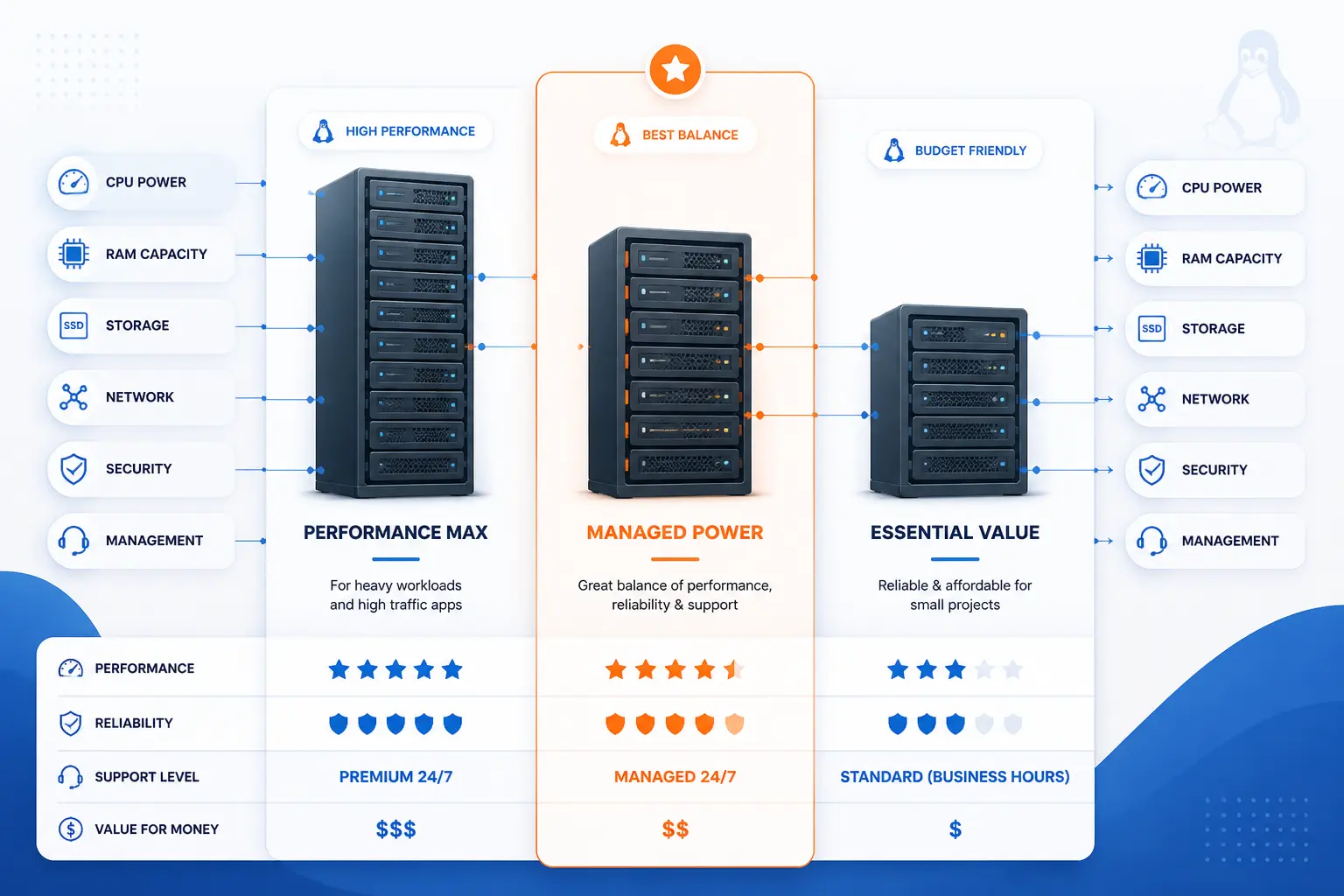
The fastest way to shortlist a provider is to line up what each one is really selling. Some of these companies are bare-metal specialists with huge hardware catalogs. Others are managed-hosting companies with a much smaller lineup but a cleaner day-to-day operating model. That difference matters more than marketing copy.
FURTHER READING: |
| 1. 15 Best Cloud Server for Game Hosting in 2026 |
| 2. 15 Best Free Website Hosting Options in 2026 |
| 3. Best CMS Platforms in 2026: Top 10 Tools for Websites and Ecommerce |
Quick Linux Dedicated Server Comparison
| Provider | Best For | Entry Price | Linux / OS Notes | Score |
|---|---|---|---|---|
| OVHcloud | Wide bare-metal choice and high-end scaling | From $10/mo in the Eco range | Ubuntu, CentOS, Fedora, Debian listed on pricing materials | 4.8 |
| 1Byte | Budget cloud hosting and general hosting services | Cloud Server from $8.99/mo | N/A for a dedicated Linux catalog on the linked page | 2.8 |
| IONOS | Configurable dedicated servers with strong bandwidth terms | From $70/mo | AlmaLinux, Debian, Rocky Linux, and Ubuntu are listed | 4.6 |
| InMotion Hosting | Small and midsize teams that want more hand-holding | Aspire from $25.00/mo | OS choice is available, but distro lineup is not clearly listed | 4.5 |
| Liquid Web | Managed dedicated hosting for business workloads | Linux package from $90/mo | AlmaLinux 9 is listed in package details | 4.7 |
| HostGator | Simple three-tier hosting lineup | Value Dedicated Server from $214.99/mo regular price | Linux and Windows options are listed | 3.8 |
| InterServer | Buy-now inventory with low entry pricing | From $79/mo on current listings | N/A on distro specifics | 4.2 |
| Hostwinds | Fully managed custom dedicated servers | From $115/mo on current cart listings | Custom installs and IPMI access are emphasized | 3.5 |
| Atlantic.Net | Compliance-minded Linux hosting | From $139/mo | Linux distro choice is included | 4.4 |
| Hivelocity | Global bare metal with fast deploy options | From $65/mo | Linux is supported, but distro lineup is not clearly listed on the page | 4.3 |
How We Researched and Evaluated These Picks
We scored the top ten providers on the same factors rather than letting one flashy headline decide the ranking.
- Capability fit: we looked at whether the provider actually offers single-tenant hardware that makes sense for Linux hosting, not just generic cloud plans dressed up as “server” products.
- Pricing clarity and value: we rewarded providers that show real plan prices, clear add-ons, and meaningful hardware details, and marked down pages that hide pricing behind placeholders or vague sales language.
- Operations features: we compared the things that change day-to-day work, including RAID options, bandwidth terms, IP allocation, backups, management level, and deployment model.
- OS and customization flexibility: we gave credit where the pages clearly list Linux distributions, root access, IPMI or KVM access, and configuration freedom.
- Public review signal: we used third-party review pages as a confidence check, but we did not let review scores outweigh weak product detail or thin official pricing.
That is why a cheaper provider does not automatically rank higher, and why a polished managed host can beat a raw bare-metal bargain when the operational tradeoff is worth it.
Top Linux Dedicated Server Providers
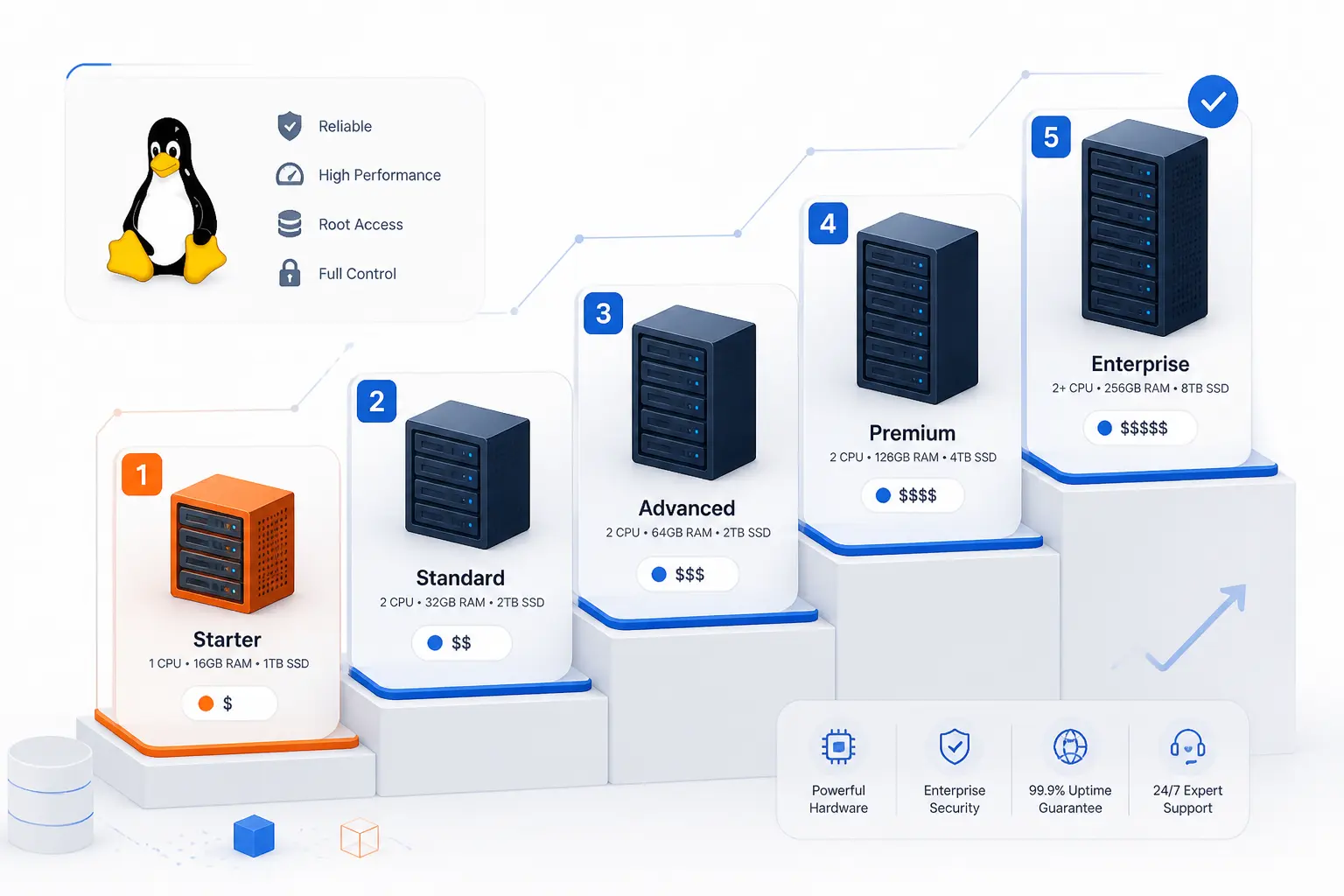
If you want the safest shortlist, start with the first five names here. They cover the widest mix of bare-metal depth, managed operations, and price-to-hardware value we found. The rest still have good reasons to make a shortlist, but they are easier to match to a narrower use case.
1. OVHcloud
- Category: Bare-metal cloud infrastructure
- Best for: Buyers who want a very deep hardware catalog
- Ease of use: Moderate
- Pricing: Eco range from $10/mo, enterprise ranges much higher
- Standout feature: Huge range from budget servers to very high-end single-tenant hardware
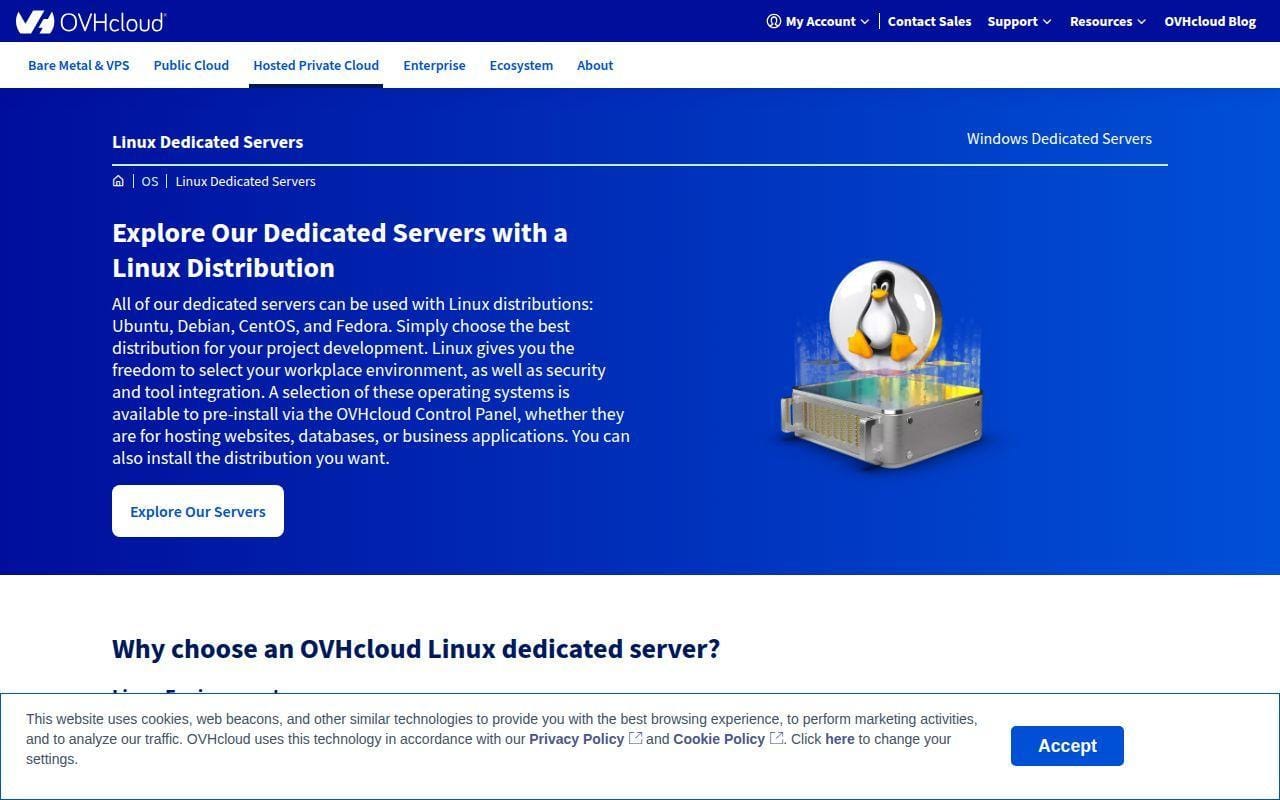
OVHcloud stands out because it gives you a genuine bare-metal menu, not just a handful of dedicated tiers. The official bare-metal pages show everything from low-cost Eco servers to Advance, Scale, and High Grade systems, which makes it one of the broadest Linux dedicated server portfolios in this roundup. For buyers who already know the kind of CPU, RAM, storage, and network profile they need, that breadth is a real advantage. It is also why OVHcloud lands at the top of this list.
The tradeoff is that OVHcloud feels more like infrastructure procurement than friendly beginner hosting. That is not a flaw. It just means this is better for technically comfortable teams than for someone who wants a managed cPanel-style experience.
How OVHcloud works
The workflow is built around choosing a server family first, then drilling down into configuration. The bare-metal catalog splits into clear ranges, with Eco for low-cost entry, Advance for versatile small and midsize business servers, Scale for more resilient infrastructure, and High Grade for critical loads. The general bare-metal page also emphasizes that you can customize your machine and get started in a few clicks, while the pricing catalog exposes model-level details like CPU generation, RAM range, SSD NVMe storage, and public and private bandwidth options.
That matters in practice. An Advance-3 configuration is shown with an AMD EPYC 4464P, 12 cores and 24 threads, NVMe storage, up to 192 GB memory, 25 Gbps private bandwidth, and public bandwidth that scales from 1 Gbps to 5 Gbps. Move up to Scale and you start seeing larger memory ceilings and up to 25 Gbps public links. At the High Grade end, OVHcloud is clearly pitching these boxes for critical, heavy-duty workloads rather than routine web hosting.
Who is OVHcloud for?
This is a strong fit for engineering teams, SaaS operators, infrastructure-heavy agencies, and buyers who need room to grow from modest hardware into serious bare metal without switching vendors. It is also a very sensible option when you want Linux distro choice and do not mind managing more of the stack yourself.
If you want a high-touch, managed-hosting relationship with lots of bundled service and less infrastructure decision-making, you should look elsewhere. Liquid Web and InMotion Hosting are easier fits for that style.
OVHcloud pricing
- Eco range: starts at $10/month, positioned as low-cost dedicated servers for getting started, with multiple Eco families including Kimsufi, So you Start, and Rise.
- Advance-3: starts at $217/month, with AMD EPYC 4464P, 64 GB to 192 GB memory, SSD NVMe storage, and up to 25 Gbps private bandwidth.
- SCALE-i1: starts at $472/month, with Intel Xeon Gold 6426Y, 128 GB to 1 TB memory, SSD NVMe storage, and up to 25 Gbps public bandwidth.
- HGR-STOR-1: starts at $1,652/month, with Intel Xeon Gold 6554S, 128 GB to 768 GB memory, HDD SAS or SSD NVMe storage, and up to 25 Gbps public bandwidth.
For the full model-by-model catalog, the full range page is the place to compare families and starting prices.
Pros and cons
Pros
- One of the widest dedicated-server ranges we found, from $10/month Eco entry points to High Grade enterprise hardware.
- Clear separation of server families by use case, which makes it easier to scale up inside one vendor.
- Linux options called out on pricing materials, including Ubuntu, CentOS, Fedora, and Debian.
- High network ceilings on upper tiers, with public bandwidth reaching 25 Gbps on Scale and High Grade ranges.
Cons
- Less beginner-friendly than managed-hosting rivals.
- The catalog is so broad that first-time buyers may need more planning before ordering.
- Some higher-end configurations still show installation fees in the pricing catalog.
OVHcloud rating and reviews
- Trustpilot: rated 3.9/5 across 7,898 reviews.
OVHcloud is our top pick when the hardware menu matters as much as the price tag. If you want real bare-metal choice and room to grow, it is one of the safest names to shortlist.
2. 1Byte
- Category: Cloud computing and web hosting provider
- Best for: Budget-conscious buyers who may not need dedicated hardware
- Ease of use: Easy
- Pricing: Cloud Server from $8.99/mo on the linked page
- Standout feature: Very low entry pricing across hosting categories
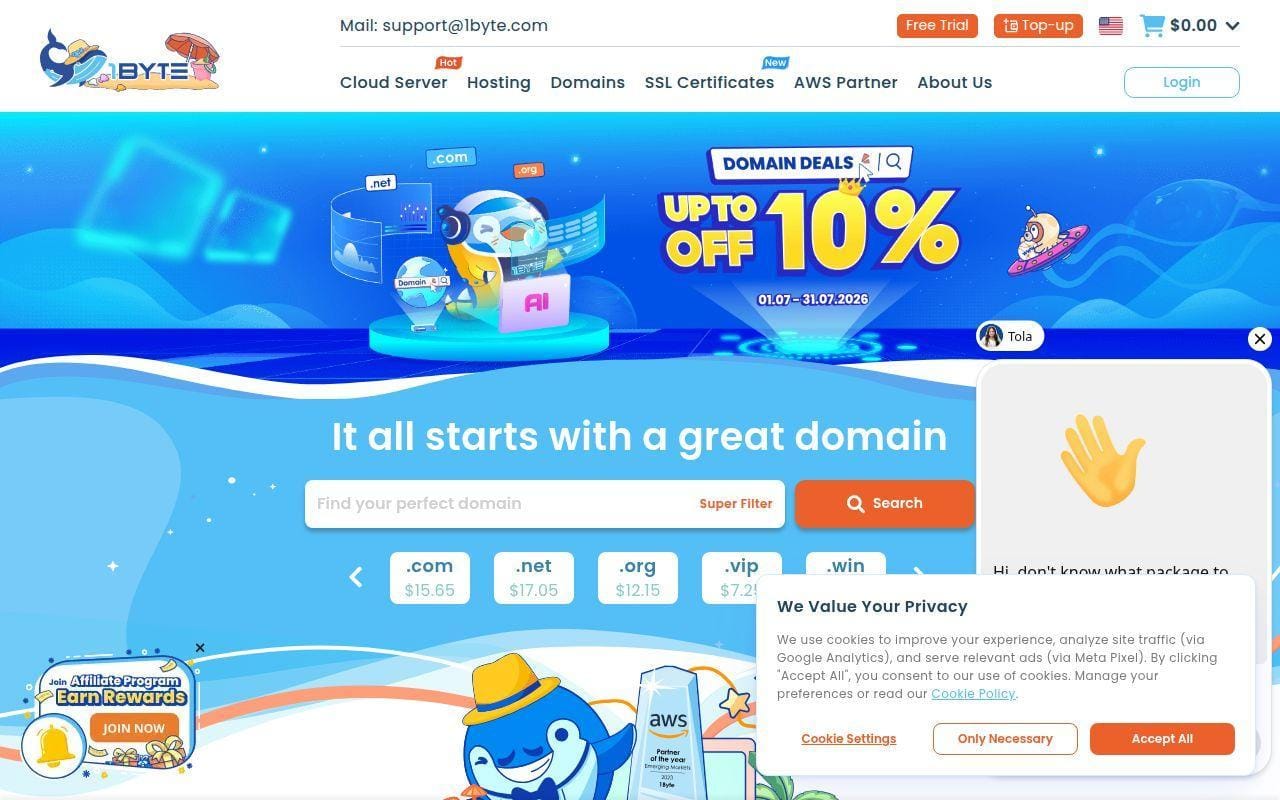
1Byte makes this list as the wildcard pick, and we want to be clear about why. The linked official page presents 1Byte as a broader hosting company with domain registration, SSL certificates, shared hosting, WordPress hosting, cloud hosting, and cloud servers, rather than as a dedicated-server specialist. That makes it the weakest direct fit for buyers who already know they need a linux dedicated server. It can still be relevant if your real requirement is “more control than shared hosting” at a much lower price than single-tenant hardware.
That distinction matters. If you need physical isolation, a dedicated IP policy, high-end RAID layouts, or hard CPU and memory guarantees from a single-tenant box, the linked 1Byte page does not give you that catalog. If you want an affordable way to move up from entry hosting, it may.
What 1Byte does
The homepage organizes the product line around service categories rather than infrastructure families. The top tiles list SSL Certificates, Shared Hosting, Cloud Server, WordPress Hosting, and Cloud Hosting with visible starting prices. Lower on the page, 1Byte repeats those categories in the services section and adds that it is an AWS Partner. That tells us the company is positioning itself as a general hosting and cloud services provider first, with cloud servers as the closest thing to a dedicated-server substitute on the linked page.
Operationally, the pitch is simple. Buy a domain, pair it with hosting or a cloud server, and manage services through 1Byte’s web-based interface. The page also highlights multilingual support, international data centers, and general affordability, but it does not expose a dedicated Linux server lineup, named bare-metal plans, or hardware-level provisioning details.
Who is 1Byte for?
1Byte is a better fit for small websites, simple business hosting, and buyers who are still deciding whether they really need dedicated hardware. It also has a straightforward appeal for shoppers who want one provider for domains, SSL, WordPress, and low-cost cloud services.
If you are shopping specifically for dedicated Linux hardware, you should look elsewhere. OVHcloud, IONOS, InMotion Hosting, Liquid Web, and even InterServer are far closer to the brief.
1Byte pricing
- Shared Hosting: starts at $2.49/month, positioned as value-focused general hosting.
- Cloud Server: starts at $8.99/month, described as the “Number one Elastic Cloud.”
- WordPress Hosting: starts at $6.99/month, presented as managed WordPress hosting.
- Cloud Hosting: starts at $9.99/month, aimed at boosting online presence with flexible hosting.
- SSL Certificates: start at $7.79/year.
The linked page does not list dedicated-server pricing, which is the main reason 1Byte ranks low in this roundup despite its low entry costs.
Pros and cons
Pros
- Very low visible entry pricing, including Cloud Server from $8.99/month and Shared Hosting from $2.49/month.
- Broad service mix on one site, including domains, SSL, WordPress, cloud hosting, and cloud servers.
- 1Byte is presented as an AWS Partner, which adds some credibility for cloud-related services.
Cons
- The linked page does not show a dedicated Linux server catalog.
- No visible hardware-level plan details for buyers who want dedicated-server comparison points.
- The page is much better for general hosting research than for dedicated-server procurement.
1Byte rating and reviews
1Byte has only a very small public review footprint at the listing we found, so we do not think it is broad enough to treat as a reliable independent market signal.
1Byte is worth a look only if your needs may stop short of dedicated hardware. If you know you need a real dedicated Linux box, move to the next names on this list.
3. IONOS
- Category: Dedicated server hosting
- Best for: Configurable servers with generous traffic terms
- Ease of use: Moderate
- Pricing: Starts at $70/mo
- Standout feature: Clear add-on pricing for bandwidth, IPs, backups, and panel licenses
IONOS is one of the most balanced providers here because it mixes mainstream hosting simplicity with real server configurability. The dedicated server page emphasizes root access, unlimited bandwidth, and dedicated hardware configured to your specifications, while the related pricing material is unusually concrete about extras like backup costs, additional IPv4 addresses, and Plesk licensing. That makes IONOS easier to budget than a lot of rivals.
We also like that IONOS clearly separates AMD, Intel, GPU, storage, and value dedicated servers. It is not the deepest bare-metal catalog in this roundup, but it is deep enough for most business buyers and a lot clearer than average.
How IONOS works
The buying flow starts with the workload, not just the server name. The dedicated server page pushes you toward AMD, Intel, GPU, storage, and value offers based on what you run, and then layers in practical features like RAID, full root access, and unlimited traffic. Lower on the page, IONOS also maps dedicated hosting to use cases such as high-performance hosting, database hosting, app development and CI/CD, file sharing, archiving, and deep learning.
Operationally, the stronger point is the companion pricing detail. IONOS lists Linux Standard support for current AlmaLinux, Debian, Rocky Linux, and Ubuntu versions. It also spells out that each server includes one IPv4 address and an IPv6 /64 network, that extra IPv4 addresses cost $5 per month, that Plesk Obsidian costs $5 per month, and that backup is optional from 6.5 cents per GB per month. Standard connectivity is 1 Gbit/s, with certain models able to add a 10 Gbit/s external connection for $230 per month including 20 TB of outbound transfer.
Who is IONOS for?
IONOS is a good fit for small and midsize businesses, agencies, and technical teams that want dedicated hardware without moving into a more intimidating enterprise platform. It is especially appealing if you care about bandwidth terms, predictable add-ons, and mainstream Linux choices.
If you want the broadest possible hardware ladder or very specialized bare metal, OVHcloud and Hivelocity go further. If you want a more bundled, managed service relationship, Liquid Web is stronger.
IONOS pricing
- Dedicated Servers: start at $70/month, with dedicated hardware, root access, RAID, and unlimited bandwidth.
- Additional IPv4: $5/month per address, with one IPv4 included per server.
- Plesk Obsidian: $5/month as an administration tool add-on.
- Backup: optional from 6.5 cents per GB/month.
- 10 Gbit/s external connection: $230/month on certain models, including 20 TB outbound transfer.
The most useful add-on and OS detail sits on the feature and pricing breakdown, which is worth checking before you compare final monthly cost.
Pros and cons
Pros
- Strong pricing transparency for extras such as backups, IPs, and Plesk.
- Linux options are clearly named, including AlmaLinux, Debian, Rocky Linux, and Ubuntu.
- Unlimited outbound traffic on standard 1 Gbit/s connections is attractive for many hosting workloads.
- Dedicated server page does a good job mapping hardware families to real workloads.
Cons
- Less hardware depth than OVHcloud at the extreme high end.
- 10 Gbit/s connectivity is an upsell, not a base inclusion.
- The product structure spans several subpages, so first-pass comparison takes a bit of reading.
IONOS rating and reviews
- Trustpilot: rated 4.6/5 across 43,650 reviews.
IONOS is one of the easiest providers here to recommend to a broad business audience. It is not the flashiest, but the mix of configurability and pricing clarity is very solid.
4. InMotion Hosting
- Category: Dedicated server hosting
- Best for: Buyers who want more managed help and easy upgrade paths
- Ease of use: Easy to moderate
- Pricing: Aspire from $25.00/mo, full dedicated tiers from $79.99/mo
- Standout feature: A very broad spread from entry dedicated hosting into managed Premier Care bundles
InMotion Hosting earns its spot because it is one of the more approachable dedicated-hosting platforms for smaller teams. The official pages show a real ladder from a low-cost Aspire server all the way up to larger dedicated boxes with RAID, more IPs, and higher bandwidth, plus managed “Premier Care” variants for buyers who want more included help. In practice, that makes InMotion easier to grow with than providers that force an early jump into expensive enterprise hardware.
The company also does a better-than-average job of showing what changes between plans. Core count, memory, storage type, bandwidth, and dedicated IP counts are all visible on pricing materials, which is exactly what buyers need at shortlist stage.
How InMotion Hosting works
InMotion’s dedicated hosting lineup is split between simpler entry plans on the main product page and a fuller pricing matrix that separates “Premier Care” managed bundles from “Full Control” tiers. That structure is useful because it lets you decide early whether you want a more self-directed server or a bundle that includes cPanel Dedicated Premier, priority support, backups, and security add-ons.
At the low end, Aspire starts with a Xeon E3-1246 v3, 4 cores and 8 threads, 16 GB RAM, 960 GB SSD, 1 Gbps unmetered bandwidth, and 1 dedicated IP. The regular dedicated tiers step up quickly. Essential moves to 64 GB DDR4 RAM and 2 TB SSD. Advanced adds 2×1.92 TB SSD in software RAID-1 and 10 dedicated IPs. Elite pushes to 128 GB RAM, 2×1.92 TB NVMe SSD, and 16 dedicated IPs. The upper end of the main product page also shows larger enterprise-style configurations with up to 25 dedicated IPs and 3 Gbps to 10 Gbps unmetered bandwidth.
Who is InMotion Hosting for?
InMotion Hosting is a very good fit for growing businesses, agencies, and site owners who are moving up from VPS or shared hosting and want a softer landing in dedicated infrastructure. It is also one of the better picks here for people who want management options without going fully enterprise.
If you already know you need specialized bare metal, very high-end CPU families, or a giant international server matrix, OVHcloud and Hivelocity give you more raw hardware breadth.
InMotion Hosting pricing
- Aspire: from $25.00/month for a 12-month term, with Xeon E3-1246 v3, 4 cores and 8 threads, 16 GB RAM, 960 GB SSD, and 1 Gbps unmetered bandwidth.
- Essential: from $79.99/month for a 12-month term, with Xeon E-2134, 64 GB DDR4 RAM, 2 TB SSD, 1 Gbps unmetered bandwidth, and 5 dedicated IPs.
- Advanced: from $119.99/month for a 12-month term, with Xeon E-2176G, 64 GB DDR4 RAM, 2×1.92 TB SSD in software RAID-1, and 10 dedicated IPs.
- Elite: from $161.99/month for a 12-month term, with Xeon E-2388G, 128 GB DDR4 RAM, 2×1.92 TB NVMe SSD in software RAID-1, and 16 dedicated IPs.
The fuller managed-versus-full-control breakdown is easiest to compare on the dedicated pricing page.
Pros and cons
Pros
- Good range from entry dedicated hosting to larger managed bundles.
- Hardware detail is easy to compare, including IP counts and RAID layout.
- Premier Care bundles visibly include cPanel, backups, security, and priority support.
- Aspire gives budget-conscious buyers a lower starting point than many managed rivals.
Cons
- The lineup spans multiple page structures, which can feel a little busy.
- Best-value prices are tied to 12-month terms.
- It is not as globally hardware-diverse as the biggest bare-metal specialists.
InMotion Hosting rating and reviews
- Trustpilot: rated 4.6/5 across 2,855 reviews.
InMotion Hosting is one of the most practical picks for teams that want dedicated hosting without a steep learning curve. It does not beat OVHcloud for server depth, but it is easier for many businesses to live with.
5. Liquid Web
- Category: Managed dedicated hosting
- Best for: Businesses that want the server layer managed
- Ease of use: Easy
- Pricing: Linux packages from $90/mo
- Standout feature: Deeply bundled dedicated packages with management, backups, and security included
Liquid Web is the cleanest managed option in this roundup. The company is not trying to win on the cheapest bare-metal entry price. Instead, it is pitching dedicated packages where the hardware, control panel, backup allocation, DDoS protection, and management are already bundled together. For business buyers who do not want to assemble their own operating model, that is a strong argument.
The official package page is especially helpful because it shows what is actually included in the Linux and Windows packages. This is one of the few providers here where “managed” is not just a vague promise. You can see the backup allocation, control panel, security stack, and support model right in the package detail.
How Liquid Web works
Liquid Web sells dedicated hosting as bundled packages, not as a blank-slate parts bin. The page says outright that the company manages the dedicated server layer, including OS updates, monitoring, patching, and hardware issues. It also emphasizes that one monthly price includes the server, control panel, backups, managed infrastructure, and security where applicable.
For Linux plans, the first package centers on Intel Xeon E-2456, 32 GB memory, 960 GB RAID-1 storage, AlmaLinux 9, cPanel BareMetal 100, Acronis 100 GB, LW DDOS Protect, and Imunify360. The 64 GB package moves to Intel Xeon Gold 6526Y while keeping the same Linux-oriented software bundle. The 128 GB package uses dual Intel Xeon Gold 6526Y and swaps in Corero Advanced DDOS for heavier-duty protection. That is the kind of packaging business buyers tend to appreciate because the monthly bill is easier to understand.
Who is Liquid Web for?
Liquid Web is best for ecommerce stores, business applications, agencies, and organizations that want dedicated resources but do not want to own every OS-level task. It is also a good fit when compliance language and single-tenant physical isolation matter to the buying process.
If you want the absolute cheapest hardware or the broadest range of one-off server models, this is not the right lane. OVHcloud, InterServer, and Hostwinds are stronger on raw catalog breadth or lower entry price.
Liquid Web pricing
- Linux 32 GB package: $90/month, with Intel Xeon E-2456, 32 GB memory, 960 GB RAID-1, AlmaLinux 9, cPanel BareMetal 100, Acronis 100 GB, and Imunify360.
- Linux 64 GB package: $137/month, with Intel Xeon Gold 6526Y, 64 GB memory, 960 GB RAID-1, AlmaLinux 9, cPanel BareMetal 100, and Acronis 100 GB.
- Linux 128 GB package: $155/month, with dual Intel Xeon Gold 6526Y, 128 GB memory, 960 GB RAID-1, Acronis 100 GB, and Corero Advanced DDOS.
The most complete package breakdown sits on the bundled package page, which is much clearer than the higher-level marketing page.
Pros and cons
Pros
- One of the clearest managed dedicated package structures in this list.
- Linux package details include OS, control panel, backup allocation, and security tools.
- Page explicitly states that OS updates, monitoring, patching, and hardware issues are managed.
- Strong fit for buyers who want fewer moving parts in operations.
Cons
- Less flexible than a bare-metal parts catalog if you like designing every component yourself.
- Lower-end storage shown in the bundles is 960 GB RAID-1, which some storage-heavy workloads will outgrow quickly.
- Not the cheapest route into dedicated hardware.
Liquid Web rating and reviews
- Trustpilot: rated 3.8/5 across 2,745 reviews.
Liquid Web is the right answer when you care as much about operations as hardware. If you would rather pay for a cleaner managed setup than chase the cheapest box, it is one of the best choices here.
6. HostGator
- Category: Dedicated hosting
- Best for: Buyers who want a simple three-tier lineup
- Ease of use: Easy
- Pricing: Regular pricing from $214.99/mo
- Standout feature: Linux and Windows options under the same three-tier structure
HostGator keeps dedicated hosting simple. The public product page centers on three NVMe tiers, Value, Power, and Enterprise, and pairs them with Linux or Windows control-panel options. That is easier to digest than a huge bare-metal catalog, especially for buyers who want to make a quick hosting-style decision rather than shop by CPU family.
The catch is pricing clarity. The front-end dedicated page currently shows placeholder promo pricing rather than live introductory numbers, so the most usable figures come from HostGator’s pricing knowledge base. That knocks HostGator down in our rankings, because a shortlist page should not make you hunt this hard.
How HostGator works
The product page presents dedicated hosting as a classic three-step ladder. Value Dedicated – NVMe 32 is the entry point, followed by Power Dedicated – NVMe 64 and Enterprise Dedicated – NVMe 128. For Linux, the page lists cPanel/WHM and Softaculous. For Windows, it lists Plesk and Plesk Application Vault. In other words, HostGator is selling this as managed web hosting with bigger hardware, not as a bare-metal engineering catalog.
That approach will work for many small businesses. You pick the tier, choose Linux or Windows, decide whether you need a panel license, and move forward. It is just not a great fit if you want detailed Linux distro choice, advanced networking nuance, or a broader range of server classes.
Who is HostGator for?
HostGator suits buyers who want dedicated hosting in a familiar shared-hosting style. It is a decent fit for agencies or site owners who prefer simple “good, better, best” choices over infrastructure shopping.
If you care about transparent live pricing, richer hardware variety, or more technical Linux detail, you should shortlist other providers first.
HostGator pricing
- Value Dedicated Server: $214.99/month regular price without cPanel, with a lower monthly effective rate on longer terms.
- Power Dedicated Server: $289.99/month regular price without cPanel, with lower monthly effective pricing on longer terms.
- Enterprise Dedicated Server: $319.99/month regular price without cPanel, with lower monthly effective pricing on longer terms.
- With cPanel: the regular monthly price rises to $226.99 for Value, $301.99 for Power, and $331.99 for Enterprise on one-month terms.
The cleanest live numbers we found were on HostGator’s regular pricing chart, because the main product page currently does not expose real intro figures in plain text.
Pros and cons
Pros
- Simple lineup with only three dedicated tiers to evaluate.
- Supports both Linux and Windows plans on the same product structure.
- Control panel options are easy to understand for mainstream hosting users.
Cons
- Main product page pricing is not transparent enough for easy comparison.
- Far less hardware nuance than OVHcloud, IONOS, or Hivelocity.
- Best value depends on term length, and one-month prices are materially higher.
HostGator rating and reviews
- Trustpilot: rated 4.6/5 across 17,489 reviews.
HostGator is easy to understand, but it is not the sharpest buy on this list. Keep it on the table if you want hosting-style simplicity, not if you want the best dedicated-server research experience.
7. InterServer

- Category: Dedicated servers and bare metal hosting
- Best for: Buyers who want in-stock servers at low entry pricing
- Ease of use: Moderate
- Pricing: Inventory-based, from $79/mo on current listings
- Standout feature: Buy-now inventory by region
InterServer makes a good case for buyers who care less about polished merchandising and more about finding a live server at a low monthly price. The dedicated page is built around regional inventory rather than neat named plans, and that has one big upside: you can see actual in-stock configurations with price tags instead of marketing copy. On current listings, the entry point we found was a Xeon E3-1270v6 with 32 GB RAM and 2×1 TB SSD for $79 per month in Dallas.
That inventory-first model will not please everyone. It is less tidy than a prepackaged plan ladder. Still, it can be a strong value if your workload does not need the latest premium silicon.
How InterServer works
The InterServer dedicated page starts by asking you to choose inventory by region. It highlights NYC for East Coast traffic, Dallas for central U.S. reach, and Los Angeles for West Coast capacity. Then it shows buy-now servers with CPU, RAM, storage, network, location, and price in one view. That is refreshingly direct.
The example lowest-priced listing we found shows Xeon E3-1270v6, 32 GB RAM, 2×1 TB SSD, 1 Gbps unmetered networking, and one VLAN IP block in Dallas for $79 per month. InterServer’s own search result for the same page also surfaced a NYC listing at $101 per month. In other words, the site behaves more like a live server rack than a traditional hosting storefront.
Who is InterServer for?
InterServer is a good fit for developers, small businesses, and price-sensitive buyers who can work within available stock and do not need a heavily managed experience. It is especially appealing when you want to start cheaply on U.S.-based inventory.
If you want more polished management bundles, more distro detail, or a bigger climb into enterprise hardware, higher-ranked providers are safer bets.
InterServer pricing
- Dallas example listing: $79/month, with Xeon E3-1270v6, 32 GB RAM, 2×1 TB SSD, 1 Gbps unmetered bandwidth, and 1 VLAN IP block.
- NYC example listing: $101/month, based on a current regional inventory result from the same dedicated page.
InterServer does not package dedicated servers into fixed branded tiers here. It sells what is in stock, which is useful for value hunters and a little messy for everyone else.
Pros and cons
Pros
- Very competitive live entry pricing.
- Region-first inventory helps you match geography to traffic patterns.
- Current listings expose real hardware, storage, and network detail up front.
Cons
- Inventory-driven presentation is less beginner-friendly than fixed plans.
- Distro and management detail is thinner than on higher-ranked competitors.
- Availability can shift by region, so the cheapest listing may not stay put.
InterServer rating and reviews
- Trustpilot: rated 4.3/5 across 2,463 reviews.
InterServer is a good shortlist pick when value comes first. It is not the prettiest buying experience, but the live inventory model can work in your favor.
8. Hostwinds
- Category: Dedicated server hosting
- Best for: Buyers who want full management on custom dedicated hardware
- Ease of use: Moderate
- Pricing: From $115/mo on current cart listings
- Standout feature: Full management is included with dedicated servers
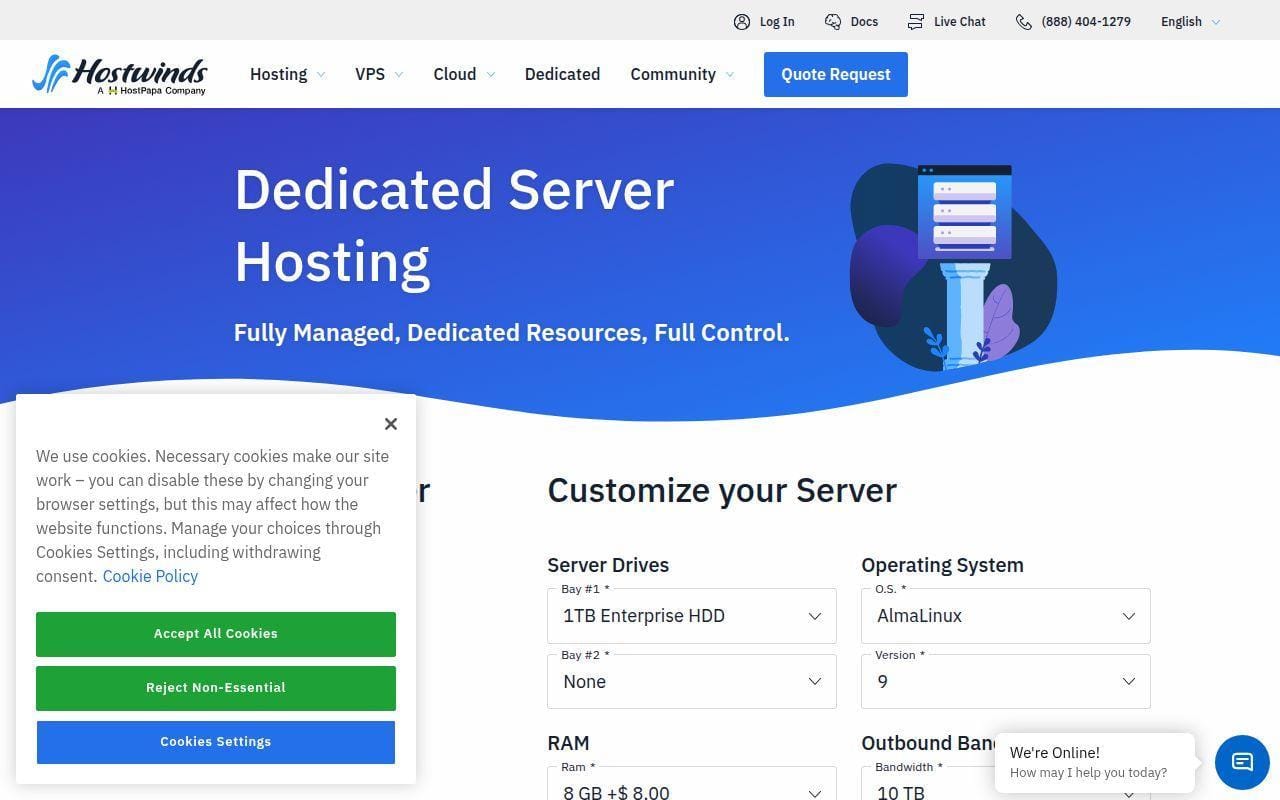
Hostwinds is the custom-build option that sounds better on paper than its pricing presentation does in practice. The official dedicated page is strong on operations detail. It says every dedicated server comes with dedicated resources, a full 1 Gbps network link, server monitoring, nightly backups, and full management support. That is a compelling bundle for buyers who want help after deployment.
The weaker part is plan transparency. The main product page focuses on features, while the current pricing is easier to spot in the client cart listing than on the marketing page itself. That is workable, but it is not elegant.
How Hostwinds works
Hostwinds sells dedicated hosting as a customizable service. The product page emphasizes that you can choose CPU type, RAM amount, disk count and size, and RAID configuration, and that nearly all servers include full IPMI access to VNC KVM controls, power controls, and ISO mounting from the client area. On top of that, Hostwinds says each dedicated server includes full management support, with technicians available day or night.
Operationally, the page hits the right notes. RAID choices range from RAID 0 through RAID 60 depending on the disk count. Monitoring is included. Nightly backups are part of the pitch. The docs also say DDoS protection is optional on dedicated servers and costs $50 per month per block of five protected IP addresses, which is the kind of detail buyers appreciate before checkout.
Who is Hostwinds for?
Hostwinds is a fit for teams that want customizable dedicated hosting with real support wrapped around it. It is also relevant if you plan to install your own OS image through IPMI and value having operations help available.
If you want slick plan comparison, cleaner live pricing, or a higher-confidence public review signal, there are safer options above it in this list.
Hostwinds pricing
- 2 x X5355 Dedicated Server: from $115.00/month on the current dedicated-server cart listing.
- 2 x L5420 Dedicated Server: from $123.00/month on the current dedicated-server cart listing.
- E3-1270 v2 Dedicated Server: from $122.00/month on the current dedicated-server cart listing.
- Dedicated DDoS protection: $50/month per block of 5 protected IP addresses.
The easiest place we found to confirm live server starting prices was the current dedicated catalog.
Pros and cons
Pros
- Full management support is included with dedicated servers.
- Clear operational features such as monitoring, nightly backups, RAID choice, and IPMI access.
- Custom hardware configuration is central to the offer.
Cons
- Main product page is not very good at exposing live starting prices.
- The server list currently surfaces some older hardware models.
- Optional DDoS protection is a paid add-on rather than a standard inclusion.
Hostwinds rating and reviews
- Trustpilot: rated 2.1/5 across 725 reviews.
Hostwinds has some appealing dedicated-server operations features, but the weak public review signal keeps us cautious. It is a shortlist candidate, not a default recommendation.
9. Atlantic.Net
- Category: Dedicated hosting and dedicated hosts
- Best for: Compliance-minded buyers and U.S.-centric business hosting
- Ease of use: Moderate
- Pricing: Linux dedicated hosting from $139/mo
- Standout feature: Triple 100% SLA on Linux dedicated hosting
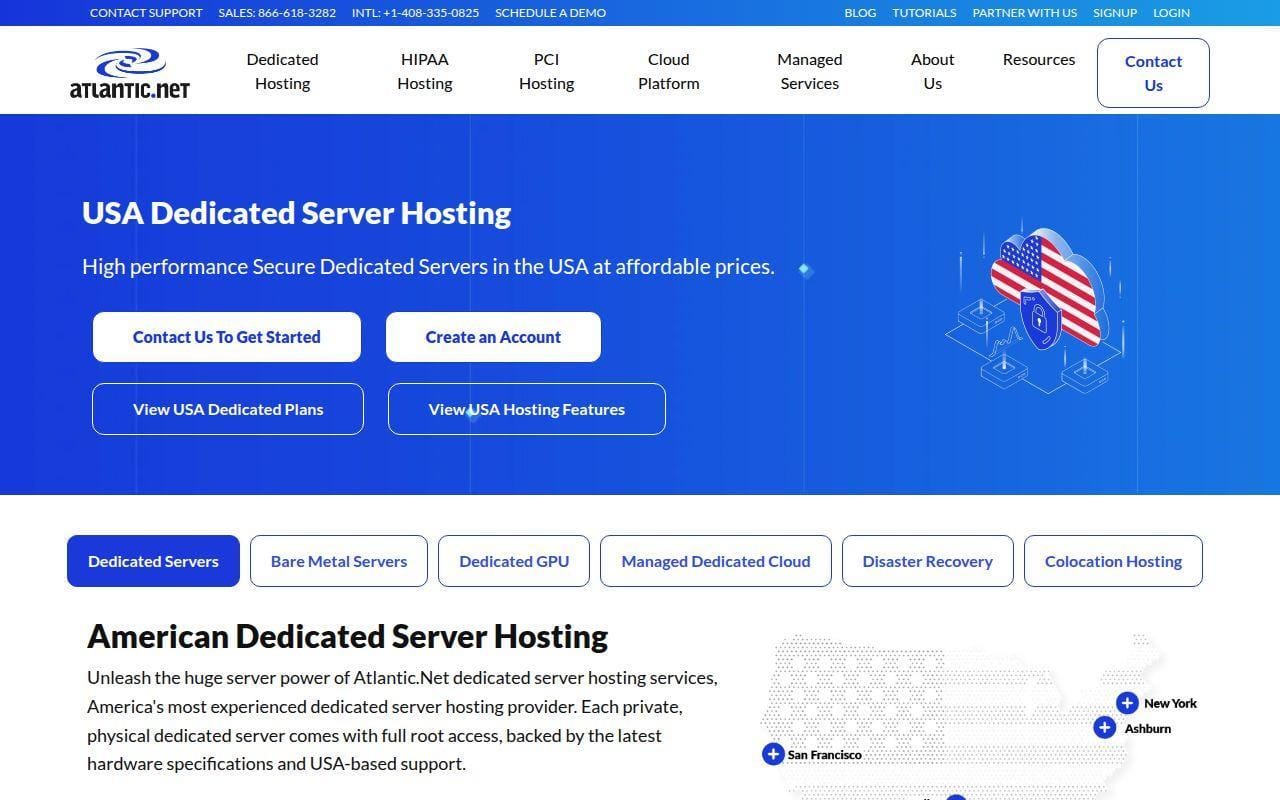
Atlantic.Net deserves more attention than it usually gets. The official Linux dedicated hosting page is unusually direct about what is included: a physical server to yourself, full root access, Linux distro choice, no setup fees, 24/7/365 U.S.-based phone support, and a triple 100% SLA covering network uptime, hardware replacement, and infrastructure availability. That is a serious business pitch, not just generic hosting copy.
The company also splits its offer between more traditional Linux dedicated hosting and a separate “Dedicated Hosts” product for cloud-integrated physical infrastructure. That gives Atlantic.Net a broader relevance than many mainstream hosting brands.
How Atlantic.Net works
The Linux dedicated hosting page frames the service around physical isolation and operational assurance. You get a server to yourself, full root access, a choice of Linux distributions, and no setup fee. For buyers who need cloud-integrated bare metal, Atlantic.Net also has Dedicated Hosts with term-based pricing and larger memory and storage profiles.
On the Dedicated Hosts page, the D2.B example shows 128 GB RAM, 6 cores and 12 threads, 960 GB SATA RAID 1, 10 TB transfer, and pricing that changes sharply by term. That page is more infrastructure-like, while the Linux dedicated hosting page is more straightforward for normal dedicated-server buyers.
Who is Atlantic.Net for?
Atlantic.Net is a strong fit for healthcare, finance, regulated business hosting, and other buyers who care about SLAs and compliance language. It is also a good option for businesses that want U.S.-based support and do not need a giant global bare-metal menu.
If you want the cheapest entry server or the broadest global server inventory, other providers are better matched.
Atlantic.Net pricing
- Linux Dedicated Hosting: starts at $139/month, with full root access, Linux distro choice, and no setup fees.
- Dedicated Host D2.B: $598/month on demand, with 128 GB RAM, 6 cores and 12 threads, 960 GB SATA RAID 1, and 10 TB transfer.
- Dedicated Host D5.A: $1,568/month on demand, with 256 GB RAM, 20 cores and 40 threads, 4.8 TB NVMe RAID 10, and 10 TB transfer.
If you want the cloud-style physical host side of Atlantic.Net as well, the dedicated host catalog adds useful context.
Pros and cons
Pros
- Triple 100% SLA is one of the clearest assurance statements in this roundup.
- Linux dedicated hosting page clearly states full root access and distro choice.
- No setup fees on Linux dedicated hosting.
- Strong fit for compliance-sensitive buyers.
Cons
- Dedicated Hosts pricing climbs quickly once you move into cloud-integrated physical infrastructure.
- Less broad in raw global hardware variety than OVHcloud or Hivelocity.
- Not the best fit for bargain-first shoppers.
Atlantic.Net rating and reviews
- Trustpilot: rated 4.3/5 across 127 reviews.
Atlantic.Net is one of the better niche picks in this market. If SLA language and regulated-workload comfort matter to you, it should be on your shortlist.
10. Hivelocity
- Category: Bare metal and dedicated servers
- Best for: Fast global deployment and customizable bare metal
- Ease of use: Moderate
- Pricing: From $65/mo
- Standout feature: Strong spread from instant servers to big custom builds
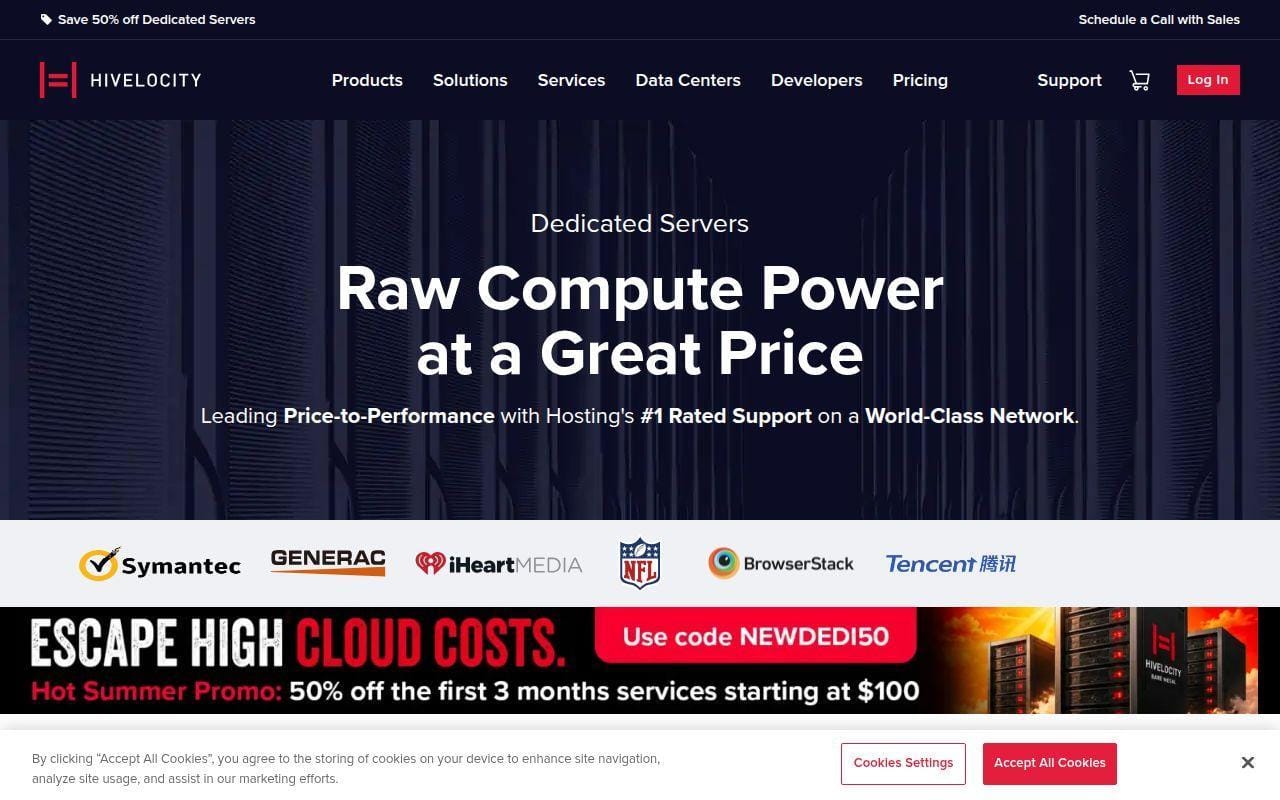
Hivelocity rounds out the top ten because it combines low starting prices with a credible global bare-metal posture. The dedicated server page shows instant-deploy servers from $65 per month, more powerful sale configurations, and custom-build capacity that scales all the way to one to four processors, up to 100 hard drives, and 8 GB to 1,000 GB RAM. For buyers who want more than a fixed hosting ladder but less sprawl than OVHcloud, that is a nice middle ground.
We also like the practical details. Hivelocity says there is no setup fee for dedicated servers, free server reboots are included, custom-built servers include one free IP, and extra IPs cost $2.50 per month each. Those are the small operational facts that tend to get buried elsewhere.
How Hivelocity works
The page splits the offer between instant deployment servers and custom-built servers. Instant servers are shown as ready-to-order configurations with price, core count, memory, storage, and bandwidth. If those do not fit, Hivelocity says you can request a custom build and tune processor count, drive count, RAM, and network profile more heavily.
On the current page, the entry option is an E3-1230 v6 3.5 GHz Kaby Lake server at $65 per month with 4 cores, 8 threads, 32 GB memory, 480 GB SSD storage, and 20 TB on a 1 Gbps port. A step up is the E-2236 3.4 GHz Coffee Lake server at $97 per month sale pricing with 6 cores, 12 threads, 16 GB memory, 480 GB SSD, and the same 20 TB on 1 Gbps. At the upper end of the visible page, Hivelocity is already into workstation-class and specialty hardware.
Who is Hivelocity for?
Hivelocity is a good fit for developers, fast-growing SaaS teams, gaming or media-adjacent workloads, and buyers who want low-friction deployment with room to spec bigger hardware later. It is especially appealing if you want both instant options and custom quotes under one roof.
If you want more bundled management or a more hand-held hosting experience, Liquid Web and InMotion Hosting are more natural fits.
Hivelocity pricing
- E3-1230 v6 3.5GHz Kaby Lake: $65/month, with 4 cores, 8 threads, 32 GB memory, 480 GB SSD, and 20 TB on 1 Gbps.
- E-2236 3.4GHz Coffee Lake: $97/month sale price, with 6 cores, 12 threads, 16 GB memory, 480 GB SSD, and 20 TB on 1 Gbps.
- 7965WX 5.4GHz Threadripper PRO: $750/month, with 24 cores, 48 threads, 1 TB memory, 512 GB NVMe plus 2×2 TB NVMe, and 20 TB on 10 Gbps.
- Additional IPs: $2.50/month each on custom-built servers after the first included IP.
For live instant-server pricing and current promotions, the pricing page is the quickest comparison view.
Pros and cons
Pros
- Low visible starting price for a real dedicated server.
- No setup fee on standard dedicated servers.
- Good mix of instant deployment and custom-build flexibility.
- Operational details like reboot policy and extra IP pricing are clearly stated.
Cons
- Less Linux distro detail on the product page than some rivals provide.
- Review profile is weaker than the top-tier mainstream names.
- Buyers who want management bundled by default will need to read more carefully.
Hivelocity rating and reviews
- Trustpilot: rated 3.7/5 across 297 reviews.
Hivelocity is an easy provider to like when you want real bare metal without overcomplicating the buy. If you like the sound of instant servers now and custom builds later, it belongs on your shortlist.
More Linux Dedicated Server Options Worth Considering

The next five picks are not as universally easy to recommend as the top ten, but each one has a real angle. Some push stronger international availability. Others lean into specific hardware classes, very low stock pricing, or a simpler managed model. If your shortlist still feels crowded, these are the providers to match against narrower needs.
11. AccuWeb Hosting
- Category: Dedicated server hosting
- Best for: Buyers who want many server categories and global locations
- Ease of use: Moderate
- Pricing: Classic Series from $121/mo
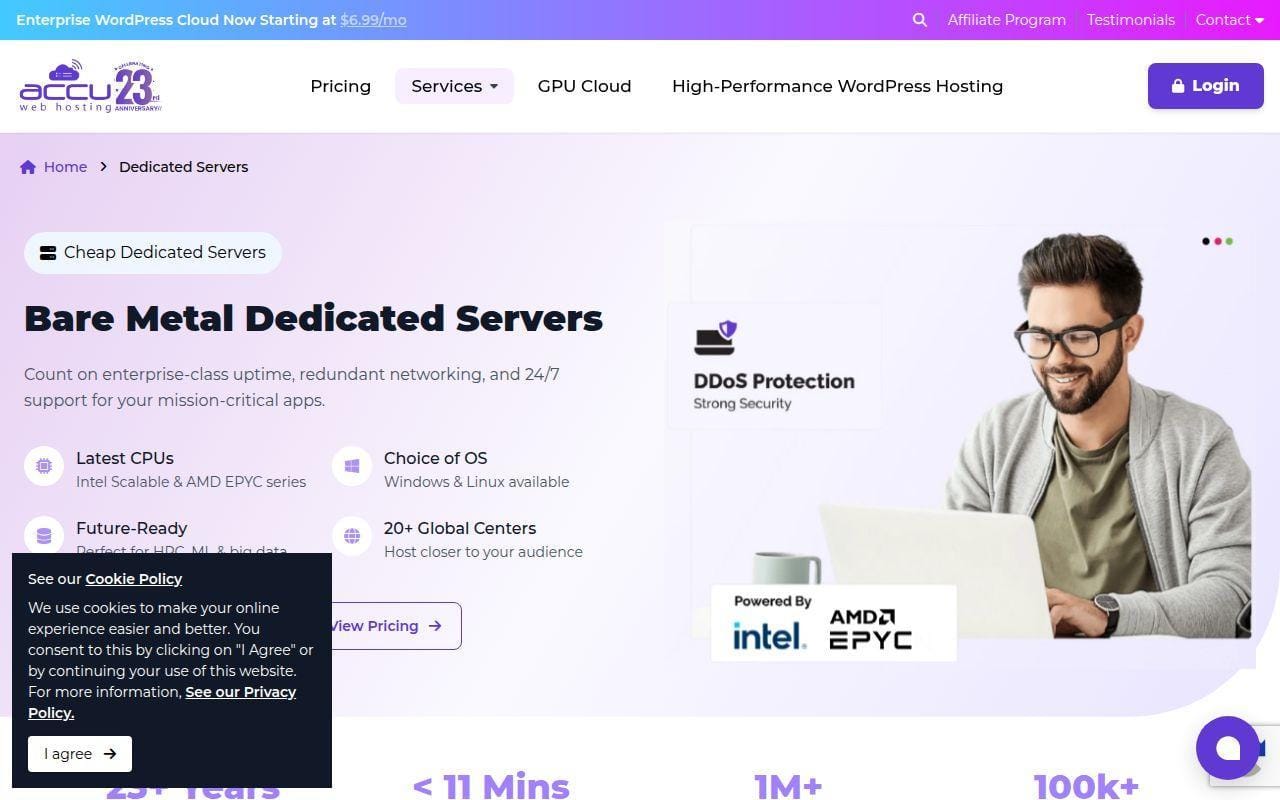
AccuWeb Hosting is the “lots of categories, lots of use cases” provider in this second tier. The dedicated-server page breaks the lineup into Classic Series, Dedicated Game Server, Dedicated Storage Server, High-Availability Servers, Infrastructure Servers, and Advanced Servers. That is a useful way to shop if you care more about workload type than brand-name plan tiers.
What it does better than several top-ten picks is breadth inside one storefront. The page calls out Intel Xeon Scalable and AMD EPYC processors, DDR4 and DDR5 ECC RAM up to 2 TB, NVMe and SSD storage, software and hardware RAID choices, up to 100 Gbps connectivity, and control-panel options including cPanel, DirectAdmin, Plesk, ispmanager, and SolidCP. It also lists Ubuntu, AlmaLinux, CloudLinux, and Debian among the OS options.
Pricing starts at $121 per month for the Classic Series, $154 per month for Infrastructure Servers, $199 per month for Advanced Servers, and goes higher for storage and high-availability categories. We also noted a practical caveat: the page says dedicated server delivery can take 2 to 15 days after configuration is confirmed, which is longer than instant-deploy rivals.
Who is AccuWeb Hosting for?
AccuWeb Hosting is a good fit for buyers who want broad category choice, many locations, and a very feature-heavy catalog. If instant deployment is your top priority, you should look higher up this list.
12. Bacloud
- Category: Linux dedicated server hosting
- Best for: High-spec entry hardware with modern Ryzen and Xeon options
- Ease of use: Moderate
- Pricing: From 109.00€ /mo
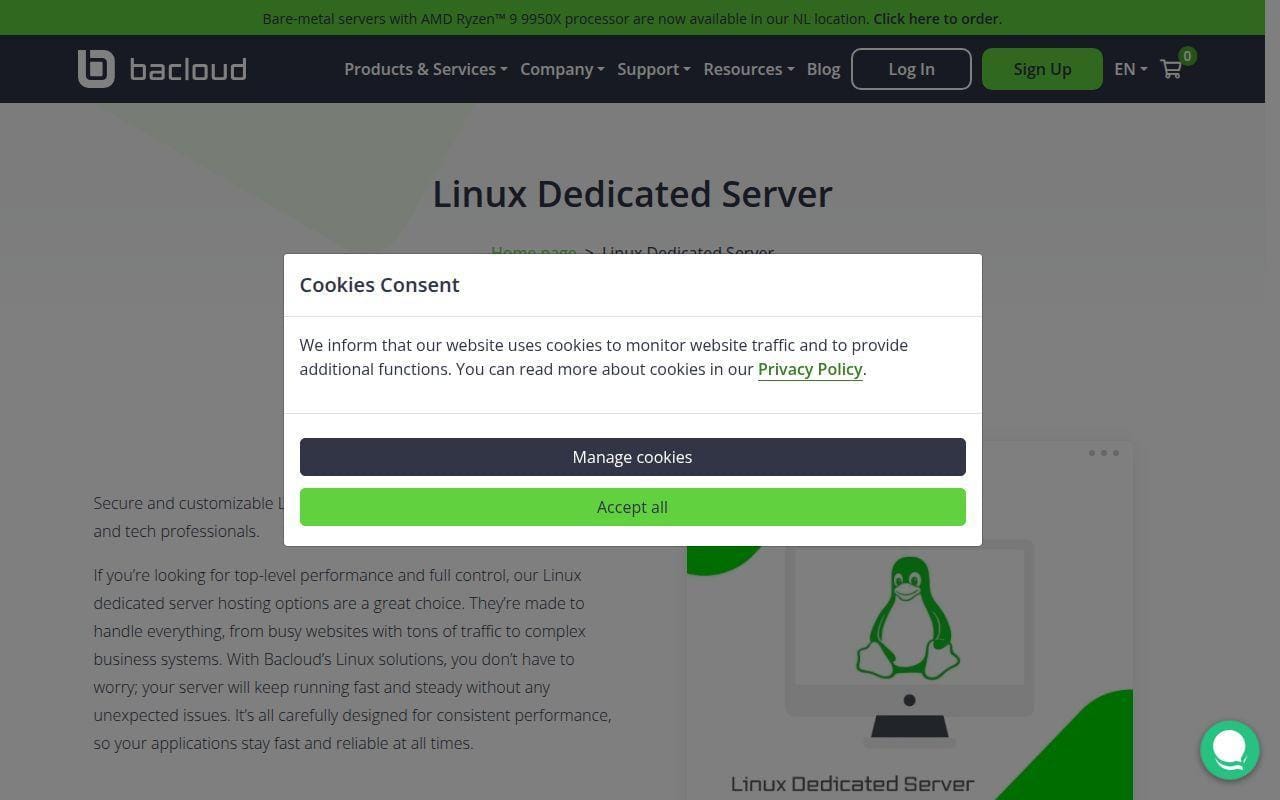
Bacloud is more interesting than its lower profile suggests. The Linux dedicated server page is unusually direct about the audience, developers and technical professionals, and it pairs that with concrete hardware cards instead of vague “contact us” positioning. That already makes it easier to take seriously than a lot of second-tier hosts.
The strongest difference here is hardware-per-dollar on the visible plans. An IE023.CORE server is shown at 109.00€ per month with an Intel Xeon E-2386G, 6 cores and 12 threads, 64 GB ECC RAM, 2×960 GB NVMe, and up to 10 Gbps connectivity. IE023.PLUS rises to 145.00€ per month with 128 GB ECC RAM and 2×1.92 TB NVMe. Higher up, AR062.CORE shows an AMD Ryzen 9 7950X3D with 128 GB ECC and 2×1.92 TB NVMe at 179.00€ per month.
Bacloud also says you can choose Ubuntu, CentOS, Debian, AlmaLinux, and more, or upload your own ISO. The page mentions layered firewalls, optional DDoS protection, scaling up RAM, storage, or CPU later, and activation within minutes of payment. That mix gives Bacloud real appeal for technical buyers who want strong starting specs without moving straight to enterprise pricing.
Who is Bacloud for?
Bacloud fits developers and power users who care about visible hardware value and Linux flexibility. Buyers who want a broader public review footprint or more polished managed services should look elsewhere.
13. HOSTKEY
- Category: Linux dedicated server hosting
- Best for: Unmanaged dedicated servers with many locations and fast deployment
- Ease of use: Moderate to advanced
- Pricing: Instant servers from €40/mo
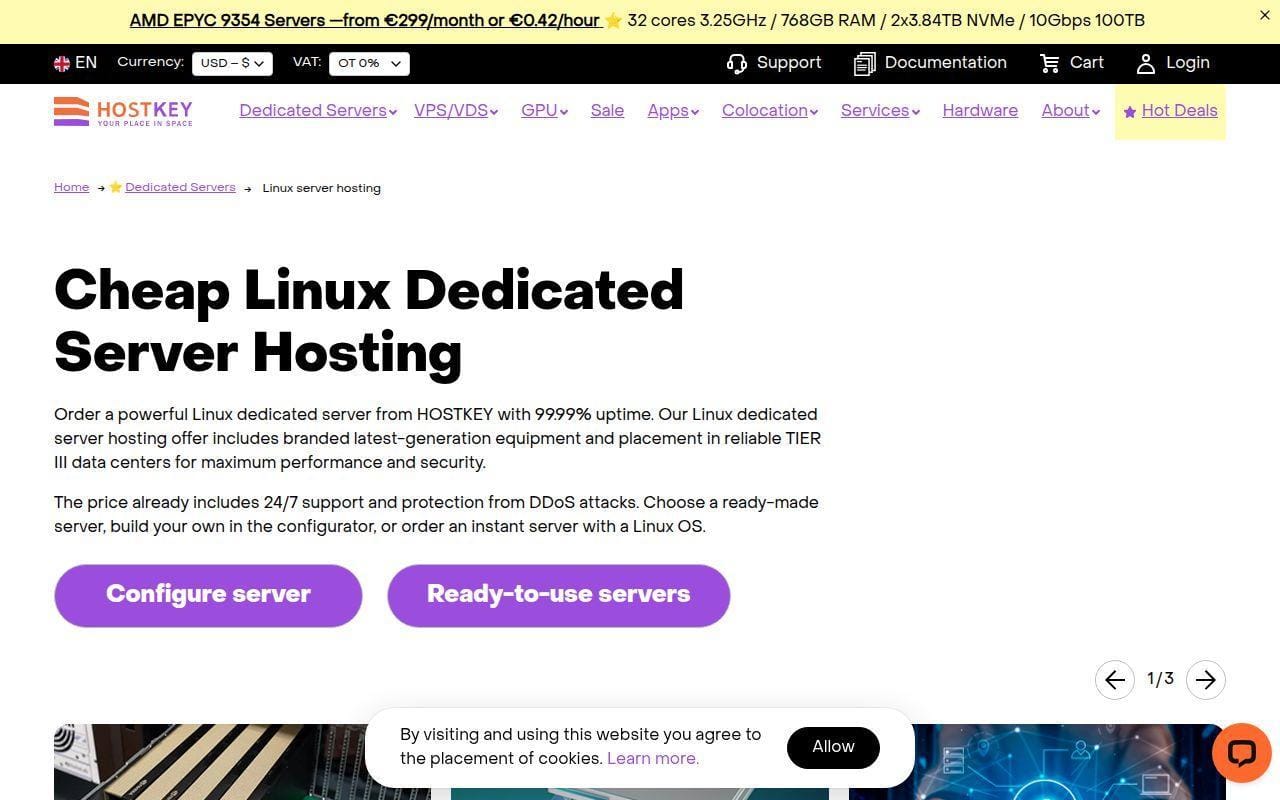
HOSTKEY is the most explicitly unmanaged option in this second tier, and that honesty works in its favor. The page says outright that all servers are unmanaged, that non-standard OS installs can be done through ISO images or your own image via IPMI, and that administration services are available for a fee. That is the right kind of clarity for technical buyers.
What HOSTKEY does better than many higher-ranked hosts is deployment and geographic spread. The page lists a long set of locations across Europe, the U.S., and more. It also lays out several product families, including instant dedicated servers from €40 per month, Ryzen and Core i9 servers from €100 per month, custom single-CPU servers from €160 per month, and custom dual-CPU servers from €205 per month.
The infrastructure pitch is strong on remote control too. HOSTKEY highlights IPMI and iDRAC access, 1 Gbps to 10 Gbps ports, full root SSH access, hourly and monthly billing, and the option to cancel instantly on certain instant servers. That makes it a sensible option for hands-on teams that care about control more than bundled support.
Who is HOSTKEY for?
HOSTKEY is best for admins who want unmanaged Linux dedicated servers with lots of location choice and out-of-band control. Beginners and buyers who want managed operations should move up the list.
14. DreamHost
- Category: Fully managed dedicated hosting
- Best for: Managed hosting buyers who want Ubuntu-based simplicity
- Ease of use: Easy
- Pricing: Starts at $165/mo promo, $199/mo monthly
DreamHost takes the opposite approach from HOSTKEY. It is fully managed, limited in lineup, and clearly aimed at business hosting rather than infrastructure tinkering. That narrower scope is not a weakness if it matches what you need.
The dedicated page shows a Standard plan and a family of Enhanced plans with monthly and yearly pricing. The starting visible promo is $165 per month for Standard, while the monthly table shows Standard 16 at $199 per month with 6 cores, 16 GB RAM, 480 GB SSD, RAID 1 storage, root access through an admin user, Ubuntu, monitoring, DDoS protection, and a 100% network uptime guarantee. Enhanced plans climb through more CPU, RAM, and storage combinations, including Enhanced 32 at $299 per month and Enhanced 64 at $349 per month in the monthly table.
DreamHost does a couple of practical things well. It clearly says Dedicated Hosting customers get server monitoring and DDoS protection, and its knowledge base explains that root access is handled through a sudo-enabled admin user. It also notes a $100 fee for re-imaging a dedicated server, which is exactly the kind of operational detail many providers leave buried.
Who is DreamHost for?
DreamHost is best for buyers who want a managed, Ubuntu-centered dedicated environment and do not need a giant hardware matrix. If you want more Linux distro choice or deeper low-level control, pick another provider.
15. Hetzner
- Category: Dedicated root servers
- Best for: Buyers comfortable shopping through a dynamic server finder
- Ease of use: Moderate
- Pricing: Dynamic on-page finder, static start prices were not clearly rendered in our research view
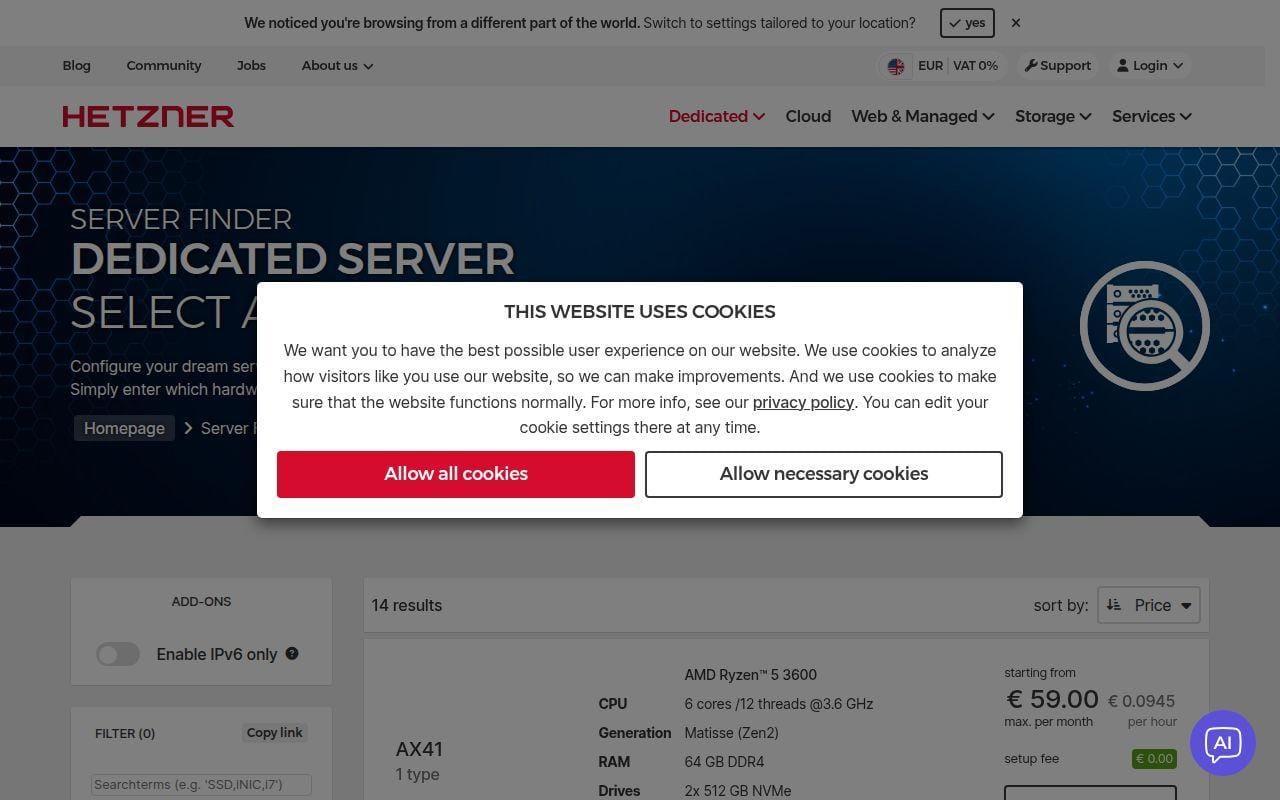
Hetzner is a serious name in dedicated hosting, but the exact page in this outline did not expose enough static plan detail in plain text for us to rank it higher with confidence. The page is built around a Server Finder and several families, including EX-Line, AX-Line, RX-Line, SX-Line, GPU-Line, and DX-Line, which tells us the catalog is broad. It is just not rendered in a way that made a static, page-level price comparison easy during this research pass.
What we could confirm is the overall positioning. Hetzner says the Server Finder lets you configure your dream server in seconds, and the page also highlights ISO 27001:2022-certified data centers in Nuremberg, Falkenstein/Vogtland, and Helsinki, along with 24/7 support from data-center technicians. That is credible infrastructure language, not generic shared-hosting fluff.
So why keep it in the second tier? Because the buying experience on this specific page is less transparent than many rivals for readers who want quick plan comparison. If you already know Hetzner’s ecosystem and are comfortable shopping through dynamic server tools, it remains worth considering. If you want a cleaner first-pass shortlist, the higher-ranked providers make that easier.
Who is Hetzner for?
Hetzner is for technically comfortable buyers who are fine using a dynamic server finder and care about infrastructure reputation. Readers who want visible static pricing and easier side-by-side comparison should start elsewhere.
What a Linux Dedicated Server Is and When It Makes Sense

A Linux dedicated server is exactly what it sounds like: one physical machine allocated to one customer, running Linux. That sounds simple, but the buying decision is really about whether you need physical isolation and full control badly enough to justify the cost and operational overhead. Many people do not. Some absolutely do.
Dedicated Servers Versus Cloud and Virtualized Environments
A dedicated server makes the most sense when you need guaranteed access to all CPU, RAM, storage, and network resources on one machine. That is the clean technical difference from shared or virtualized hosting. As the Hostwinds explanation puts it, a dedicated server is a physical machine, while cloud and VPS products carve resources out of larger shared infrastructure.
The practical difference shows up in noisy-neighbor risk, custom kernel or hypervisor work, storage layout control, and licensing edge cases. DreamHost’s own knowledge base also frames dedicated hosting as a server where no other customers share resources with your sites, while managed VPS resources are still protected slices on shared physical hardware, which you can see in its hosting-plan guide.
That does not mean cloud is worse. It means cloud is better when elasticity matters more than hard physical boundaries. If your workload grows and shrinks all day, cloud is often the cleaner answer. If your workload is steady, sensitive, or operationally picky, dedicated Linux can still be the better bet.
Workloads That Benefit Most From Dedicated Linux
The best candidates are high-traffic websites, large databases, busy ecommerce stores, CI/CD runners, media workloads, and private virtualization hosts. IONOS is especially clear on this point, mapping dedicated servers to database hosting, app development pipelines, file repositories, archival storage, and high-performance hosting. Those are the sorts of jobs where predictable disk, RAM, and CPU behavior really pays off.
Dedicated Linux also makes sense when you want to run several services on one machine and tune the stack yourself. That might mean Nginx in front, a database on local NVMe, custom firewall policy, and your own backup flow. If you do not need that much control, you may just be paying for bragging rights.
Linux Dedicated Server Benefits That Matter Most
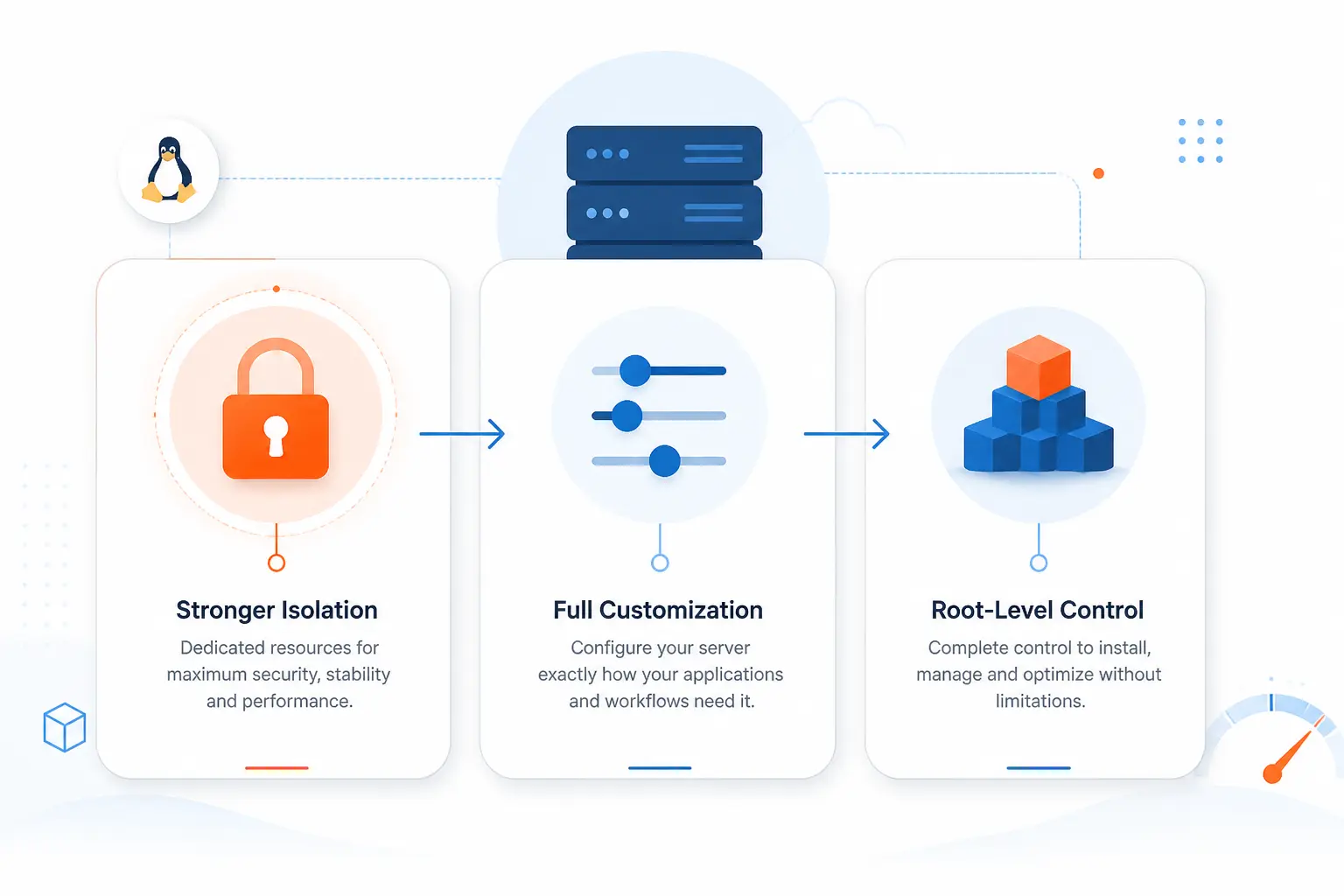
The best reasons to buy dedicated Linux are practical, not philosophical. You get full administrative control, cleaner resource isolation, and more freedom to build the exact stack you want. Those benefits matter most when your site or app is already large enough to notice the difference.
Root Access Customization and Full Administrative Control
Root access is the big one. It lets you install packages directly, change kernel or system settings, manage users, run containers, adjust filesystem layouts, and automate deployment the way your team prefers. Ubuntu’s official server docs are built around that mindset, with sections for managing software, storage, networking, security, and virtualization in the server documentation set.
That level of control is why Linux dedicated servers appeal to developers and sysadmins. You are not limited to what a hosting panel wants to expose. Of course, that freedom cuts both ways. If nobody on your team can manage SSH access, package updates, or service hardening, raw control becomes a liability fast.
Performance Security and Resource Isolation
Single-tenant hardware gives you more predictable performance because there is no other customer sharing the CPU scheduler, I/O path, or RAM pool. Liquid Web leans hard on that in its package page, and Atlantic.Net does the same in its Linux dedicated pitch. Those claims are not marketing fluff. They describe the main operational reason people still buy dedicated hardware.
Security also improves in a narrow but meaningful sense. Physical isolation lowers exposure to neighbor-induced contention and removes some multi-tenant concerns entirely. It does not secure the machine by itself, though. You still have to patch the OS, lock down SSH, limit open ports, and monitor logs.
Scalability Flexibility and Developer Workflows
Dedicated servers scale differently from cloud. You usually scale up in larger steps, but each step gives you cleaner, more deterministic resources. That is useful for build runners, big relational databases, and private Kubernetes or virtualization nodes where steady local performance matters more than minute-by-minute elasticity.
It also fits modern developer workflows surprisingly well. IONOS explicitly lists Jenkins, GitLab, GitHub runners, Docker, and Kubernetes nodes as good matches for dedicated servers, while many providers in this list mention virtualization or container-heavy use cases. The key is being honest about your workload pattern. If you only spike once in a while, cloud still wins the flexibility argument.
Linux Distros Licenses and Software Stack Options

Your distro choice shapes more than package names. It affects update cadence, admin familiarity, repository ecosystem, panel compatibility, and how quickly you can troubleshoot issues at 2 a.m. In real buying terms, Ubuntu and Debian are usually the safest defaults for general-purpose hosting, while AlmaLinux and similar enterprise-family options make sense when you want a RHEL-style environment.
Choosing Between Ubuntu Debian AlmaLinux and Enterprise Linux
Ubuntu is the easiest starting point for many teams because the official server docs are broad, current, and written with practical operations in mind. It is a comfortable fit for web apps, containers, and general-purpose Linux hosting, especially when your stack already expects modern package versions and easy community support.
Debian is the steadier, more conservative choice. The administrator’s handbook is still one of the best public references for classic Linux server administration, and Debian remains a favorite for teams that want a stable base with minimal surprises.
AlmaLinux is the option to consider when you want a RHEL-compatible operating model without paying for RHEL itself. The installation guide shows the project’s current focus on x86_64 and ARM64 support, along with boot, minimal, and full ISO types, which matches the practical server use case well.
| Distro | What Stands Out | Best Fit |
|---|---|---|
| Ubuntu | Broad documentation and current LTS focus | General web apps, containers, beginner-friendly admin work |
| Debian | Conservative, stable admin base | Classic server stacks and teams that value predictability |
| AlmaLinux | RHEL-style environment with server-focused ISO options | Panel hosting, enterprise-style Linux workflows |
| Enterprise Linux family | Longer-lived, compatibility-minded ecosystem | Operations that want RHEL-like conventions |
Control Panels Web Servers Databases and Default Tools
Most providers here either bundle or upsell a control panel such as cPanel or Plesk. That is convenient, but it is not mandatory. Many Linux dedicated server buyers are happier running a leaner stack with Nginx, a database server, and SSH-based admin tooling. The official Nginx docs are a good reminder of how much you can do without a heavyweight panel, including HTTPS configuration, TCP or UDP handling, and load balancing.
The main practical question is this: are you buying the server to host a few websites quickly, or to run an application stack you actually want to shape? If it is the first case, a panel is often worth the monthly fee. If it is the second, you may be better off keeping the machine cleaner and managing web, database, and deployment services directly.
Hosting Features That Change Day to Day Operations
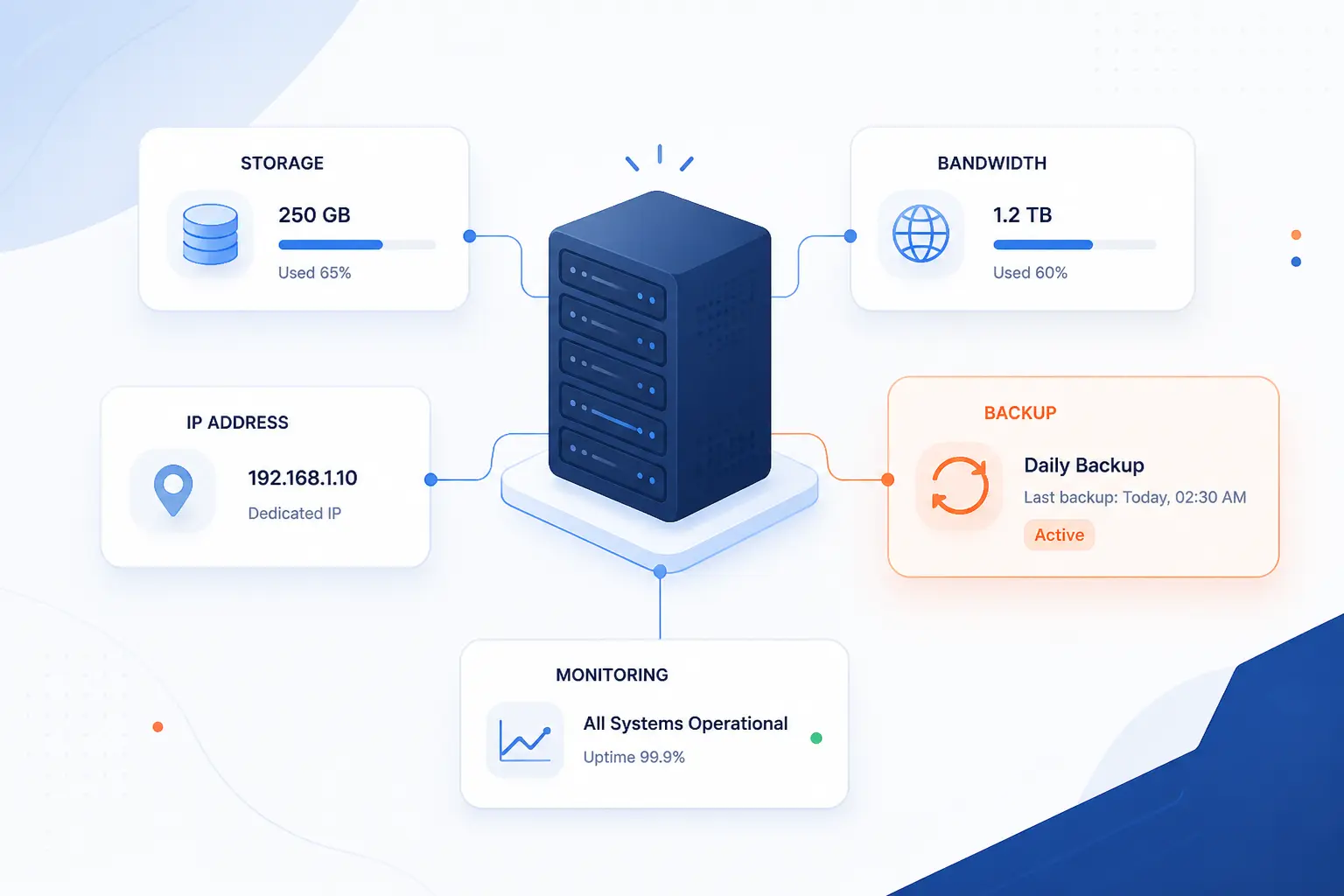
The difference between a provider you like and one you regret usually shows up after deployment. Pricing gets the click. Operations features decide whether the service stays tolerable. That means you should compare storage layout, traffic terms, IP policy, backups, monitoring, and protection features before you buy, not after something breaks.
Storage Bandwidth Dedicated IPs and DDoS Protection
Storage and bandwidth are not just specs. They change what you can safely host and how much stress the machine can absorb. NVMe storage is the safer default for modern app hosting, while large HDD arrays still make sense for backups and archives. On bandwidth, IONOS and OVHcloud are stronger than average because their pages are unusually clear about public and private link ranges and traffic terms.
Dedicated IP policy also matters more than many buyers expect. Hivelocity includes one free IP on custom builds and charges $2.50 per month for additional IPs, while IONOS includes one IPv4 and charges $5 per month for extras. Hostwinds goes one step further and documents its DDoS add-on pricing clearly in the protection overview, where dedicated-server coverage costs $50 per month per block of five protected IP addresses.
Backups Monitoring Uptime and Deployment Speed
Backups and monitoring are where managed providers often justify their higher monthly price. Liquid Web bakes Acronis allocations into its package details. InMotion adds backup storage in its managed Premier Care bundles. Hostwinds markets nightly backups and server monitoring as part of the dedicated-server offer.
The other operational question is restore behavior. Backups are only useful if you understand retention, setup, and recovery flow. Hostwinds at least documents backup behavior in the retention notes, which is the sort of operational clarity we like to see.
Deployment speed can be just as important. Some providers, such as Hivelocity and HOSTKEY, lean into instant or near-instant options. Others, like AccuWeb Hosting, explicitly say delivery can take days. There is no universal right answer here, but you should know which model you are buying into.
Linux Dedicated Server Setup and Hardening Checklist

Buying the server is the easy part. The real work starts right after provisioning. If you want a stable machine, the first day should focus on hardware sanity, operating-system choice, secure access, service setup, and monitoring. Miss those basics and even a great provider can turn into a frustrating mess.
Select Hardware and Install the Right OS
Start by matching hardware to the workload, not to your ego. Fast NVMe and decent RAM matter more for many web apps than piling on extra cores you will never use. Then pick the distro your team can actually support. Ubuntu is usually the easiest mainstream choice, Debian is excellent when you want a stable classic base, and AlmaLinux-style environments make sense when panel compatibility or enterprise conventions matter.
- Choose the CPU, RAM, and storage layout for the workload, not just the cheapest or biggest box.
- Pick the distro your team already knows how to patch and troubleshoot.
- Confirm whether you need a control panel or whether SSH-based admin is enough.
- Set up RAID and storage layout before you load production data.
Apply Security Updates and Lock Down Access
Do the boring security work first. Update the OS, create a non-root admin user, set up SSH keys, disable password auth where possible, and restrict open ports to only the services you need. Debian’s handbook is still a good checklist source for secure remote login, permissions, backups, and monitoring topics in the server admin manual.
You should also decide early whether DDoS protection, web application security, and backup encryption are provider add-ons or your job. Do not assume they are included just because the sales page sounds reassuring.
Configure Services Monitoring and Ongoing Maintenance
Once access is locked down, install only the services you need and put monitoring in place before the server matters to anyone. That usually means web server, database, firewall rules, scheduled updates, backups, and some sort of uptime or resource alerting. If you use Nginx, the official documentation is still one of the best places to verify HTTPS, request handling, and load-balancing configuration details.
Then keep the machine boring. Patch it regularly, review logs, test restores, and document what changed. A linux dedicated server should feel predictable. If it feels mysterious, something in your setup process is already drifting.
Linux Dedicated Server FAQ
These are the questions buyers ask right before they decide. The direct answer is usually short. The useful answer needs a bit more context, so that is what we have done here.
How Much Does a Linux Server Cost
A Linux server can cost anywhere from under $10 per month for a basic cloud server to well over $1,000 per month for high-end dedicated hardware. In this list alone, the visible starting points range from 1Byte cloud servers at $8.99 per month up to OVHcloud and Hivelocity enterprise-class hardware priced far higher. The right question is not “what is the cheapest server,” but “what hardware and management level does my workload actually need?”
Which Linux Server Is Best for Beginners
For true beginners, InMotion Hosting is the easiest dedicated-hosting pick in this roundup. Its lineup is easier to read than most, and its managed options make the first jump to dedicated infrastructure less intimidating. If you are still unsure whether you need dedicated hardware at all, a simpler cloud server or managed VPS may be the better first step.
Can I Host My Own Server for Free
Yes, you can host your own server for free on hardware you already own, but that is not the same as getting reliable production hosting for free. You still have to pay for internet uptime, power, hardware failure risk, backups, and security work. For most business use, “free” becomes expensive the moment availability matters.
Is Linux Better for Hosting Servers
Linux is often the better choice for hosting servers, especially for web apps, databases, containers, and open-source stacks. It gives you strong administrative control, broad software support, and a huge documentation ecosystem. Windows can still make sense for Microsoft-specific workloads, but Linux is the default for a reason.
Should You Choose Managed or Unmanaged Linux Dedicated Hosting
You should choose managed hosting if nobody on your team wants to spend nights patching, monitoring, and fixing server issues. Choose unmanaged hosting if you need maximum control and already have the skills to run the box safely. In plain terms, managed is easier to live with, unmanaged is usually more flexible.
Which Linux Distro Should You Use on a Dedicated Server
Ubuntu is the safest general-purpose choice for most teams. Debian is great when you want a stable, conservative server base. AlmaLinux or another enterprise-family option makes sense when you want a RHEL-style environment or control-panel compatibility. The best distro is usually the one your team can support quickly and confidently.







Conclusion
If we were narrowing this list to the strongest shortlists, we would start with OVHcloud for pure bare-metal range, Liquid Web for managed business hosting, IONOS for balanced configurability and clear pricing, and InMotion Hosting for smaller teams that want help getting comfortable on dedicated infrastructure.
That said, the right provider depends on a blunt question: do you really need single-tenant Linux hardware, or would a simpler cloud server do the job for less money and less hassle? Answer that first, then pick the provider whose operating model fits your team, not just the one with the loudest price tag. Which side of that line are you on right now?