

- An Internet Exchange Point Is Where Networks Exchange Traffic Directly
- How Traffic Moves Through an Internet Exchange Point
- Who Connects to an IXP
- The Physical Setup Behind an IXP
- Why Networks Use IXPs
- How Internet Exchange Points Are Organized
- FAQ
- How 1Byte Supports Websites and Network Growth
- Conclusion
An Internet Exchange Point is a shared physical and technical meeting place where different networks connect and exchange internet traffic directly. Instead of sending packets through a paid upstream carrier every time, networks can pass traffic to each other across a local switching fabric. We think of it as a well-run marketplace for routes, where internet service providers, cloud networks, CDNs, hosting providers, and content platforms decide who they will exchange traffic with. For website owners, the topic matters because shorter network paths often mean faster page loads, lower congestion risk, and fewer mystery slowdowns between users and servers.
An Internet Exchange Point Is Where Networks Exchange Traffic Directly

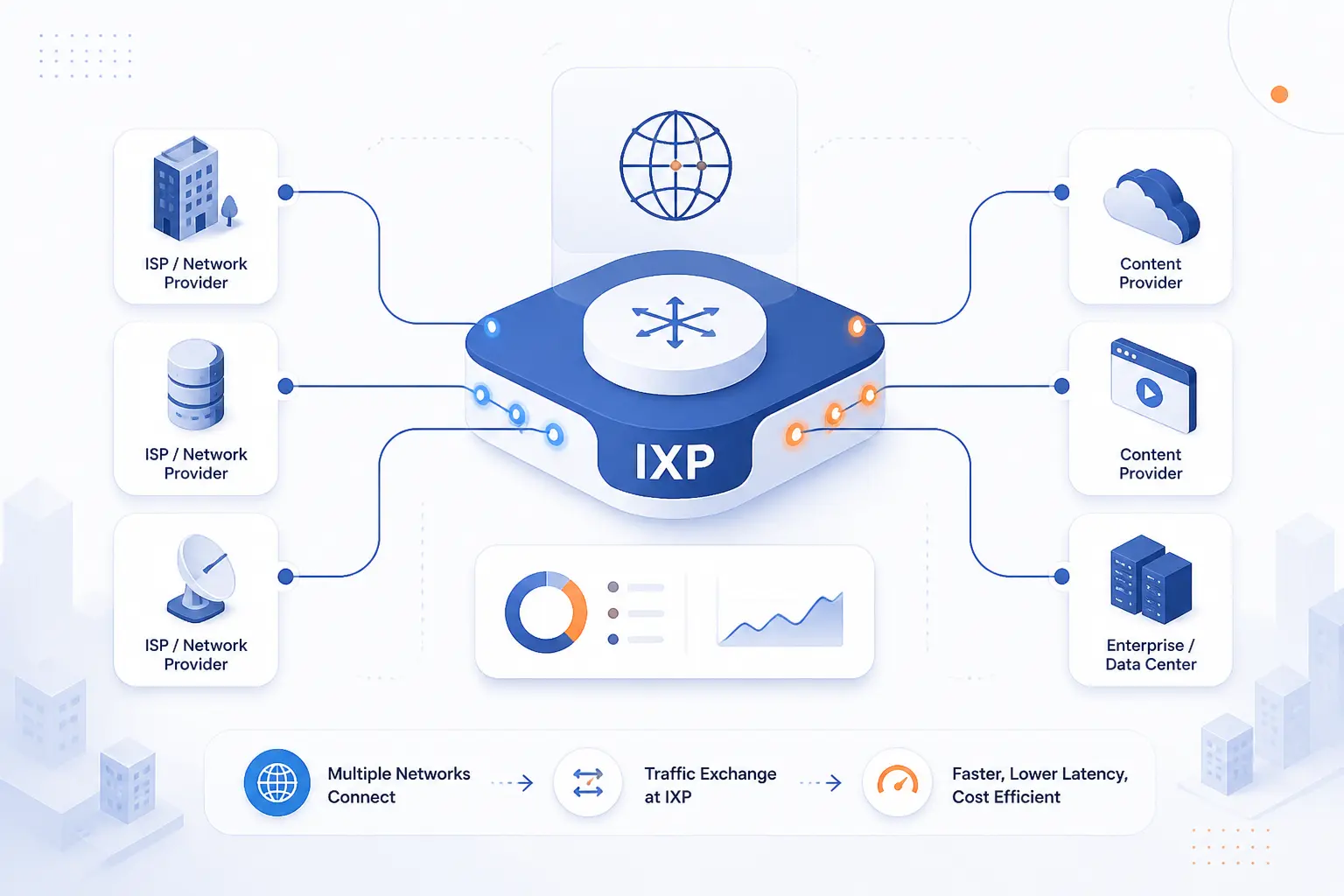
An Internet Exchange Point is a facility, or a connected group of facilities, where independent networks meet to exchange traffic without routing every packet through a third-party transit provider. The simple idea is this: if Network A and Network B both connect to the same exchange fabric, they can send traffic directly after agreeing how to route it. The IXP usually provides the shared Layer 2 platform, while each participant brings its own router, IP addresses, autonomous system number, and routing policy. We like this model because it keeps the internet less centralized, more local, and more accountable to the networks that use it.
Here is the most useful mental picture. A home user streams a video, opens a website, or downloads an app. Their ISP must reach the network that hosts that content. If both networks meet at an Internet Exchange Point, the packet can cross a short local path instead of taking a longer paid route through another carrier.
The exchange itself does not usually “buy and sell internet access” to the public. It is not the same thing as an ISP. It is a neutral platform where networks connect, establish peering relationships, and exchange routes. That neutrality is the soul of a good exchange.
FURTHER READING: |
| 1. What Is DNS Filtering and Why Does It Matter |
| 2. What Is a Local Area Network and How It Works |
| 3. How to Use a Proxy Server on Windows Mac and Mobile |
How Traffic Moves Through an Internet Exchange Point

Traffic moves through an Internet Exchange Point when two participating networks connect their routers to the exchange fabric, exchange routing information, and then forward packets across that shared fabric. The IXP provides the technical meeting point, but the networks decide the routing policy. In practice, this means the exchange carries packets at Layer 2, while routers on each side make Layer 3 decisions using BGP. The result is direct network-to-network delivery when both policy and routing conditions agree.
Shared Switching Fabric Inside the Exchange
The shared switching fabric is the common Ethernet platform that lets many routers attach to the same exchange environment. Each participant connects a router port to the IXP’s switching infrastructure, often through a cross-connect in a data center. Once connected, that router can reach other participants on the same peering LAN, subject to routing agreements and port rules.
This is why an IXP is often described as a Layer 2 service. The switches move Ethernet frames. The participants’ routers decide which IP prefixes should be reachable through which peer. That separation matters. It means the IXP does not need to become the routing brain of the internet. It supplies the road surface, while the networks choose their lanes.
Large exchanges are more than one switch in one rack. AMS-IX Amsterdam, for example, describes its setup as a distributed platform across multiple independent colocation facilities, while still presenting a shared Layer 2 Ethernet service to participants. That is a useful real-world example because it shows how the simple idea can grow into metro-scale infrastructure.
Peering Agreements Between Participating Networks
Peering agreements define whether two networks are willing to exchange traffic directly and under what conditions. Some networks use open peering, where they accept many peers that meet basic requirements. Others use selective peering, where they review traffic volume, traffic balance, geography, routing hygiene, and business fit.
Peering can be informal or documented in a written agreement. At smaller traffic volumes, two engineers may agree to connect after checking routing records and contact details. At larger volumes, legal, commercial, and operations teams may get involved. We have seen both styles work, as long as the routing policy is clear and both sides can fix problems quickly.
Content networks are an easy example. Netflix says its Open Connect program works with over a thousand ISPs and supports open peering at interconnection locations. That kind of direct relationship helps content move closer to viewers, which is exactly why IXPs matter to everyday internet performance.
BGP Route Announcements and Route Filtering
BGP is the routing protocol networks use at an IXP to tell each other which IP prefixes they can reach. More formally, BGP is an inter-AS routing protocol, which means it is designed for routing between separate autonomous systems. Each participating network has an ASN, announces routes, receives routes, and applies policy before accepting or preferring a path.
At an IXP, networks may establish direct BGP sessions with each peer. They may also use a route server, which reduces the number of individual BGP sessions needed. Instead of configuring sessions with dozens or hundreds of peers one by one, a participant can peer with the route server and receive routes from other participants that also use it.
Route servers are convenient, but they must be handled carefully. RFC guidance explains route server behavior in this environment, including the special way a route server distributes reachability information without acting like a normal transit AS. Good exchanges also filter bad announcements. MANRS guidance says an IXP route server should filters announcements using routing information data such as IRR and RPKI, which helps reduce route leaks and accidental hijacks.
When Traffic Uses Transit or a Private Interconnect
Traffic uses transit or a private interconnect when the IXP path is unavailable, unsuitable, or not preferred by routing policy. An IXP is powerful, but it is not magic. If two networks do not peer, if one side does not announce the needed prefix, or if policy prefers another route, the packet will go elsewhere.
Transit is the paid service that gives a network reachability to the broader internet. It is the default safety net for many smaller networks. Private interconnects, sometimes called private peering, are dedicated links between two networks. They make sense when traffic volume is high, operations need tighter control, or the two parties want capacity that does not share a public fabric.
Our practical view is simple. IXPs, transit, and private interconnects are complements. A mature network often uses all three. The art is knowing which path should carry which traffic.
Who Connects to an IXP

The networks that connect to an IXP are usually organizations that either deliver internet access, host content, operate infrastructure, or move large volumes of data between users and services. ISPs join to reach content and other access networks more directly. CDNs and content providers join to place traffic closer to eyeball networks. Hosting, cloud, DNS, security, research, education, and enterprise networks may also join when direct reachability improves performance or cost control.
| Participant type | Main reason to connect | Common traffic pattern |
|---|---|---|
| Internet service providers | Reach content and other networks directly | Heavy inbound traffic to end users |
| CDNs and content providers | Deliver data closer to users | Heavy outbound traffic |
| Other operators and service providers | Improve reachability, redundancy, or service quality | Mixed traffic |
Internet Service Providers
Internet service providers connect to IXPs to give their customers shorter paths to popular networks and content. A residential ISP, for example, wants fast routes to video platforms, game networks, cloud services, and local websites. If that traffic can cross a nearby exchange, customers may see lower latency and fewer congested long-haul routes.
ISPs also use IXPs to reduce dependence on upstream transit. That does not mean transit disappears. It means less traffic needs to take the paid default path. For smaller ISPs, joining a local exchange can be one of the most practical steps toward better customer experience.
There is also a community effect. When local ISPs meet each other at the same fabric, local traffic can stay local. That sounds obvious, but it is not guaranteed unless the networks actually interconnect.
CDNs and Content Providers
CDNs and content providers connect to IXPs to push content closer to the networks that serve end users. A CDN may serve video chunks, images, scripts, software updates, and cached web pages. When the CDN peers directly with an ISP, the path between viewer and content is often shorter and easier to operate.
This is where the internet becomes visible to normal people. A faster video start, a smoother software update, or a quicker page load may depend on good interconnection behind the scenes. Nobody clicks a button labeled “use peering,” of course. The routing system quietly decides.
Large content networks often use a mix of public peering at IXPs, private links, and embedded cache systems. That mix lets them serve different traffic volumes in different markets. We see that as healthy engineering, not overcomplication.
Other Network Operators and Service Providers
Other operators connect to IXPs when direct network reachability supports their service goals. This group can include hosting providers, cloud platforms, DNS operators, security networks, universities, government networks, and enterprise networks with their own ASNs. Their traffic may be smaller than a large ISP’s traffic, but it can still be important.
A DNS operator may value low-latency reachability from many networks. A hosting provider may want better routes between hosted websites and local users. A cloud network may want more predictable paths to customers and partners. The motivation changes, but the pattern is familiar: meet in a neutral place, exchange routes, and keep packets on a sensible path.
From our 1Byte perspective, this is one reason hosting and network design cannot be separated. A powerful server still depends on the path users take to reach it.
The Physical Setup Behind an IXP

The physical setup behind an IXP is a mix of data center space, fiber cross-connects, Ethernet switches, routers owned by participants, and operational systems that keep the peering fabric stable. The exchange operator normally manages the switching platform. The participants manage their own routers and BGP policy. In larger markets, the same exchange may span several buildings so networks can connect from different carrier-neutral facilities.
Neutral Data Centers and Local Exchange Sites
Neutral data centers are common homes for IXPs because many carriers, hosting providers, and network operators can meet there without one participant controlling the playing field. A neutral facility lowers friction. Networks can order cross-connects, install routers, connect to carriers, and join the exchange from one building.
The word “neutral” matters. If an exchange is too closely tied to one carrier, competitors may hesitate to join. A strong IXP wants dense participation, so trust is part of the architecture. The cables and switches are physical, but the business environment shapes who shows up.
Local exchange sites also help keep local traffic local. If two networks in the same city exchange traffic locally, packets do not need to travel to a distant hub and back. That saves distance, and distance is one of latency’s oldest enemies.
Ethernet Switches and Layer 2 LAN Design
Ethernet switches form the shared LAN that lets participant routers reach one another on the exchange fabric. The participant does not plug directly into every other participant. Instead, each network connects to the IXP platform, and BGP sessions run over that common Layer 2 environment.
This design is efficient, but it must be disciplined. Exchanges set rules for allowed traffic on the peering LAN. They usually restrict unnecessary broadcasts, require correct MAC and IP behavior, and monitor for misconfigurations. A shared LAN is useful only when everyone treats it as shared infrastructure, not as a dumping ground.
We are fond of the elegance here. Ethernet does the simple forwarding job. BGP does the policy job. Human operators define the guardrails. When those three layers stay in their lanes, the model works beautifully.
One Facility or Multiple Buildings
An IXP can operate from one facility or stretch across multiple buildings in a metro area. A smaller exchange may begin with one switch in one neutral data center. A larger exchange may use redundant switch platforms across several facilities, connected by metro fiber.
The multi-building model gives participants more places to connect. It can also improve resilience because the exchange is not tied to a single room or single facility event. The tradeoff is complexity. More sites mean more fiber, more monitoring, more failure planning, and more operational discipline.
DE-CIX, for example, publishes connection options across enabled sites so networks can choose where they physically attach to the platform through the available locations. That is the practical side of “distributed” interconnection: more entry points, same basic goal.
Why Networks Use IXPs

Networks use IXPs because direct exchange can shorten routes, reduce reliance on paid transit, increase available capacity, and add path diversity. The benefits are practical, not theoretical. If a packet can travel from an ISP to a content network across the same metro fabric, it may avoid a longer and more congested route. For growing networks, that can mean better user experience and cleaner network economics.
Lower Latency and Shorter Paths
IXPs can lower latency by letting traffic cross a shorter network path between the source and destination networks. Fewer long-haul hops usually mean fewer places where delay, congestion, and packet loss can appear. The gain is most visible when local users access content hosted or cached near the exchange.
Think of a user in a city visiting a site hosted in that same region. Without local interconnection, traffic might travel to a distant transit hub, cross another provider, and return. With local peering, the packet can stay much closer to home. That is not always guaranteed, because BGP policy decides the path, but it is the design goal.
For websites, latency is not a vanity metric. It affects how quickly pages begin to render, how APIs respond, and how stable interactive sessions feel. Good hosting starts at the server, but it never ends there.
Lower Transit Costs
IXPs can lower transit costs by shifting suitable traffic from paid upstream routes to direct peering paths. Transit providers charge for internet reachability, often based on committed capacity or measured usage. When two networks exchange traffic directly, that portion may not need to consume transit capacity.
The savings depend on traffic volume, port fees, cross-connect costs, equipment, staff skill, and peering success. We do not advise treating an IXP as a magic discount machine. The math must include the whole operating cost.
Still, the economic pattern is well known. Research on interconnection costs found that traffic-sensitive network cost decreases as networks add interconnection points, though the returns are not unlimited. That matches what operators know from experience: peering helps most when traffic volumes and peer availability justify the setup.
Better Bandwidth and Resilience
IXPs can improve bandwidth and resilience by giving networks additional high-capacity paths outside their transit links. If a network relies on one upstream provider for most traffic, a problem at that upstream can hurt many destinations. Peering adds another path class, which can help routing adapt when links fail or congestion appears.
Large public fabrics show how much traffic these paths can carry. AMS-IX Amsterdam reports a 15.095 Tb/s peak on its public statistics page. DE-CIX Frankfurt reported surpassing 18 Tbit/s, which shows how central exchange fabrics have become in major internet hubs.
Resilience is not automatic, though. Networks still need redundant ports, clean routing policy, monitoring, and fallbacks through transit or private links. Peering adds options. Good engineering decides how those options behave under stress.
How Internet Exchange Points Are Organized

Internet Exchange Points are organized through ownership models, governance rules, technical policies, and cost-sharing structures. Some are nonprofit member associations. Some are commercial operators. Others are hosted by universities, public agencies, telecom associations, or data center companies. The best model is the one that attracts participation, keeps operations neutral, and funds the platform reliably.
| Model | How it usually works | Best fit |
|---|---|---|
| Member association | Participants influence rules through membership | Markets that value community control |
| Commercial operator | A company runs the platform as a service | Markets needing rapid rollout and managed operations |
| Public or academic host | A public-interest body supports the platform | Developing ecosystems and research communities |
Neutral Ownership and Consensus Governance
Neutral ownership and consensus governance help an IXP earn trust from competing networks. Participants are often rivals in the retail market, yet they need to cooperate on shared infrastructure. That is easier when the exchange operator does not favor one network’s commercial interest over another’s.
Governance covers admission rules, technical standards, fees, dispute handling, maintenance communication, and voting rights where applicable. A member-led exchange may debate policy in working groups. A commercial exchange may publish service terms and technical requirements. Both can work if the rules are transparent.
Internet Society guidance describes governance, neutrality, business models, and peering policy as core pieces of the community toolkit. We agree with that framing. An IXP is infrastructure, but it is also a cooperation machine.
Common IXP Models
The common IXP models are nonprofit association, commercial exchange, public-sector supported exchange, academic exchange, and operator consortium. A nonprofit association gives participants a voice and often grows from a local technical community. A commercial operator may bring capital, automation, sales reach, and repeatable operations across multiple cities.
Public-sector and academic models can help where the market is still forming. They may support local content exchange, research networks, or national connectivity goals. Operator consortia can also work when several networks share the cost and governance burden.
No model is morally superior by default. We judge an IXP by outcomes: neutrality, uptime discipline, routing hygiene, participation density, fair pricing, and clear operations. A beautiful governance chart means little if the fabric is unstable or nobody joins.
How Participants Share Costs
Participants share IXP costs through membership fees, port fees, cross-connect charges, remote access services, sponsorships, or a mix of these. The exchange must pay for switches, optics, racks, power, fiber, monitoring, staff, software, audits, and replacement cycles. Someone has to fund the plumbing.
Port-based pricing is common because capacity drives equipment and operational cost. A network with a small port should not carry the same burden as a network pushing heavy traffic through multiple large ports. Some exchanges also charge a joining fee or annual membership fee to cover shared administrative costs.
Cross-connect costs usually belong to the data center, not the exchange. That detail surprises beginners. Joining an exchange often means paying the IXP and paying the facility or carrier that physically connects your router to the IXP switch.
FAQ
The short answer to most IXP questions is that an exchange is shared infrastructure, while peering is the routing relationship that uses it. Beginners often mix up ownership, location, BGP, and private links. The answers below separate those pieces without burying you in jargon.
Who Owns Internet Exchange Points?
Internet Exchange Points can be owned by nonprofit associations, commercial companies, telecom groups, public institutions, universities, or data center-related organizations. The ownership model varies by market and history. What matters most is whether the operator runs the platform neutrally and publishes clear technical rules.
Where Are Internet Exchange Points Located?
Internet Exchange Points are usually located in carrier-neutral data centers, telecom hotels, university networks, or connected metro facilities. A small IXP may live in one building, while a large one may span several sites in the same region. Networks connect by placing equipment nearby or by using approved access providers.
How Is an IXP Different From Private Peering?
An IXP is a shared fabric where many networks can connect, while private peering is a dedicated connection between two networks. Public peering at an IXP is efficient when many possible peers are present. Private peering makes more sense when two networks exchange enough traffic to justify a dedicated link.
Do Internet Exchange Points Use BGP?
Yes, networks connected to Internet Exchange Points use BGP to exchange routing information. The IXP itself usually provides the Layer 2 fabric, while participant routers run BGP sessions. Those sessions may be direct between two networks or handled through route servers.
How 1Byte Supports Websites and Network Growth
1Byte supports websites and network growth by providing the building blocks site owners need before they ever think about interconnection strategy. Domain registration gives a site its public name. SSL certificates help browsers trust the connection. WordPress hosting, shared hosting, cloud hosting, and cloud servers give projects places to run as their traffic and technical needs change. As an AWS Partner, we also see how cloud decisions and network paths meet in real deployments.
| 1Byte service | Practical connection to the topic | Typical need |
|---|---|---|
| Domain registration and SSL certificates | Make a site reachable and trusted | Launching a public website |
| WordPress hosting and shared hosting | Host everyday sites without managing low-level infrastructure | Blogs, business pages, small projects |
| Cloud hosting and cloud servers | Give growing sites more control over compute and deployment choices | Higher traffic, custom apps, expanding workloads |
Domain Registration and SSL Certificates for a Trusted Online Presence
Domain registration and SSL certificates are the first trust layer before users ever benefit from good routing. A domain tells users and DNS resolvers where to find a site. An SSL certificate lets browsers establish encrypted HTTPS connections and show users that the site identity has been validated according to the certificate type.
This connects to IXPs in a practical way. Fast paths are valuable only if users can reach the right destination safely. A short route to a misconfigured or untrusted site still creates friction. We see domain and certificate setup as the front door, while routing and hosting quality shape what happens after the door opens.
WordPress Hosting and Shared Hosting for Everyday Sites
WordPress hosting and shared hosting are practical starting points for everyday websites that do not need custom server administration. Many businesses need a stable place to publish pages, handle forms, run a blog, and serve images. They do not need to design BGP policy or negotiate peering agreements.
Still, the IXP lesson applies. Hosting is never just disk space and CPU. Visitors reach a site through many networks, and those networks choose paths. Good hosting providers pay attention to network quality because the server is only one side of the experience.
Our opinion is straightforward. Start simple when the site is simple. Move to more controlled hosting only when traffic, application complexity, or performance requirements justify it.
Cloud Hosting and Cloud Servers for Scalable Performance
Cloud hosting and cloud servers support growing websites by giving teams more room to match compute resources with application demand. A larger site may need more control over software versions, caching, background workers, databases, or deployment workflows. Cloud servers can also suit custom applications that do not fit a basic hosting package.
This is where network awareness becomes more valuable. A growing website may serve users across regions, connect to APIs, process media, or run customer dashboards. The path between user, application, and supporting services can affect the final experience.
As 1Byte, we do not treat cloud as a buzzword. We treat it as an operating choice. The right setup should match the site’s traffic, risk, budget, and growth plan.


Conclusion
An Internet Exchange Point is one of the quiet systems that makes the internet feel fast, local, and resilient. It gives networks a shared place to exchange traffic directly, while BGP and peering policy decide which routes are used. The physical details matter, from data center cross-connects to Ethernet switches. The human details matter too, especially trust, neutrality, cost sharing, and routing discipline.
For beginners, the big takeaway is simple. An IXP does not host your website, replace your ISP, or guarantee a faster path by itself. It creates the conditions for better paths when networks choose to peer and operate responsibly. If you are planning a website or cloud project, start with the fundamentals: a good domain, trusted HTTPS, suitable hosting, and a provider that understands the network behind the server.
Our next-step suggestion is practical: look at where your users are, where your site runs, and which hosting model fits the traffic you expect. The better you understand the path, the better you can choose the platform.