

- What AI Impact on Marketing Means Today
- Where AI Changes the Marketing Workflow Most
- The Business Value Marketers Can Expect
- How to Turn AI Impact on Marketing Into a Working Plan
- How AI Changes Marketing Teams and Agency Relationships
- Challenges and Risks to Manage
- What Is Next for AI in Marketing
- FAQ
- How 1Byte Supports AI-Ready Marketing Operations
- Conclusion
The AI impact on marketing is easiest to understand as a shift in how marketing work gets done. It moves teams from slow, manual campaign work toward systems that can analyze behavior, suggest actions, generate variants, and improve performance in a tighter loop. In practice, that means less time spent pulling reports and more time spent deciding what message, offer, and experience deserve attention. At 1Byte, we think the real change is not that AI writes faster. It is that marketing becomes more adaptive, more measurable, and more dependent on clear human judgment.
That sounds exciting, but it can also get fuzzy fast. So we will keep this guide practical. We will show where AI changes the workflow most, what business value is realistic, how to turn it into a plan, and which risks need real discipline before you automate anything important.
What AI Impact on Marketing Means Today
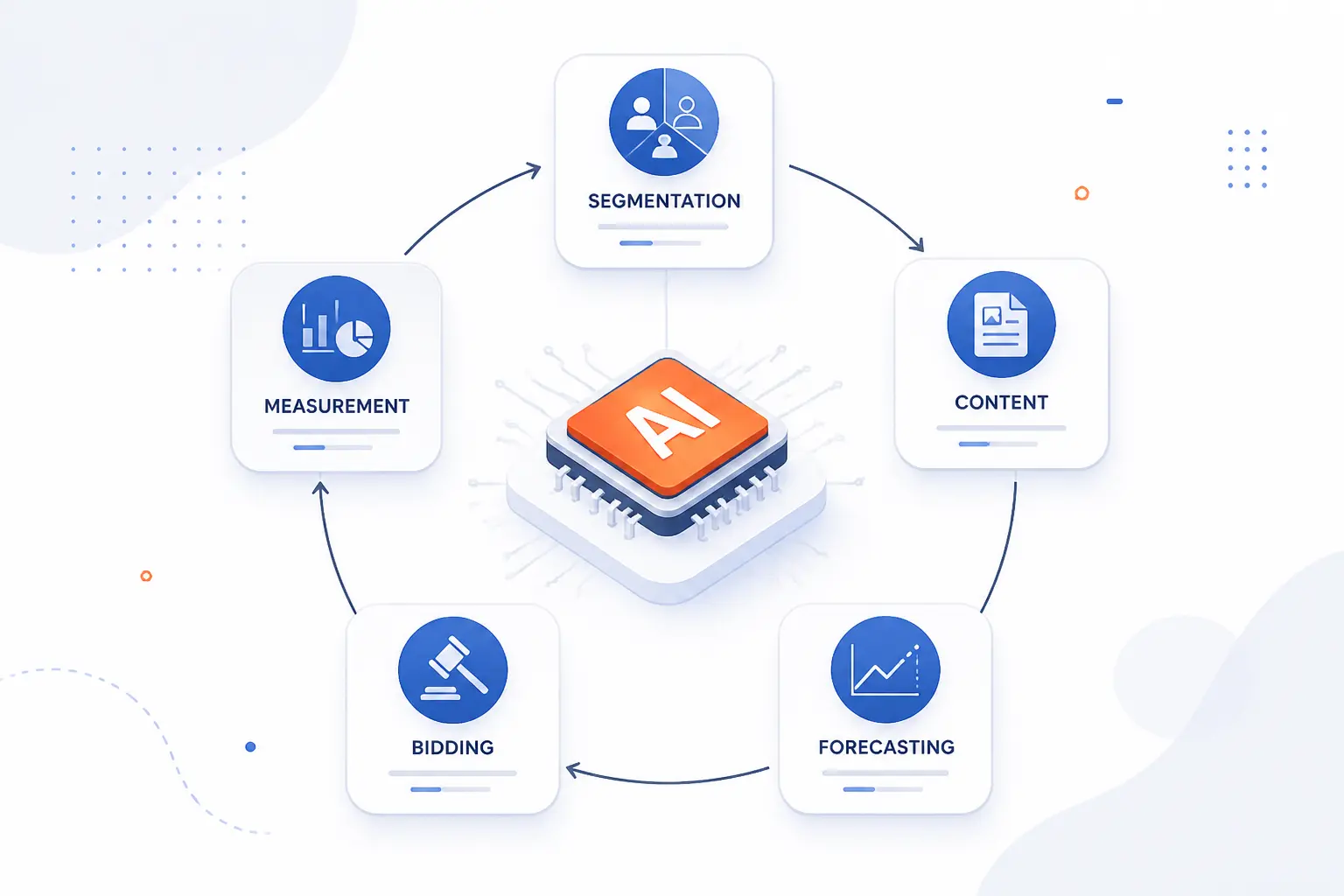
What AI impact on marketing means today is simple: AI is becoming part of the daily operating system for segmentation, content, forecasting, bidding, and measurement. Marketing is one of the first business functions to feel this shift because it already runs on patterns, repetition, testing, and feedback. In a broad enterprise survey, 78% of respondents said their organizations use AI in at least one business function, and marketing and sales ranked among the most common places for generative AI use. We read that as a strong signal that marketing is no longer in the pilot phase alone.
We do not think this means every brand should automate every touchpoint. The deeper meaning is that marketers are becoming system designers. We set the goals, the rules, the review standards, and the thresholds for action. AI helps with speed and pattern detection, but people still own brand judgment, customer empathy, and the hard trade-offs between short-term lifts and long-term trust.
Where AI Changes the Marketing Workflow Most
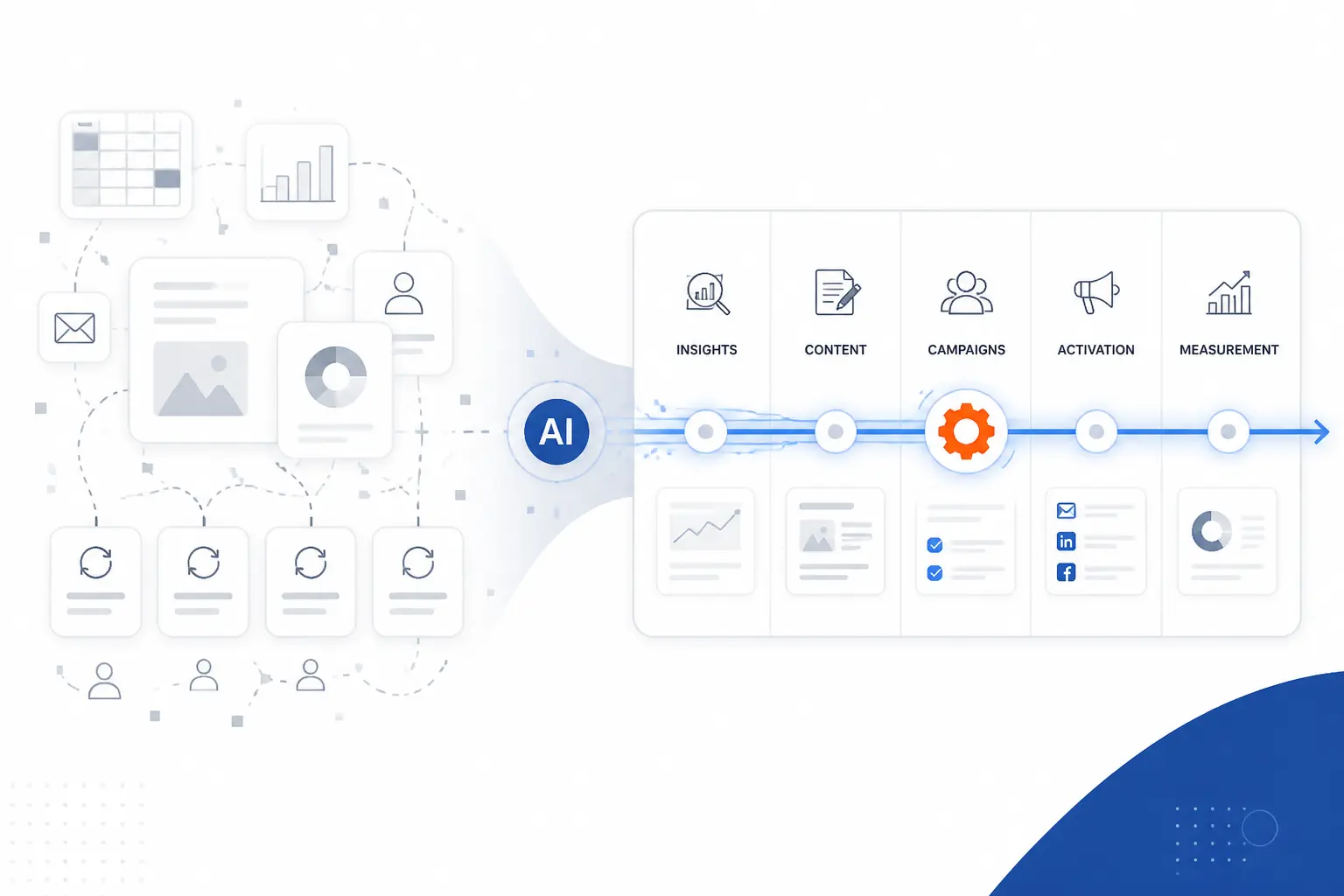
AI changes the marketing workflow most where teams face too much data, too many content variations, or too many repetitive decisions. The biggest gains usually show up in segmentation, personalization, content operations, forecasting, measurement, and paid execution. In one recent CMO survey, only 1 in 6 marketing activities were already automated or enhanced by AI, even though leaders expected much more change ahead. To us, that gap says the hard part is not interest. It is planning.
If we were prioritizing from scratch, we would start where volume is high, decisions repeat often, and results can be measured clearly. That usually means audience work first, then content and optimization, and only then broader orchestration.
Data Analysis and Customer Segmentation
AI improves data analysis first by turning messy behavioral signals into usable segments faster than manual reporting can. Instead of building audiences from a few static rules, teams can spot intent, churn risk, likely value, and timing patterns across far more inputs. We recommend starting with a small set of business-ready segments, such as high-intent prospects, first-time buyers, repeat customers, and likely churners. Give each segment a clear action, a clear owner, and a clear exclusion rule, or you will end up with fancy labels and no campaign logic.
Personalization Across Channels
AI changes personalization by deciding which message, offer, format, or send time is most relevant for a given person or audience slice. That matters across email, websites, ads, chat, and mobile because each channel now produces enough feedback to train better choices. A useful lesson comes from listener controls and recommendation feedback in large recommendation systems, where relevance improves when behavioral signals and explicit preferences work together. We think marketers should copy that logic by combining observed behavior with preference centers, simple feedback tools, and clear opt-down choices.
Content Creation and Curation
Content creation is where AI feels most dramatic, but it works best as a drafting engine, remix tool, and review assistant. It can speed up briefs, outlines, subject lines, product summaries, social variants, localization passes, and content repackaging from one core asset into many formats. Coca-Cola described one early branded initiative as a co-creation experiment, and we think that mindset is the right one. Use AI to widen the first draft and shorten production time, but keep humans in charge of the final taste, the emotional angle, and the parts of the story that make the brand memorable.
Predictive Analytics and Marketing Research
Predictive analytics becomes useful when it changes what you do next, not when it only makes a dashboard look smart. Marketers can already work with signals such as purchase probability and churn probability to decide who should receive a nudge, who should be suppressed, and which journeys need rescue. The same logic helps in research, where AI can cluster open-text feedback, detect recurring objections, and surface demand patterns that deserve follow-up interviews. Our rule is simple: never ask a model for a prediction unless you already know the action that prediction will trigger.
Campaign Measurement and Optimization
AI improves measurement when it helps marketers decide what to change next. It can flag anomalies, detect underperforming audiences, estimate likely outcomes, and help reallocate effort while a campaign is still live. Still, we should not confuse more reporting with better measurement. The strongest setup ties AI-assisted analysis to business metrics like qualified leads, pipeline contribution, repeat purchase, margin, or retention, then uses holdouts, comparison periods, and creative diagnostics to decide whether the system is learning the right lesson.
Email, Conversational, and Programmatic Execution
Execution gets more dynamic when systems can tune bids, placements, send timing, and responses faster than a human queue can. Paid media platforms already use auction-time bidding and contextual signals to adjust decisions at scale, which is powerful when your goals and conversion data are clean. The same pattern shows up in email and chat, where AI can draft variants, route common questions, and trigger follow-ups based on behavior. Our advice is to automate the repetitive move, then place clear guardrails around frequency, brand language, legal review, and escalation to a person.
The Business Value Marketers Can Expect
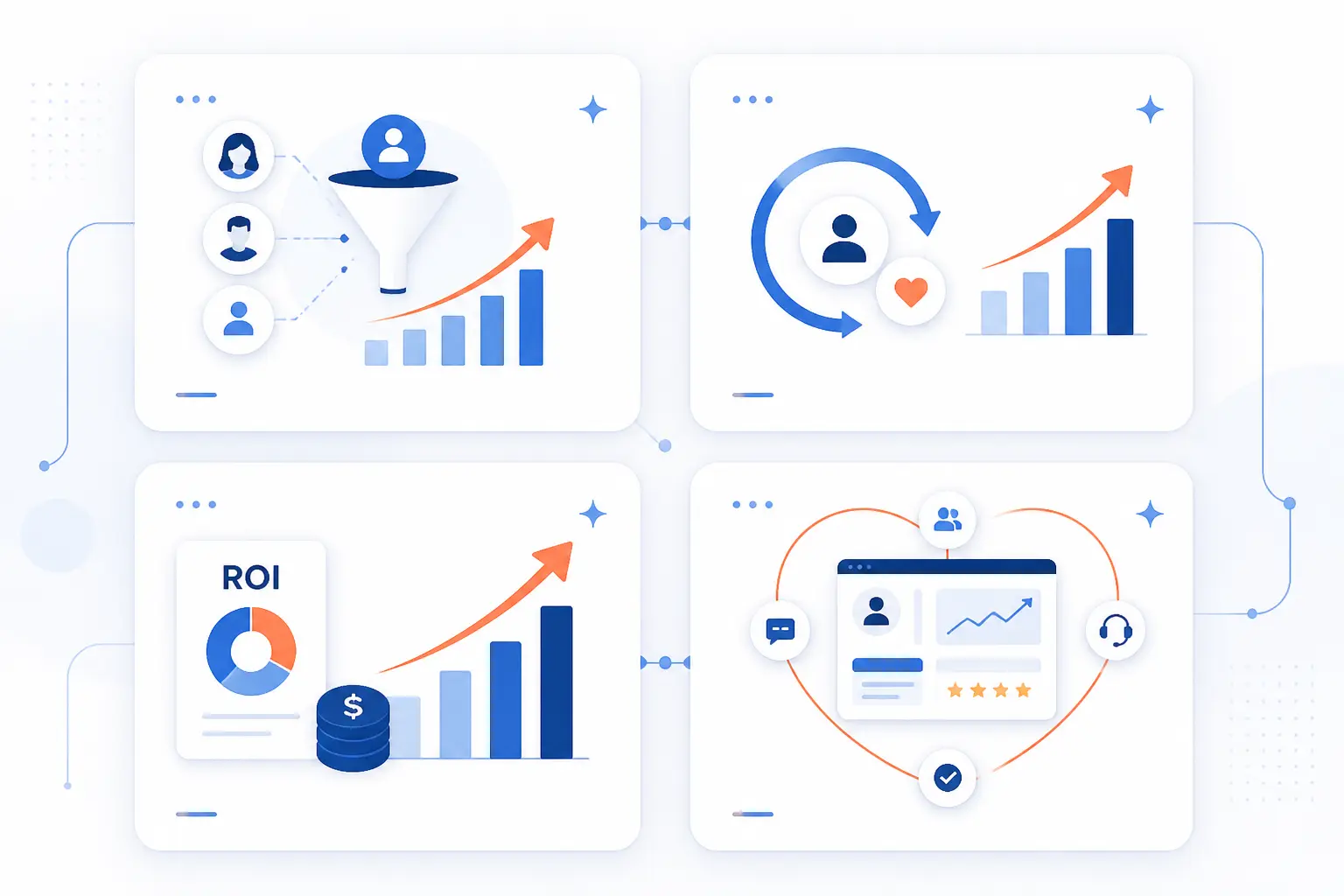
The business value of AI in marketing usually falls into four buckets: stronger acquisition and retention, faster execution, clearer ROI, and customer experiences that can grow without collapsing under manual work. That is the short answer. The longer answer is that these gains only show up when the team has decent data, clear ownership, and a habit of testing. AI does not rescue a confused strategy. It sharpens a sound one.
We have also found that value rarely appears all at once. It starts in one workflow, proves itself, and then spreads into adjacent work. That is why disciplined rollout matters more than flashy demos.
Stronger Customer Acquisition and Retention
AI can improve acquisition and retention by matching messages to intent more precisely. It helps identify who is ready to act, who needs education, and who should not be pushed right now. On the retention side, it can flag drop-off behavior early and trigger win-back or loyalty messages before silence turns permanent. The practical win is not only better targeting. It is better timing.
Faster Execution With Less Manual Work
Faster execution is one of the most immediate benefits because AI removes a lot of repetitive production work. Teams can draft more variants, summarize more research, tag more assets, and move from insight to launch with fewer bottlenecks. We like this benefit most when it creates room for better thinking, not just more output. If a team publishes twice as much but reviews less carefully, speed becomes noise.
Better ROI and Performance Visibility
Better ROI comes from tighter feedback loops, not from automation alone. AI helps marketers see which audiences, offers, and channels are performing early enough to act, which means budget can move before waste compounds. It also makes performance conversations less anecdotal because more decisions are tied to observable signals. In our view, the best ROI stories come from teams that connect AI work to revenue logic from day one.
More Scalable Customer Experiences
AI makes customer experience more scalable by letting one brand system produce many relevant variations. That can mean different homepage modules, product recommendations, onboarding messages, or support prompts for different user states. The key is to scale relevance without making the experience feel synthetic or over-scripted. Customers notice when personalization feels helpful, and they also notice when it feels creepy or lazy.
How to Turn AI Impact on Marketing Into a Working Plan
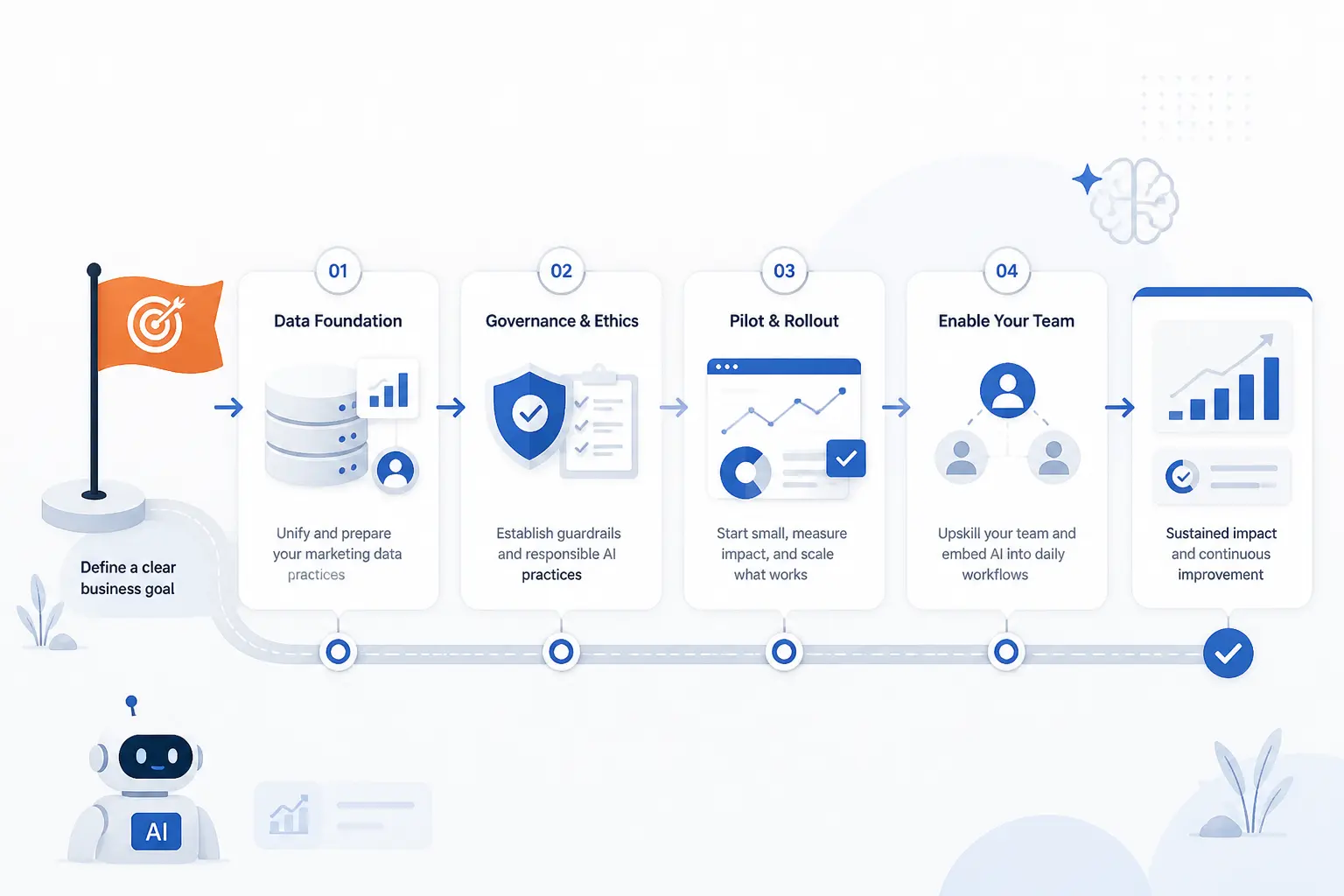
To turn AI impact on marketing into a working plan, start with business outcomes and build outward into data, governance, rollout, and training. That is the most direct answer. We would treat this as an operating change, not a shopping spree for tools. The teams that get value fastest are usually the teams that define one problem clearly, prove one workflow, and only then expand.
If you want a practical mental model, think in this order: goal, data, guardrails, pilot, training, improvement loop. That order keeps the project grounded when the market noise gets loud.
Set Clear Goals Before Choosing Tools
Start by naming the business decision you want AI to improve. Pick one primary outcome, such as lower acquisition cost, higher repeat purchase, faster content turnaround, or better lead qualification. Then define the workflow metric that shows progress, such as response time, campaign build time, or approved asset volume. When goals are fuzzy, every demo looks useful and no deployment stays focused.
Unify and Improve Your Data Foundation
Your data foundation matters more than your prompt library. AI systems need consistent naming, clean event tracking, reliable customer identifiers, and current consent states to make sound recommendations. We suggest fixing the boring stuff early, including duplicate records, broken source tags, missing events, stale audiences, and disconnected reporting. That work is not glamorous, but it is where trustworthy automation begins.
Build Privacy, Ethics, and Transparency In
Privacy, ethics, and transparency must be built into the workflow before AI touches sensitive customer data or public-facing content. That means deciding which data can be used, which actions require approval, what disclosures are needed, and how people can challenge or correct bad outcomes. It also means documenting your rules in plain language. If your team cannot explain an automated decision clearly, you are not ready to scale it.
Start Small and Expand by Workflow
Start with one workflow where the value is visible and the risk is manageable. A good first pilot might be lead scoring, lifecycle email drafting, product content enrichment, or campaign anomaly alerts. Measure results tightly, keep a human reviewer close, and note where the process breaks. Once one workflow becomes stable, expand to the next adjacent one instead of trying to transform the whole department in one jump.
Train Teams to Prompt, Test, and Iterate
Training should focus on judgment, not just tool buttons. Marketers need to know how to frame tasks well, compare outputs, spot weak reasoning, and decide when a model is useful or unsafe. We recommend shared prompt patterns, shared evaluation rubrics, and examples of good and bad outputs from your own brand context. People learn faster when the training looks like the work they actually do every week.
Use Automation and Analytics to Keep Improving
Continuous improvement is what turns a pilot into an operating habit. Build feedback loops that compare human work and model work, track acceptance rates, monitor quality drift, and feed wins and failures back into the system. This is where automation and analytics belong together. One helps act faster, and the other helps decide whether the action was worth repeating.
How AI Changes Marketing Teams and Agency Relationships
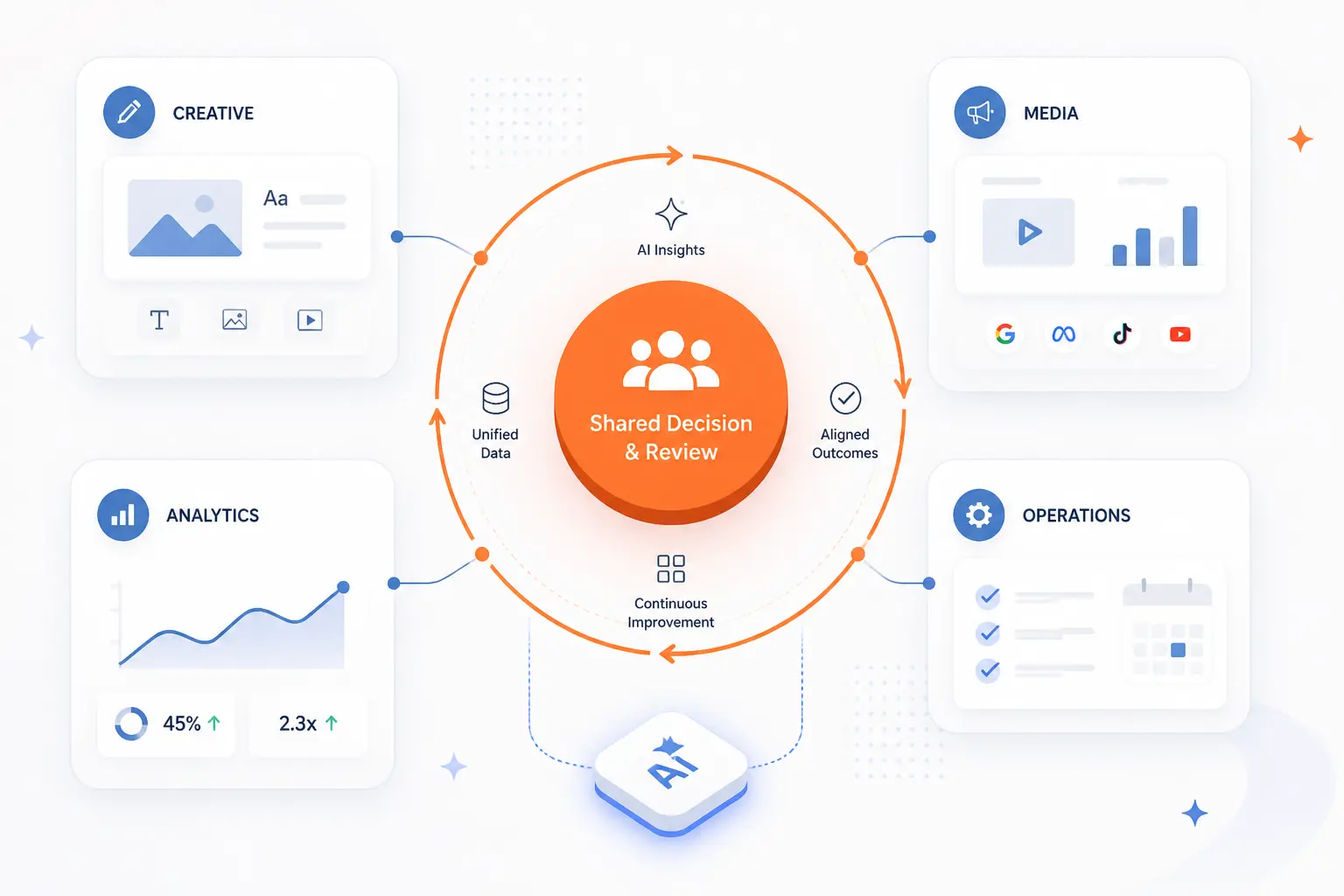
AI changes marketing teams by shifting work away from isolated specialists and toward shared systems, reviews, and business outcomes. That is the practical answer. The important organizational change is not that everyone learns prompts. It is that creative, media, analytics, and operations start working inside one tighter decision loop. Agencies feel the same pull.
We think this is where many AI plans get too shallow. A team may add tools without changing roles, incentives, approval paths, or reporting lines. When that happens, the workflow stays slow even if the model is fast.
Move Beyond One-Off Productivity Gains
One-off productivity gains are nice, but they are not a strategy. If AI only helps one person write faster or edit images quicker, the organization has not really changed. Real progress appears when teams redesign how briefs, approvals, targeting, experimentation, and measurement connect. We should ask how work moves, not only how quickly one step happens.
Redesign Creative and Media Workflows
Creative and media workflows need to be rebuilt together because AI changes both the asset and the distribution logic. Creative teams can produce more variants, while media teams can test and learn from those variants faster than before. That sounds great, but it also means naming ownership for prompts, brand controls, performance thresholds, and final approvals. Without that structure, variant volume quickly outruns quality control.
Align the C-Suite Around Business Outcomes
C-suite alignment matters because AI projects die when they stay trapped in marketing language alone. We need to translate experiments into business outcomes the rest of the company already respects, such as conversion quality, sales efficiency, retention, or margin. That makes budget conversations clearer and prevents AI from being judged only by novelty. In our experience, leadership support gets stronger when the plan reads like operating discipline instead of trend chasing.
Rework Agency Partnerships Around Shared Value
Agency relationships should move from output volume toward shared value creation. Brands should expect partners to help shape testing systems, audience logic, governance, and measurement, not just produce deliverables faster. Agencies, in turn, need better access to approved data, brand rules, and feedback loops if they are going to use AI responsibly. The relationship becomes healthier when both sides are accountable for outcomes and learning, not only activity.
Shift Talent Toward Strategy and Human Judgment
Talent shifts upward when repetitive production becomes easier. That does not mean junior roles disappear overnight. It means the most valuable people are the ones who can frame a problem, interpret weak signals, protect the brand, and make trade-offs under uncertainty. We think AI raises the value of judgment, taste, and commercial context. Those are human muscles worth strengthening now.
Challenges and Risks to Manage

The biggest challenges with AI in marketing are not mysterious. They are bad data, weak governance, privacy mistakes, blind trust in automation, and output that sounds efficient but feels generic. We think the practical response is straightforward: keep humans close to high-impact decisions and keep evidence close to claims. That discipline lowers risk without killing momentum.
Risk management should also be proportional. A subject line draft does not need the same review path as dynamic pricing logic or eligibility targeting. Good governance knows the difference.
Data Privacy, Consent, and Compliance
Privacy risk becomes serious the moment AI touches audience data, behavioral tracking, or personalized decision rules. In the United States, consumers already have the right to opt out of sharing for cross-context behavioral advertising under California privacy rules, along with rights around access, correction, and deletion. That should push every marketing team to map data sources, review consent logic, and stop passing customer information around casually. If you cannot trace where the data came from and why you are using it, the workflow is already too loose.
Bias, Accuracy, and Transparency
Accuracy and fairness should be tested, not assumed. The NIST generative AI profile recommends that teams verify sources and citations, assess bias, and document provenance because models can sound confident while being wrong, incomplete, or uneven across groups. In marketing, that can show up as misleading copy, exclusionary targeting, or false certainty in reporting. We should use review checklists, audience-level testing, and plain-language disclosures where automated content or recommendations meaningfully affect the customer experience.
Skill Gaps and Change Management
Skill gaps can quietly sink a promising rollout. Teams often buy tools before they build the habits needed to evaluate outputs, challenge bad assumptions, and work across functions. Change management matters just as much as technical setup because people need new routines, not only new access. If managers do not reward experimentation, documentation, and careful review, adoption will stay shallow.
Overreliance on Automation
Overreliance on automation happens when convenience replaces judgment. It shows up in autopublished content, unreviewed recommendations, and bidding or messaging systems that keep running long after conditions have changed. We think every automated workflow needs a stop rule, an alert threshold, and an owner with the authority to intervene. Automation should reduce repetitive effort, not suspend responsibility.
Protecting Creativity With Human Oversight
Human oversight protects creativity because AI tends to average toward what already exists. That can be useful for format, structure, and speed, but it rarely creates a bold point of view on its own. Brands still need people to decide what deserves emphasis, what emotional tone fits the moment, and what should stay weird enough to be remembered. If everything becomes statistically safe, the work may perform decently and still be forgotten.
What Is Next for AI in Marketing
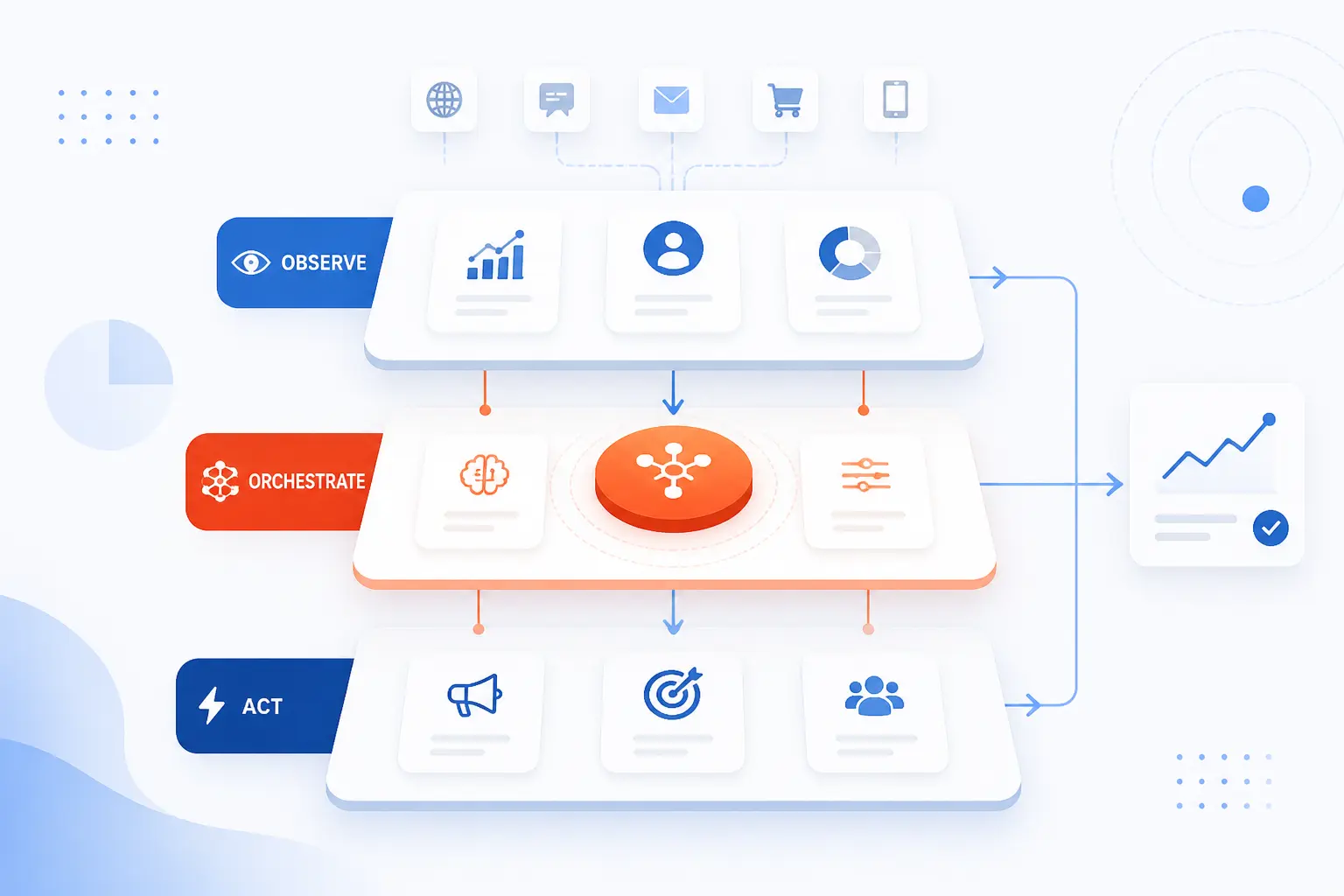
What comes next is a move from isolated tools to connected systems that can observe, recommend, and sometimes act across the whole marketing stack. That is the clearest answer. We expect less obsession with single prompts and more focus on orchestration, approvals, and data flow. The real question will not be whether AI can produce output. It will be whether it can support reliable business action without breaking trust.
That future will reward teams that build steady operating habits now. The tools will keep changing. Sound process will matter longer.
Agentic Systems and Connected Workflows
Agentic systems matter because they move AI from suggestion into supervised action. Instead of only drafting copy or summarizing a report, an agent can pull data, prepare an audience, recommend a campaign change, and wait for approval in one chain. We expect this to reduce handoff friction across analytics, content, CRM, and media platforms. Still, the stronger the agent, the more important approval logic and audit trails become.
Real-Time Engagement and Adaptive Storytelling
Real-time engagement will push brands to adapt messages while the customer journey is still unfolding. That could mean changing homepage modules, send timing, support prompts, or paid creative based on fresh signals rather than weekly reporting cycles. The upside is relevance. The danger is losing narrative consistency if every moment becomes reactive. We think brands should define a stable story first, then let AI adapt the delivery around it.
Responsible Growth as AI Matures
Responsible growth will separate mature teams from noisy ones. The winners will be the teams that can move quickly while proving why a model was used, what data informed it, and how mistakes are caught. That is less glamorous than a flashy launch, but it builds trust inside the company and outside it. In the long run, disciplined use usually beats reckless speed.
FAQ
These are the short answers we think most readers need before they commit budget or time. Each one points back to the same rule: use AI where it improves a decision, not where it only adds motion.
How Does AI Change Marketing Research
AI changes marketing research by helping teams process more evidence faster and test better questions. It can cluster survey comments, summarize interview themes, detect shifts in customer language, and support faster hypothesis building. We still need human researchers to design the study, challenge the patterns, and decide what is truly meaningful.
What Are Common Examples of AI in Marketing
Common examples include audience segmentation, product recommendations, chatbot replies, lead scoring, email optimization, content drafting, ad bidding, and churn prediction. The pattern behind all of them is the same. AI handles repeated decisions and large signal sets better than manual workflows do. People still need to set goals, approve important outputs, and judge quality.
What Are the Biggest Pros and Cons of AI in Marketing
The biggest pros are faster execution, stronger personalization, and clearer optimization opportunities. The biggest cons are privacy mistakes, weak oversight, bland creative, and false confidence in bad outputs. We think the balance stays positive when teams automate low-value repetition and keep human review around customer-facing or high-stakes decisions.
Will AI Replace Human Creativity in Marketing
No, AI will not replace human creativity in marketing. It can expand options, accelerate drafts, and help teams test more ideas, but it does not understand taste, context, or brand meaning the way people do. The best results usually come when humans set the direction and AI helps explore the range.
How 1Byte Supports AI-Ready Marketing Operations
AI-ready marketing operations still depend on dependable web infrastructure, secure customer touchpoints, and room to grow when campaigns work. At 1Byte, we support that foundation through domain registration, SSL certificates, WordPress hosting, shared hosting, cloud hosting, and cloud servers. We are also an AWS Partner, which matters when marketing operations grow from simple publishing into heavier cloud-based workflows. The practical point is simple: smarter marketing still needs stable places to live, load, and convert.
| Service group | Best when | Practical role |
|---|---|---|
| Domain registration and SSL certificates | You need trusted campaign destinations | Secure branded pages, forms, and customer entry points |
| WordPress hosting and shared hosting | You need to publish quickly and often | Support blogs, landing pages, and content operations |
| Cloud hosting and cloud servers | You expect heavier traffic or custom workflows | Support performance-sensitive sites and integrated stacks |
Build a Secure Brand Foundation With Domain Registration and SSL Certificates
A secure brand foundation starts with the basics customers actually notice. Domain registration gives your campaigns a clear branded home, and SSL certificates help protect the traffic, forms, and trust that flow through it. When AI helps attract more visitors or personalize more landing pages, those pages still need to look credible and handle customer data responsibly. We see this layer as the front door of AI-ready marketing operations.
Publish and Grow Faster With WordPress Hosting and Shared Hosting
Fast publishing matters because AI often increases how much content a team can produce and test. WordPress hosting and shared hosting give marketers a practical base for articles, landing pages, campaign updates, and iterative experiments without overcomplicating the stack. If your near-term goal is to publish more, test faster, and keep content organized, this is usually the right place to start. Good marketing systems still need an orderly publishing engine.
Scale Traffic and Performance With Cloud Hosting and Cloud Servers
Cloud hosting and cloud servers matter when marketing work becomes more performance-sensitive or more custom. Higher traffic, richer applications, and more connected workflows put pressure on infrastructure quickly, especially when campaigns, analytics, and customer experiences all depend on responsiveness. As an AWS Partner, we understand the practical link between growth in demand and the need for cloud-based architecture decisions. That makes this layer especially relevant when AI-driven marketing starts generating real volume.







Conclusion
The AI impact on marketing is not a future concept anymore. It is already changing how teams analyze audiences, create content, run campaigns, and prove value. The smartest move is not to automate everything. It is to choose one workflow where better decisions, better speed, and better measurement can reinforce each other.
If we were advising a team to start this week, we would pick one use case, define one business metric, clean the data behind it, and set one human review loop. That is enough to learn something real. Which part of your marketing workflow is ready for that first serious test?