

- An IPsec VPN Is a Secure, Encrypted IP Tunnel
- Why It Matters on Public Networks
- How IPsec Protects Traffic Step by Step
- The Protocols That Make IPsec Work
- Tunnel Mode vs Transport Mode
- Common IPsec VPN Topologies and Use Cases
- Operational Details That Affect Deployment
- IPsec VPN vs SSL VPN
- FAQ
- How 1Byte Supports Secure Website and Cloud Infrastructure
- Conclusion
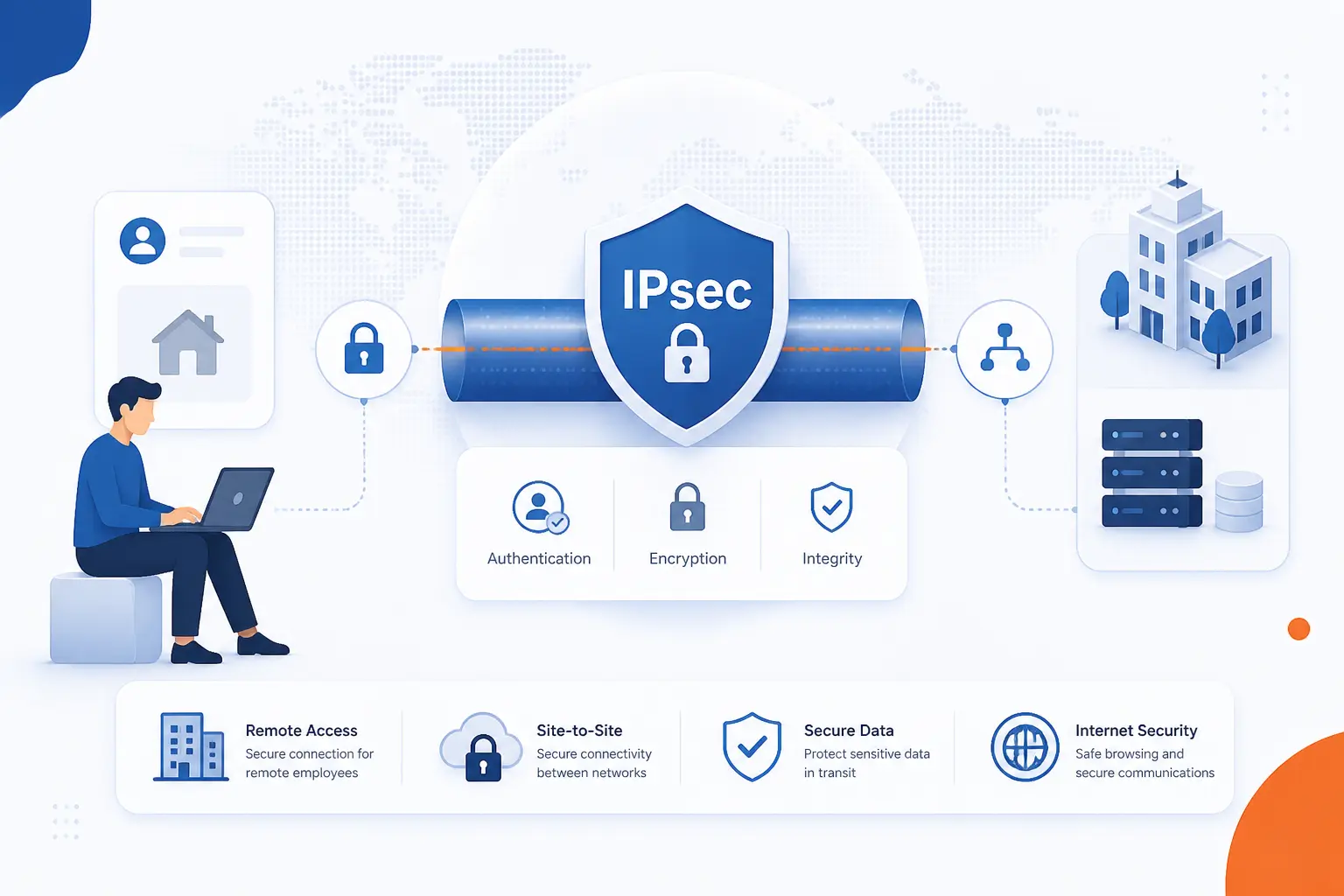
An IPsec VPN is a secure network connection that encrypts IP traffic between two endpoints, such as a user device and an office network, or one business network and another. It works by wrapping packets in security controls, checking that the sender is trusted, and hiding the packet contents from anyone watching the path. We like it because it protects traffic at the network layer, where entire subnets and many applications can be covered at once. That makes an IPsec VPN especially useful for branch offices, cloud networks, remote workers, and private links across the public internet.
At 1Byte, we see IPsec as plumbing rather than decoration. It is not the flashy part of infrastructure, but when it is designed well, everything above it feels safer and more predictable. The key is understanding what the tunnel protects, how the negotiation works, and where the operational traps sit.
An IPsec VPN Is a Secure, Encrypted IP Tunnel
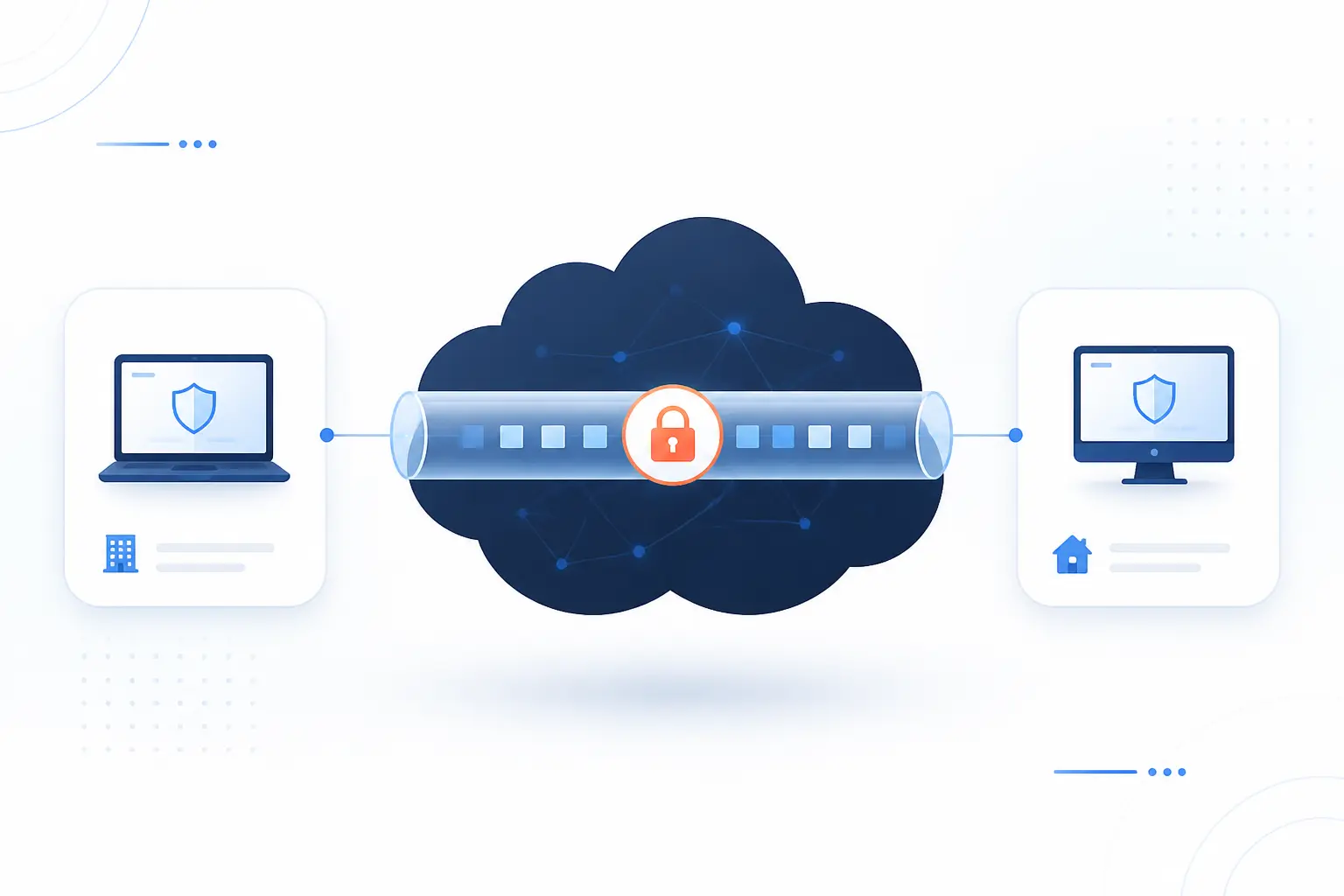
An IPsec VPN is a virtual private network that uses the IPsec protocol suite to protect IP packets as they travel across an untrusted network. In simple terms, it builds an encrypted tunnel between endpoints and sends private traffic through that tunnel. The “IP” part matters because protection happens around IP packets, not just around one browser session or one application. The core architecture is standardized in RFC 4301, which describes security services for traffic at the IP layer in both IPv4 and IPv6 environments.
The tunnel can connect two routers, two firewalls, two servers, or a client device and a gateway. In a site-to-site setup, for example, a company might connect its office network to a cloud VPC so private database, file, or monitoring traffic can cross the internet safely. In a remote access setup, a laptop can receive access to internal subnets as if it were closer to the private network.
We think of IPsec as a disciplined packet handler. It does not ask whether the application is a web app, mail server, database, or backup tool. If the traffic matches the policy, IPsec can protect it. That broad coverage is powerful, but it also means configuration must be precise.
FURTHER READING: |
| 1. What Is an Internet Exchange Point and How It Works |
| 2. What Is DNS Filtering and Why Does It Matter |
| 3. What Is a Local Area Network and How It Works |
Why It Matters on Public Networks
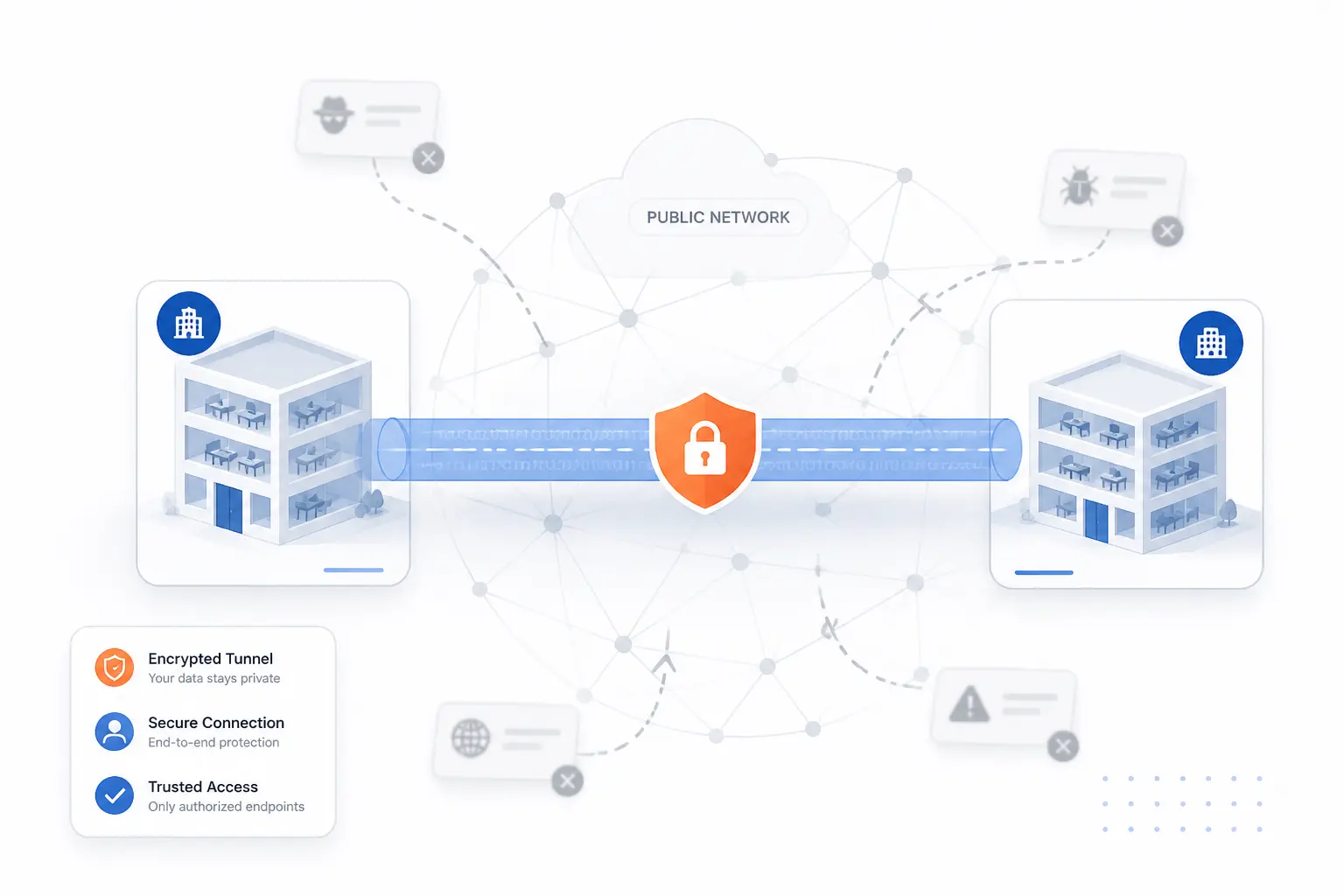
IPsec matters on public networks because the internet was built to route packets, not to keep every packet private by default. A tunnel reduces the risk that outsiders can read traffic, alter it unnoticed, or impersonate a trusted endpoint. It also gives organizations a practical way to connect private systems without leasing a dedicated physical circuit. For us, the biggest value is that IPsec lets teams extend private routing across infrastructure they do not own.
Keeping Traffic Private Across Shared Infrastructure
IPsec keeps traffic private by encrypting packet contents before they cross networks controlled by third parties. That is the heart of the design. If a packet travels through an ISP, public Wi-Fi provider, transit carrier, or cloud edge, the intermediate network should only see protected traffic and routing information.
Consider a retail company with stores in several cities. Each store may need to send inventory updates to a central application. Without encryption, sensitive operational data could cross shared links in readable form if another protection layer is missing. With IPsec, the store firewall and the central gateway can create a private tunnel over the internet.
This does not remove every risk. Endpoint security, routing policy, identity controls, and logging still matter. But encryption at the packet path closes a major gap, especially for older internal protocols that were never designed for direct exposure.
Authenticating Senders and Protecting Data Integrity
IPsec verifies that protected packets come from the expected peer and have not been changed in transit. Privacy alone is not enough. If an attacker can inject or modify packets, encrypted traffic can still become dangerous.
This is where authentication and integrity checks come in. The receiving endpoint checks cryptographic values tied to the packet and the negotiated security settings. If the packet fails the check, it is discarded instead of passed to the protected network.
We consider this part underrated. Many beginners focus on encryption because it sounds dramatic. In real operations, knowing that traffic is from the correct peer is just as important as hiding the content.
Supporting Remote Access to Internal Resources
IPsec can give remote users and devices controlled access to internal network resources. A remote laptop may need to reach a private Git server, database admin tool, internal dashboard, or file share. The tunnel gives that traffic a protected path back into the organization.
This model is useful when many internal applications use different protocols. Instead of creating separate secure access patterns for every tool, the network can route selected traffic through one protected tunnel. That said, we prefer pairing remote access with strong identity checks and narrow authorization.
A VPN should not become a master key. The better pattern is to allow only the subnets and ports the user or device truly needs.
How IPsec Protects Traffic Step by Step
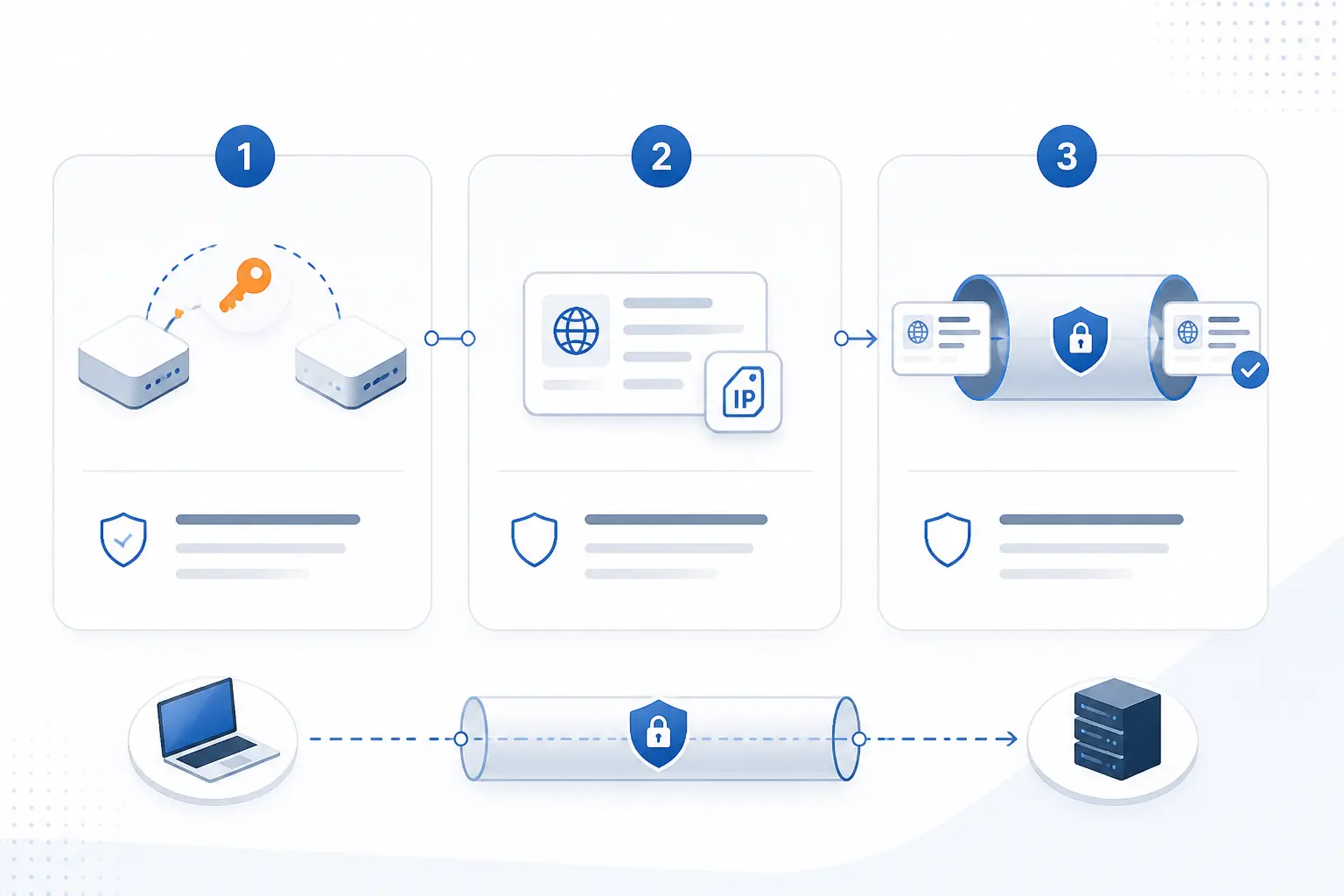
IPsec protects traffic by first agreeing on security settings, then marking packets for protection, then encrypting and validating them as they move. The process looks complex because several pieces cooperate behind the scenes. For beginners, it helps to separate negotiation from packet handling. The first part creates trust, and the second part applies that trust to live traffic.
- The endpoints authenticate each other and agree on algorithms, keys, and lifetimes.
- They create Security Associations, which define how traffic will be protected.
- Matching packets are wrapped with IPsec headers, trailers, or both.
- The sender encrypts and signs the protected traffic according to policy.
- The receiver validates, decrypts, and forwards the original traffic.
Key Exchange and Security Associations
Key exchange creates the shared security rules that both VPN endpoints will use. The usual mechanism is IKE, especially IKEv2 in modern deployments. IKE authenticates peers, negotiates algorithms, and establishes Security Associations.
A Security Association is a one-way agreement for protecting traffic. In practice, bidirectional communication uses matching state in both directions. That state includes items such as encryption choices, integrity algorithms, keys, lifetimes, and identifiers for the protected flow.
The IKEv2 specification describes the protocol as a component used for mutual authentication and for establishing and maintaining Security Associations in the Internet Standard. If that negotiation fails, the tunnel does not carry protected traffic. When it succeeds, packet processing can begin.
Adding Headers and Trailers to Each Packet
IPsec adds protocol data around packets so the receiver knows how to verify and process them. The exact wrapping depends on whether the deployment uses AH, ESP, transport mode, or tunnel mode. Most practical VPN deployments use ESP, especially when confidentiality is required.
In tunnel mode, IPsec places the original IP packet inside a new outer packet. The outer header helps the packet travel between VPN gateways. The inner packet remains the private traffic that the gateways protect.
In transport mode, IPsec protects the payload of the original IP packet while keeping the original IP header visible. That makes it more suitable for host-to-host cases where both endpoints themselves participate in IPsec.
Encrypting, Authenticating, and Delivering Traffic
The sender encrypts and authenticates matching traffic, while the receiver checks and unwraps it before delivery. If the packet passes validation, the receiver decrypts it and forwards the original data to the destination. If validation fails, the packet should be dropped.
This process happens packet by packet. That is why CPU capacity, hardware acceleration, packet size, and algorithm choices can affect performance. A small office tunnel may run comfortably on modest hardware, while a busy data replication link may require careful sizing.
Our practical view is simple: test with real traffic before declaring success. A tunnel that passes a ping may still struggle with large transfers, voice traffic, or fragmented packets.
The Protocols That Make IPsec Work
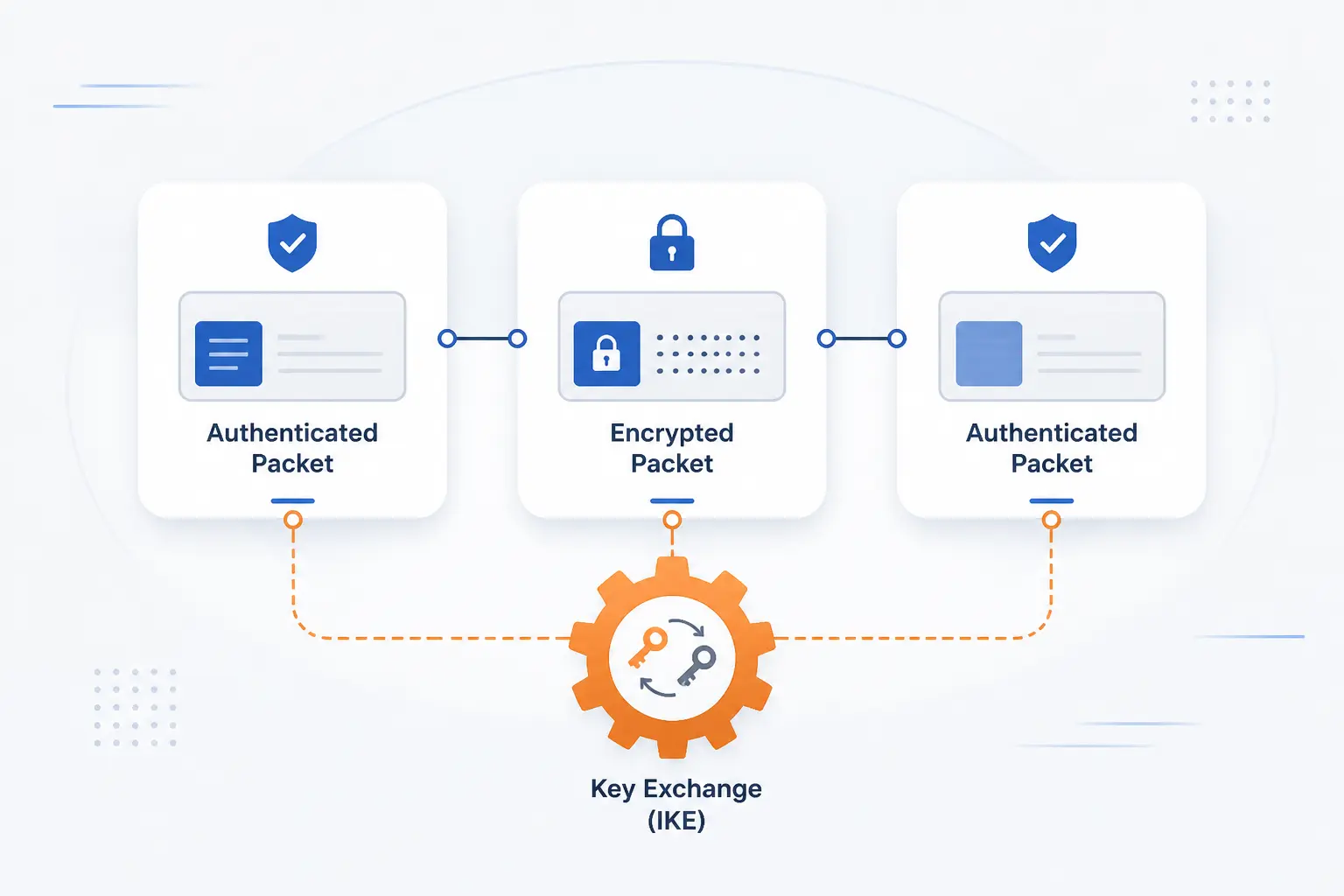
IPsec works through a small set of cooperating protocols, each with a specific job. AH focuses on authentication and integrity. ESP adds confidentiality and is the common choice for encrypted VPN tunnels. IKE handles negotiation, authentication, and key management before protected traffic flows.
| Protocol | Main role | Typical use |
|---|---|---|
| AH | Authenticates packets and checks integrity | Special cases where encryption is not needed |
| ESP | Encrypts and can authenticate protected traffic | Most encrypted tunnel deployments |
| IKE | Negotiates trust, keys, and security rules | Automatic tunnel setup and rekeying |
Authentication Header
Authentication Header proves packet origin and integrity, but it does not encrypt the packet payload. AH is designed to provide connectionless integrity, data origin authentication, and anti-replay protection. Its official format uses protocol value 51 in the preceding IP header field.
AH can be useful when tamper detection matters more than secrecy. Still, we rarely see it as the first choice for business VPNs because most teams also want confidentiality. Another issue is NAT, which can modify IP header fields that AH may cover.
That NAT behavior can break validation. For many real-world internet paths, ESP with NAT traversal is easier to operate.
Encapsulating Security Payload
Encapsulating Security Payload is the IPsec workhorse because it can encrypt traffic and also protect integrity. ESP can provide confidentiality, data origin authentication, connectionless integrity, anti-replay service, and limited traffic flow confidentiality depending on how it is configured. The RFC describes ESP with protocol value 50 for protected packets.
ESP is what most people mean when they talk about an encrypted IPsec tunnel. In tunnel mode, ESP can hide the original packet’s source, destination, and payload inside the outer packet. That is useful when two private networks need to talk across a public path.
We usually recommend starting design discussions around ESP. AH has a place, but ESP aligns better with the practical need to keep business traffic private.
IKE and ISAKMP
IKE negotiates the secure relationship that IPsec uses to protect traffic. ISAKMP is historically associated with the framework for security association and key management, while IKE became the practical protocol used to do the negotiation. In modern planning, most teams focus on IKEv2 settings.
IKE reduces the need to manually configure keys on both sides. It can authenticate peers with pre-shared keys or certificates, agree on cryptographic proposals, and refresh keys during the tunnel lifetime. That automatic rekeying matters because long-lived static keys are a poor security habit.
Misaligned IKE settings are a common cause of tunnel failures. If one side allows a different encryption algorithm, Diffie-Hellman group, lifetime, or identity value, negotiation can fail before data ever moves.
Tunnel Mode vs Transport Mode
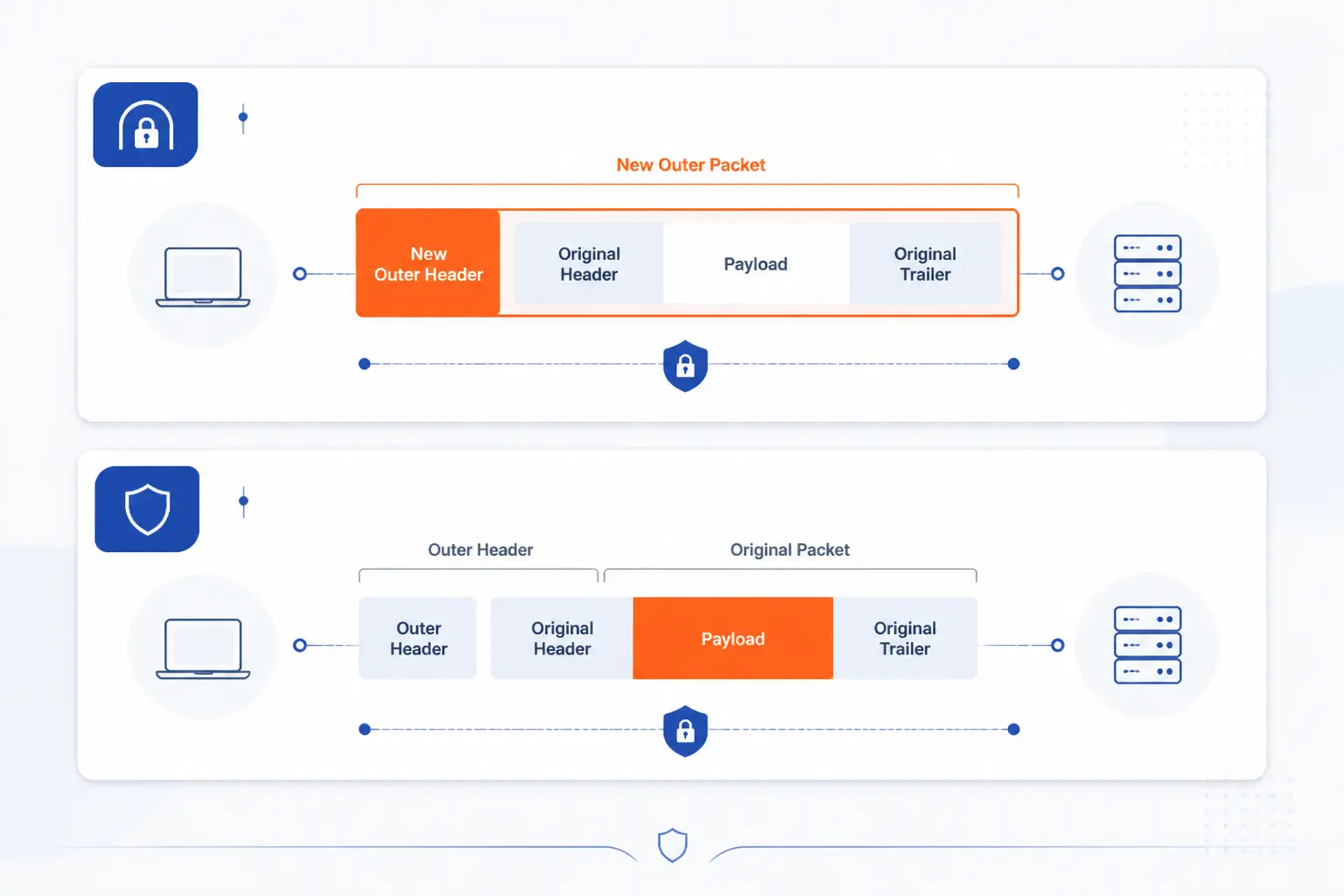
Tunnel mode and transport mode differ in how much of the original packet they protect and how the protected packet is routed. Tunnel mode wraps the whole original packet inside a new outer packet. Transport mode protects the payload while keeping the original IP header in place. For VPNs between networks, tunnel mode is usually the natural fit.
| Mode | What it protects | Best fit |
|---|---|---|
| Tunnel mode | The entire original IP packet | Gateway-to-gateway and remote access links |
| Transport mode | The payload of the original packet | Host-to-host protection |
Tunnel Mode for Gateway-to-Gateway Traffic
Tunnel mode is best for connecting networks through security gateways. A branch firewall can protect traffic from a local subnet and send it to a cloud gateway. The hosts behind each gateway do not need to run IPsec themselves.
This model is common because it maps cleanly to routing. The local gateway knows which remote subnets should go through the tunnel. The remote gateway does the same in reverse.
Tunnel mode also hides the inner addresses from the public path. The internet still needs outer source and destination addresses, but the private packet remains inside the protected envelope.
Transport Mode for Host-to-Host Communication
Transport mode is best when the two communicating hosts are the IPsec endpoints. It protects the packet payload while leaving the original IP header available for routing. That makes it less suitable for typical branch-to-cloud private network designs.
Transport mode can make sense for server-to-server security where both systems are managed closely. For example, two infrastructure hosts might use it to protect a specific flow across a controlled network. The operational burden is that every participating host needs correct IPsec policy.
We prefer transport mode only when the architecture truly calls for host-level protection. Otherwise, tunnel mode is usually simpler to reason about.
Common IPsec VPN Topologies and Use Cases
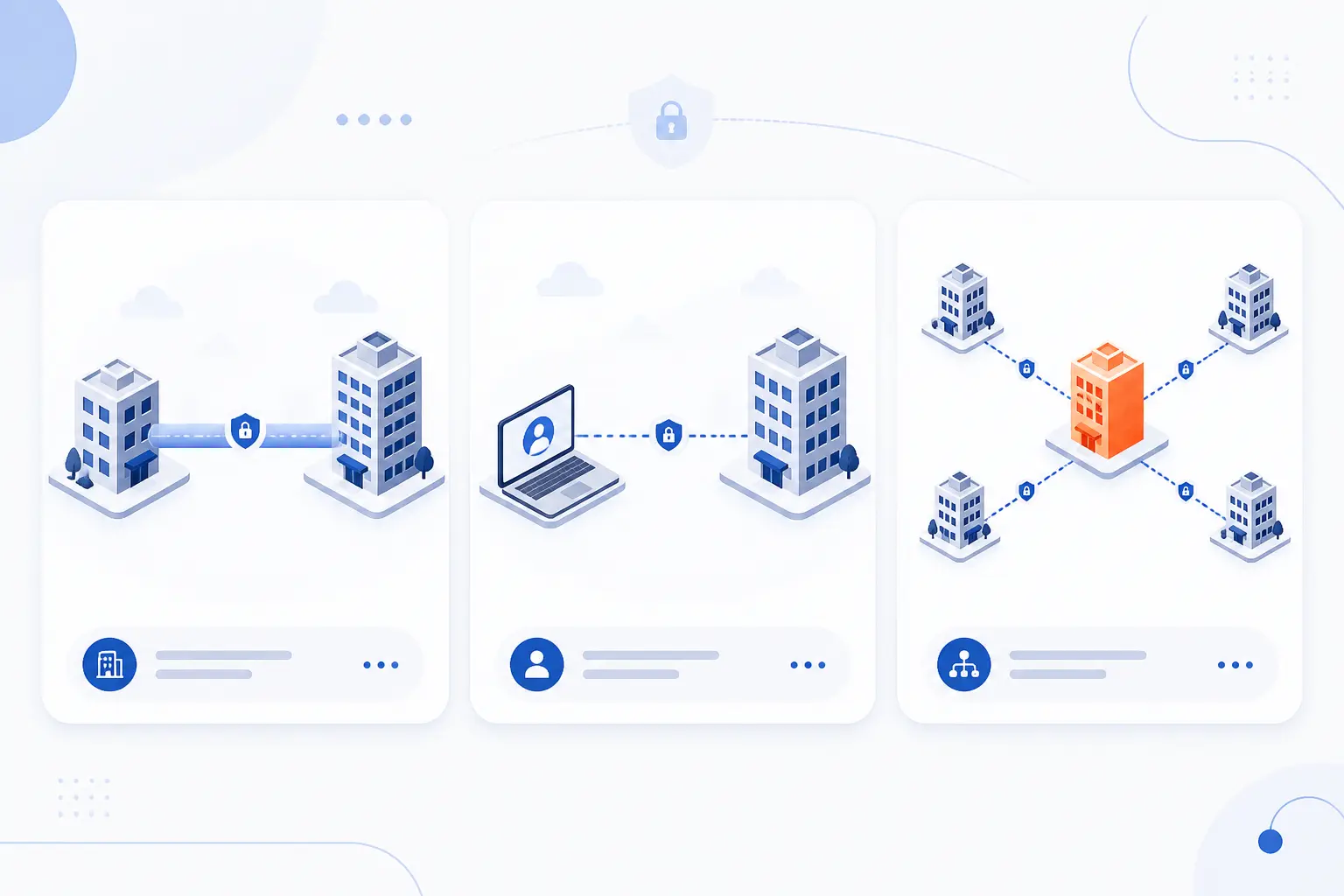
Common IPsec designs include site-to-site tunnels, remote access tunnels, and hub-and-spoke branch networks. Each topology answers a different question. Do we need to connect whole networks, individual users, or many branches through a central point? The right choice depends on routing, trust boundaries, and how much management effort the team can handle.
| Topology | Best for | Main planning concern |
|---|---|---|
| Site-to-site | Office, data center, or cloud network links | Subnet design and routing |
| Remote access | Users and managed devices | Identity, device posture, and permissions |
| Hub-and-spoke | Many branch networks | Route scale and central gateway capacity |
Site-to-Site Connections
Site-to-site connections link one private network to another private network through gateways. This is the classic IPsec design for offices, data centers, and cloud VPCs. The tunnel carries selected subnets between both sides.
A real-world cloud example is AWS Site-to-Site VPN. The service documentation states that it supports IPsec connections and that each connection includes two VPN tunnels that can be used for high availability. That pattern shows why IPsec remains practical for hybrid infrastructure.
The main planning task is address design. If both sites use overlapping private ranges, routing becomes messy fast. We always want clean CIDR planning before the first tunnel is built.
Remote Access for Users and Devices
Remote access connections let individual users or devices reach private resources over a protected tunnel. This is useful for administrators, traveling staff, contractors, or managed endpoints that need internal access. The tunnel usually terminates at a VPN gateway, firewall, or remote access appliance.
Remote access needs stricter policy than many teams expect. A user who connects from a home network should not automatically receive broad access to every internal subnet. Strong authentication, endpoint controls, and least-privilege routing keep the tunnel from becoming too generous.
We also like split design thinking here. Some traffic may need the tunnel, while ordinary internet browsing may not. The choice should follow risk and compliance needs, not habit.
Hub-and-Spoke Designs for Branch Networks
Hub-and-spoke designs connect many branch tunnels to a central gateway or cloud transit point. Each branch is a spoke, and the hub controls routing between shared services and remote locations. This can be cleaner than building a full mesh between every branch.
The tradeoff is concentration. If the hub is poorly sized or poorly monitored, many sites feel the pain at once. Routing tables, tunnel counts, failover behavior, and logging all become central design concerns.
For growing networks, we usually suggest documenting a repeatable branch template. Consistent encryption proposals, route naming, tunnel monitoring, and change control save headaches later.
Operational Details That Affect Deployment
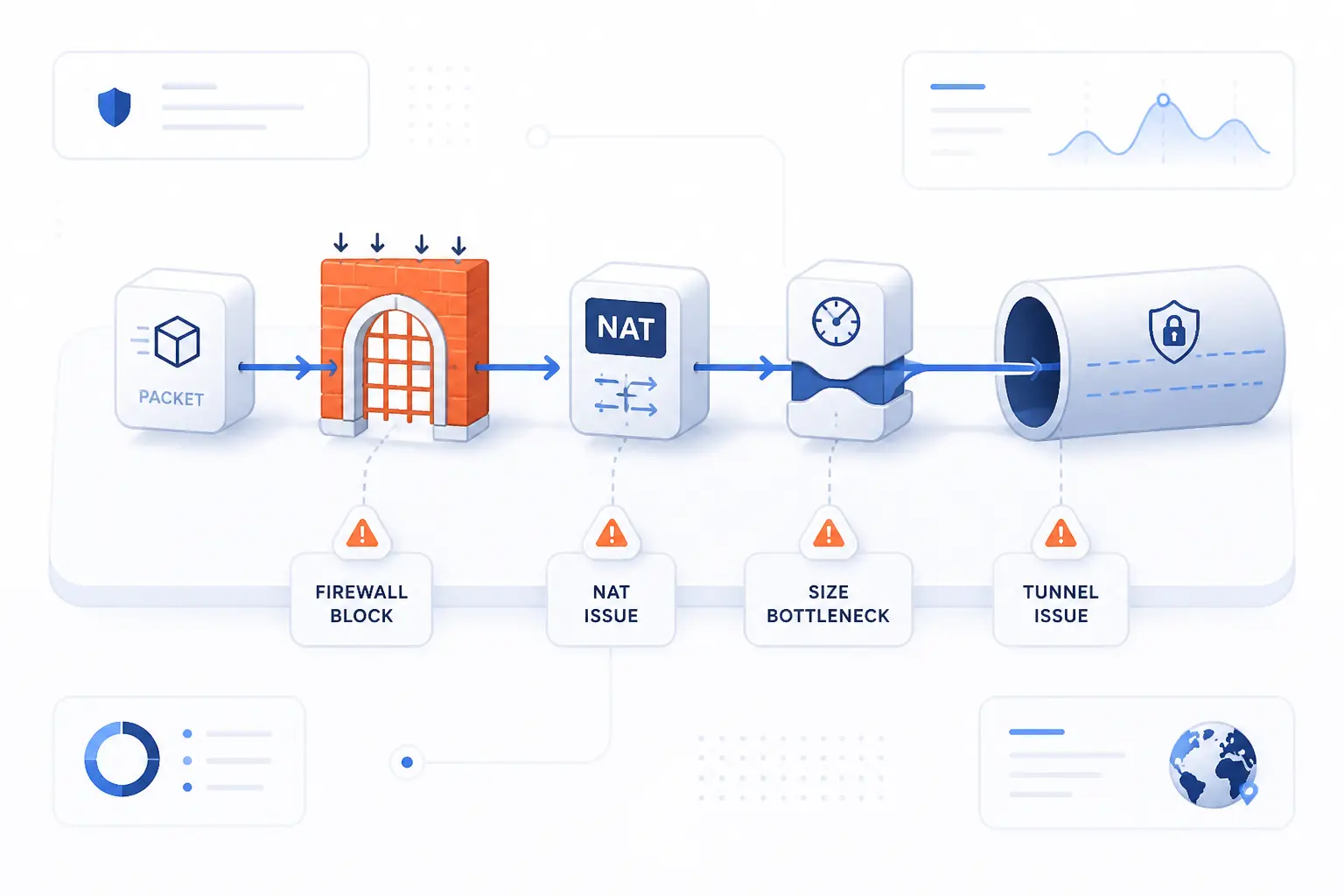
IPsec deployment succeeds or fails in the details: ports, NAT behavior, packet size, routing, and tunnel management. The protocol can be solid while the implementation still feels fragile. Firewalls may block negotiation, NAT may interfere with packet validation, and oversized packets may disappear in awkward ways. We treat IPsec as both a security project and a network engineering project.
Ports, UDP Transport, and Firewall Traversal
IPsec needs the right traffic allowed through firewalls before negotiation and protected data can work. IKE commonly starts on UDP 500, and NAT traversal commonly carries protected ESP traffic over UDP 4500. The UDP encapsulation behavior for ESP is specified in the traversal standard.
This matters because many networks are friendly to TCP and HTTPS but suspicious of unfamiliar protocols. If the path blocks the required traffic, both sides may look correctly configured while the tunnel never comes up. Logs on both endpoints are your friend here.
We prefer testing from both directions when possible. A tunnel problem is often a middlebox problem, not a cryptography problem.
AH, ESP, and NAT Compatibility
NAT compatibility is one reason ESP is far more common than AH for internet-facing tunnels. NAT changes address or port information as traffic crosses a boundary. AH can fail because its integrity coverage may include fields that NAT changes.
ESP handles this better when NAT traversal is available. Instead of sending raw ESP in a way that some NAT devices cannot track, the protected traffic can be encapsulated in UDP. That gives common firewalls and routers a more familiar flow to maintain.
Our rule of thumb is blunt: if the tunnel crosses consumer routers, ISP equipment, or cloud edge devices, plan for NAT traversal early. Do not treat it as a last-minute checkbox.
Packet Overhead, MSS, and MTU Changes
IPsec adds overhead, so packet size must be planned to avoid fragmentation and black-hole behavior. Encryption headers, trailers, padding, and outer IP headers make protected packets larger than the original packets. If the resulting packet exceeds the path MTU, performance can suffer or traffic can fail.
TCP MSS clamping is a common fix. It lowers the maximum segment size for TCP sessions so packets fit after IPsec encapsulation. For UDP-heavy applications, testing matters even more because there is no TCP MSS negotiation to rescue the flow.
This is one of those problems that hides until real users arrive. A login page may load, but file uploads, backups, or database replication may stall. We would rather measure early than troubleshoot at midnight.
Scaling Tunnel Management Across Many Sites
Scaling IPsec means standardizing policies, routing, monitoring, and lifecycle management across many tunnels. A handful of tunnels can be managed by careful administrators. Dozens or hundreds require templates, naming rules, inventory, and alerting.
Key rotation and certificate renewal also become operational issues. If every site uses unique settings with no documentation, a simple rekey event can turn into an outage. Consistency is security’s quiet companion.
We recommend keeping a tunnel register that records peers, protected subnets, proposals, lifetimes, owners, and change history. It is not glamorous work. It is the kind of work that keeps production calm.
IPsec VPN vs SSL VPN
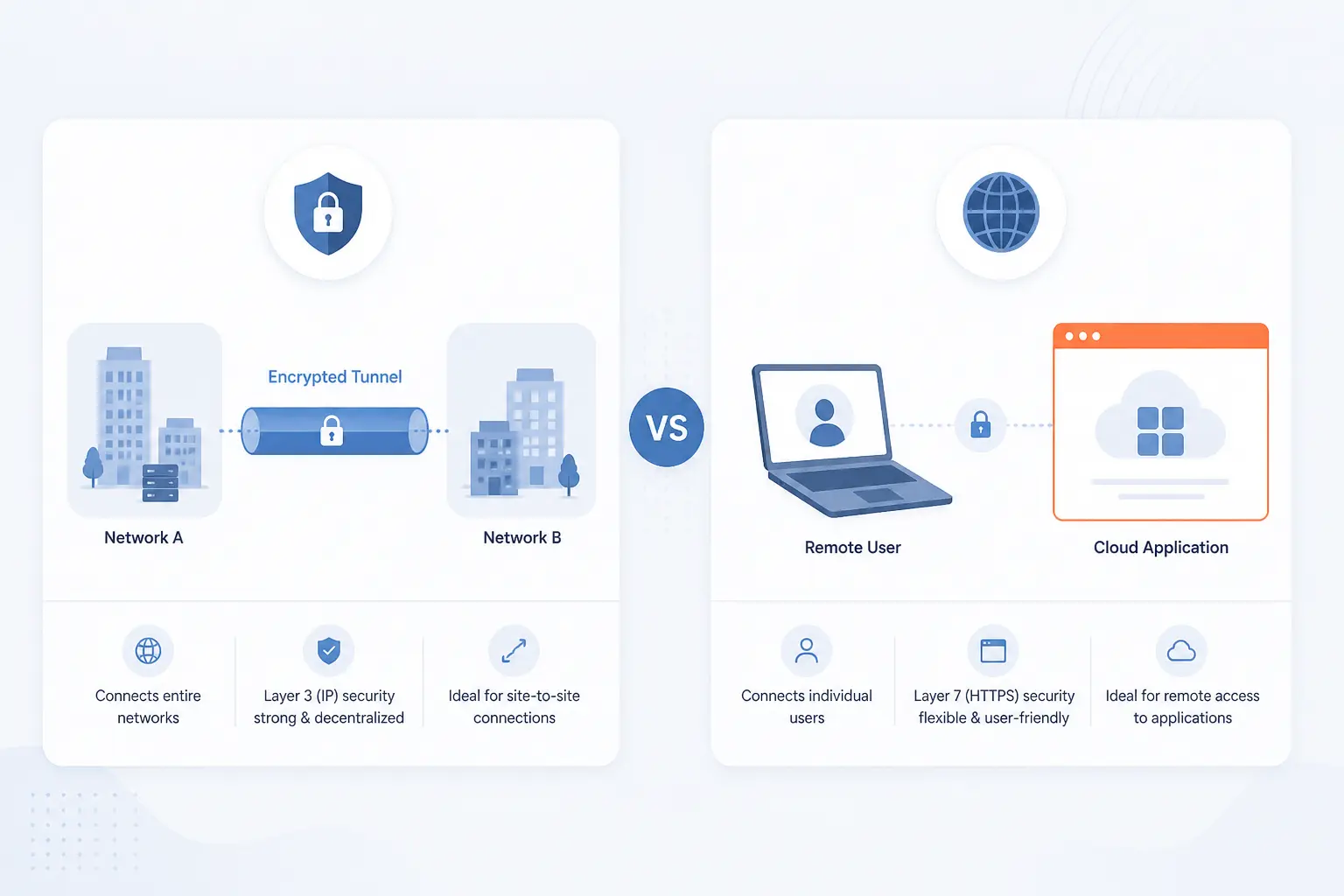
IPsec VPN and SSL VPN differ mainly by where they protect traffic and how users connect. IPsec protects at the IP layer and is strong for whole-network access. SSL VPNs usually use browser or TLS-based access patterns and can be easier for user-facing remote access. NIST’s SSL guidance notes that browser-based access can reduce special client configuration in some deployments, as explained in the remote-access guide.
| Option | Typical protection scope | Best fit |
|---|---|---|
| IPsec | Network-layer packets and subnets | Site links and full private routing |
| SSL VPN | Application or session-oriented access | Browser-friendly remote access |
Which Network Layer Each One Protects
IPsec protects traffic at the network layer, while SSL VPNs usually protect higher-layer sessions through TLS-based mechanisms. That difference shapes everything else. IPsec can carry many protocols through a private route, while SSL VPNs often focus on user access to specific applications or portals.
Neither model is automatically better. They solve different problems. If we need to connect a branch subnet to a cloud subnet, IPsec is usually the cleaner fit. If we need temporary browser access to a web application, SSL-style access may be simpler.
Beginners often compare them as if they are rival products. We see them as different tools in the same security toolbox.
When IPsec Is Better for Whole-Network Access
IPsec is better when you need private routing between networks, not just access to one application. It is well suited for cloud migration, branch offices, partner networks, backup replication, and private administrative access. The tunnel can carry many protocols without redesigning every application.
This strength can become a weakness if policy is too broad. A whole-network tunnel must be narrowed with routes, firewall rules, segmentation, and logging. Otherwise, one compromised endpoint may have more reach than intended.
Our preference is to design the network map first. Decide which subnet talks to which subnet, then build the tunnel around that map.
When SSL VPN Is Easier to Roll Out
SSL VPN is often easier when users need browser-friendly access and the organization wants less endpoint configuration. A portal can present approved resources after user authentication. That experience is easier for many nontechnical users than managing a full network tunnel.
SSL-style access can also fit contractors or bring-your-own-device scenarios where full private routing would be too risky. The gateway can expose a narrower set of applications rather than opening broad subnet access. That reduces blast radius when designed well.
Still, SSL VPNs are not magic. They need patching, strong authentication, careful authorization, and monitoring just like IPsec gateways.
FAQ
This FAQ answers the questions we hear most often from readers who are new to IPsec. The short version is that IPsec is still widely relevant, but it must be matched to the right access model. It is excellent for private network links and controlled routing. It is less ideal when the real goal is per-application access for many unmanaged users.
What Is the Difference Between VPN and IPsec VPN
A VPN is the broad idea of a private connection over another network, while an IPsec VPN is a VPN built with the IPsec protocol suite. Other VPNs may use TLS, WireGuard, proprietary protocols, or application-layer gateways. If someone says “VPN” without detail, we always ask which protocol and access model they mean.
What Are the Main Drawbacks of IPsec
The main drawbacks of IPsec are configuration complexity, NAT and firewall friction, packet overhead, and broad network access if policies are loose. It can be very reliable, but it is not a set-and-forget tool. Good routing design, monitoring, and change control make the difference between a clean tunnel and a recurring ticket generator.
Is IPsec Being Replaced
No, IPsec is not being fully replaced, but it is sharing space with SSL VPN, zero trust access, private connectivity, and newer tunneling tools. The IETF still maintains and extends the protocol family, with active work visible in the working group charter. We expect IPsec to stay useful for network-to-network protection, even as user access becomes more identity-centered.
How 1Byte Supports Secure Website and Cloud Infrastructure
1Byte supports secure infrastructure by helping customers build the public and private pieces around their websites, hosting, and cloud systems. IPsec protects network paths, while services such as domain registration, SSL certificates, WordPress hosting, shared hosting, cloud hosting, and cloud servers support the systems people actually reach. As an AWS Partner, we also understand why secure cloud connectivity matters when customers connect private workloads to broader infrastructure. Our practical view is that security starts with clear ownership: names, certificates, hosting, servers, and private network paths all need to line up.
Domain Registration and SSL Certificates for Trusted Access
Domain registration and SSL certificates help users reach the right service and protect the browser connection to it. IPsec may secure private network traffic behind the scenes, but public websites still need trusted names and HTTPS. These are different layers, and both matter.
A domain tells users where to go. An SSL certificate helps prove the site they reached can establish an encrypted HTTPS session for that name. When we plan infrastructure, we avoid treating these as paperwork. They are part of the trust chain users experience directly.
For example, a business might use IPsec to connect an admin subnet to cloud servers, while customers access the public site over HTTPS. The two protections complement each other.
WordPress Hosting and Shared Hosting for Protected Web Projects
WordPress hosting and shared hosting support web projects that need simple, public-facing access without requiring every visitor to use a VPN. Most websites should not sit behind an IPsec tunnel for ordinary readers. They need proper hosting, a domain, and HTTPS.
IPsec may still help the operational side. Administrators might use private access for management tools, backups, or internal dashboards. Public visitors, meanwhile, should receive a normal secure web experience.
We like this separation. The public surface stays easy to reach, while sensitive administrative traffic can follow a more restricted path.
Cloud Hosting and Cloud Servers for Private Network Architectures
Cloud hosting and cloud servers can be part of private network architectures where IPsec connects offices, administrators, or other environments to hosted workloads. This is where the tunnel idea becomes very practical. A company can keep management ports private and allow only trusted network paths to reach them.
For cloud servers, IPsec can support private administration, data synchronization, monitoring, and hybrid application patterns. The goal is not to hide everything behind a tunnel. The goal is to decide which traffic belongs on the public internet and which traffic belongs on a protected private route.
As 1Byte, we favor that kind of clean boundary. Public services should be intentionally public. Private services should stay private by design.






Conclusion
An IPsec VPN is a secure, encrypted tunnel for IP traffic, and its biggest strength is broad network-layer protection. It is especially useful for site-to-site links, branch networks, cloud connectivity, and remote access that needs private routing. The main pieces are IKE for negotiation, ESP for encrypted packet protection, and well-planned policies that decide what traffic enters the tunnel.
Our personal view at 1Byte is that IPsec rewards careful engineers. It is mature, proven, and still deeply useful, but it does not forgive vague network design. Start with the routes, identity model, firewall rules, and traffic patterns before touching the tunnel settings.
If you are planning secure website or cloud infrastructure, the next step is to map which systems should be public, which should be private, and which connections need encrypted network paths.