


- How These Online Payment Methods Were Compared
- Top 10 Online Payment Methods Worth Offering
- Five More Online Payment Methods Worth Considering
- Why More Online Payment Methods Improve Conversion
- How Customer Preferences Shape Payment Choice
- How to Choose the Right Online Payment Methods for Your Business
- How to Roll Out New Payment Methods Without Hurting Checkout
- How Payment Priorities Change by Business Model
- FAQ
- Conclusion
The best online payment methods for most businesses are the ones customers already trust and can complete with almost no extra typing. For a broad U.S. audience, that usually means starting with PayPal, Apple Pay, Google Pay, and a strong card processor, then adding buy now, pay later options only where basket size and customer demand justify the extra cost. The shortlist changes by business model, though. A subscription company, a fashion store, and a cross-border seller should not build the same checkout.
We researched each option through official product pages, documentation, fee pages, and public review listings where they exist. What matters most is not who has the flashiest logo. It is which method removes friction, fits your margins, works with your stack, and feels familiar enough that customers do not bail out at the last step.
How These Online Payment Methods Were Compared
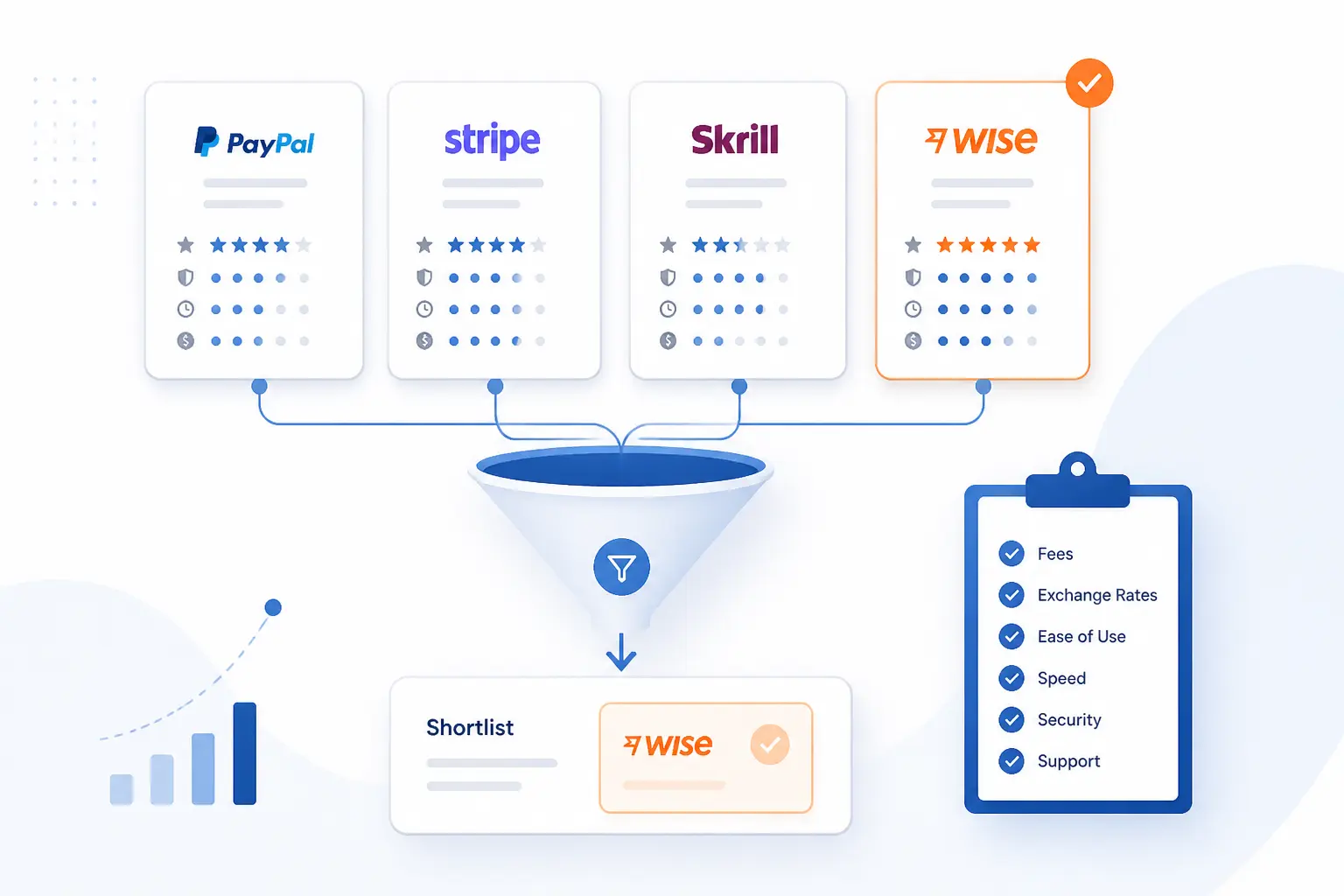
We compared these payment methods for one practical reason, to help readers narrow a real shortlist fast. The goal was not to crown one universal winner. It was to judge which options most reliably improve checkout speed, trust, and coverage for different kinds of businesses.
FURTHER READING: |
| 1. 15 Restaurant Ordering System Picks Worth Using |
| 2. 15 Free CRM Tools Worth Using for Small Teams |
| 3. 15 Best IoT Platform Providers For Real-World Needs |
Quick Comparison of the Best Online Payment Methods
| Payment Method | Best For | Merchant Pricing | Setup Route | Score |
|---|---|---|---|---|
| PayPal | Broad checkout coverage in one button | Transaction-based | Hosted or expanded checkout | 4.8 |
| Apple Pay | Fast mobile checkout for iPhone-heavy audiences | No Apple fee | PSP integration or Apple Pay JS | 4.7 |
| Google Pay | Android and browser-based wallet checkout | No added Google fee | Google Pay API | 4.6 |
| Stripe | Developer-led teams that want one payments stack | Pay-as-you-go or custom | Single integration with add-ons | 4.6 |
| Klarna | Higher-cart ecommerce with BNPL merchandising | Custom merchant contracts | Web SDK or hosted page | 4.4 |
| Affirm | Big-ticket U.S. purchases and financing | Custom merchant contracts | Merchant Portal plus API | 4.3 |
| Adyen | Global and enterprise-grade payment mix | Method-based plus processing fee | Single platform integration | 4.3 |
| Amazon Pay | Amazon-familiar checkout for mainstream retail | Transaction-based | Web and mobile integration | 4.2 |
| Alipay | Cross-border sales to Chinese shoppers | Contract pricing | QR code or payment link flow | 4.0 |
| Afterpay | Lifestyle retail with installment demand | Custom transaction fee | Platform or gateway integration | 3.9 |
How We Researched and Evaluated Each Option
We scored the top 10 using the same editorial framework, then adjusted for where each method genuinely fits. A fast wallet and a BNPL service solve different checkout problems, so the question was not just who offers more features. It was who does the job cleanly, transparently, and with the least friction for the merchant and shopper.
- Checkout fit: we looked at how clearly each method supports online checkout, mobile use, guest flow, recurring payments, or pay-later use cases on its official pages.
- Merchant economics: we favored options with transparent fees, predictable settlement, or a clear reason why higher pricing may still pay off for certain baskets or audiences.
- Integration and control: we checked whether the docs show a lightweight setup, strong platform coverage, or more advanced routes for teams that need deeper control.
- Buyer familiarity and trust: we considered how recognizable the method is at checkout and whether the official materials emphasize security, tokenization, dispute tools, or shopper protections.
- Independent reputation: where public review pages were available, we used them as a check on recurring praise or complaints rather than as a replacement for our own scoring.
That means a method can rate well without being right for everyone. It also means a lower-ranked option can still be the correct call if your customers, region, or average order value line up with it better.
Top 10 Online Payment Methods Worth Offering
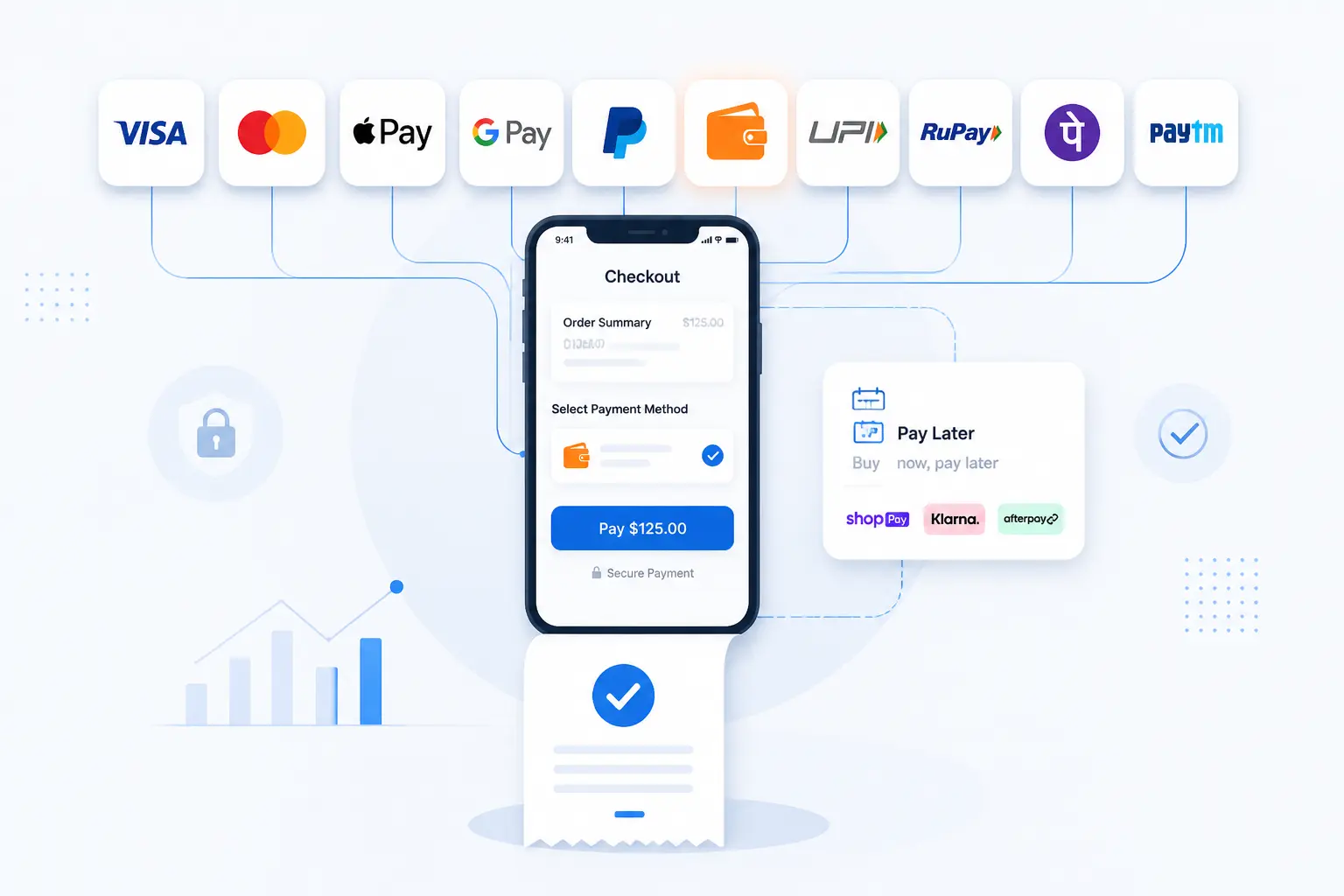
If you only want the short version, start with the wallet or processor your customers already know, then add a pay-later option only when it solves a real sales problem. The best online payment methods are usually the simplest ones to complete on a phone and the easiest ones for a merchant to support without creating a messy checkout.
1. PayPal
- Category: Wallet and checkout platform
- Best for: Broad coverage across wallets, cards, and pay later
- Setup effort: Low to medium
- Pricing: Transaction-based, no setup fee
- Standout feature: One stack can cover PayPal, Venmo, cards, and Pay Later
For most U.S. merchants, PayPal is still the safest first add after cards because it covers several buyer habits in one checkout stack. The official checkout pages show a simple hosted route for smaller teams and a more customizable route for businesses that want more control. That breadth is why it ranks first here. Few options make it this easy to serve PayPal users, Venmo users, guest card buyers, and installment shoppers without stitching together multiple providers.
The product pages also make PayPal unusually practical for smaller businesses. A PayPal Business account is free to open, and the checkout lineup clearly separates the lighter PayPal Checkout flow from Expanded Checkout. That gives merchants a real choice instead of one forced setup.
How PayPal works
PayPal presents two main online routes. PayPal Checkout is the simpler option, with preset button styles and PayPal-managed risk handling. Expanded Checkout gives a developer more control over the experience and lets a business show Apple Pay, Google Pay, and other alternate methods alongside PayPal payments and cards. The official comparison also shows guest checkout support, recurring payments, and the option to add chargeback protection on the more advanced route.
In practical terms, that means a merchant can start with PayPal buttons and card entry, then expand later if they want a more branded experience. The documentation also makes it clear that Venmo and Pay Later can sit inside the same family of checkout options, which matters when you want fewer moving parts.
Who is PayPal for?
PayPal fits small businesses, solo sellers, nonprofits, and mid-market stores that want quick trust at checkout without a long implementation project. It also makes sense for U.S. merchants that know Venmo matters to their audience. If you want one recognizable option that works for both logged-in wallet buyers and guest card buyers, PayPal stays hard to beat.
Businesses that want very fine-grained control over the entire payment stack, routing, and acquiring logic should look elsewhere. Stripe and Adyen are stronger picks for that kind of payments-led architecture.
PayPal pricing
- PayPal Checkout: 2.99% + $0.49 per credit or debit card transaction, with card processing, guest checkout, and PayPal-managed checkout flow.
- PayPal and Venmo wallet payments: 3.49% + $0.49 per transaction, with PayPal wallet acceptance and Venmo support for eligible U.S. buyers.
- Pay Later: 4.99% + $0.49 per transaction, with installment support inside the same checkout family.
- Expanded Checkout card payments: 2.89% + $0.29 per transaction, with more checkout control, Apple Pay support, and alternate payment methods.
PayPal lays out those rates on its business fee page.
Pros and cons
Pros
- Combines PayPal, Venmo, Pay Later, and card acceptance in one family of products.
- Offers a low-friction hosted route and a more customizable route, which suits both beginners and larger teams.
- No monthly or setup fees are listed for the core online checkout options.
- Guest checkout support helps merchants avoid forcing account creation.
Cons
- Wallet transactions cost more than standard card processing.
- The most flexible checkout setup needs more developer involvement.
- Some G2 reviewers repeatedly mention high fees and support frustrations.
PayPal rating and reviews
- G2: rated 4.4/5 across 2,723 reviews.
PayPal is not the cheapest option in every scenario, but it is the easiest all-round recommendation for businesses that want faster checkout without rebuilding the whole payments stack. If your current checkout still feels like a form, this is one of the fastest ways to make it feel like a button.
2. Apple Pay
- Category: Digital wallet
- Best for: iPhone-heavy audiences and mobile checkout
- Setup effort: Low through a PSP, medium direct
- Pricing: No Apple fee
- Standout feature: Extremely fast checkout on Apple devices
If your buyers skew toward iPhone and Mac users, Apple Pay is one of the cleanest ways to remove typing from checkout. Apple’s product and developer pages show a very direct shopper flow, tap or click the Apple Pay button, authenticate with Face ID, Touch ID, or passcode, and finish without filling long forms. That is exactly why it ranks this high. Few online payment methods cut form fatigue more sharply on mobile.
Apple also leans hard into privacy and tokenization. The official page says a device-specific number and unique transaction code are used for purchases, and that the actual card number is not shared with merchants or stored on Apple servers. For buyers who already trust their iPhone more than a random checkout form, that matters.
How Apple Pay works
Apple’s developer documentation shows two main merchant routes. The lighter route is to enable Apple Pay through an e-commerce platform or payment service provider that already supports it. The more direct route is to configure Apple Pay on the web yourself by creating a merchant ID, generating certificates, verifying your domain, and using Apple Pay JS or the Payment Request API. Apple also notes that approved platforms can register merchants through the Apple Pay Web Merchant Registration API.
For shoppers, the front-end flow stays simple. On Apple devices, they click or tap the Apple Pay button and confirm. On non-Safari browsers, Apple says shoppers can scan an Apple Pay code with an iPhone to complete the purchase, which helps extend it beyond the old Safari-only mental model.
Who is Apple Pay for?
Apple Pay is a strong fit for fashion, lifestyle, DTC, travel, and subscription businesses with a lot of mobile traffic from Apple users. It is also a smart add for brands that want a premium, low-friction feel without building their own wallet logic.
If your audience is mostly desktop B2B buyers or Android-heavy shoppers, Apple Pay should be an add-on rather than the center of your checkout plan. In that case, pair it with PayPal, cards, or Google Pay instead of expecting it to carry the whole flow.
Apple Pay pricing
- Apple Pay: $0 from Apple to use the wallet, with online, in-app, and subscription support shown across Apple’s public materials.
- Direct web setup: requires a merchant ID, certificates, domain verification, and either Apple Pay JS or the Payment Request API.
Pros and cons
Pros
- Removes a large chunk of mobile form filling for Apple users.
- Strong privacy story, with device-specific numbers and transaction codes.
- Can be enabled through many platforms and payment service providers.
- Works online, in apps, and for merchant-initiated recurring charges under supported setups.
Cons
- Its impact depends heavily on how many Apple users you actually have.
- Direct setup involves merchant IDs, certificates, and domain verification.
- It is best as a wallet layer, not a full payments stack by itself.
Apple Pay rating and reviews
Apple Pay does not have a clean standalone merchant review footprint on the software review sites we checked, so we would not force a third-party score here.
For the right audience, Apple Pay feels less like an extra method and more like a checkout shortcut. If your mobile analytics show heavy iPhone traffic, it belongs near the top of your shortlist.
3. Google Pay
- Category: Digital wallet
- Best for: Android users, Chrome users, and fast mobile checkout
- Setup effort: Low to medium
- Pricing: No added Google fee
- Standout feature: Lightweight API and strong autofill experience
Google Pay makes the strongest case when your traffic comes from Android phones, Chrome, or buyers who want fast wallet-based checkout without friction. Google’s business and developer materials are straightforward about the pitch. Add the button, pass the payment request, and let the wallet handle saved payment details and a faster form fill experience. That simplicity is why it lands this high.
Unlike some wallet pages, Google’s documentation also speaks clearly to merchants. It highlights fast setup, tokenized payments, and the ability to integrate with just a few lines of code through the API. That matters for teams that do not want a giant payments project just to add one recognizable option.
How Google Pay works
The official setup flow starts with business sign-up, bank verification, Google review of the sign-up, integration with your technical platform, then testing and launch. On the developer side, the web tutorial breaks the flow into defining the API version, choosing a tokenization method, selecting supported card networks, creating the Google Pay button, checking readiness with isReadyToPay, and opening the sheet with loadPaymentData.
Google also calls out device-token benefits for eligible transactions. On the business page, it notes that qualifying Google Pay API transactions facilitated with Visa or Mastercard device tokens may shift fraud chargeback liability to issuers, which is a meaningful operational detail for some merchants.
Who is Google Pay for?
Google Pay is a natural fit for merchants with lots of Android traffic, browser-based commerce, food delivery, retail, ticketing, and other fast-checkout use cases. It also pairs well with Apple Pay when you want a wallet strategy that covers both sides of the mobile market without forcing card entry for everyone.
It is less compelling as a standalone differentiator if most of your customers already use PayPal or if your traffic is overwhelmingly Apple-based. In that case, it still helps, but it may not move the needle as much as Apple Pay or PayPal.
Google Pay pricing
- Google Pay API: no additional Google fee for users, merchants, or developers, with payment processing fees still handled by your processor.
- Merchant setup: business sign-up, bank verification, technical integration, testing, and launch support through Google Pay for Business.
Google spells that out in its fee FAQ.
Pros and cons
Pros
- No added Google fee on top of processor charges.
- Clear API flow for web checkout, with readiness checks and payment sheet handling.
- Strong fit for Android and browser-based shoppers.
- Google highlights issuer liability shift for qualifying tokenized Visa and Mastercard transactions.
Cons
- Its payoff depends on your audience mix, just like Apple Pay.
- It still relies on your payment processor for the actual processing economics.
- It is an acceleration layer, not a full merchant account or acquiring platform.
Google Pay rating and reviews
Google Pay has plenty of consumer chatter online, but we did not find a clean merchant-facing review footprint on the review platforms that best fit this roundup.
For mobile-first stores, Google Pay is often less about adding another logo and more about closing the gap between intent and payment. If you already plan to offer Apple Pay, Google Pay is usually the obvious twin.
4. Stripe
- Category: Payments platform
- Best for: Developer-led businesses that want one extensible stack
- Setup effort: Medium
- Pricing: Pay-as-you-go or custom
- Standout feature: One integration for cards, wallets, and local methods
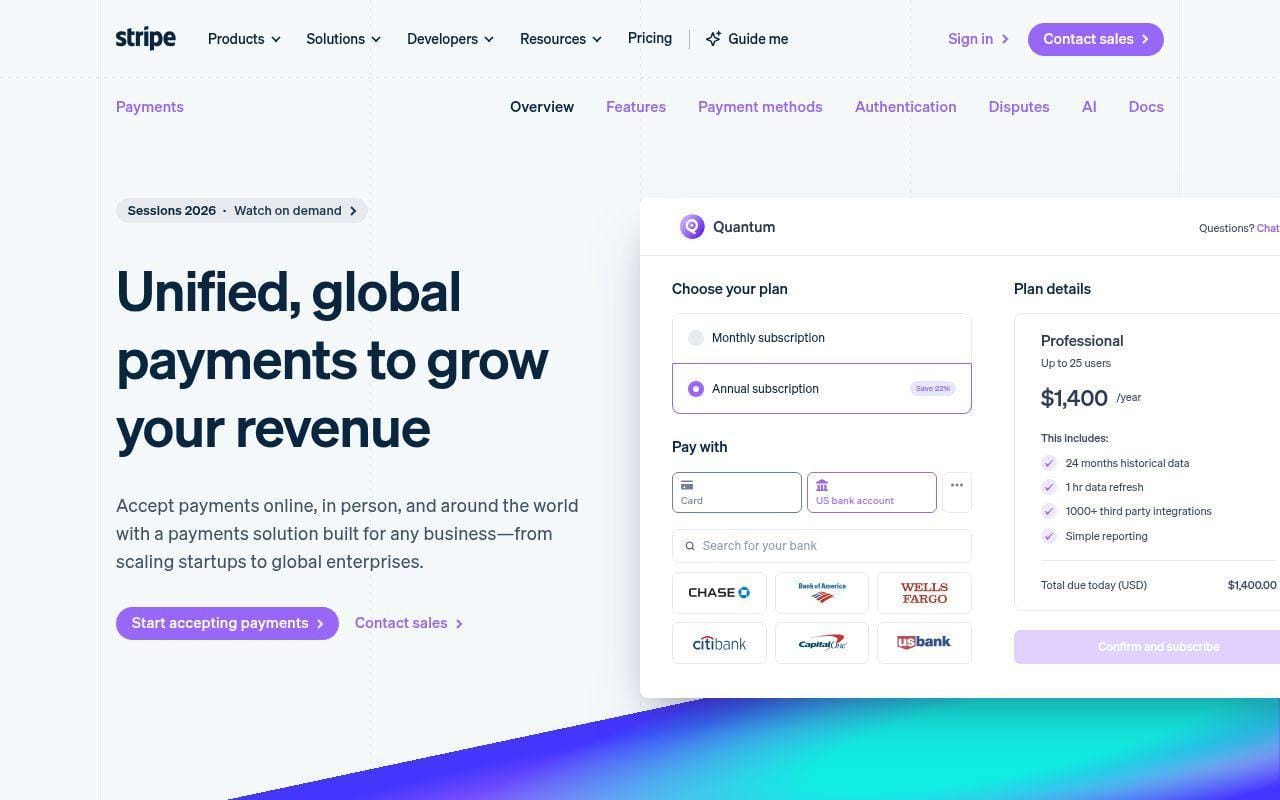
Stripe is the most capable all-rounder here for businesses that want a payment method mix and a full payments platform in the same purchase. The official payments and pricing pages position it as a single integration for cards, digital wallets, bank-based methods, and BNPL options, backed by prebuilt UIs and fraud tooling. That mix of range and control is why it stays near the top. If PayPal is the easiest broad recommendation, Stripe is the most flexible one.
Stripe also stands out because its public pricing is unusually readable for a platform this capable. Standard pricing, custom pricing, local methods, fraud tooling, and wallet support are all explained in one place. That level of transparency helps when you are comparing real costs, not just marketing copy.
How Stripe works
Stripe’s official materials show a modular flow. A business can use prebuilt UIs to accept payments fast, then layer in Link for accelerated checkout, Radar Lite for fraud protection, and additional payment methods without adding separate providers. Stripe says businesses can accept payments in more than 195 countries, support more than 135 currencies, and turn on more than 100 payment methods through one integration.
That matters because the operational model is not just “accept cards.” It is “start with a payments core, then switch on wallets, bank methods, and local methods as your business needs them.” For product teams that expect checkout to evolve, that architecture is a real advantage.
Who is Stripe for?
Stripe fits SaaS companies, marketplaces, fast-growing ecommerce brands, and startups that want room to expand without switching platforms every year. It is also a strong choice when subscriptions, global billing, stored payment methods, and checkout customization all matter at once.
Very small businesses that just want a familiar wallet button or a turnkey basic checkout may find Stripe more platform than they need. In those cases, PayPal or a simpler gateway can be easier to live with day one.
Stripe pricing
- Standard card payments: 2.9% + $0.30 per successful domestic card transaction, with no setup fees, monthly fees, or hidden fees listed on the standard plan.
- Instant bank payments: 2.6% + $0.30 per successful transaction.
- Klarna via Stripe: 5.99% + $0.30 per successful transaction, plus international and currency conversion surcharges where applicable.
- Custom pricing: volume discounts, IC+ pricing, country-specific rates, and multi-product discounts for larger businesses.
Stripe publishes those details on its pricing page.
Pros and cons
Pros
- One integration can support cards, wallets, bank methods, and BNPL.
- Public pricing is clearer than many enterprise payment platforms.
- Prebuilt UIs reduce front-end work for teams that do not want to build from scratch.
- Link and Radar Lite give it a credible story on accelerated checkout and built-in fraud tools.
Cons
- The platform can feel more technical than wallet-first options.
- Costs stack up once you add international cards, currency conversion, or premium payment methods.
- G2 reviewers often praise flexibility but also mention setup complexity.
Stripe rating and reviews
- G2: rated 4.2/5 across 448 reviews.
Stripe is one of the strongest picks if you want to think of payments as infrastructure, not just checkout decoration. It is rarely the simplest option, but it is often the one you grow into rather than out of.
5. Klarna
- Category: Buy now, pay later
- Best for: Ecommerce brands with higher baskets and installment demand
- Setup effort: Medium
- Pricing: Custom merchant contracts
- Standout feature: Strong range of pay-later options from one brand
Klarna earns its place when you want BNPL that shows up throughout the shopping journey, not just at the final payment step. The official U.S. consumer pages highlight Pay in 4, Pay in 30 days, Pay in full, and longer financing, while the developer docs show both hosted and more integrated web routes. That combination gives merchants more merchandising flexibility than a plain “split payments” badge.
Where Klarna is strongest in this list is customer choice. It is not just a single installment offer. It is a broader pay-later menu, which can help if your catalog ranges from impulse buys to bigger-ticket items.
How Klarna works
Klarna’s documentation shows merchants can start with a test account, generate API credentials, get environment endpoints, and plan either an inline web integration or a hosted payment page. Klarna also provides a Web SDK and a broader integration checklist geared toward production readiness. On the shopper side, Klarna’s U.S. payment pages explain that Pay in 4 takes the first payment when an order ships, then automatically collects the remaining three payments every two weeks.
That means the merchant story is twofold. First, integrate Klarna as a checkout method through its SDK or hosted flow. Second, surface the right financing message before checkout, because Klarna clearly expects its payment options to be merchandised earlier in the funnel as well.
Who is Klarna for?
Klarna fits fashion, beauty, home, and lifestyle stores where flexible payments can help buyers commit. It also makes sense for merchants who want both short-term installment plans and longer financing under one recognizable BNPL brand.
Low-margin sellers should be careful here. If your average order value is modest and your margins are tight, Klarna can raise conversion while still hurting net economics.
Klarna pricing
- Custom merchant pricing: Klarna does not publish a universal self-serve merchant rate, so pricing is handled through merchant contracts and integration arrangements.
- Pay in 4: interest-free for shoppers who pay on time, with automatic payments every two weeks after the initial payment is collected when the order ships.
- Pay over time: longer monthly financing options are available for eligible purchases, with U.S. terms on the consumer side shown as 6 to 24 months.
Klarna’s U.S. terms are easiest to review on its Pay in 4 page.
Pros and cons
Pros
- Offers more than one BNPL format, which helps merchants match different purchase sizes.
- Official docs support both hosted and more integrated web setups.
- Strong brand recognition in pay-later shopping.
- Good fit when you want payment messaging on product and cart pages, not just checkout.
Cons
- Merchant pricing is not publicly posted in a clean U.S. self-serve table.
- BNPL does not suit every vertical or every margin structure.
- G2 reviews are more mixed here than for the wallet leaders in this list.
Klarna rating and reviews
- G2: rated 3.2/5 across 57 reviews.
Klarna is not a must-have for every checkout. For the right product categories, though, it can materially change how customers think about affordability before they ever reach the card form.
6. Affirm
- Category: Buy now, pay later and financing
- Best for: Higher-ticket U.S. purchases and clear financing offers
- Setup effort: Medium
- Pricing: Custom merchant fee structure
- Standout feature: Stronger financing orientation than many BNPL peers
Affirm makes the most sense when “pay later” really means financing, not just splitting a small order into four pieces. The business FAQ and merchant onboarding materials focus on flexible programs, clear consumer terms, and fast merchant settlement. That is why it sits ahead of several broader processors in this list for financing-heavy use cases. If you sell furniture, fitness equipment, travel, or other higher-ticket categories, Affirm deserves a serious look.
We also like that Affirm’s merchant materials are direct about how fees work. The company does not post a universal public rate, but it does say a typical fee is a base percentage plus a transaction fee, with no integration, annual, or monthly fees. That level of candor is helpful even without a public rate card.
How Affirm works
Affirm’s merchant onboarding starts in the Merchant Portal. The developer introduction says merchants should log in, set up their development environment, and retrieve sandbox and live API keys. The merchant support materials also show that charges are visible in the Merchant Dashboard, where teams can review charge details and process orders if their platform does not handle the processing directly.
On the buyer side, Affirm’s business FAQ explains that options vary by purchase amount and merchant, with Pay in 4 at 0% APR and longer-term plans ranging from 0% to 36% APR based on eligibility. That makes the customer journey less “micro-installments for everything” and more “pick a financing route that fits the purchase.”
Who is Affirm for?
Affirm fits U.S. merchants selling mid-ticket and big-ticket goods where financing is part of the buying decision. It also works for brands that want consumers to see exact terms up front instead of vague pay-later marketing.
Merchants selling low-cost impulse purchases should usually look elsewhere. A wallet or simpler card optimization will often matter more than a financing offer at that end of the basket range.
Affirm pricing
- Merchant pricing: Affirm says a typical fee is a base percentage plus a transaction fee, with the exact rate varying by business type, size, risk profile, and program choice.
- Merchant costs: no integration fees, annual fees, or monthly fees are listed in the merchant FAQ.
- Settlement: merchants are paid upfront by ACH within 1 to 3 business days, less the merchant discount rate and transaction fee.
- Consumer terms: Pay in 4 is 0% APR, while longer plans can range from 0% to 36% APR based on eligibility.
Affirm explains those merchant terms in its merchant fee FAQ.
Pros and cons
Pros
- Better aligned than many rivals for larger purchases and real financing needs.
- Merchant FAQ clearly states there are no integration, annual, or monthly fees.
- Upfront merchant settlement within 1 to 3 business days is spelled out clearly.
- Merchant Portal and API-key setup are documented in a straightforward way.
Cons
- No public universal merchant rate card.
- Mostly a U.S.-centric recommendation for this roundup.
- Consumer review sentiment on support is much rougher than the product pitch.
Affirm rating and reviews
- Trustpilot: rated 1.7/5 across 8K reviews.
Affirm is not the broadest option here, but it is one of the clearest fits for merchants who need financing to do real work. When order value is high enough, that matters more than adding yet another wallet button.
7. Adyen
- Category: Enterprise payments platform
- Best for: Global merchants that want many methods under one roof
- Setup effort: Medium to high
- Pricing: Fixed processing fee plus method fee
- Standout feature: One platform can cover cards, wallets, BNPL, and pay by bank
Adyen is the strongest enterprise-style option in this roundup for businesses that want many online payment methods managed through one platform. Its docs and pricing pages show a wide method catalog, a fixed processing fee plus payment-method-specific pricing, and support for wallets, BNPL, and open-banking style flows. That breadth is exactly where Adyen stands out. It is not trying to be the easiest beginner tool. It is trying to be the payments control room.
The pricing page also earns points for transparency. Adyen does not boil everything down to one flat percentage. Instead, it shows that each transaction carries a fixed processing fee and a method fee, which is more honest for merchants comparing cards, bank methods, and BNPL.
How Adyen works
Adyen’s docs describe a single platform where merchants request or enable payment methods, then add them to checkout through the integration options they already use. The supported-method pages show Apple Pay, Google Pay, Klarna, Afterpay, Affirm, PayPal, and Pay by Bank. For Pay by Bank in the U.S., Adyen explains that shoppers are redirected to Plaid, choose a bank, authenticate with their bank, and return to the merchant site, with tokenization recommended for better repeat-payment performance.
That operational model is important. Adyen is less about one branded button and more about assembling the right local and global mix inside one payments platform. For international growth, that is a serious advantage.
Who is Adyen for?
Adyen fits mid-market and enterprise merchants with complex payment mixes, multiple markets, or a need to coordinate cards, wallets, and bank-based methods in one place. It is also a good match for teams that care about acquiring transparency and method-level economics.
Very small sellers that just want a faster checkout button will probably find it heavier than necessary. PayPal, Apple Pay, Google Pay, or Stripe are usually easier starting points.
Adyen pricing
- Visa and Mastercard cards: $0.13 processing fee plus 0.80% and Interchange++ in the United States, with no setup or monthly fees listed on the main pricing page.
- Pay by Bank (US): $0.13 plus 0.60% and $0.40.
- Klarna in the United States: $0.13 plus 4.29% and $0.30.
Adyen publishes those method rates on its payment method pricing page.
Pros and cons
Pros
- Very broad payment method coverage in one platform.
- No setup or monthly fee is listed on the main pricing page.
- Method-level pricing is public, which helps serious comparison work.
- Useful fit for global expansion and payment-method diversification.
Cons
- More operationally complex than wallet-first tools.
- The best value shows up when you use more of its broader platform.
- G2 reviewers often praise capabilities but mention a steeper learning curve.
Adyen rating and reviews
- G2: rated 3.8/5 across 36 reviews.
Adyen is not the most beginner-friendly option here, but it is one of the most complete. If your checkout roadmap includes multiple regions, multiple methods, and real payment operations work, it deserves its place on the shortlist.
8. Amazon Pay
- Category: Digital wallet and branded checkout
- Best for: Mainstream retail where Amazon familiarity matters
- Setup effort: Low to medium
- Pricing: Transaction-based
- Standout feature: Lets buyers use details already stored with Amazon
Amazon Pay makes sense when your audience already trusts Amazon enough that its brand reduces hesitation at checkout. The product pages emphasize that customers can use the information already stored in their Amazon accounts, and that the service works across web and mobile. That familiarity is the whole play here. It is less flexible than a full payments platform, but it can feel very natural for general ecommerce.
The merchant-facing materials also keep the pitch grounded. Amazon Pay talks about easy integration, transaction-based fees, mobile optimization, and no hidden upfront costs. That is exactly the sort of plain-English positioning we like in a commercial shortlist.
How Amazon Pay works
Amazon says the product works with a merchant’s website and is optimized for mobile checkout. The service lets shoppers use their Amazon account information on third-party merchant sites, while merchants manage activity through Seller Central reporting and transaction views. Amazon also notes support for different transaction types and points merchants to its A-to-z Guarantee policy for additional context.
In plain terms, the merchant adds Amazon Pay, the customer chooses it at checkout, and Amazon handles the account-backed wallet experience buyers already recognize. That can be especially useful when trust is the main barrier rather than financing or advanced routing.
Who is Amazon Pay for?
Amazon Pay fits general retail, household goods, consumer products, and stores that sell to mainstream U.S. shoppers who already buy on Amazon regularly. It is also sensible for merchants that want another fast wallet option without building a more complex payment architecture.
It is a weaker fit for international-first merchants or brands whose buyers do not see Amazon as part of their normal purchase behavior. In those cases, PayPal or card-and-wallet combinations are often more universal.
Amazon Pay pricing
- Web and mobile domestic transactions: 2.9% processing fee plus a $0.30 authorization fee.
- Cross-border transactions: domestic pricing still applies, with an added cross-border processing fee on eligible transactions.
- Fee structure: transaction-based, with fees collected only when a transaction is successfully authorized and processed.
Amazon details that structure on its transaction fee page.
Pros and cons
Pros
- Very familiar checkout experience for Amazon customers.
- Web and mobile support is clearly documented.
- Pricing is straightforward for domestic transactions.
- Good fit when brand trust is a bigger problem than financing or method breadth.
Cons
- Not as broad or customizable as full payment platforms.
- Its value is tied closely to how much Amazon familiarity matters to your shoppers.
- Cross-border pricing becomes less simple than the domestic headline rate.
Amazon Pay rating and reviews
- G2: rated 4.5/5 across 583 reviews.
Amazon Pay is a strong trust-builder, not a full replacement for broader payment strategy. Used well, though, it can remove enough hesitation to justify the extra button.
9. Alipay
- Category: Cross-border digital wallet
- Best for: Merchants selling to Chinese shoppers
- Setup effort: Medium
- Pricing: Contract-based
- Standout feature: Strong fit for cross-border checkout into Alipay’s ecosystem
Alipay is not a universal wallet play for U.S. merchants, but it is one of the clearest specialist options in the list. If Chinese shoppers matter to your business, offering Alipay can be far more useful than adding another Western wallet your audience does not need. That narrower but stronger fit is why it still lands in the top 10.
The official global product pages are practical about the flow. They describe website, app, and mobile-web payment options, settlement currencies, merchant application conditions, and technical request requirements. This is not a vague “global payments” promise. It is a documented cross-border payment method with a specific buyer base.
How Alipay works
For website payments, Alipay’s official flow says the customer checks out on the merchant website, chooses Alipay, and the merchant system sends a transaction request. Alipay then returns a payment QR code link, the merchant displays it, and the customer scans and confirms payment before being redirected back. For in-app payments, the flow uses a payment link that invokes the Alipay app instead of a QR presentation. The help center also notes that interface requests use HTTPS with GET or POST and XML or JSON response formats, plus signature verification requirements.
For some partners or acquirer-style setups, Alipay also expects secondary merchant registration. The help center explains that those records can be managed through the Global Merchant Portal or via interface-based registration.
Who is Alipay for?
Alipay is for merchants with clear cross-border demand from Chinese consumers, especially travel, luxury, education, hospitality, and international retail. If a meaningful share of your target audience already expects Alipay, offering it can remove a major trust and compatibility barrier.
Merchants without that audience should skip it. Alipay is powerful in its lane, but it is not a general U.S. checkout default.
Alipay pricing
- Merchant pricing: Alipay does not publish a simple self-serve global fee table for this product, and settlement mode is handled according to contract.
- Settlement support: the official product page lists settlement currencies including USD, EUR, JPY, GBP, CAD, AUD, SGD, CHF, SEK, DKK, NOK, NZD, THB, and HKD.
- Merchant requirements: valid business license, implementation URL, company details, and legal representative or shareholder identification documents are required.
Pros and cons
Pros
- Very clear fit for merchants targeting Chinese shoppers.
- Supports web, app, and mobile-web payment flows.
- Official pages spell out merchant requirements and settlement currencies.
- Cross-border flow is documented in practical step-by-step terms.
Cons
- Not a broad default for general U.S. checkout.
- Public pricing transparency is limited compared with PayPal, Stripe, or Amazon Pay.
- Implementation can involve extra merchant registration details depending on setup type.
Alipay rating and reviews
We did not find a strong merchant-facing public review footprint for Alipay on the review platforms that best fit this roundup, so we are not forcing a score that would blur consumer and merchant use cases.
Alipay is the definition of a situational winner. If your business needs it, it can be essential. If not, it should stay off the checkout page.
10. Afterpay
- Category: Buy now, pay later
- Best for: Retail brands where installment shopping is part of the purchase path
- Setup effort: Medium
- Pricing: Custom transaction fee
- Standout feature: Pays merchants upfront while shoppers pay over time
Afterpay is most compelling for retail brands that want a familiar installment option and are comfortable making BNPL part of the shopping story. The business pages are explicit that customers can pay in 4 or use monthly options, while merchants are paid upfront and manage activity in Afterpay Business Hub. That clarity is why it closes the top 10. It does one main job, and it says so plainly.
The official merchant materials also make Afterpay easy to place in context. This is not a broad wallet or a full processor. It is a retail-focused pay-later option that plugs into major ecommerce platforms and payment gateways.
How Afterpay works
Afterpay’s business pages say merchants first apply for an account, then integrate with their ecommerce platform and payment gateway once approved. Supported partners listed in the merchant materials include Square, Magento, Shopify, WooCommerce, and others. On the shopper side, customers choose Afterpay at checkout and split payments into installments, while the merchant receives the full purchase amount upfront, less a transaction fee.
Afterpay also points merchants to Business Hub for account management, order tracking, and settlement visibility. The support pages say merchants are assigned a reconciliation period between 1 and 5 business days, depending on their agreement.
Who is Afterpay for?
Afterpay fits fashion, beauty, accessories, and lifestyle merchants that already know installment demand is part of their sales pattern. It also makes sense for merchants who want a pay-later option without building financing logic themselves.
It is a weaker fit for low-margin categories or businesses whose customers do not naturally shop with BNPL. In those cases, faster wallets and stronger card flow usually deserve priority.
Afterpay pricing
- Custom merchant pricing: Afterpay says merchants receive the full purchase amount upfront, minus a transaction fee, but does not publish one public self-serve rate card on the U.S. business page.
- Settlement timing: the merchant agreement assigns a reconciliation period between 1 and 5 business days.
- Customer options: the U.S. business page promotes Pay in 4 and monthly installment options for eligible purchases.
Afterpay explains the merchant setup and settlement model on its business sign-up details.
Pros and cons
Pros
- Clear retail-first BNPL positioning.
- Merchant gets paid upfront while Afterpay handles shopper installments.
- Works with major ecommerce platforms and gateways.
- Business Hub gives merchants a dedicated account-management layer.
Cons
- Public U.S. merchant pricing is not transparent.
- Best fit is fairly narrow compared with wallets and processors above it.
- BNPL fees can be hard to justify on lower-margin products.
Afterpay rating and reviews
- G2: rated 4.1/5 across 41 reviews.
Afterpay belongs on the shortlist when pay-later clearly matches your retail audience. If that fit is weak, keep checkout simpler and invest first in wallets and card flow.
Five More Online Payment Methods Worth Considering
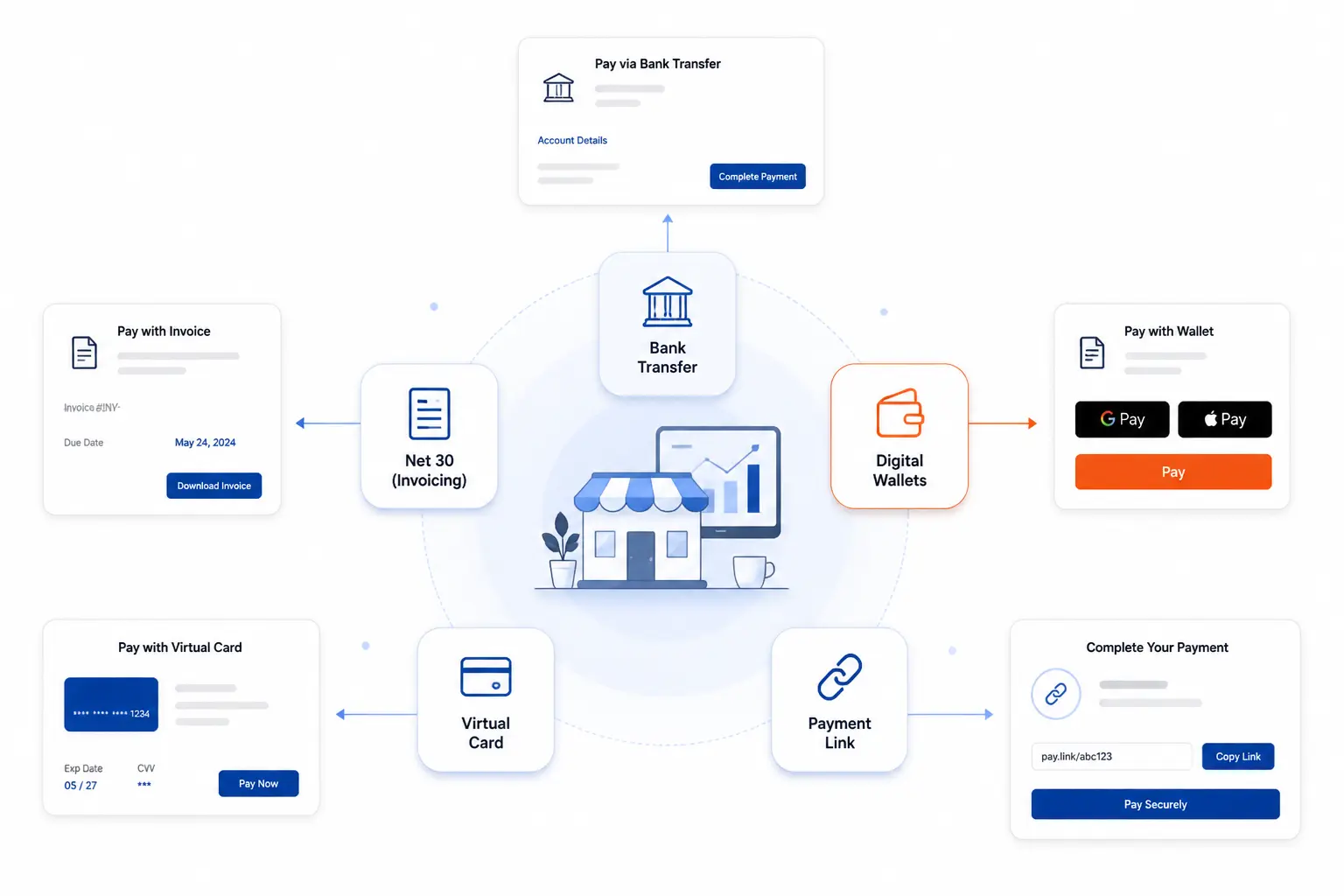
The next five are not as universal as the top tier, but each solves a real checkout or payment collection problem. If your business model is specialized, these can be smarter additions than blindly copying a giant brand’s checkout page.
11. Zelle
- Category: Bank-to-bank transfer network
- Best for: Direct payments to trusted small businesses
- Setup effort: Low through a participating bank
- Pricing: Bank-dependent
Zelle is worth considering when you collect direct payments from customers who already know and trust your business. The official small-business FAQ says payments to enrolled businesses typically arrive within minutes and cannot be canceled once sent to an already enrolled business. That speed is useful for invoices, local services, deposits, and repeat customer payments.
Where Zelle stands out from the top-10 picks is simplicity for direct bank-to-bank transfer. You are not adding a classic ecommerce wallet or BNPL button. You are adding a very fast payment rail that lives inside participating banking apps. For contractors, clinics, local service providers, and appointment-based businesses, that can be enough.
The tradeoff is obvious. Zelle is not designed to mimic a polished online store checkout, and the official guidance plainly tells users to pay only businesses they trust. That alone keeps it out of the top tier for mainstream ecommerce.
Who is Zelle for?
Zelle fits local service businesses, repeat-client payment collection, and invoice-style flows better than shopping-cart checkout.
12. Trustly
- Category: Pay by bank
- Best for: Subscription, bill pay, and direct bank checkout
- Setup effort: Medium
- Pricing: Custom merchant pricing
Trustly is one of the more interesting alternatives if cards are not always the right answer for your checkout. Its product pages focus on direct bank payments, recurring payments from verified bank accounts, and lower operating overhead for subscription and bill-pay use cases. That makes it a more specialized but often more strategic choice than adding another wallet logo.
The strongest difference versus the top-10 picks is recurring bank-based collection. Trustly’s subscription and recurring pages emphasize no interchange fees, no chargeback overhead, and a setup flow that connects directly to the customer’s bank account rather than relying on card credentials that expire. For subscription businesses, utilities, and billers, that is not a small difference.
Public merchant pricing is not posted in a simple rate card, so this is a sales-led product, not a casual self-serve add. Consumers, however, are told the service is free to use unless a payment later returns for insufficient funds.
Who is Trustly for?
Trustly fits subscription businesses, billers, and merchants who want pay-by-bank collection to reduce card costs and credential churn.
13. Worldpay
- Category: Payments platform
- Best for: Established businesses with global payment needs
- Setup effort: Medium to high
- Pricing: Quote-based in the U.S.
Worldpay stands out for breadth rather than simplicity. Its online payments pages describe access to more payment options in over 70 markets, cross-border reach in 190 countries, support for hundreds of currencies, and low-code or no-code connection options. For growing or multinational merchants, that is the appeal.
What it does better or differently than many top-10 picks is global acquiring depth and payment-method coverage at scale. The developer docs also show recurring payment support, repeat card payments, and hosted payment page routes. That makes Worldpay a stronger operational platform than a simple wallet add.
For U.S. merchants, public self-serve pricing is not laid out as cleanly as Stripe or Authorize.net, which is why it lands here instead of higher. Still, if you need enterprise-grade reach and recurring support in one family of products, it deserves a look.
Who is Worldpay for?
Worldpay fits established ecommerce brands, travel companies, and multi-market merchants that need scale, payment breadth, and recurring payment support more than they need a beginner-friendly onboarding path.
14. Authorize.net
- Category: Payment gateway
- Best for: SMBs that want a classic gateway with predictable monthly pricing
- Setup effort: Low to medium
- Pricing: Monthly subscription plus transaction fees
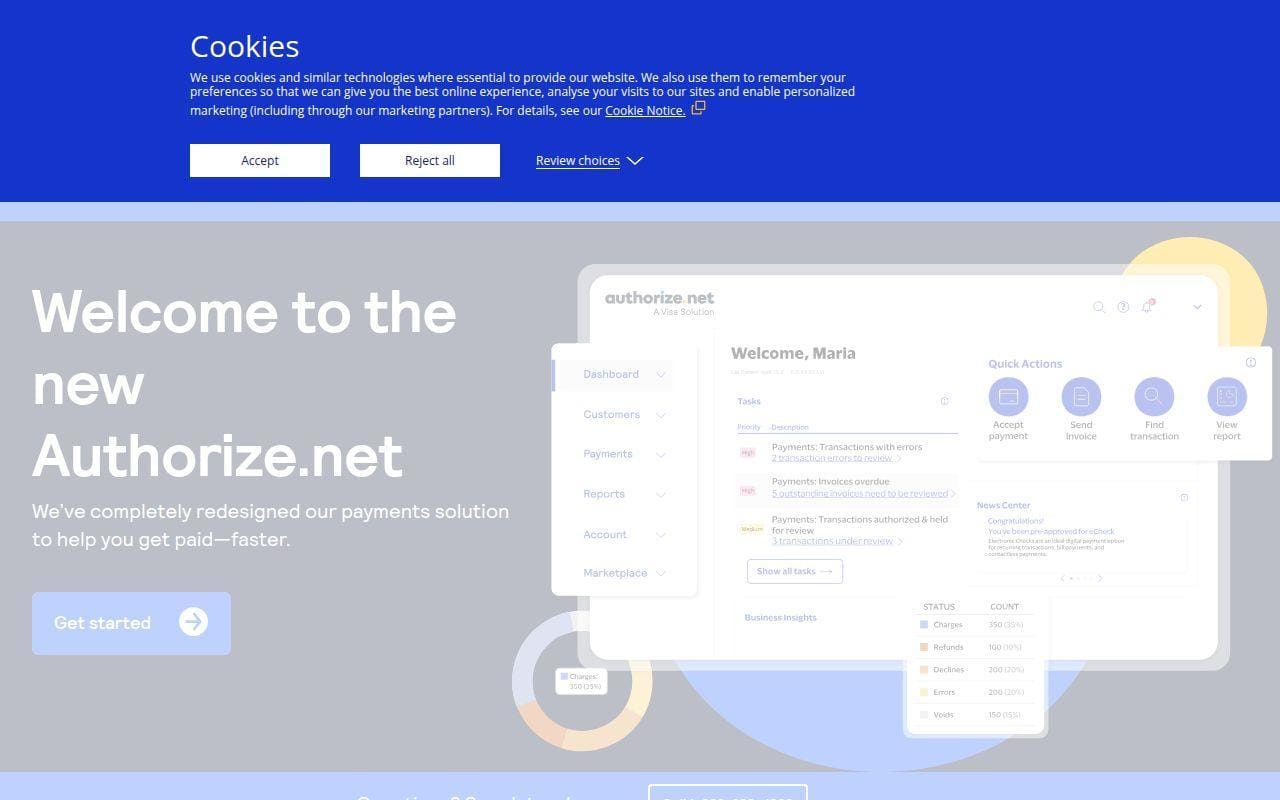
Authorize.net is still a practical option for small businesses that want a traditional gateway with recurring billing, invoicing, and fraud tools in one familiar package. It does not feel as modern as Stripe, but the pricing page is refreshingly concrete and the feature bundle is still relevant. That predictability is what earns it a place here.
Its biggest difference from most of the top-10 picks is the classic gateway model. Instead of hiding behind custom sales quotes, Authorize.net posts several plans with monthly pricing and clearly listed inclusions. For some merchants, especially those who already understand gateway-plus-merchant-account setups, that is easier to buy and budget.
The standout public plan is All-in-One at $25 per month plus 2.9% and 30 cents per transaction, with a merchant account, gateway, digital wallets, automated recurring billing, Advanced Fraud Detection Suite, Customer Information Manager, digital invoicing, reporting, and live support. Gateway Only and Gateway + eCheck give merchants more control if they already have processing relationships.
Who is Authorize.net for?
Authorize.net fits SMBs that want posted pricing, classic gateway structure, recurring billing, and digital wallet support without moving to a broader payments platform.
15. Checkout.com
- Category: Enterprise payments platform
- Best for: Businesses that want custom acquiring and payment optimization
- Setup effort: Medium to high
- Pricing: Custom pricing by profile and risk
Checkout.com is a serious contender for businesses that need more control than a simple processor gives them, but it is not a casual plug-in choice. Its pricing page says fees are based on business profile and risk category, while the docs center the platform around a Unified Payments API and a PaymentSession-based flow. That signals an enterprise-first product.
What it does differently than many top-10 picks is lean harder into tailored acquiring economics and modular payments architecture. If you are already thinking about authorization rates, local methods, risk tooling, and payment orchestration, Checkout.com starts to make more sense.
The catch is the same reason it sits in this second tier. There is no tidy public self-serve rate table for most merchants, and smaller businesses may find that the platform is more than they need. For companies with real payment complexity, though, the ceiling is high.
Who is Checkout.com for?
Checkout.com fits scaling and enterprise merchants that want custom pricing, deeper payment optimization, and a more configurable platform than entry-level gateways offer.
Why More Online Payment Methods Improve Conversion
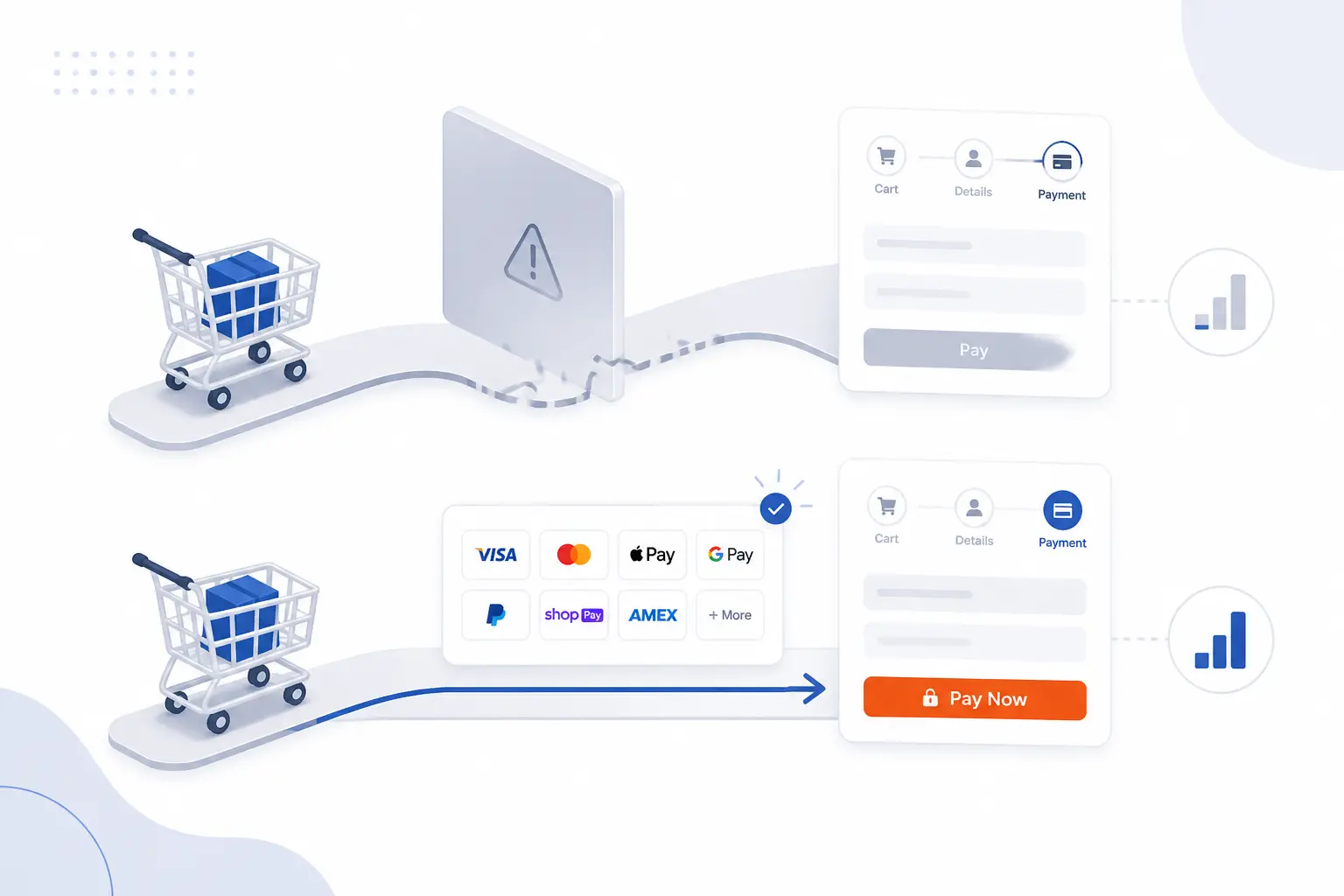
Offering more payment methods usually helps when each option removes a real barrier, not when you pile on logos for show. Shoppers abandon checkout for lots of reasons, but payment friction is one of the last and most painful ones because it hits after the customer has already decided to buy.
Reduce Cart Abandonment and Checkout Friction
Checkout friction is expensive because 70.19% of carts are still abandoned on average, which means even small wins at the payment step can matter. A wallet that skips form fill, a guest checkout path, or a trusted BNPL button can remove the last excuse to leave. The practical lesson is simple. Add methods that reduce effort, not just methods that decorate the page.
Build Trust With Familiar Ways to Pay
Familiarity is not fluff at checkout. Worldpay’s consumer research says 56% of global e-commerce transaction value now flows through digital wallets, so showing the wallet people already use can act as both a speed boost and a trust signal. That is why PayPal, Apple Pay, Google Pay, and Amazon Pay still punch above their weight. They are recognizable before the customer reads a word of fine print.
Expand Reach Across Regions and Demographics
More methods also widen the audience you can realistically serve. A global payments market view from Worldpay notes that Europe leans heavily toward digital wallets online, while APAC has even stronger wallet leadership in many markets, which is a good reminder that one U.S.-style card form does not match every buyer expectation on regional payment behavior. If you sell across borders, payment choice is not a nice extra. It is part of localization.
How Customer Preferences Shape Payment Choice
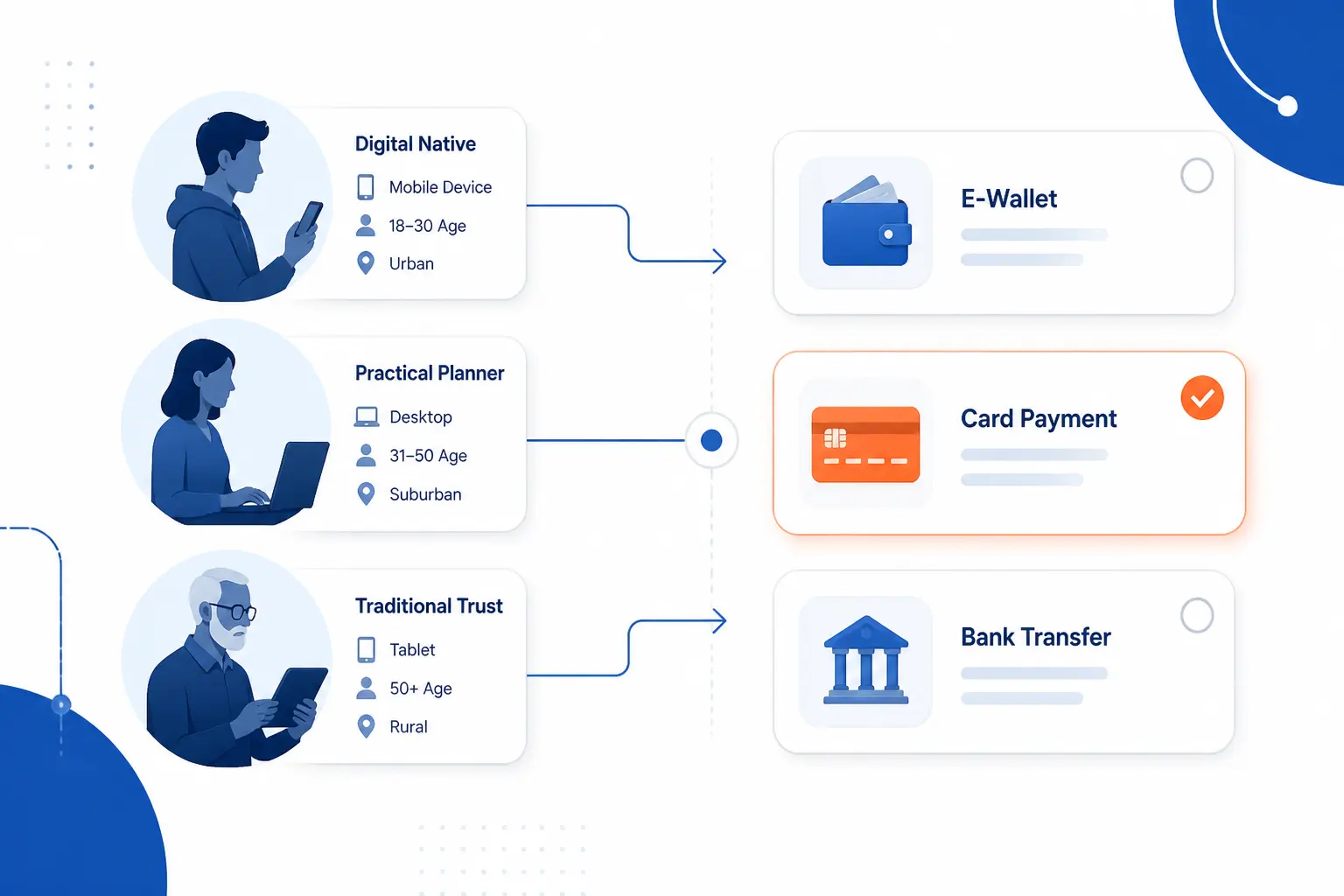
The right mix depends on who your customer is, not just what your platform supports. Age, device habits, geography, and purchase size all shape what feels “normal” at checkout. When merchants ignore that, they end up paying for methods customers never touch.
Online Payment Methods by Age Group
Age still changes what buyers expect from checkout. Atlanta Fed research found 93% of Gen Z consumers under 25 had adopted a mobile payment app, versus 50% of adults age 65 and older. That does not mean older customers reject digital payments. It does mean younger audiences are more likely to expect wallets and phone-based flows as the default.
Regional Preferences That Change Checkout Expectations
Regional preference shifts are not subtle. In the U.S., cards still carry a lot of everyday payment volume, but wallet use keeps growing and card habits remain strong in parallel. In Europe and much of APAC, the wallet and bank-transfer mix can look very different, which is why a merchant expanding internationally should start by checking local expectations rather than cloning the same payment page everywhere.
How to Choose the Right Online Payment Methods for Your Business
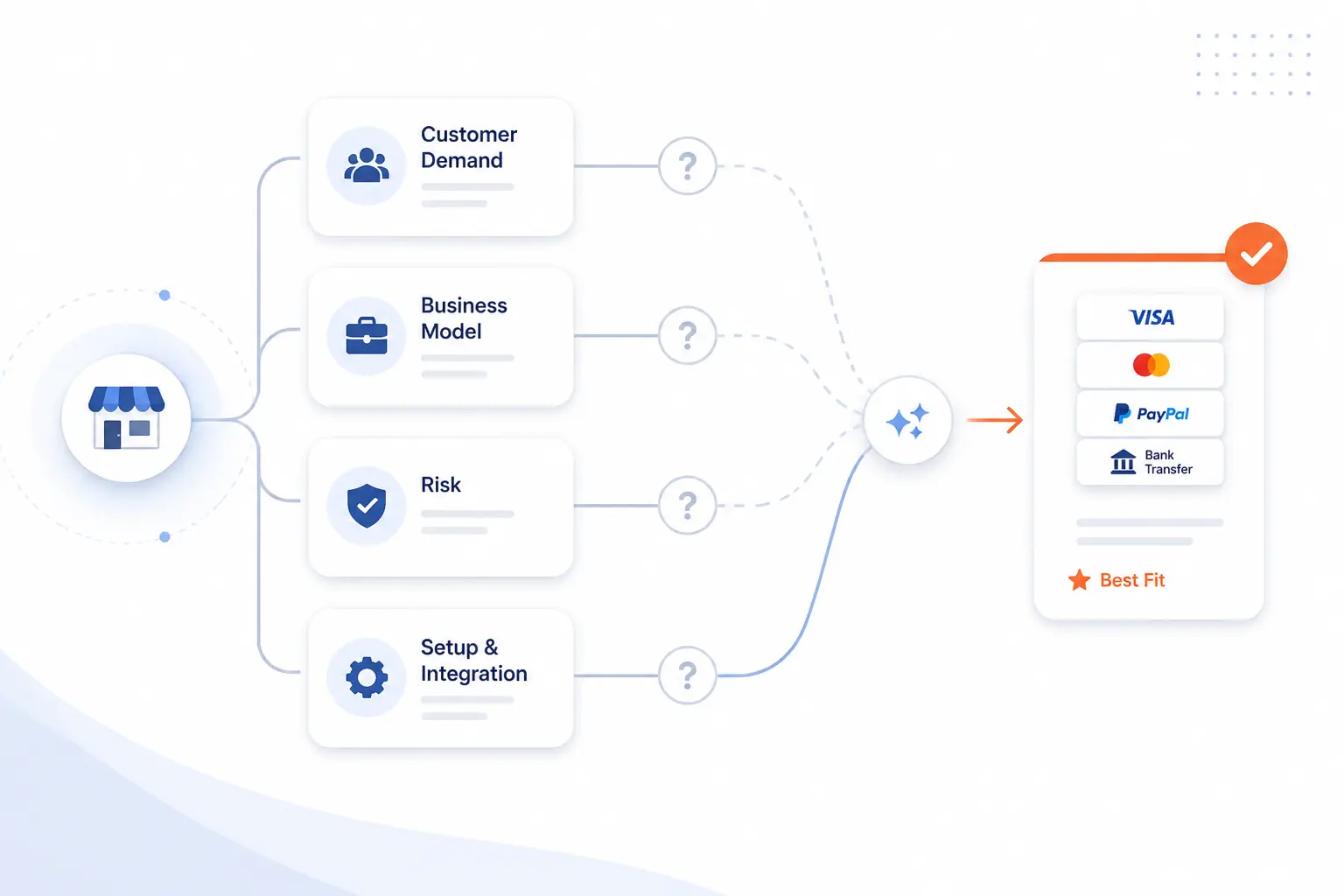
Choosing the right set is mostly about business fit. Start with what your customers already use, then add methods that help your margins, risk profile, and technical setup instead of complicating them. If a method does not solve a real checkout problem, it probably does not belong.
Customer Demand and Business Model Fit
Look at what your customers are already comfortable using before you add anything new. The Atlanta Fed’s 2024 consumer payment diary found 35% of consumer payments were made with credit cards and 30% with debit cards, so cards still deserve a first-class experience even when wallets are rising. Then map the extras to your model. Wallets help mobile speed, BNPL helps larger baskets, and pay by bank helps cost-sensitive or recurring use cases.
Fees, Fraud, Compliance, and Integration Requirements
Fee comparison is only half the job. You also need to know what risk and compliance work stays with you after you outsource payment handling. PCI SSC makes that point clearly. Even merchants that fully outsource checkout still have responsibilities, and SAQ A merchants with redirect pages or embedded iframes can still need external ASV scanning. Cheap payment acceptance gets expensive fast when security scope is misunderstood.
International Reach and Recurring Revenue Needs
If you sell across borders or rely on subscriptions, choose methods that match those realities from the start. Worldpay’s payments research says payment apps accounted for 67% of global e-commerce value in 2025, which is a strong signal that international checkout often needs more than plain card entry. For recurring revenue, also check whether the method supports merchant-initiated transactions, tokenization, and account updating, not just first-time payments.
How to Roll Out New Payment Methods Without Hurting Checkout
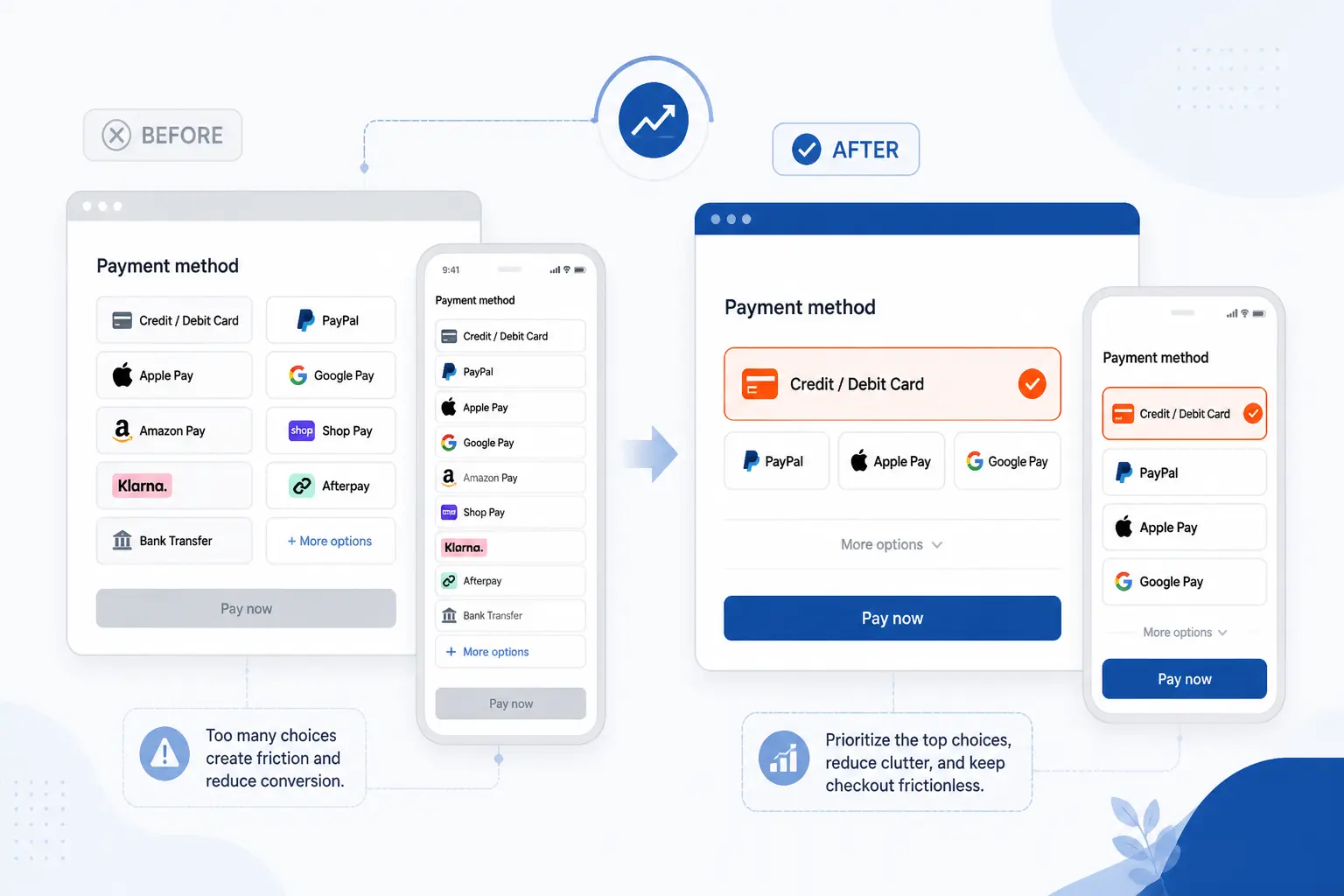
Rolling out a new method should make checkout clearer, not busier. The biggest rollout mistake is adding too many options without deciding which ones deserve top placement on mobile, desktop, or specific product pages. Good payment strategy is part merchandising, part operations.
Assess Needs Before Adding Another Option
Start with your traffic, devices, regions, and average order value. If most orders are small and mobile, wallets may do more than BNPL. If repeat billing drives revenue, bank or tokenized card methods may matter more than adding yet another branded button. The cleanest checkout is usually the one that solves the most common buying path first.
Confirm Provider Compatibility and Security Standards
Compatibility is not just about whether a logo can appear on the page. It is about how the payment form is hosted, where scripts originate, and what that does to your compliance scope. PCI SSC notes that SAQ A eligibility for ecommerce hinges on payment page elements originating from compliant service providers and on protecting merchant webpages from script attacks. In other words, “outsourced checkout” is not the same thing as “nothing to manage.”
Test Across Devices Before Launch
Always test on real devices and real checkout paths before launch. Google’s own deployment guide says the Google Pay test environment does not return live chargeable payment information and should be used to validate the purchase workflow before go-live. That same mindset applies to every wallet and BNPL method here. What looks fine in staging on desktop can fail badly on a phone.
Prioritize Mobile Speed and a Simpler Checkout
Once a method is live, place it where it can reduce work. Put wallet buttons where mobile users can act on them quickly. Keep default card entry clean. Avoid pushing niche methods above the options most customers already trust. Faster checkout usually comes from fewer decisions and less typing, not from showing every possible payment brand at once.
How Payment Priorities Change by Business Model
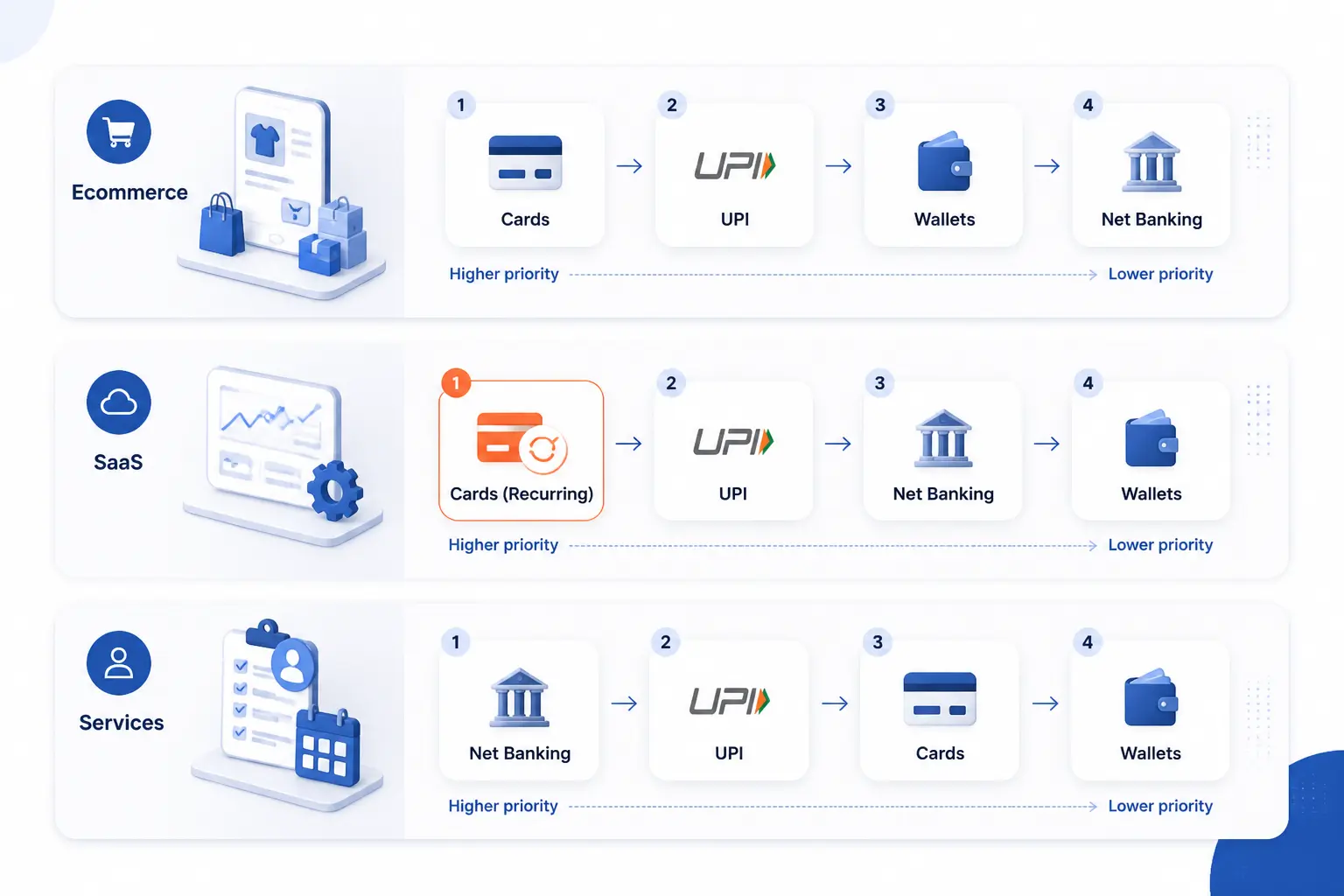
Different business models need different payment priorities. What works for a fashion store is rarely what works for a SaaS company or an on-demand service. That is why copying someone else’s checkout is usually a dead end.
Ecommerce and Marketplaces
Ecommerce and marketplace businesses usually need the broadest mix. Cards still matter, but wallets matter more on mobile, and BNPL matters when order value is high enough to change purchase behavior. A practical starting mix is strong card acceptance, one or two wallets, then a BNPL option only if basket size, category, and margin support it.
On Demand Services
On-demand services need speed and reliability more than breadth. Apple Pay, Google Pay, card-on-file support, and simple guest checkout usually do more for conversion than a long list of niche options. If the service is local and trust-based, direct transfer tools like Zelle can also make sense outside a traditional cart flow.
SaaS and Subscription Businesses
SaaS and subscription businesses should think beyond the first checkout. Recurring support, tokenization, updater services, merchant-initiated transactions, and recovery from expired credentials matter more here than flashy wallet coverage. Stripe, Adyen, Worldpay, Trustly, and Authorize.net all have stronger stories in that recurring-revenue lane than pure wallet providers do.
FAQ
The short answers below should help if you are still deciding what belongs in your checkout first. In most cases, the right approach is to start with a small, high-fit mix, then expand only when the data says another method would earn its place.
What Is the Best Online Payment Method?
The best online payment method for most businesses is the one customers already trust and can complete fastest. In practice, that usually means strong card acceptance plus PayPal or a major mobile wallet like Apple Pay or Google Pay. If your average order value is high, a BNPL option like Klarna, Affirm, or Afterpay may matter too.
What Are the Different Types of Online Payments?
The main types are card payments, digital wallets, bank transfers or pay-by-bank methods, and buy now, pay later financing. Some businesses also use recurring bank debits, invoicing links, or stored card payments for subscriptions. The right mix depends on what you sell and how your customers prefer to pay.
What Are the Top Payment Apps for Online Use?
The top payment apps for online use usually include PayPal, Apple Pay, Google Pay, and Amazon Pay. In cross-border or pay-later scenarios, Alipay, Klarna, Affirm, and Afterpay can also be important. The best mix still depends on your region, device split, and order size.
Which Online Payment App Is Most Widely Used?
Globally, digital wallets are now the most influential group of online payment apps. Which single app leads for your business depends on audience and region, but PayPal, Apple Pay, and Google Pay are among the most broadly relevant choices for U.S.-focused merchants. In some international markets, Alipay or local wallet behavior can matter more.
Which Online Payment Methods Should Small Businesses Offer First?
Small businesses should usually start with cards, PayPal, and at least one mobile wallet. That combination covers the broadest range of shoppers without making checkout messy. Add BNPL later only if your basket size, product category, and margins clearly support it.





Conclusion
The best online payment methods for faster checkout are the ones that match how your customers already want to buy. For many businesses, that means starting with cards, PayPal, Apple Pay, and Google Pay, then adding a pay-later or pay-by-bank option only when the business case is clear. Keep it simple, measure what people actually use, and let the data decide what earns a permanent spot.
If you are narrowing a shortlist today, ask yourself one practical question first. Which payment method would remove the most friction for your next 100 customers?