

- AI Tokens Are the Basic Units AI Models Read and Generate
- How Tokenization Breaks Text Into Model-Ready Units
- How Large Language Models Process and Generate With Tokens
- Why AI Tokens Matter for Cost, Speed, and Limits
- How to Count and Estimate Token Usage
- Where Tokens Show Up in Real AI Workflows
- How to Use Fewer Tokens Without Hurting Results
- FAQ
- Conclusion
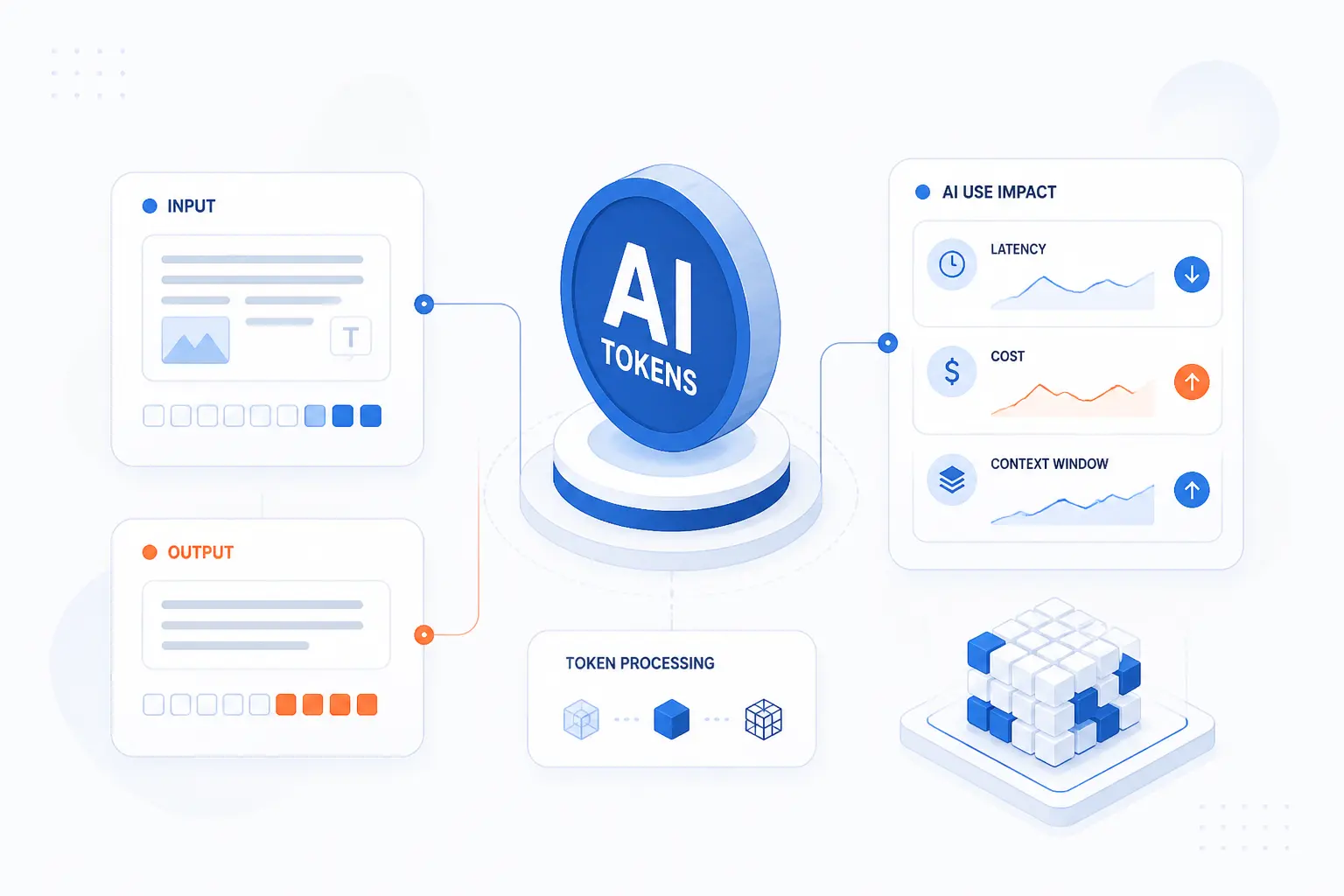
AI tokens are the small units an AI model reads as input and produces as output. They are not the same as words. One token might be a whole word, part of a word, a space, punctuation, or a special control symbol. When we talk about AI cost, speed, and limits, we are usually talking about how many AI tokens move through the model. At 1Byte, we think that one idea clears up most beginner confusion right away.
AI Tokens Are the Basic Units AI Models Read and Generate
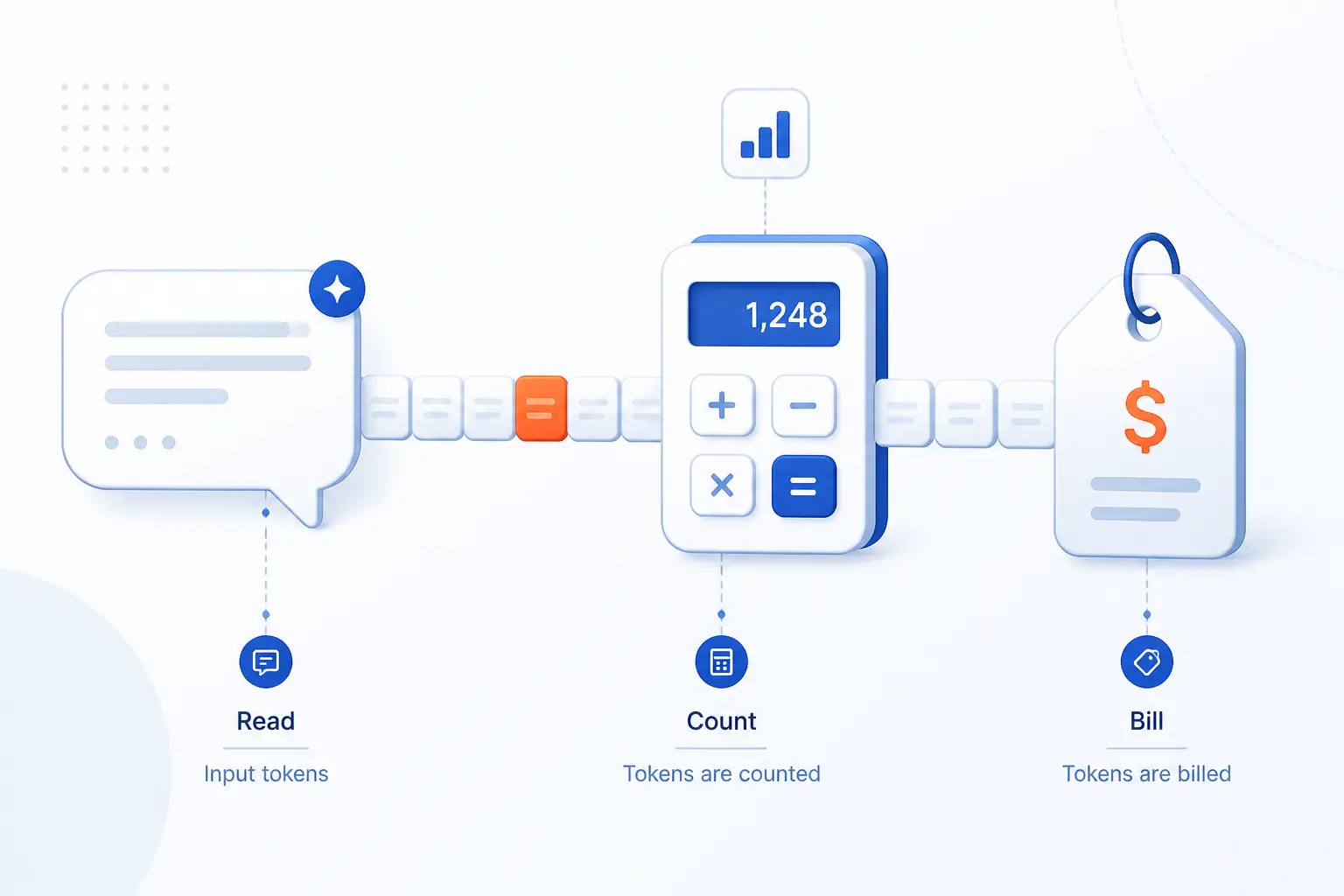
AI tokens are the model-sized chunks used to turn human language into something a machine can process. In plain terms, they are the units the model counts, stores, predicts, and bills against. That is why AI tokens affect pricing, context limits, and response length so directly. We usually tell beginners to stop picturing “words” and start picturing “pieces.” That mental shift makes the rest of the topic much easier to follow.
Those pieces matter because the model never sees your prompt the way you do on screen. It sees a sequence of units, then predicts new units one after another until it stops. If your prompt is long, your history is long, or your reply is long, the token total rises even when the text looks modest to a human reader.
FURTHER READING: |
| 1. What Is AI IoT? How Smart Devices Learn and Act |
| 2. AI Impact on Marketing Guide for Smarter Growth |
| 3. AI in Project Management for Smarter Delivery |
How Tokenization Breaks Text Into Model-Ready Units
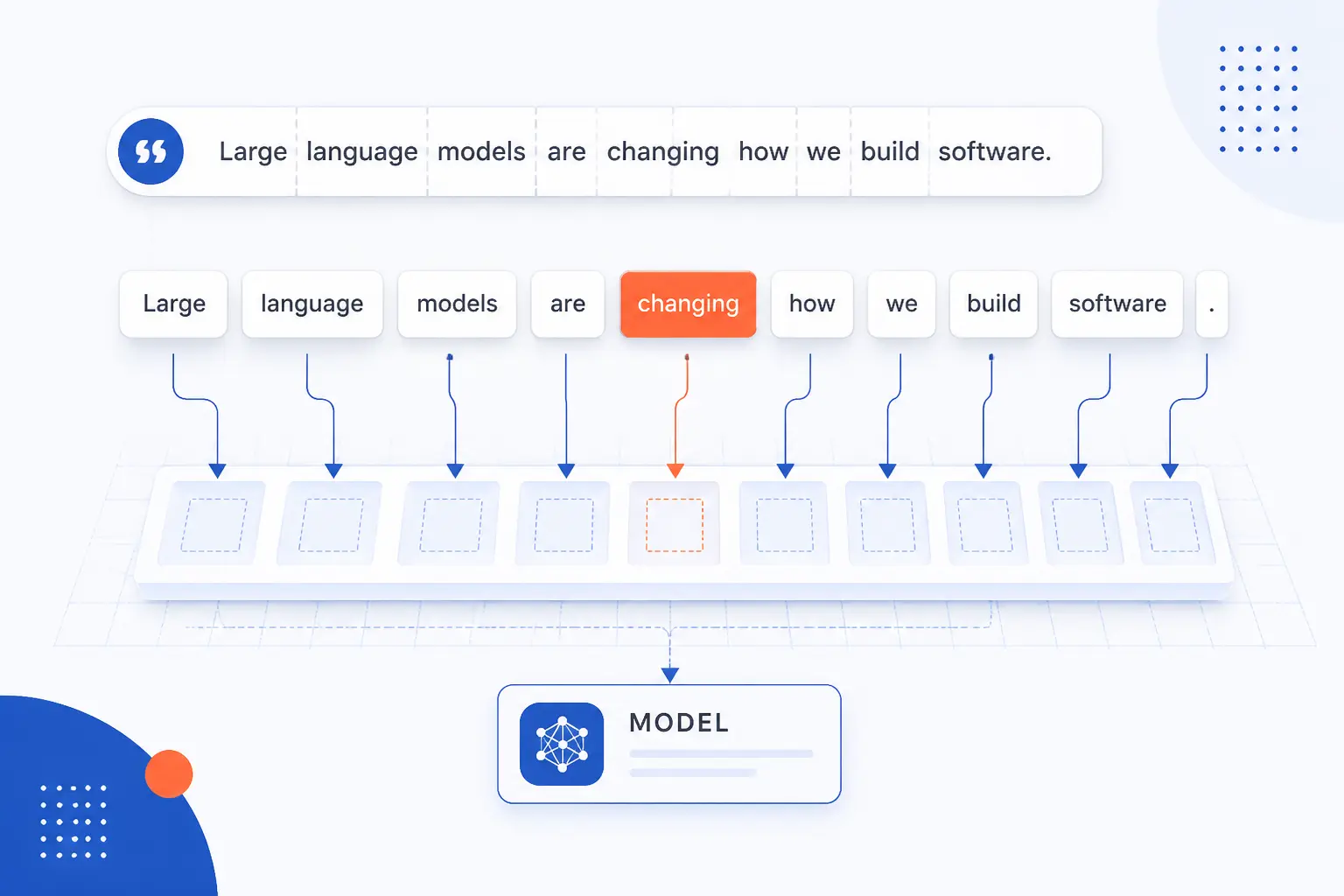
Tokenization is the step that breaks raw text into pieces a model can index and work with. It happens before the model “understands” anything. Different systems split text differently because they use different vocabularies and segmentation rules. We see this as the hidden layer of AI use that most people ignore until a bill or limit forces the issue. Once you understand tokenization, many odd model behaviors stop looking odd.
Words, Subwords, Spaces, and Punctuation
A tokenizer does not simply split on spaces. It often treats spaces, punctuation marks, and partial words as meaningful units too. In a glossary example, Hugging Face shows unfamiliar text like “VRAM” being broken into several smaller pieces instead of one neat word. That is why a short line of text can contain more units than you expect.
We think this is the first practical rule to remember: language gets chopped into what the model has learned to store efficiently, not what school grammar calls a word. Contractions, commas, code symbols, and leading spaces all change the count. That is also why two prompts with the same word count can still cost different amounts.
Why Different Models Split the Same Text Differently
Different models split the same sentence differently because they are trained with different vocabularies, rules, and optimization goals. Some tokenizers are built from pre-tokenized words, while others can learn directly from raw sentences, as described in this paper. That design choice affects how well a model handles spacing, multilingual text, and rare terms.
Real systems show this clearly. Meta says Llama 3’s updated vocabulary can yield up to 15% fewer pieces than Llama 2, which means the exact same prompt may fit more efficiently on one model than another. We see that as a reminder that a token count is never universal. It always belongs to a specific model and its tokenizer.
From Tokens to Numeric Vectors
After text is split, each piece is turned into an integer ID and then into a learned vector so the model can do math on it. That ID step is visible in the same glossary example, where the encoded sequence is stored under input_ids. Once the pieces become numbers, the network can compare positions, patterns, and relationships.
From there, the model uses learned representations rather than raw characters. We like to explain it this way: tokenization decides the pieces, and embeddings give those pieces coordinates in a mathematical space. That is where similarity, context, and prediction begin to take shape.
How Large Language Models Process and Generate With Tokens
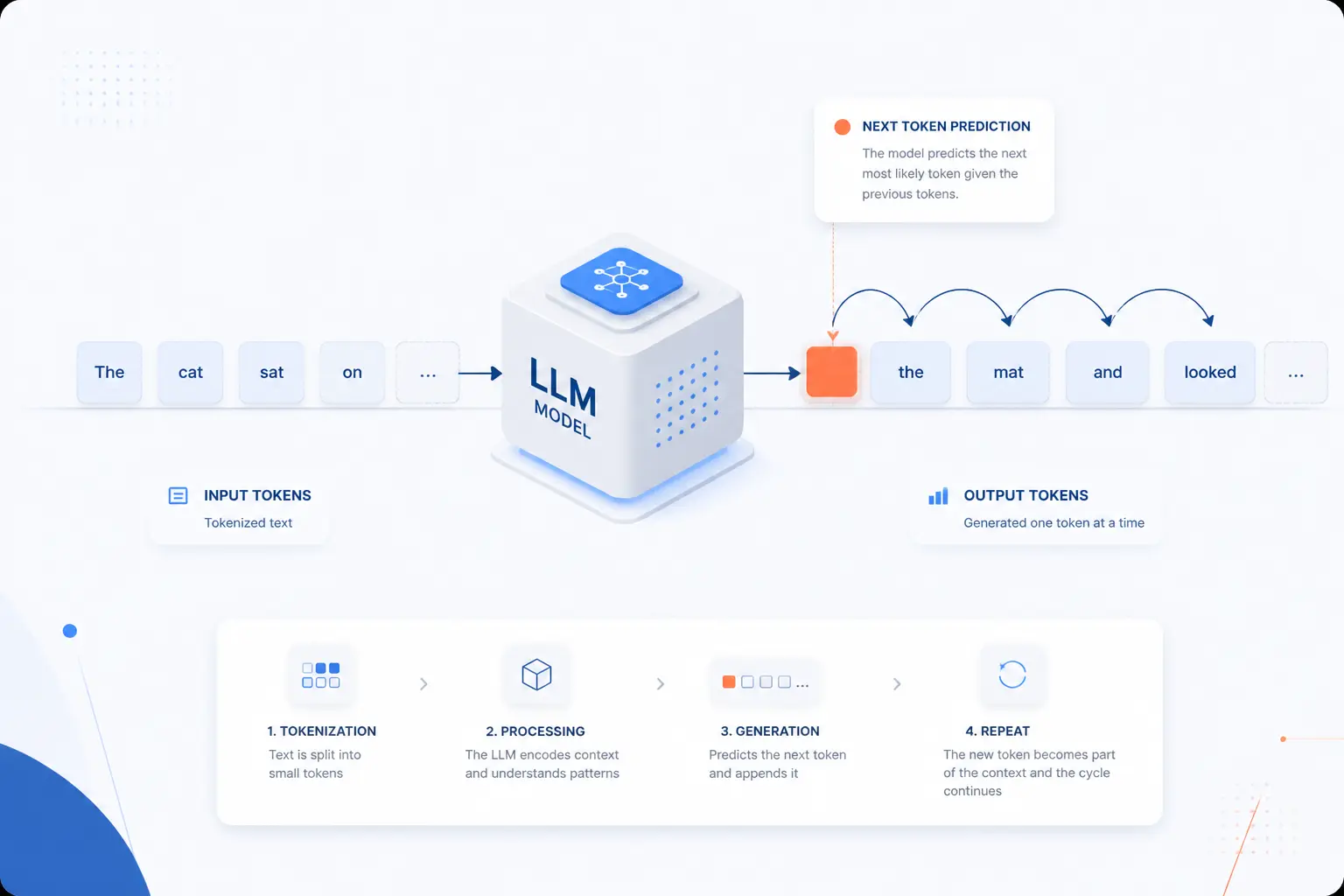
Large language models process AI tokens as ordered sequences and generate new ones by predicting what should come next. Training teaches the model statistical patterns over huge token streams. In use, your prompt becomes the current sequence, and the model extends it step by step. This sounds simple because, at the core, it is simple. The complexity comes from scale, not from a different basic unit.
Training on Massive Token Sequences
Training means feeding the model enormous tokenized text sequences and updating it when its predictions miss the mark. The scale is hard to overstate, but the mechanism is familiar: see a sequence, guess the next part, compare, adjust, repeat. We find that many beginners imagine training as storing answers, when it is closer to compressing patterns from giant amounts of data.
That approach is why LLMs pick up grammar, style, code patterns, and common factual structures. They do not memorize every sentence in a tidy library. They learn probability distributions over sequences they have seen, then reuse those patterns when new prompts arrive.
Reading Prompts as Input Tokens
When we send a prompt, the model receives a bounded sequence of input tokens, not a magical blob of text. System instructions, user messages, tool results, retrieved passages, and attached text all compete for the same space. That is why a “simple” chatbot can hit limits quickly once history and search results pile up.
In practice, this is where many teams overspend. They send full documents when excerpts would do. They keep every turn of a chat when only the last few still matter. We see far more waste in excess context than in short answers.
Predicting Output Tokens One Step at a Time
Generation is iterative: the model predicts one output token, adds it to the sequence, and then predicts the next. The autoregressive pattern is described in the original paper, which explains that the decoder generates symbols one element at a time. That one fact explains a lot about latency and why long answers take longer.
It also explains why output control matters. If we ask for a five-line answer, the model has fewer prediction steps to take than if we ask for a 2,000-word essay. Shorter answers are not just cheaper. They are mechanically shorter generation runs.
Why AI Tokens Matter for Cost, Speed, and Limits
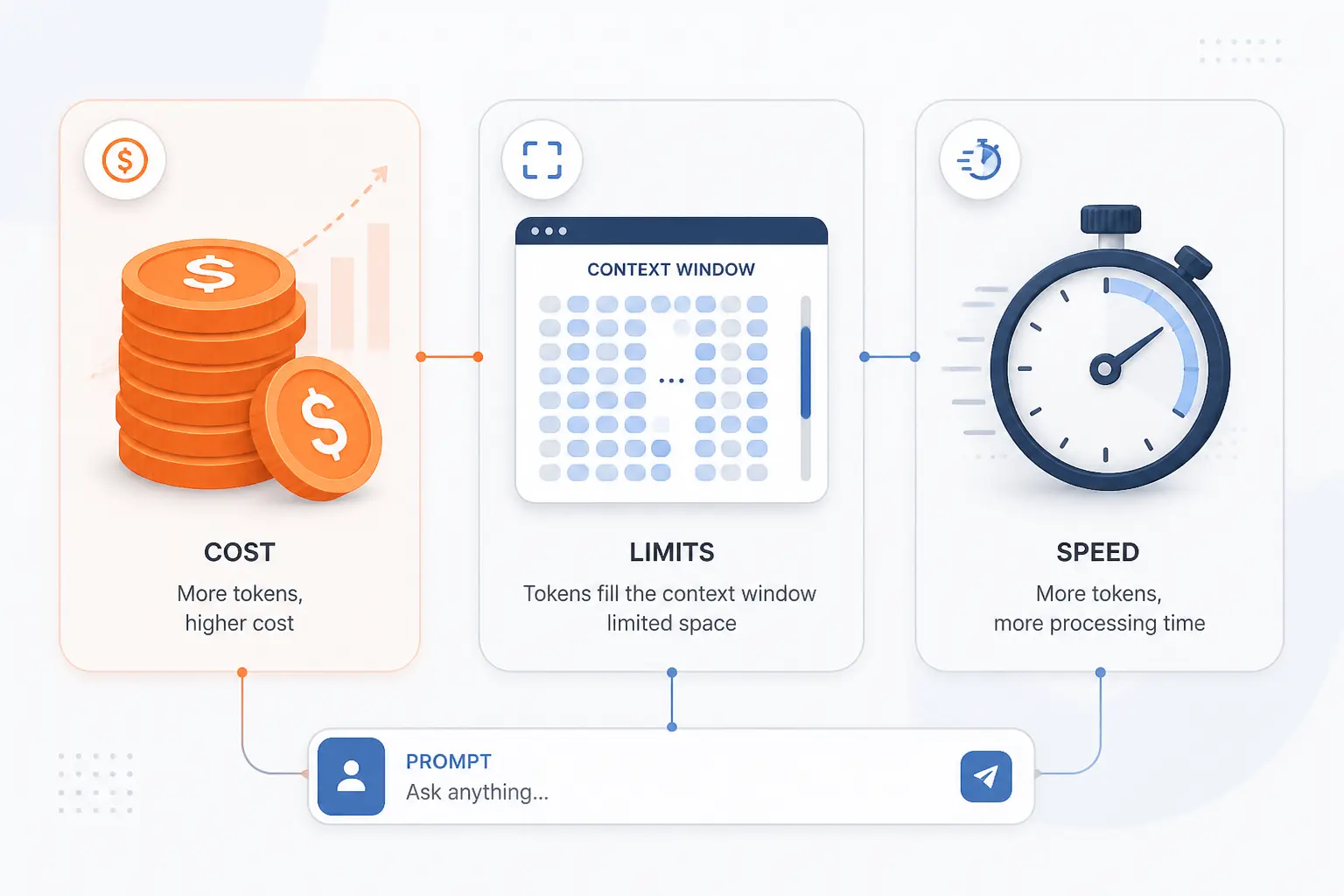
AI tokens matter because they define three practical constraints at once: what you pay, what fits in context, and how long the interaction takes. If you ignore token counts, AI feels random. If you track them, model behavior becomes much more predictable. At 1Byte, we see token awareness as basic operational hygiene, not advanced optimization. It belongs in the first week of using any model seriously.
Billing and Usage Costs
Most API providers bill based on how many input and output pieces you use, and some discount reused context. That means the same request can have several cost buckets even before tools or images enter the picture. We think this is the fastest way to explain why “a million” is not one flat price. Direction matters, and so does whether the model can reuse prior context.
Context Windows and Response Length
A context window is the maximum amount of model-readable content a system can consider in one request. On one current example, OpenAI lists a 1,050,000 context window and a separate maximum output allowance for GPT-5.4 Pro. That is generous, but it is still a limit, and every prompt, attachment, and tool result counts against it.
We tell readers not to confuse large context with infinite memory. If you keep stuffing in transcripts, PDFs, and chat history, you can still run out of room. Even before you hit the hard ceiling, crowded context can make it harder to control what the model focuses on.
Latency, Throughput, and User Experience
More tokens usually mean slower replies and lower throughput because the system has more input to read and more output to generate. You feel this in two places. The first is time to first answer. The second is time to finish a long answer.
That is why lean prompts often feel snappier than bloated ones. We would rather send one precise paragraph than five fuzzy ones. In production, token discipline is often the difference between a crisp assistant and one that feels like it is wading through mud.
How to Count and Estimate Token Usage
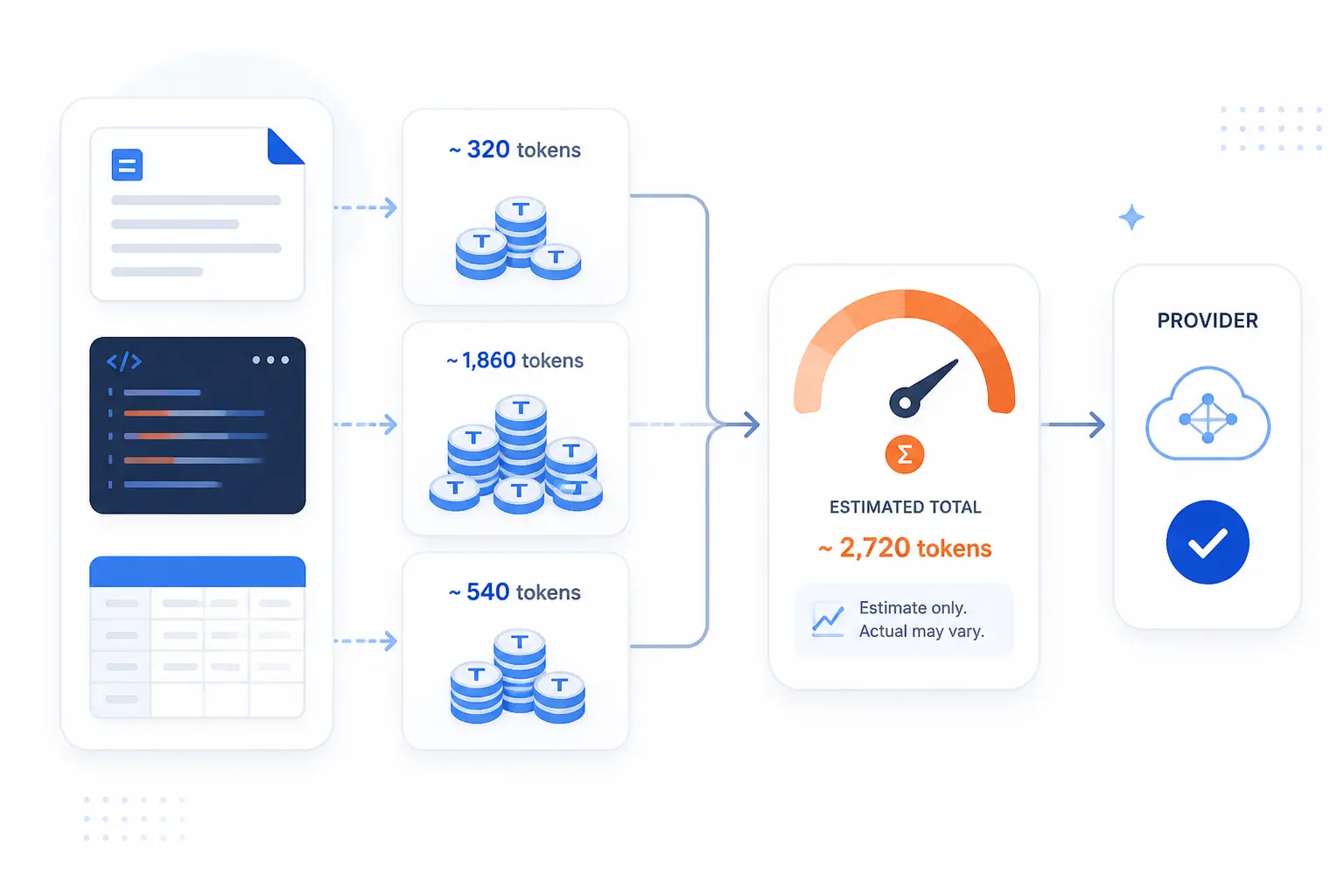
You can estimate token usage well enough for planning without counting every piece by hand. The trick is to use rough rules for prose, then watch for content types that break those rules. Code, tables, logs, and multilingual text are the usual troublemakers. We advise estimating first, then checking real usage from the provider response. That habit keeps both budgets and surprises in check.
Rules of Thumb for English Text
For English prose, rough estimates are useful but never exact. Provider docs commonly frame the count in characters and word fractions rather than lines or pages. We use those estimates for budgeting, not for precise billing. If a project lives near a hard limit, always measure the real count instead of trusting a rule of thumb.
Why Code, Rare Terms, and Other Languages Use More Tokens
Dense code, uncommon identifiers, emoji, and many non-English scripts often consume more pieces than plain English. A short JSON block, a stack trace, or a medical term can split into many fragments even when it looks compact on screen. We see this mistake constantly when teams estimate by word count alone.
Language also matters. Some writing systems map efficiently to a tokenizer’s vocabulary, while others fragment more. The same goes for code. Punctuation, indentation, variable names, and repeated symbols all add up fast.
Input, Output, Cached, and Reasoning Token Totals
Most provider dashboards separate usage into at least input and output, and some also break out cached usage. OpenAI’s usage reference lists fields such as input_tokens, output_tokens, and input_cached_tokens. That distinction matters because the cheapest million and the most expensive million may not be the same kind of usage.
Some newer models also expose reasoning-related support or controls, which means internal work can affect how you think about budget and latency even when the final visible answer is short. We recommend reading the usage object after every test run. Guessing is fine for drafts. Logging is better for production.
Where Tokens Show Up in Real AI Workflows
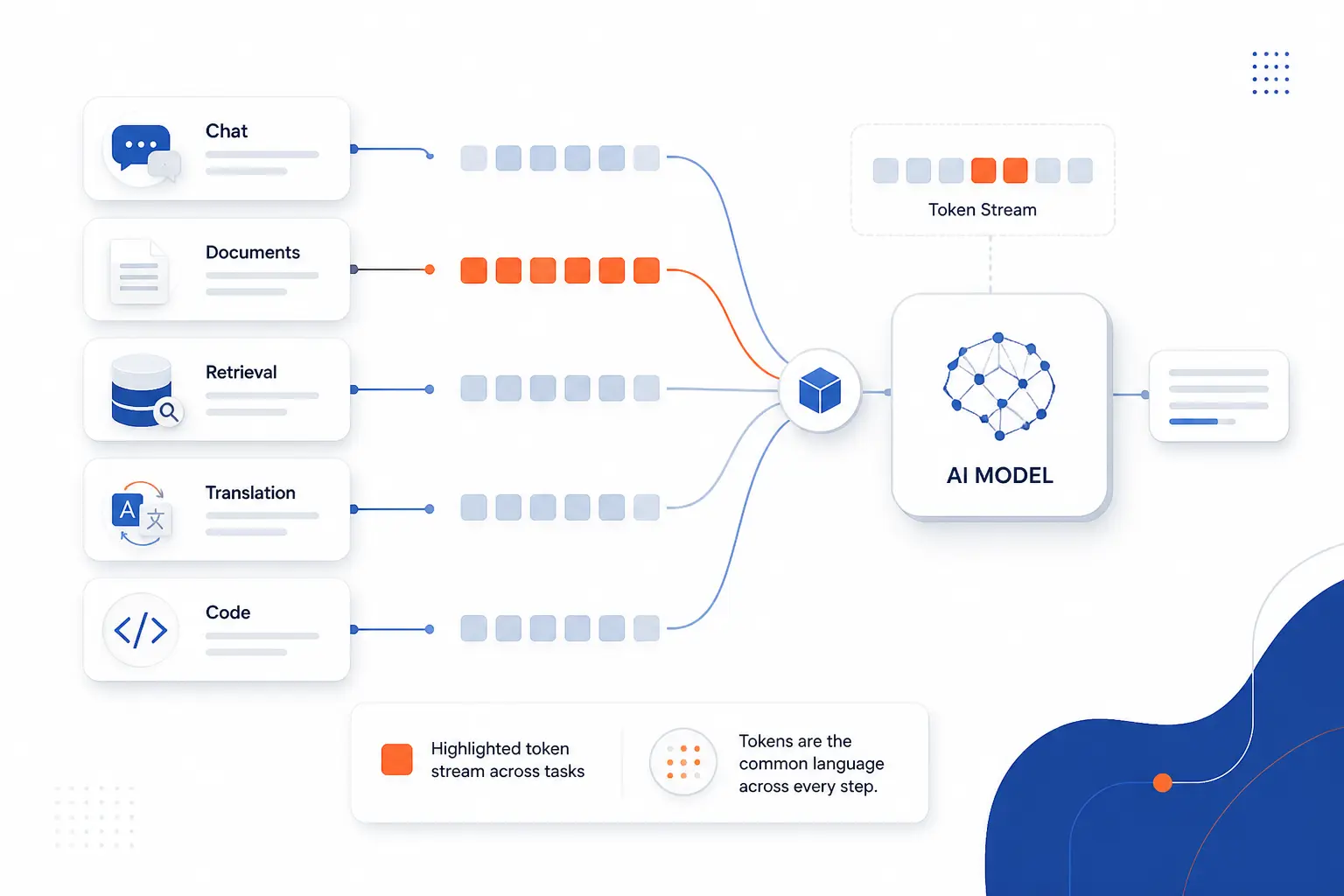
Tokens show up anywhere a model must count, limit, or bill model-readable input. That includes chat, summarization, retrieval-augmented generation, translation, sentiment analysis, and code tasks. They also show up in multimodal systems, though providers may count text, image, or audio units differently. We think this is where the concept becomes real. Once tokens touch your workflow, they stop being abstract.
Text Generation, Chat, and Summarization
In chat and writing tools, every instruction, message, and pasted source passage affects the total. A short user question can still become an expensive request if the system prompt is long and the conversation history is sprawling. That is why support bots, research assistants, and document summarizers all need token discipline.
Summarization is a classic example. If we feed a full report into a model, the input may dwarf the answer. When people say AI is “expensive,” the hidden culprit is often long context, not long output.
Translation, Sentiment Analysis, and Code
Task type changes token behavior even when the visible text length looks similar. Sentiment analysis may use a tiny prompt and a tiny reply, while code generation may burn through far more pieces because syntax, indentation, and odd identifiers fragment easily. Translation sits somewhere in the middle and depends heavily on language pair and writing system.
We like real examples here. A plain customer review might be cheap to classify. A short SQL query plus schema plus expected JSON output can be more expensive than it looks. The screen length fools people. The count does not.
Images, Audio, Video, and Other Data Types
Multimodal systems still meter model-ready input, but providers may label the units separately for different modalities. For example, OpenAI’s image model page lists separate pricing buckets for text input and image input on the same model. That is the practical takeaway for beginners: once you move past plain text, do not assume one flat unit of cost.
We expect the same pattern to keep spreading. Images, audio, and video still have to be turned into model-consumable pieces somehow, even if the provider wraps that in a more specialized pricing scheme. If your workflow mixes media types, budget for each one explicitly.
How to Use Fewer Tokens Without Hurting Results
The best way to use fewer tokens is to remove waste, not intelligence. Good prompts are compact because they are clear, not because they are vague. At 1Byte, we have found that shorter usually wins only when it is also sharper. The goal is to keep the signal and cut the padding. Done well, that improves cost, speed, and consistency at the same time.
Write Clearer, Shorter Prompts
State the task, the needed output format, and the constraints once, then stop. Repeating instructions in three different ways rarely helps. It usually just consumes budget and gives the model more wording to reconcile.
We prefer a tight pattern: role, task, context, output format. If an example is necessary, include one strong example, not five weak ones. Clear beats long almost every time.
Trim Conversation History and Large Inputs
Keep only the turns and documents the model still needs. Old greetings, repeated confirmations, and irrelevant detours should be summarized or dropped. Long chat history is one of the easiest places to cut usage without cutting quality.
The same goes for files. Send the relevant section of a handbook, not the whole handbook. Pass the error trace, not the entire log directory. We would rather curate context than make the model do our housekeeping.
Control Response Length and Retrieved Context
Put hard bounds on how much the model may return and how much outside material you attach. If you only need five bullets, ask for five bullets. If your retrieval system finds twenty passages, do not dump all twenty into the prompt.
Small controls go a long way here. Limit output size. Cap retrieval results. Chunk source material sensibly. Those simple moves usually save more than heroic prompt rewrites.
FAQ
The short answers are practical. Providers count these units with a tokenizer, rough text size is only an estimate, cost depends on the model and direction of use, and the term usually does not refer to something you can buy as an investment. We find that most confusion comes from mixing technical usage with crypto marketing. Keep those two meanings separate and the FAQ becomes much easier.
How Are AI Tokens Counted?
They are counted by the model’s tokenizer before input is processed and as output is generated. Providers usually report the totals in usage fields, often split into input, output, and sometimes cached categories. The key point is that counting happens at the model-unit level, not by visible words or characters alone.
How Much Text Is 1,000 Tokens?
For English prose, 1,000 tokens is often roughly 750 words. Anthropic’s pricing reference gives the common estimate of about four characters or three-quarters of a word per token in English. Treat that as a planning shortcut, not a billing guarantee.
How Much Can 1,000,000 Tokens Cost?
It depends on the model and on whether those pieces are input, cached input, or output. As one current example, GPT-5 mini lists $0.25 input and $2 output per million, with a lower cached-input rate as well. In other words, a million can cost pocket change or real money depending on what kind of usage it is.
Can You Invest in AI Tokens?
Usually no, not in the sense discussed in this article. Here, AI tokens are metered units of model input and output, not shares, funds, or standard investable assets. If you see “AI tokens” used in crypto marketing, that is a different category entirely and should not be confused with LLM usage units.







Conclusion
AI tokens are the units that make model use measurable. They shape what fits, what costs money, and what returns quickly. Once we understand that, AI stops feeling like a black box and starts feeling like an engineered system with readable limits.
At 1Byte, our view is simple: learn tokens early and you will make better decisions everywhere else, from prompt design to cost control. If you are building with AI now, the next smart step is to inspect the token totals in your own prompts and see where the waste really is.