

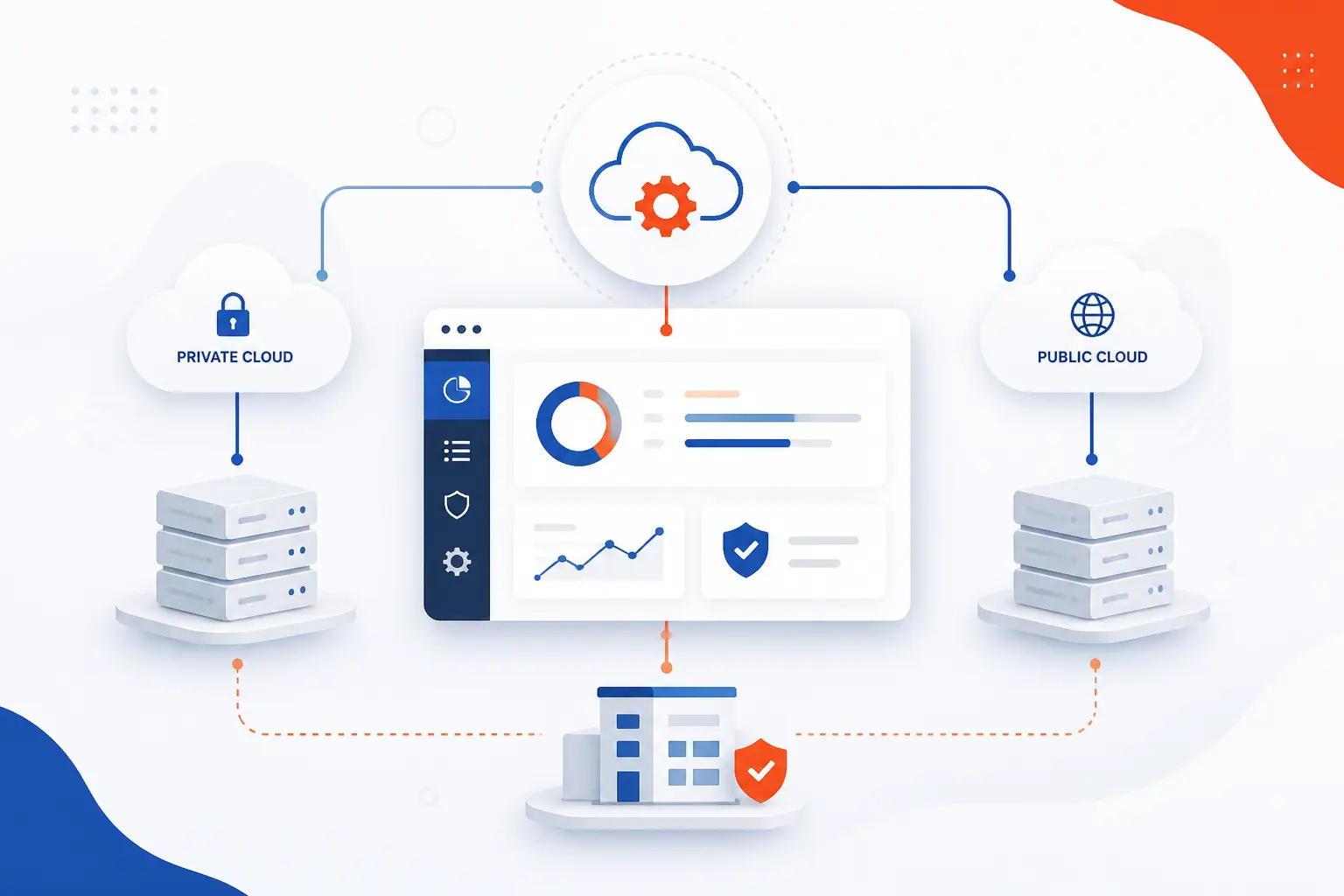
- Hybrid Cloud Management Is the Unified Control of On-Premises, Private, and Public Cloud Resources
- How It Fits Into a Hybrid Cloud Environment
- What a Unified Management Platform Actually Handles
- Why Businesses Use This Operating Model
- Challenges That Make Hybrid Operations Harder
- How to Plan a Sustainable Hybrid Strategy
- Examples of Hybrid Cloud Management Tools
- Where This Approach Shows Up in Practice
- FAQ
- How 1Byte Supports Hybrid Cloud Operations
- Conclusion
Hybrid cloud management is the practice of running on-premises systems, private cloud resources, and public cloud services as one controlled environment. In simple terms, it is how teams provision, monitor, secure, govern, and pay for workloads that live in more than one place. We think that distinction matters because many businesses already have a hybrid setup, but they do not always manage it in a unified way. When that happens, costs drift, visibility breaks, and operations get harder than they need to be.
At 1Byte, we see hybrid cloud management less as a product category and more as an operating discipline. It gives a business one way to decide where an application should run, how data should move, who is allowed to change what, and how performance and spend are tracked across environments. That is why it matters. Without it, hybrid cloud becomes a patchwork. With it, hybrid cloud becomes a deliberate architecture.
Hybrid Cloud Management Is the Unified Control of On-Premises, Private, and Public Cloud Resources
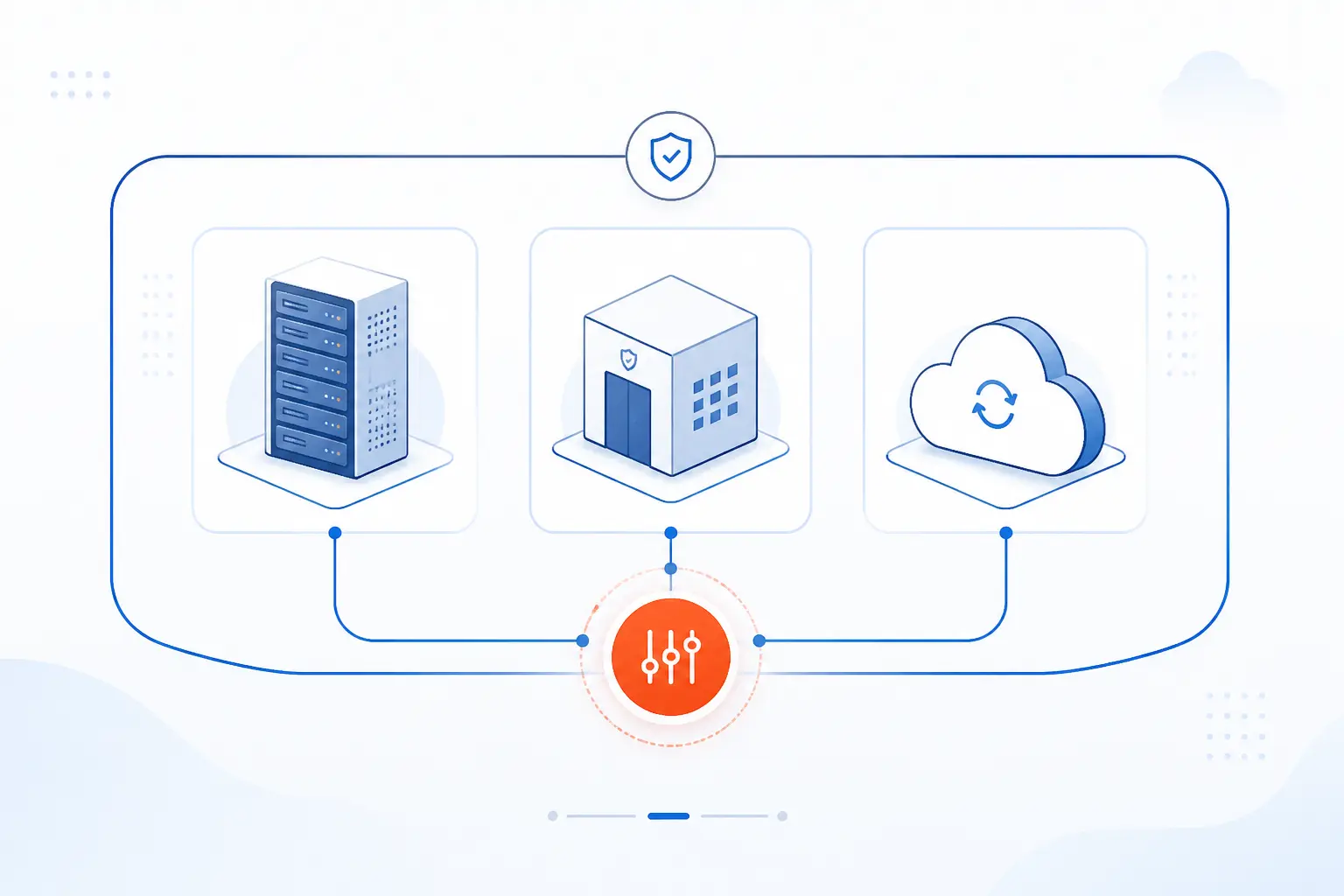
Hybrid cloud management is the unified control layer for infrastructure and applications spread across public cloud, private cloud, and on-premises systems. Its job is to make those separate environments behave like one operating model, even when the hardware, tools, and ownership lines differ. In practice, that means shared policies, common automation, centralized visibility, and consistent cost controls. The baseline definition of hybrid cloud itself comes from NIST SP 800-145, which describes a composition of distinct clouds bound together for data and application portability.
FURTHER READING: |
| 1. What Is SMTP Server? How Email Delivery Works |
| 2. HTML Fonts Guide to Web-Safe Fonts, Google Fonts, and CSS Styling |
| 3. What Is FTP Hosting and How Does It Work |
How It Fits Into a Hybrid Cloud Environment
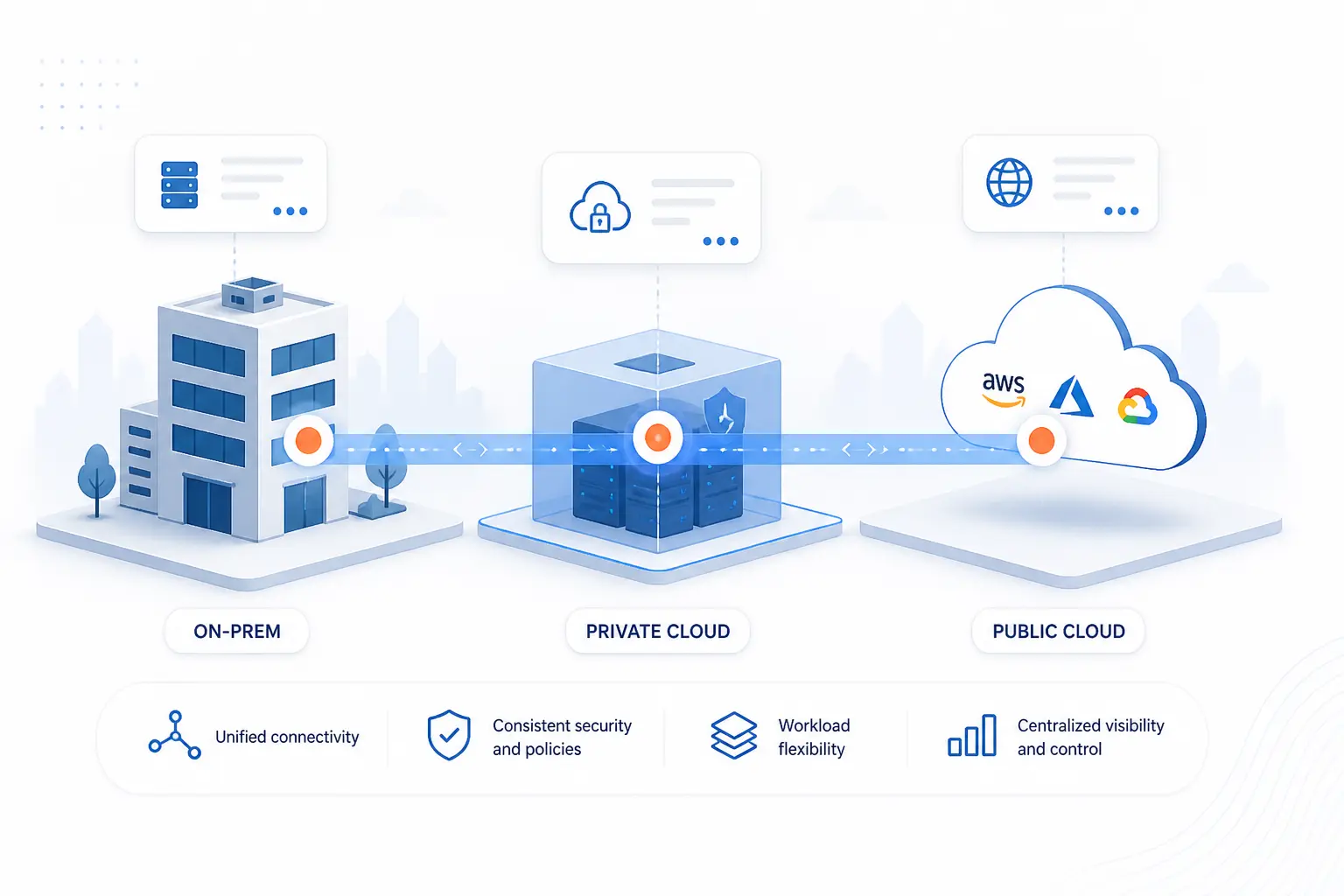
Hybrid cloud management fits across every part of the environment because the environment itself is mixed by design. It does not replace public cloud, private cloud, or on-premises infrastructure. It coordinates them. That coordination is increasingly relevant in the field, where 39% of respondents in the 2024 CNCF Annual Survey said they were using a combination of on-premises and public cloud. We usually tell readers to picture the model as one control plane sitting above several resource pools.
| Environment | What it usually hosts | What management must account for |
|---|---|---|
| Public cloud | Elastic apps, short-term capacity, managed services | Usage spikes, identity, spend, provider-native services |
| Private cloud | Controlled internal platforms and regulated workloads | Capacity planning, internal standards, security boundaries |
| On-premises infrastructure | Legacy systems, local databases, specialized hardware | Hardware lifecycle, networking, backup, operational overhead |
| Multicloud layer | Apps spread across more than one public cloud | Portability, policy consistency, duplicated tooling |
Public Clouds
Public clouds provide the most elastic part of a hybrid environment. Teams often use them for burst capacity, managed databases, AI services, test environments, and workloads that benefit from fast global deployment. The management challenge is not access to resources. It is controlling sprawl, permissions, network paths, and bills once teams can create resources in minutes.
Private Clouds
Private clouds give an organization cloud-style automation with tighter ownership and policy control. They are common when a business wants self-service provisioning but must keep stronger control over data location, security design, or internal platform standards. In a hybrid setup, private cloud often becomes the steady-state home for sensitive or predictable workloads.
On-Premises Infrastructure
On-premises infrastructure is the physical and virtual estate a business still runs in its own facilities or dedicated colocation footprint. This is where older line-of-business systems, appliances, specialized licensing, and latency-sensitive workloads often remain. Hybrid cloud management matters here because these systems rarely disappear overnight. They have to be monitored, secured, and integrated alongside newer cloud services.
Where Multicloud Expands the Picture
Multicloud expands the picture by adding more than one public cloud provider to the mix. That is not the same thing as hybrid cloud, but the two often overlap. Once a team runs private or on-prem workloads plus two public clouds, the operational burden rises fast. Naming, identity, logging, policy, and cost allocation can diverge unless they are intentionally standardized.
What a Unified Management Platform Actually Handles
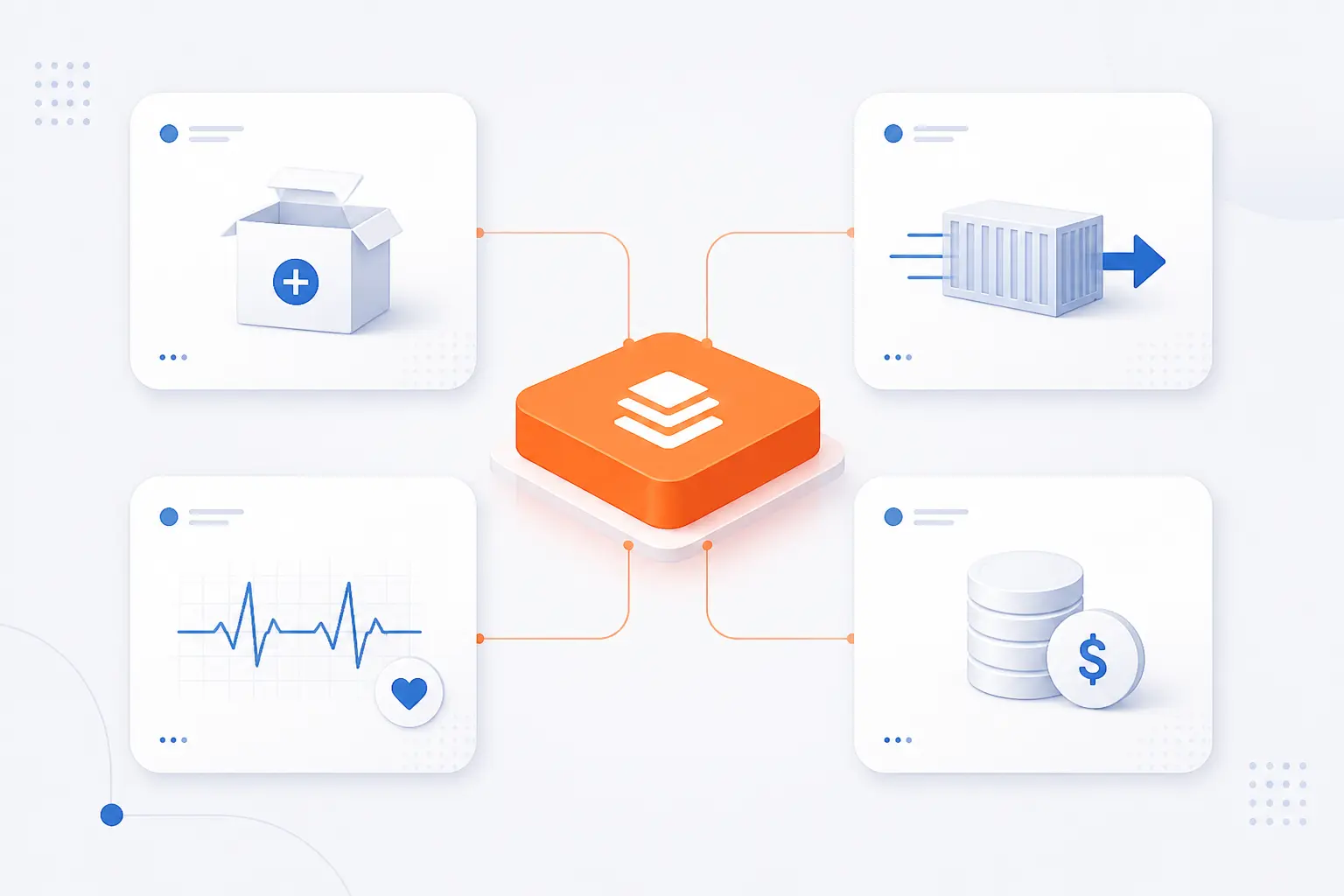
A unified management platform handles the daily operational tasks that make a hybrid environment usable at scale. It is less about a single magic dashboard and more about a consistent way to provision resources, move workloads, watch health, enforce rules, and track spend. We think the best platforms reduce translation work between environments. They give teams fewer one-off procedures and more repeatable workflows.
Provisioning and Scaling Resources
Provisioning and scaling resources means creating infrastructure in a repeatable way instead of clicking through every environment by hand. In mature teams, that usually happens through templates and infrastructure as code. The official Terraform docs describe this approach as a way to define and manage both cloud and on-prem resources with one workflow. That matters in hybrid operations because the same application may need network, compute, storage, and DNS changes in more than one place.
Orchestrating Workloads Across Environments
Orchestrating workloads across environments means deciding where an application runs and how it moves when conditions change. A team might keep a database on-premises, run core services in a private cluster, and push front-end traffic to the public cloud during peak demand. Good orchestration keeps those choices intentional. It handles placement, failover, dependencies, and service connectivity without turning every deployment into a manual handoff.
Monitoring Performance and Visibility
Monitoring performance and visibility means seeing one service as one service, even when its parts live in different places. In real life, that requires shared metrics, logs, traces, and alerting rules. The Kubernetes observability guidance shows how metrics pipelines and centralized logging work, including multi-cluster visibility patterns that are common in hybrid estates. We view this as a non-negotiable baseline because blind spots are where outages like to hide.
Governance, Security, and Compliance
Governance, security, and compliance are the guardrails that keep hybrid flexibility from turning into operational chaos. Teams need common identity rules, access boundaries, tagging standards, change controls, and policy checks that apply everywhere. The OPA documentation frames this well by treating policy as code that can be enforced across services, Kubernetes, and CI/CD pipelines. That is especially useful when one team works in a public cloud account while another maintains on-prem or private infrastructure.
Tracking Spend and Optimizing Costs
Tracking spend and optimizing costs means turning raw usage into decisions about value, waste, and placement. In hybrid environments, that is harder than it sounds because some costs are variable and some are fixed, and some sit in cloud invoices while others sit in hardware, licensing, and staff overhead. The FinOps Framework treats this as a cross-functional discipline involving engineering, finance, and business teams. We agree with that view. Cost control is rarely a tooling problem alone.
Why Businesses Use This Operating Model
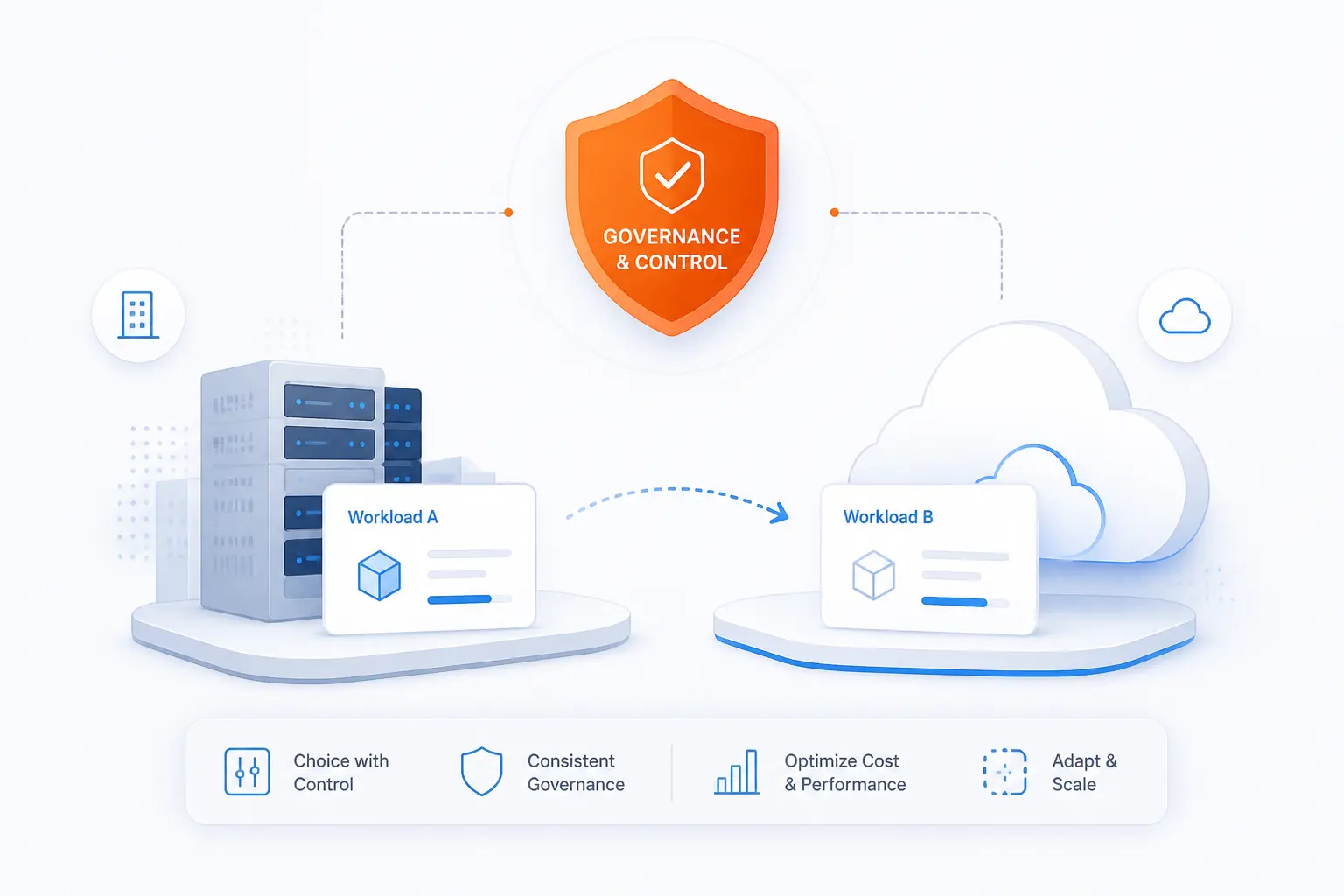
Businesses use hybrid cloud management because they want choice without losing control. The operating model lets them keep the workloads that should stay close, move the workloads that should be elastic, and govern both with fewer conflicting processes. In our experience, the appeal is practical rather than ideological. Most teams are not chasing a perfect diagram. They are trying to balance performance, risk, compliance, and budget.
Flexibility and Resource Optimization
Flexibility and resource optimization are the clearest benefits of this model. A business can place stable systems where it already has sunk cost, and move variable workloads to infrastructure that expands on demand. That reduces the need to overbuild every environment for the worst-case scenario. It also gives architects room to match workloads to the hardware, latency, and data locality they actually need.
Resilience, Backup, and Disaster Recovery
Resilience, backup, and disaster recovery are major reasons companies keep hybrid designs in play. The point is not just to copy data somewhere else. It is to preserve service when one environment fails or becomes unavailable. A public example comes from USAID, which GSA describes as completing a 2018 migration with full disaster recovery in a hybrid setup for business-critical systems. That is the kind of outcome hybrid management is supposed to support.
Support for Modern Apps and Cloud Bursting
Support for modern apps and cloud bursting is where hybrid operations often feel most tangible. A retailer might keep its inventory system close to existing databases, then burst web and API capacity into the public cloud during holiday traffic. A data team might train models in one environment and serve them from another. The key is not the burst itself. It is having policy, networking, and automation ready before demand arrives.
Challenges That Make Hybrid Operations Harder
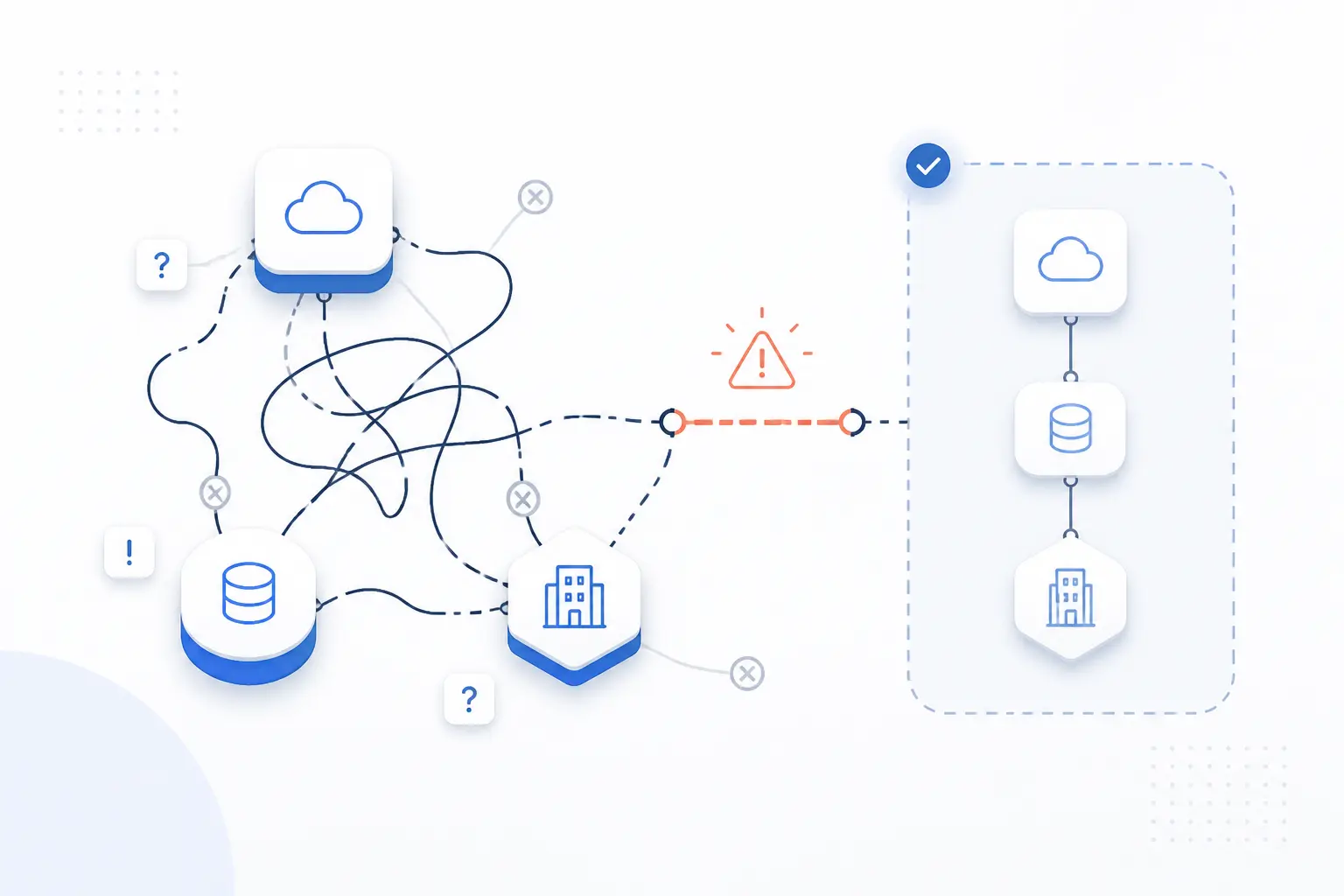
Hybrid operations are harder because they combine different infrastructure models, ownership patterns, and failure modes into one system. The reward is flexibility, but the cost is complexity. We think this is where many projects stumble. Teams underestimate the operational glue required between environments, then discover that the hardest part is not provisioning resources. It is keeping standards and visibility consistent afterward.
Complexity and Interoperability
Complexity and interoperability are the first obstacles most teams hit. APIs differ, networking differs, IAM models differ, and managed services do not map neatly from one provider to another. Even simple tasks, like moving an app that depends on a provider-specific load balancer or database feature, can turn messy. Hybrid cloud management helps, but it cannot erase real architectural differences.
Data Movement and Visibility Gaps
Data movement and visibility gaps can quietly undermine the whole design. Data may need to cross regions, vendors, private networks, and compliance boundaries, each with its own latency and security tradeoffs. Meanwhile, logs and metrics may land in separate tools that do not tell one coherent story. If teams cannot see where data lives and how systems behave end to end, decision-making slows down fast.
Skills, Governance, and Vendor Lock-In
Skills, governance, and vendor lock-in are long-term pressure points. Running hybrid well demands cloud knowledge, platform engineering discipline, networking fluency, security judgment, and cost awareness. At the same time, weak governance leads to sprawl, while overly tight governance blocks delivery. The trick is to standardize where it counts and stay portable where lock-in would become expensive later.
How to Plan a Sustainable Hybrid Strategy
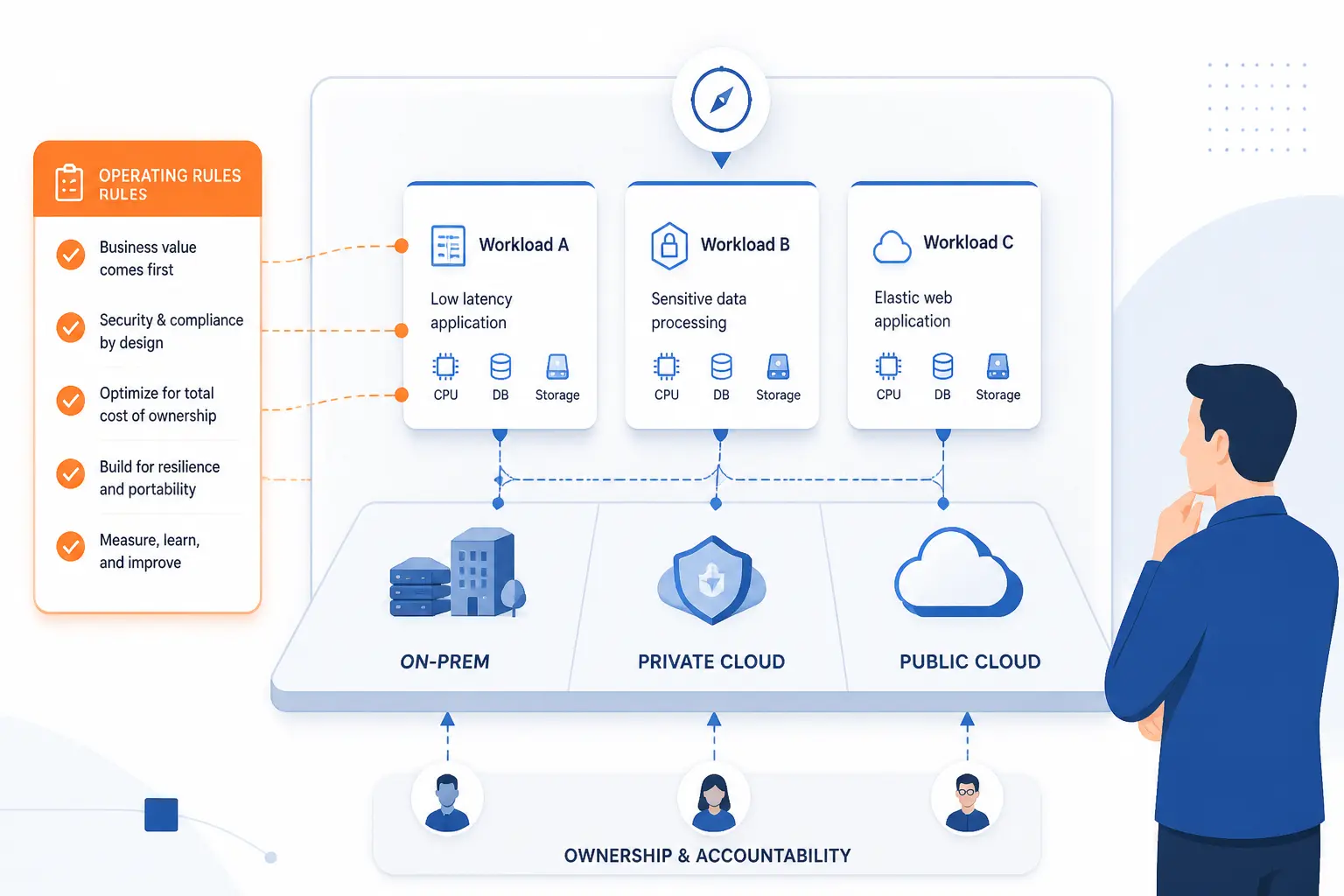
A sustainable hybrid strategy starts with operating rules, not just architecture diagrams. The best plans decide who owns which environments, what standards apply everywhere, and how workloads will be placed and reviewed over time. We would not start by asking, “Which cloud should we use?” We would start by asking, “Which workloads belong where, and how will we govern those choices six months from now?”
Set Policies, Roles, and Responsibilities Early
Set policies, roles, and responsibilities early so the hybrid environment does not become a negotiation every time something changes. Decide who approves network changes, who owns identity, who responds to incidents, and who reviews cost anomalies. Write those rules down and automate what you can. Clear ownership beats heroics almost every time.
Inventory Workloads and Choose the Right Placement
Inventory workloads and choose placement based on requirements, not fashion. Start with data sensitivity, latency needs, dependency chains, peak demand patterns, and recovery targets. Then classify which workloads belong on-premises, which fit a private cloud, and which gain real value from public cloud elasticity. We think this workload-first approach prevents expensive moves that solve the wrong problem.
Review SLAs and Standardize Security Controls
Review SLAs and standardize security controls before your environment grows large. A hybrid design is only as reliable as its weakest dependency, whether that is backup frequency, DNS failover, access review, or logging retention. Standardizing baselines across environments reduces surprises during audits and incidents. It also makes new workloads easier to onboard.
Examples of Hybrid Cloud Management Tools
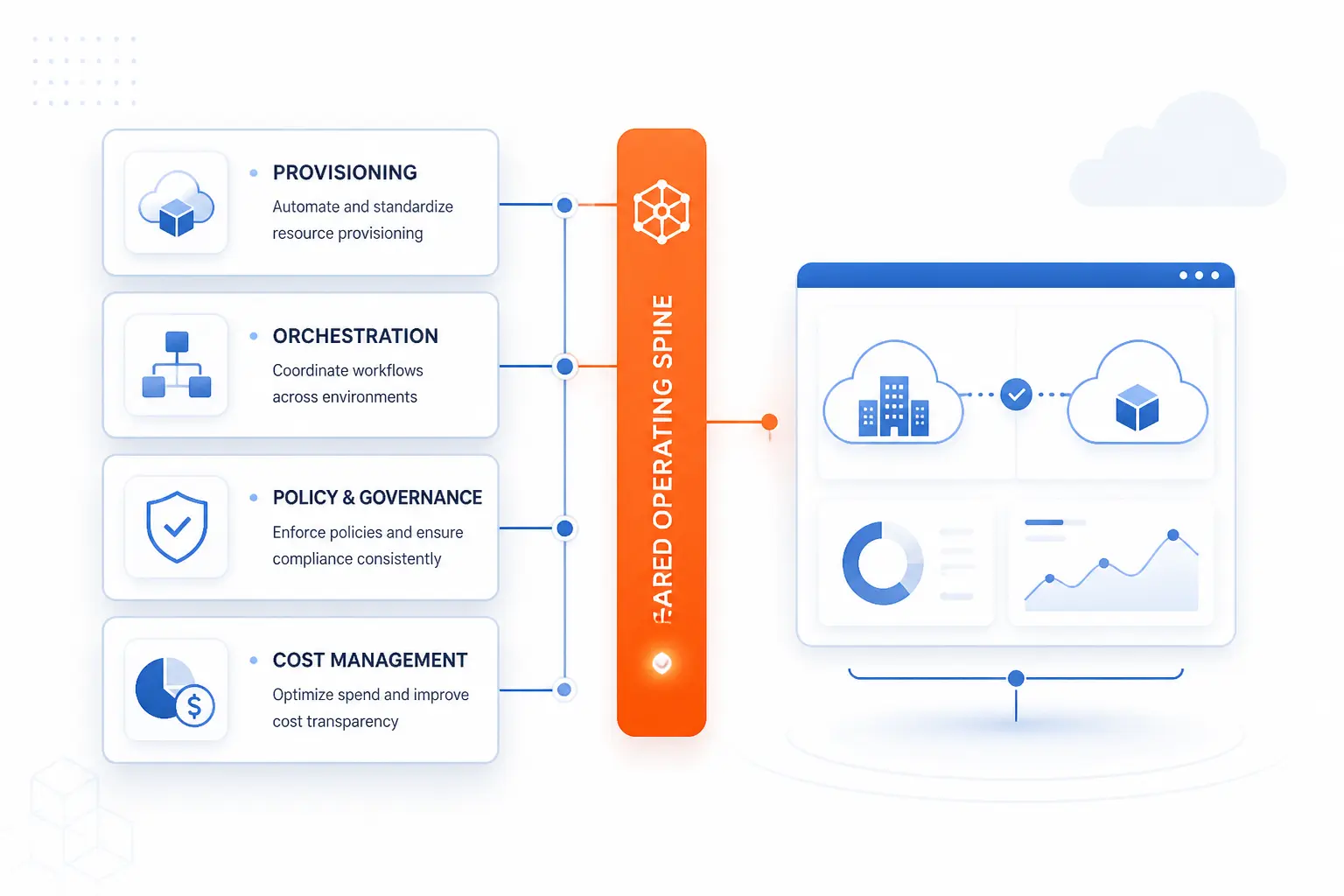
Hybrid cloud management tools usually come in layers rather than as one all-in-one suite. Some handle provisioning, some handle orchestration, some enforce policy, and some explain spend. That is normal. What matters is whether the tools share a clear operating model. We generally prefer a small, coherent stack over a giant toolbox nobody fully understands.
| Tool category | What it helps manage | Typical examples |
|---|---|---|
| Cloud management platforms | Inventory, policy, service catalogs, lifecycle views | Provider-native and third-party control planes |
| Automation and IaC | Provisioning, change control, repeatability | Terraform, CI/CD pipelines, Git-based workflows |
| Open-source cross-cloud tooling | Containers, observability, governance, portability | Kubernetes, Prometheus, policy engines |
| Security and cost controls | Policy checks, compliance, allocation, anomaly review | OPA, OpenCost, Cloud Custodian, FinOps tools |
Cloud Management Platforms
Cloud management platforms give teams a centralized view of resources, policies, and lifecycle actions across environments. Some are provider-native. Others sit above several environments and try to normalize workflows. Their value is highest when they become the place where teams request, approve, and track infrastructure changes, rather than one more dashboard that nobody trusts.
Automation and Infrastructure as Code
Automation and infrastructure as code are the backbone of repeatable hybrid operations. Without them, the same network, VM, or policy may be configured three different ways depending on where it runs. IaC lets teams version changes, review them in pull requests, and rebuild environments with less guesswork. For hybrid estates, that consistency is often more valuable than any single feature.
Open-Source and Cross-Cloud Tooling
Open-source and cross-cloud tooling helps reduce dependency on one provider’s control model. Kubernetes, Prometheus, and policy engines are popular because they carry familiar operating patterns across environments. For governance work, the Cloud Custodian documentation is a good example of tooling built to apply compliance, tag, cleanup, and cost rules across multiple cloud providers. We like these tools when they simplify standards instead of adding fresh layers of abstraction.
Security, Cost, and Compliance Controls
Security, cost, and compliance controls turn a hybrid environment from loosely connected infrastructure into an accountable platform. They help answer basic but important questions like who changed this, why is this resource here, and which team owns this spend.
For Kubernetes-heavy estates, the OpenCost specification is useful because it provides a vendor-neutral model for measuring and allocating infrastructure and container costs. That does not solve every finance question, but it gives engineers and finance teams a shared starting point.
Where This Approach Shows Up in Practice
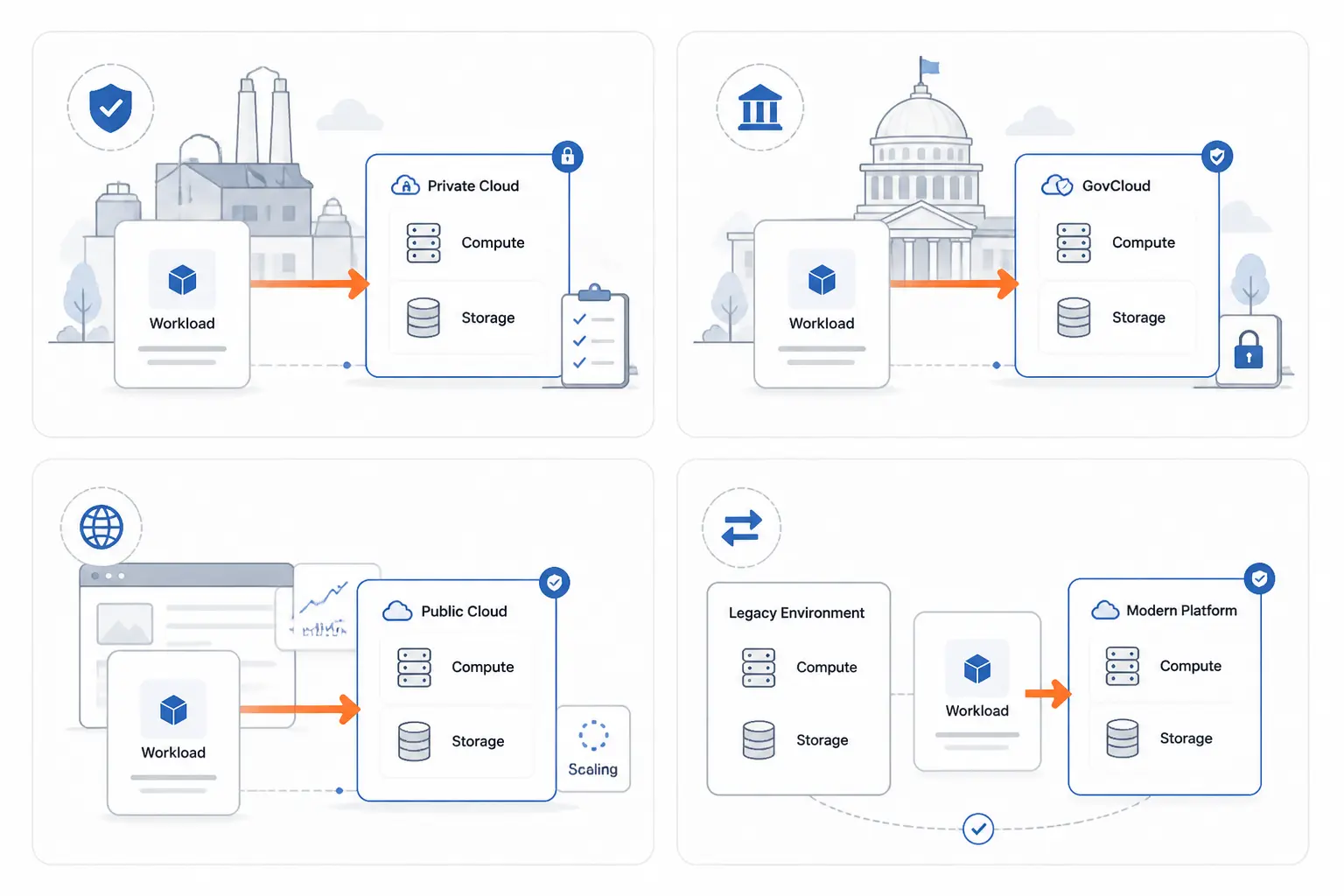
Hybrid cloud management shows up wherever organizations have to balance control with elasticity. That includes regulated sectors, public sector environments, high-traffic web platforms, and companies modernizing gradually instead of rebuilding everything at once. We find that the most durable examples are rarely flashy. They are sensible workload placement decisions backed by solid operations.
Keeping Sensitive Data in a Private Environment
Keeping sensitive data in a private environment is one of the most common hybrid patterns. The business keeps tightly governed data stores inside a private or on-prem boundary, while less sensitive application layers consume public cloud services where that makes sense. A concrete public example is CMS, which documents managed AWS, Azure, and on-prem hosting as part of its preferred hybrid environment. That is a practical reminder that governance often drives architecture.
Using Public Cloud for Testing and Demand Spikes
Using public cloud for testing and demand spikes is the pattern many teams adopt first. It is a low-friction way to get elastic capacity without moving every core system at once. Development teams can spin up short-lived environments, run load tests, or absorb seasonal traffic in the public cloud while primary records systems stay elsewhere. When managed well, this keeps change fast without forcing the entire estate into one model.
Supporting High-Availability Workloads Across Providers
Supporting high-availability workloads across providers is a stronger form of resilience. Here, the goal is to prevent one site, one provider, or one control plane from becoming a single point of failure. That can mean replicated services, secondary recovery targets, or active-active patterns across multiple environments. It is more expensive to run, but for critical systems, the operational trade is often worth it.
FAQ
These short answers cover the questions readers usually ask first when they are trying to separate cloud terms that sound similar but mean different things.
What Is a Hybrid Cloud?
A hybrid cloud is a computing model that combines at least two distinct environments, usually public cloud plus private cloud or on-premises infrastructure, and connects them so data or applications can move between them. The environments stay distinct, but they work together. The key idea is coordinated use, not just owning servers in more than one place.
What Is an Example of a Hybrid Cloud?
An example of a hybrid cloud is a company that keeps its customer database in a private environment and runs its web front end in a public cloud. During peak traffic, it adds public cloud compute instead of buying more on-prem hardware. That setup is hybrid because the application depends on more than one environment working together.
What Is Hybrid Cloud Cost Management?
Hybrid cloud cost management is the process of tracking, allocating, and optimizing spending across public cloud, private cloud, and on-premises resources. It includes both variable cloud charges and less obvious fixed costs like hardware, software licenses, and support overhead. Good cost management helps teams decide not only what they spend, but where each workload should run.
What Skills Are Needed for Hybrid Cloud?
Hybrid cloud work needs a mix of cloud platform, networking, security, automation, and operations skills. Teams also need judgment around workload placement, governance, and cost analysis. In our view, the soft skill that matters most is coordination, because hybrid environments punish siloed decision-making.
How 1Byte Supports Hybrid Cloud Operations
We support hybrid cloud operations by covering the web-facing and infrastructure layers that often connect a mixed environment together. In practical terms, that means helping teams secure domains, protect traffic with SSL, host web projects, and run scalable infrastructure where public-facing services need room to grow. As an AWS Partner, we also understand why many businesses want cloud services to complement, rather than replace, what they already run elsewhere.
Secure Online Foundations With Domain Registration and SSL Certificates
Domain registration and SSL certificates provide the public-facing trust layer for hybrid operations. If a business exposes customer portals, APIs, status pages, or admin access points from any environment, it still needs clear DNS ownership and encrypted connections. We see this as table stakes. Hybrid architecture may be complex behind the scenes, but the entry points still need to be simple and secure.
Host Web Projects With WordPress Hosting and Shared Hosting
WordPress hosting and shared hosting can serve the lighter public edge of a broader hybrid setup. A company may keep internal systems or regulated data elsewhere while running a marketing site, documentation hub, or customer-facing content layer on straightforward hosted infrastructure. That split is common, sensible, and often cheaper than overengineering every web property from day one.
Scale Infrastructure With Cloud Hosting and Cloud Servers
Cloud hosting and cloud servers are useful when the hybrid model needs flexible compute outside a fixed private environment. Teams can place web apps, staging stacks, jump hosts, integration services, or overflow capacity on scalable infrastructure while keeping selected systems on-premises or in a private cloud. From our perspective, this is where hybrid cloud management becomes concrete. It stops being a concept and starts becoming a workload placement decision.





Conclusion
Hybrid cloud management is the discipline that turns a mixed estate into an intentional operating model. It brings public cloud, private cloud, and on-premises infrastructure under shared provisioning, visibility, security, and cost control. We think that is why it matters so much. The hard part of hybrid cloud is rarely having multiple environments. The hard part is running them coherently. If you are planning your next move, which workload should you classify first, and what would a better placement decision save you?