

- DDoS Attacks Are Malicious Efforts to Overload a Service and Block Real Users
- From Botnet to Outage How DDoS Attacks Overwhelm a Target
- The Three Attack Patterns Behind Most Incidents
- What These Attacks Do to Websites and Networks
- Clues That a Site May Be Under Attack
- How to Reduce the Risk of DDoS Attacks
- Why Attackers Use This Tactic
- FAQ
- How 1Byte Supports a Safer and More Reliable Online Presence
- Conclusion
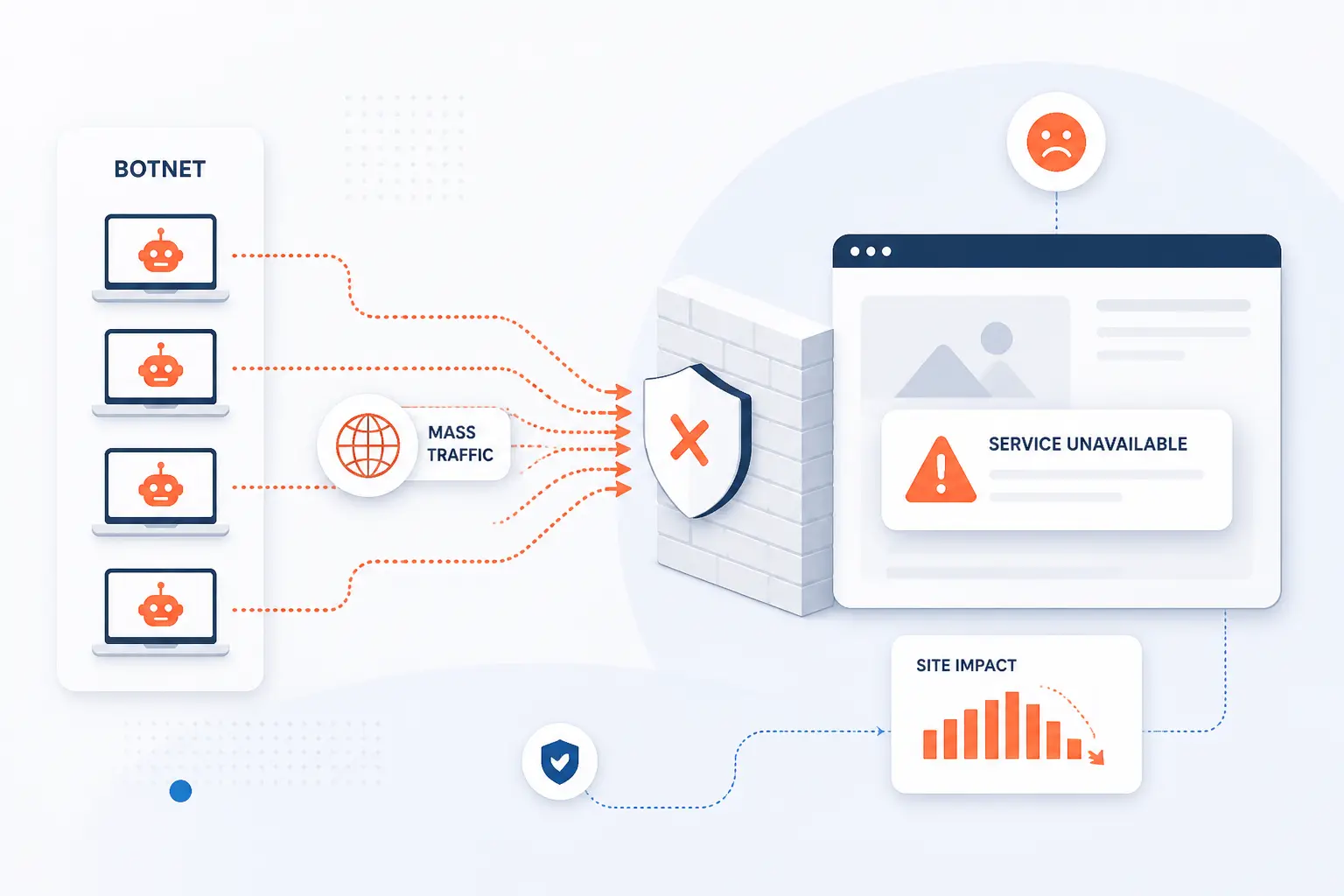
DDoS attacks are malicious efforts to flood a website, application, server, or network with more traffic than it can handle. The goal is simple and nasty: block real users from reaching a service. We think of them as crowding the doorway on purpose, except the “crowd” is often made of hijacked computers, servers, routers, cameras, or other internet-connected devices. For site owners, the result can look like slow pages, failed checkouts, broken logins, or a full outage.
At 1Byte, we see DDoS attacks as an availability problem first. Security is not only about keeping criminals out. It is also about keeping legitimate customers in. A site that is technically intact but unreachable is still failing its users, and that is why this topic matters to anyone running a serious online presence.
DDoS Attacks Are Malicious Efforts to Overload a Service and Block Real Users
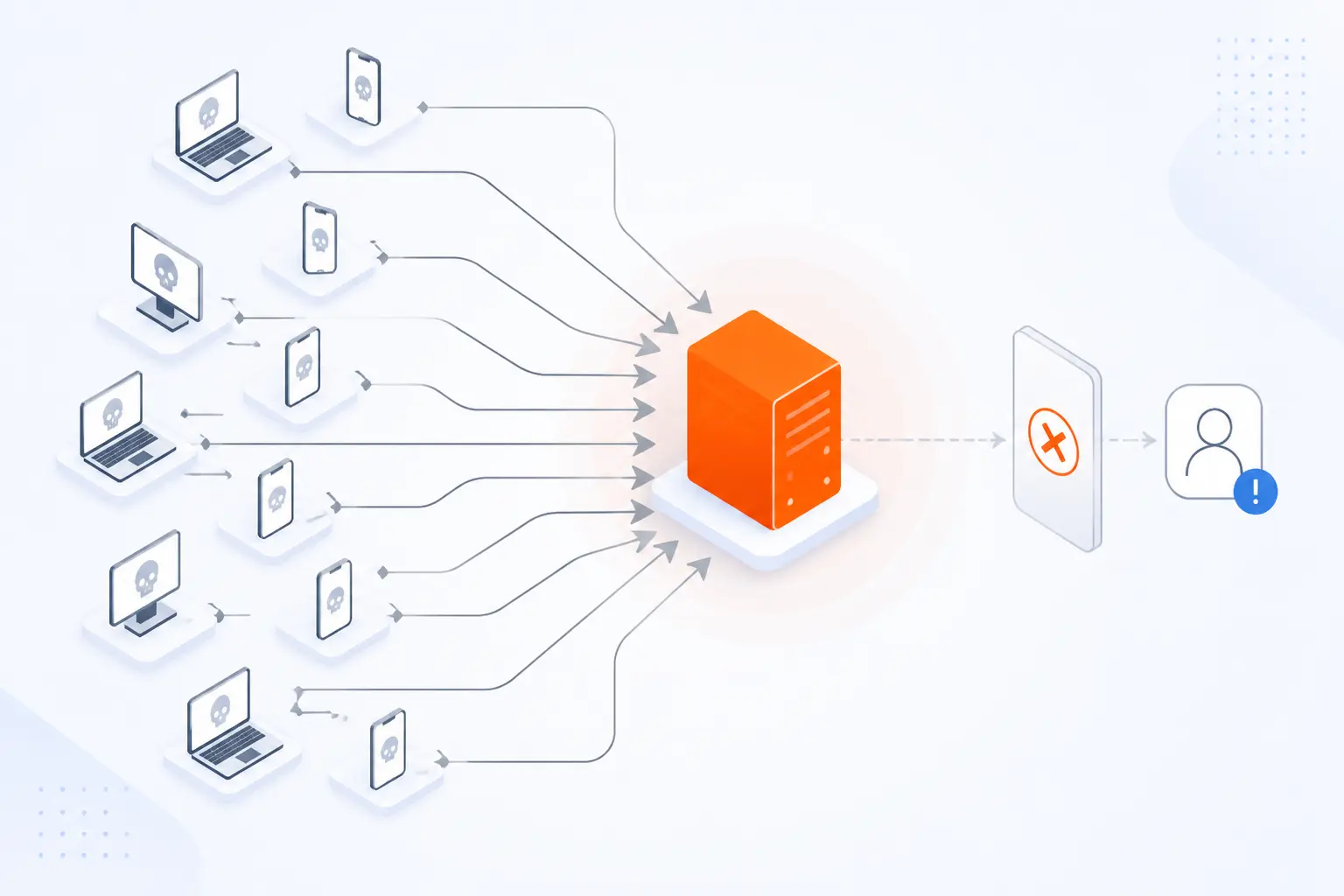
DDoS attacks are coordinated attempts to make an online service unavailable by overwhelming it with traffic, requests, or protocol activity from many sources. “DDoS” stands for distributed denial of service, and the word “distributed” is the key. Instead of one machine hammering a target, many machines send traffic at once. That makes the attack harder to filter, because some malicious requests can resemble normal visitor activity.
The target can be a website, API, DNS service, game server, email system, payment flow, or network link. The attacker does not always need to break into the target. Often, the attacker only needs to consume enough bandwidth, memory, CPU, connection slots, or application capacity that real users cannot get through.
This is why DDoS attacks are different from many other cyber threats. A ransomware attack tries to encrypt data. A credential attack tries to log in. A DDoS campaign tries to deny access, often by exhausting scarce computing resources that a service needs to stay responsive.
We prefer to define the problem this way because it keeps the focus practical. A DDoS attack is not magic. It is pressure applied to a bottleneck. The defender’s job is to find that bottleneck before the attacker does, then add filtering, capacity, distribution, and a response plan around it.
FURTHER READING: |
| 1. What Is SASE? Architecture, Components, and Benefits |
| 2. What Is Penetration Testing and How Does It Work |
| 3. What Is a Botnet? How It Works and Why It Matters |
From Botnet to Outage How DDoS Attacks Overwhelm a Target
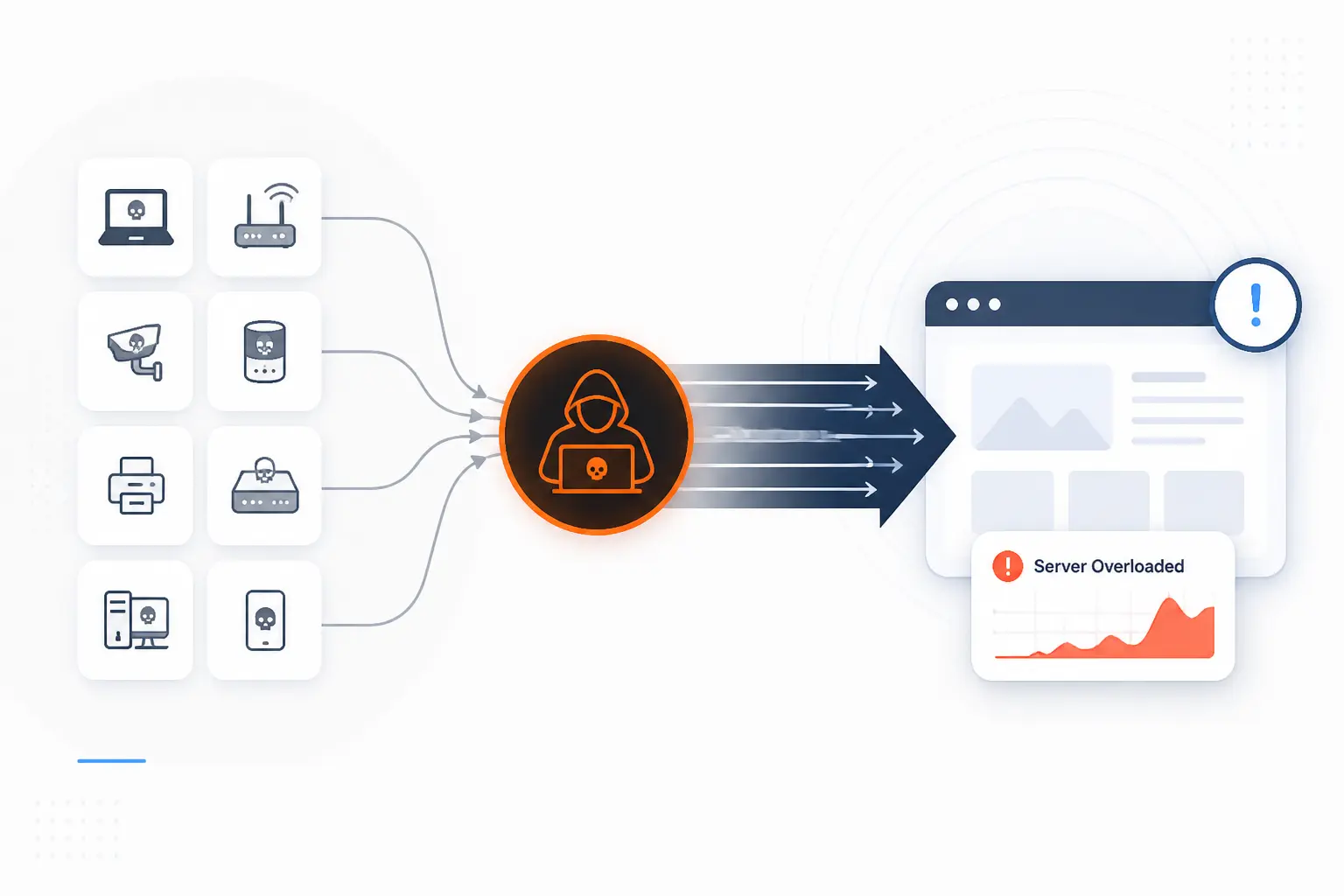
DDoS attacks usually work by turning many devices into traffic sources and aiming them at one victim. The attacker may control those devices directly through malware, rent access to them through a criminal service, or abuse misconfigured internet services that reflect traffic toward the target. The victim then receives more packets or requests than its network, server, or application can process. If defenses cannot absorb or filter the load, real users experience errors, slow responses, or total unavailability.
There are three moving parts we always look for: the sources, the pressure point, and the filtering challenge. The sources create the scale. The pressure point is what fails first. The filtering challenge is what makes the incident hard, because the attack may come from thousands of places at once.
Bots and Botnets Send Traffic From Many Compromised Devices
A botnet is a group of compromised devices that an attacker can command as a single weapon. Those devices may include home routers, DVRs, webcams, servers, virtual machines, or infected personal computers. The owners often have no idea their equipment is participating.
Law enforcement and security agencies have repeatedly tied large disruption campaigns to botnets built from hijacked internet-connected devices. The FBI’s Internet Crime Complaint Center describes botnets as networks of hijacked devices used for cybercrime, and its federal botnet guidance warns that traffic from many sources makes single-source blocking ineffective.
We find this point especially important for small businesses. A DDoS attack can look like a giant enterprise problem, but the attack supply chain often begins with ordinary devices using weak passwords, exposed admin panels, or old firmware.
Requests and Packets Exhaust Bandwidth or Server Resources
The attack succeeds when the target runs out of something essential. That “something” might be network bandwidth, CPU, memory, database connections, web worker threads, firewall state tables, or application queue capacity.
At the network level, packets can saturate an internet link before they ever reach the web server. At the transport level, connection attempts can consume state on firewalls or load balancers. At the application level, ordinary-looking requests can hit expensive operations such as search, login, checkout, report generation, or uncached API calls.
This is where many beginners get caught off guard. A homepage might survive heavy traffic because it is cached. A login endpoint might fail under far less volume because every request touches a database, session store, password check, or fraud rule.
Distributed Sources Make the Attack Harder to Stop
The distributed nature of the traffic is what makes DDoS mitigation difficult. If all traffic came from one IP address, blocking it would be easy. In a real campaign, traffic may arrive from many networks, countries, hosting providers, consumer ISPs, and compromised devices.
That distribution creates a painful tradeoff. Filter too loosely, and the attack keeps hurting the service. Filter too aggressively, and real users get blocked. Good defense depends on patterns: request rate, geography, user-agent behavior, protocol flags, path selection, cookie behavior, TLS behavior, and whether a visitor acts like a browser or a script.
In our view, this is the heart of the problem. DDoS defense is not just “more bandwidth.” It is controlled decision-making under pressure, close to the network edge, before the origin server is drowning.
The Three Attack Patterns Behind Most Incidents
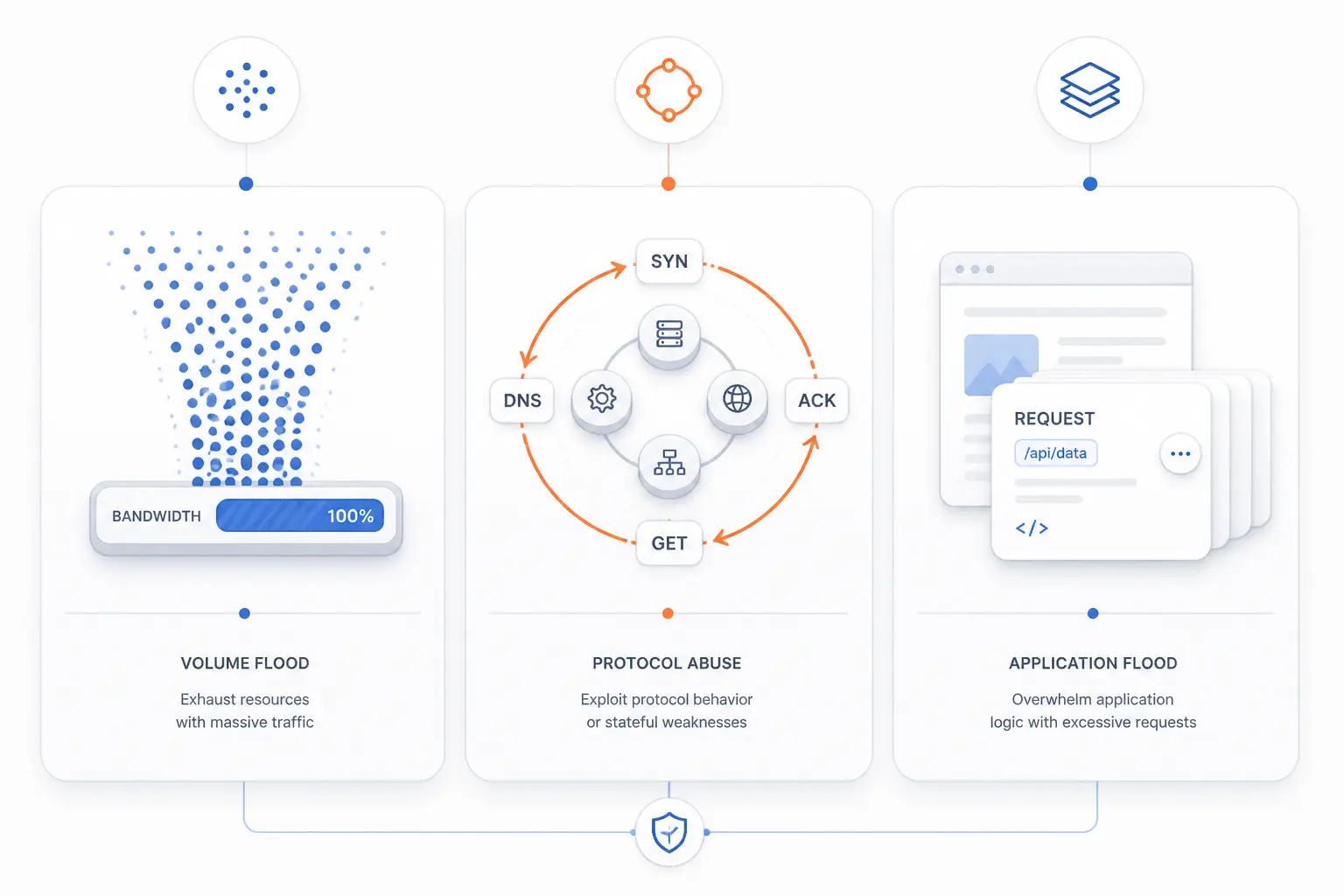
Most DDoS attacks fit into three broad patterns: volumetric, protocol, and application-layer pressure. These categories describe what the attacker is trying to exhaust. Volumetric campaigns flood bandwidth. Protocol campaigns abuse network and transport behavior. Application-layer campaigns make the web application spend too much work on each request.
| Pattern | Main target | Common result |
|---|---|---|
| Volumetric | Network bandwidth | Links become saturated |
| Protocol | Network devices and server state | Firewalls, load balancers, or servers run out of capacity |
| Application-layer | Web application logic | Specific pages, APIs, or functions become slow or fail |
Volumetric Attacks Flood Available Bandwidth
Volumetric attacks try to fill the pipe before legitimate traffic can pass. These campaigns often use UDP floods, reflection, amplification, or other high-volume packet techniques. The target may be healthy internally, yet unreachable because the network path is congested.
Reflection and amplification are especially troublesome. The attacker can send spoofed requests to third-party services, and those services send larger replies to the victim. CISA has warned about exposed UDP services being abused this way through a UDP reflection advisory.
For a website owner, the symptom may be blunt: everything times out. The server dashboard might not show a normal application error because the traffic is failing upstream.
Protocol Attacks Drain Network and Server Capacity
Protocol attacks abuse how networking protocols handle connections, sessions, or packet processing. SYN floods are the classic example, because they exploit the setup process for TCP connections. Other protocol attacks may target fragmented packets, state tables, TLS negotiation, or firewall inspection behavior.
The damage comes from forcing infrastructure to remember, inspect, or respond to too much at once. Firewalls and load balancers are powerful, but they still have limits. When those limits are reached, even legitimate packets can be dropped.
We like to explain this as paperwork overload. The attacker may not need to send the largest amount of data. They only need to create enough half-finished or awkward work that the network equipment falls behind.
Application-Layer Attacks Mimic Real Users and Hit Costly Functions
Application-layer attacks target the parts of a site that require the most server work. Instead of sending obvious junk traffic, the attacker may request real URLs, submit forms, call APIs, run searches, or repeatedly trigger login and checkout paths.
These attacks can be smaller in raw traffic volume but more damaging to the application. A modest number of requests can hurt if each one starts a database query, cache miss, image generation job, or third-party API call. Google disclosed an HTTP/2 Rapid Reset campaign that peaked above 398 million requests per second, which shows how application-layer pressure can reach extraordinary scale.
From our seat, this is the type many teams underestimate. They buy bandwidth, then forget that an expensive endpoint can be the smallest door in the building.
What These Attacks Do to Websites and Networks
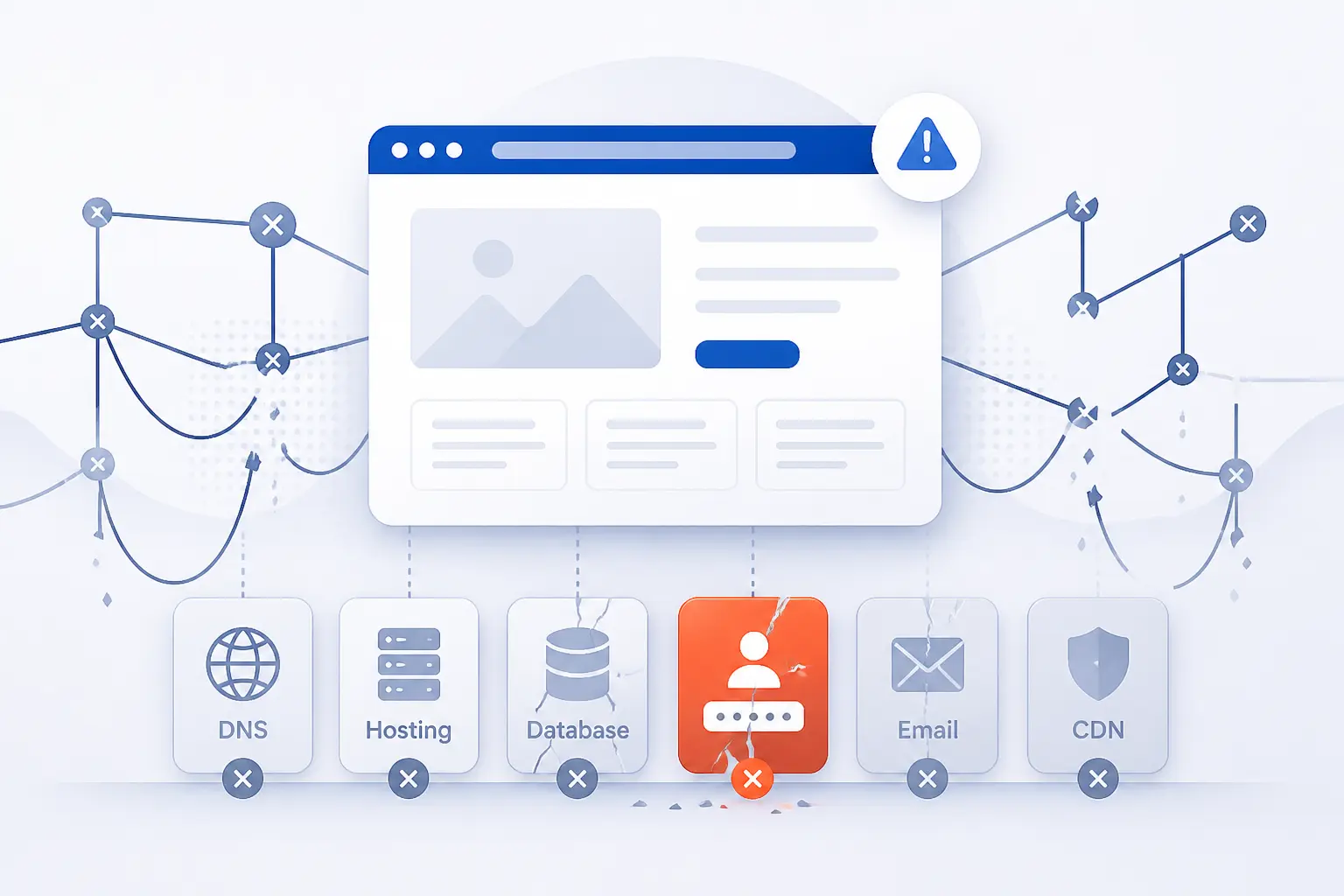
DDoS attacks disrupt websites and networks by making normal access unreliable or impossible. Some incidents slow pages without taking the site fully offline. Others break DNS, APIs, login systems, payment flows, dashboards, or entire network ranges. The business impact depends on timing, customer expectations, and how quickly the team responds.
A small brochure site may suffer embarrassment and lost inquiries. An online store may lose orders. A SaaS platform may trigger customer complaints and service credits. The technical event is only one layer of the damage.
Slow Performance and Unreliable Connections
Slow performance is often the first visible sign of trouble. Pages take longer to load, API responses become erratic, and users refresh because they think the site is broken.
This gray zone can be harder than a clean outage. Monitoring may show high traffic and increased latency, but not a single obvious failure. Teams then have to separate a real demand spike from malicious pressure.
We recommend treating unexplained slowness as an availability incident until proven otherwise. Waiting for a complete outage wastes the early minutes when filtering is usually easiest.
Service Outages and Failed Access for Legitimate Visitors
A severe attack can make a service unreachable for legitimate visitors. Users may see browser timeouts, gateway errors, failed DNS lookups, broken app screens, or repeated login failures.
The tricky part is that different users may see different symptoms. Someone near one network path may reach the site. Someone routed through a congested provider may fail. That uneven view can make the incident feel random.
For customer-facing teams, the best response is plain language. Tell users what is affected, what still works, and where updates will appear. Silence makes an outage feel longer.
Operational, Sales, and Reputation Damage
DDoS damage often spreads beyond the technical team. Sales teams lose leads, support queues fill up, ad spend points to broken pages, and managers ask for answers before logs are clean.
Reputation harm can be especially sharp for businesses that sell trust. A bank, hosting provider, online school, or ecommerce store cannot simply say, “The server was fine.” Customers care whether they could use the service when they needed it.
There is also a distraction cost. While engineers fight traffic floods, they are not shipping features, patching systems, improving performance, or helping customers. That opportunity cost rarely appears in the first incident report, but it is real.
Clues That a Site May Be Under Attack
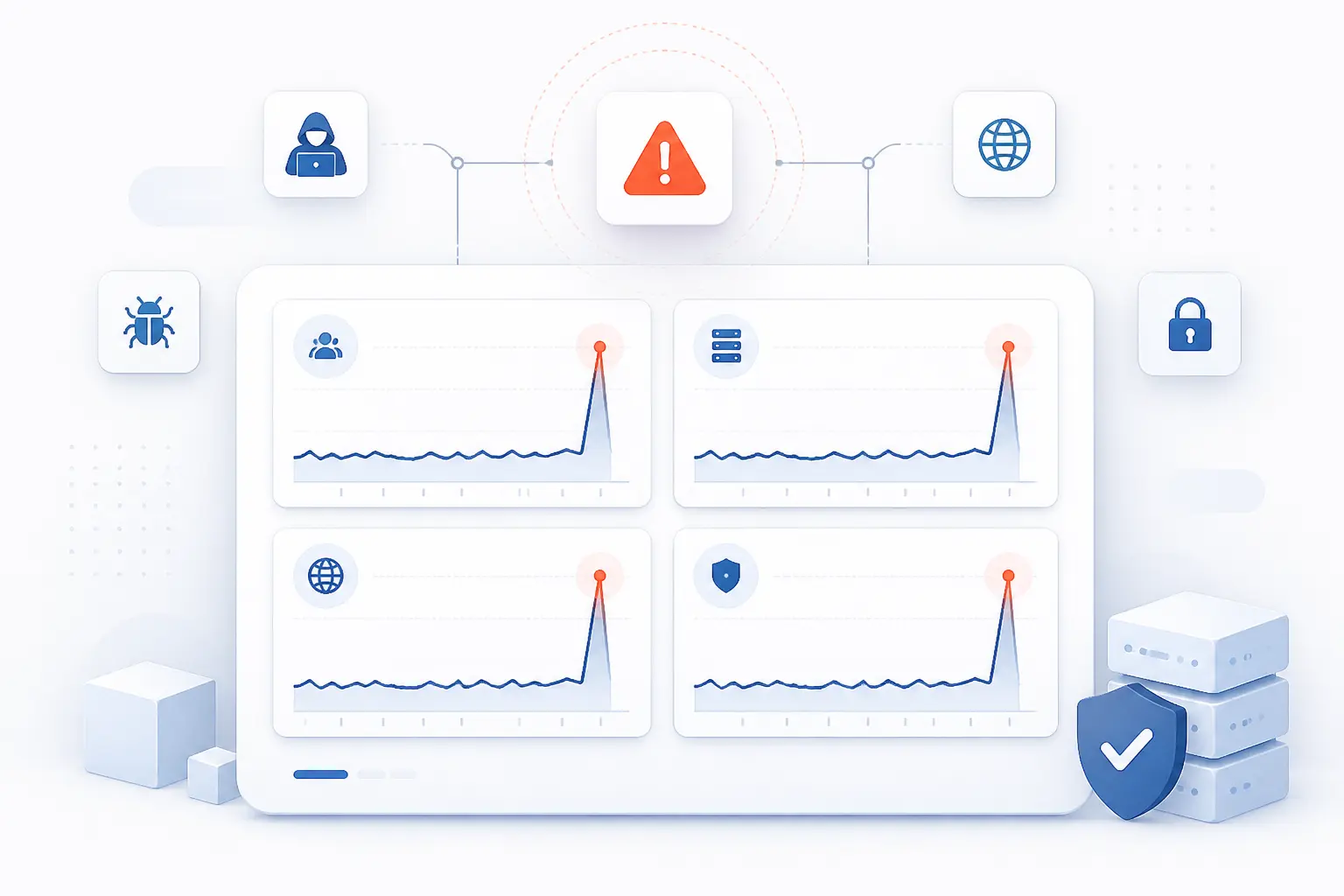
A site may be under attack when traffic, error rates, resource usage, or access patterns suddenly change without a normal business reason. No single clue proves a DDoS incident by itself. A sale, product launch, viral post, or software bug can look similar at first. The strongest signal is a cluster of symptoms that appear together and do not match normal behavior.
We encourage teams to compare suspicious activity against a baseline. What is normal for Monday morning? What is normal after an email campaign? What is normal for login traffic compared with homepage traffic? Without that context, every spike looks scary.
Sudden Traffic Surges From Similar Sources
A sudden surge from similar sources can indicate coordinated traffic rather than healthy demand. The sources may share IP ranges, hosting providers, user agents, paths, headers, request timing, or geographic patterns.
For example, a real marketing spike often brings variety. Visitors browse different pages, carry normal browser headers, and behave unevenly. Attack traffic may hit one endpoint over and over with mechanical timing.
That said, source similarity is not always obvious. Modern botnets can be messy by design. We look for repeated behavior, not just repeated addresses.
Unusually Slow Network or Website Performance
Unusually slow performance can mean the service is being forced past a resource limit. CPU may climb, memory may fill, database connections may spike, or bandwidth may sit near its ceiling.
Good monitoring should show both user-facing and infrastructure-facing signals. Watch latency, error rates, request count, cache hit ratio, connection count, packet rate, and database wait time. The combination tells a better story than any one graph.
If only one expensive path is slow, suspect application-layer pressure. If the whole network is unreachable, suspect upstream congestion or infrastructure-layer pressure.
Unexpected Offline Periods or Inaccessible Services
Unexpected offline periods are a serious warning sign when they coincide with abnormal traffic. A site that drops offline, recovers, then drops again may be hitting a recurring capacity limit.
Intermittent failures can happen when auto-scaling, caches, load balancers, or upstream providers are absorbing part of the load but not all of it. The service appears to “breathe” under pressure. Users see that as unreliability.
When this happens, capture evidence quickly. Logs, traffic samples, screenshots, provider alerts, and timestamps are much easier to collect during the incident than after the smoke clears.
How to Reduce the Risk of DDoS Attacks
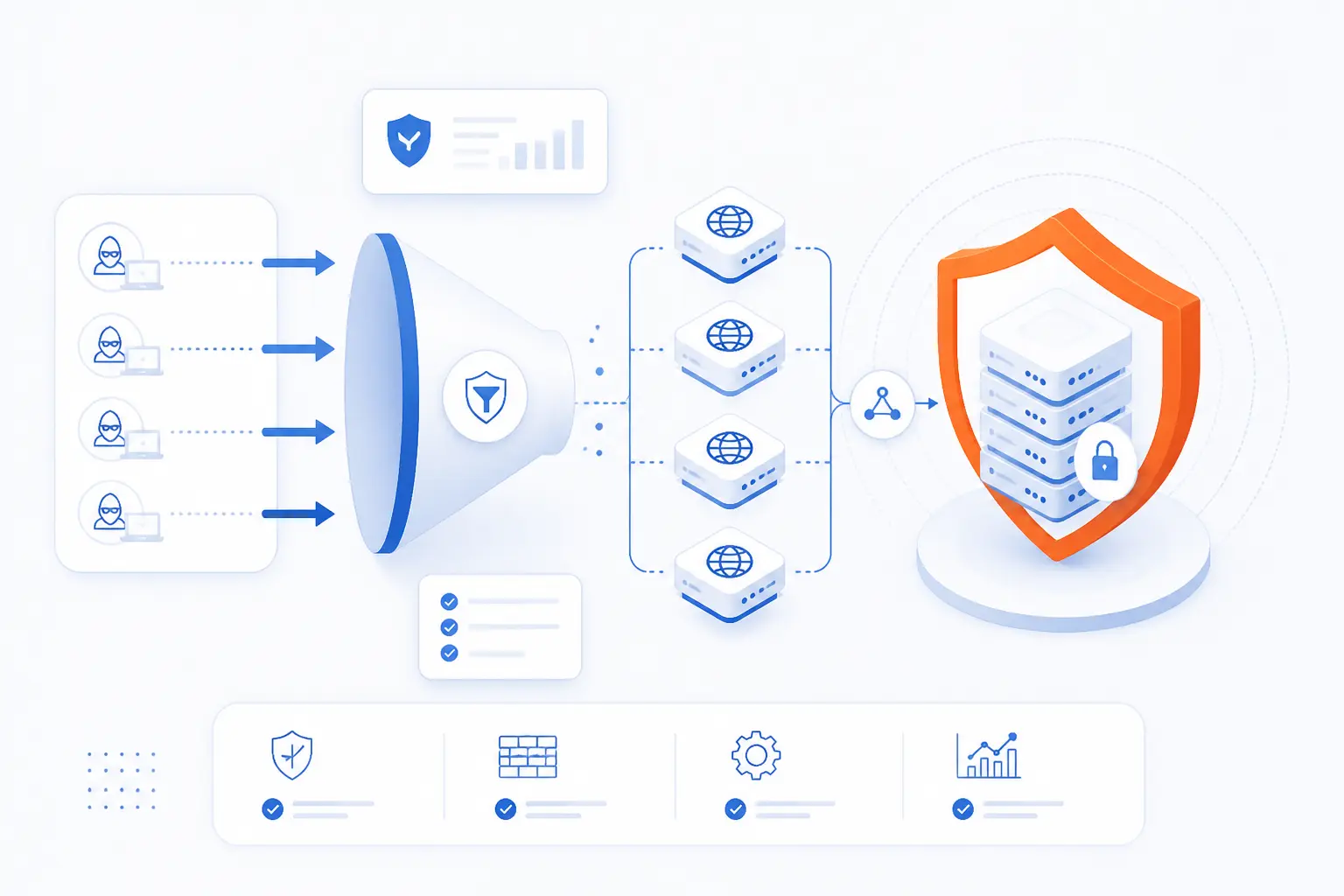
You reduce the risk of DDoS attacks by shrinking exposure, filtering abnormal behavior, distributing traffic, and preparing a response before the first packet flood arrives. No single control solves the problem. Firewalls help, but they cannot absorb unlimited bandwidth. Capacity helps, but it can still be wasted by expensive application requests. The best defense is layered and boring, which is exactly how we like critical infrastructure to be.
| Defense layer | What it does | Best for |
|---|---|---|
| Exposure reduction | Limits what attackers can reach | Reducing easy targets |
| Traffic filtering | Separates suspicious behavior from users | Application and API abuse |
| Traffic absorption | Spreads or absorbs large volumes | High-volume floods |
| Incident planning | Defines decisions before pressure hits | Faster recovery |
Reduce Exposure With Firewalls, ACLs, and a Smaller Attack Surface
The first defensive action is to make fewer services reachable from the public internet. Admin panels, databases, staging sites, origin servers, SSH, RDP, and internal dashboards should not be open to everyone.
Firewalls and access control lists help enforce that boundary. Allow what must be public, restrict what is private, and remove old test services that nobody owns anymore. AWS recommends using security groups and network ACLs as part of its edge architecture guidance for improving application availability under hostile traffic.
Our opinion is blunt here: many outages begin with unnecessary exposure. If an attacker cannot reach a fragile service, they cannot overload it directly.
Use Rate Limits, WAF Rules, and Traffic Baselines to Separate Good Traffic
Rate limits and WAF rules help distinguish normal users from abusive traffic patterns. They can limit repeated requests, block suspicious paths, challenge questionable clients, or apply stricter rules to costly endpoints.
A baseline makes these controls smarter. If a login endpoint normally receives steady traffic, a sudden jump deserves different handling than a homepage spike after a product announcement. Rules should protect the most expensive actions first.
Be careful with blunt limits. A strict global threshold may block real users during a launch or seasonal sale. We prefer layered rules that look at behavior, not just volume.
Absorb Large Floods With CDNs, Anycast, Load Balancers, and Scalable Capacity
Large floods are best handled before they reach the origin server. CDNs, Anycast routing, load balancers, and scalable infrastructure spread traffic across more capacity and more locations.
A CDN can serve cached content from edge locations, reducing requests that hit the origin. Anycast can route traffic to multiple network locations, which prevents one site from carrying all the load. Load balancers distribute accepted traffic across healthy backends.
Scalable capacity matters too, but it should not be the only plan. If the application scales without filtering, the business may simply pay to process junk. Capacity buys breathing room. Filtering decides what deserves that room.
Prepare an Incident Response Plan Before an Attack Starts
An incident response plan turns a chaotic outage into a sequence of known actions. The plan should define who declares the incident, who contacts providers, who changes traffic rules, who updates customers, and who preserves evidence.
At minimum, document escalation contacts, DNS access, hosting access, CDN access, firewall access, logging locations, and rollback steps. Run a tabletop exercise before you need it. The first time people meet the plan should not be during a flood.
We also recommend preparing customer messages in advance. You can always edit them during the incident, but a draft prevents panic writing when everyone is tired.
Why Attackers Use This Tactic
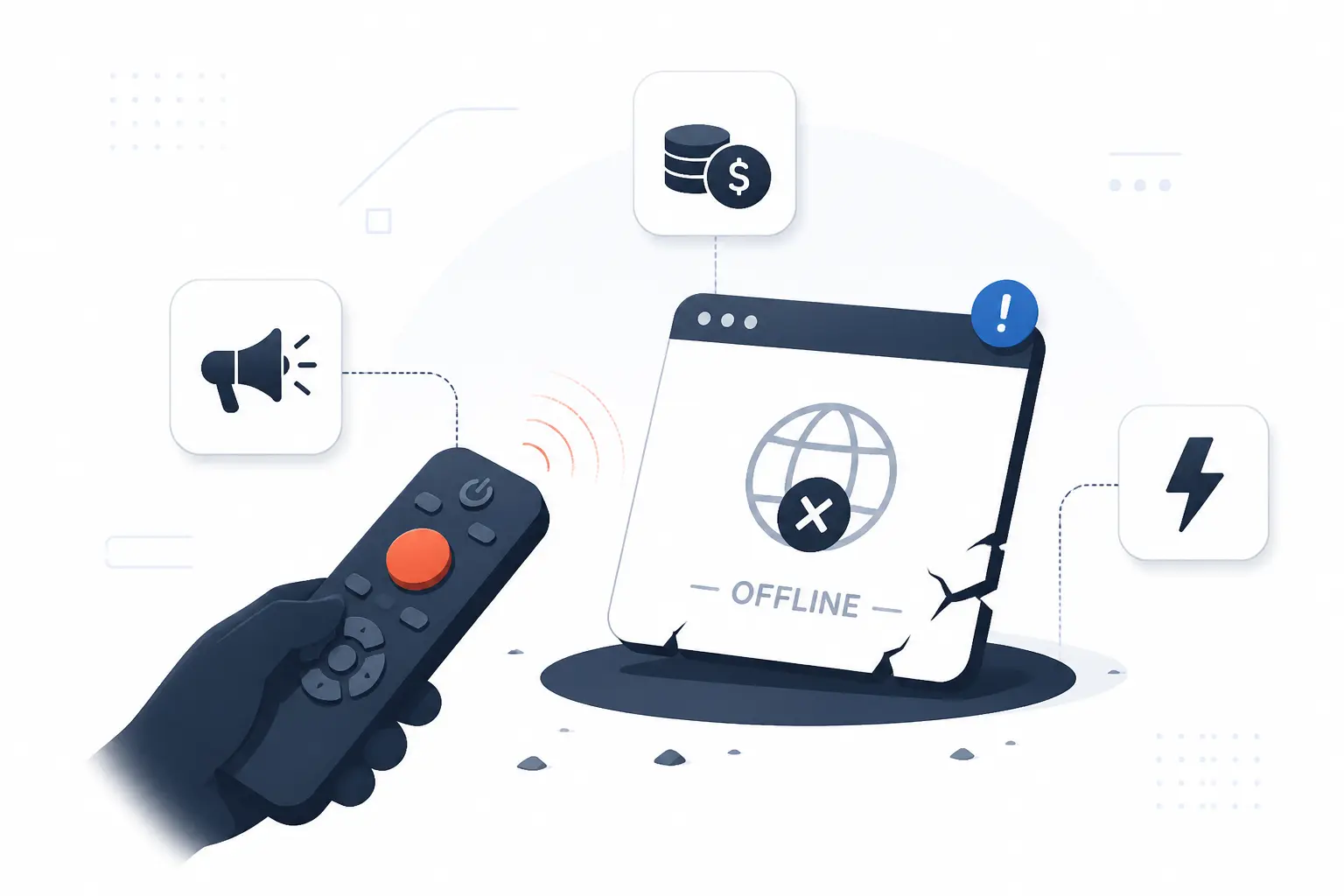
Attackers use DDoS attacks because disruption is visible, stressful, and relatively easy to prove to a victim. If a website goes down, everyone notices. That makes the tactic useful for extortion, protest, revenge, competition, and pressure during broader cyber campaigns. It can also distract defenders while another attack happens elsewhere.
The motive matters because it shapes the response. An extortion attempt needs evidence preservation and law enforcement consideration. A protest campaign needs public communication. A competitive disruption may require legal and provider coordination.
Extortion, Blackmail, and Ransom Pressure
Extortion campaigns use downtime as pressure to make victims pay. The attacker may send a threat, launch a short demonstration, then demand money to stop or prevent a larger incident.
DDoS pressure also appears in multi-part extortion, where attackers combine disruption with data theft or ransomware. Akamai has described this as part of triple-extortion analysis, where service disruption becomes one more lever against the victim.
We do not view payment as a reliable fix. Paying can mark a business as willing, and it does not repair the underlying weakness.
Hacktivism, Revenge, and Ideological Motives
Hacktivist and revenge-driven attacks use disruption as a public signal. The target may be a government site, media outlet, school, business, creator, game server, or community platform.
These attacks often follow public controversy. A post goes viral, an organization takes a position, or a community feud escalates. The technical traffic may be temporary, but the reputational pressure can be intense.
For these cases, communication matters almost as much as filtering. People want to know whether the service is safe, whether data is affected, and when access will return.
Competitive Disruption and State-Backed Pressure
Competitive and state-linked disruption uses availability as leverage. An attacker may target a rival during a major launch, a gaming event, a trading window, an election period, or a geopolitical crisis.
These cases can be harder to attribute. Traffic alone rarely proves who paid for it or ordered it. Defenders should focus first on restoration, evidence, and coordination with providers.
We are careful with attribution for that reason. Guessing loudly may satisfy curiosity, but clean logs and a steady recovery plan help the business more.
FAQ
These quick answers cover the common questions beginners ask about DDoS attacks. The short version is this: the tactic is about denying availability, usually through distributed traffic pressure. The details vary by method, motive, and target. If you remember nothing else, remember that availability is a security requirement.
What Is a DDoSing Attack?
A DDoSing attack is an attempt to make a website, server, or online service unavailable by overwhelming it with traffic from many sources. The phrase is informal, but people use it to mean launching a distributed denial-of-service campaign. In practical terms, real users cannot access the service because malicious traffic is consuming the path or the system.
How Is a DDoS Attack Different From a DoS Attack?
A DDoS attack uses many traffic sources, while a DoS attack may use only one source. The distributed version is harder to block because the traffic is spread across many devices and networks. Both aim to deny service, but the scale and filtering challenge are usually greater with the distributed form.
What Is an Example of a DDoS Attack?
A well-known example is the Mirai botnet case, where compromised internet-connected devices were used for major disruption campaigns. The U.S. Department of Justice announced that the Mirai creators pleaded guilty to conspiracy charges tied to operating the botnet. This case showed how weakly secured devices can become part of a large traffic weapon.
Is a DDoS Attack Illegal?
Yes, launching a DDoS attack against systems you do not own or have permission to test is illegal in many jurisdictions, including the United States. U.S. prosecutors use the Computer Fraud and Abuse Act to address cyber conduct that harms the confidentiality, integrity, or availability of information. Authorized load testing is different, but permission and scope must be clear in writing.
How Long Can a DDoS Attack Last?
A DDoS attack can last minutes, hours, days, or recur in waves over a longer campaign. Short attacks may be probes to test defenses. Longer incidents often involve extortion, public pressure, or repeated attempts to find a weaker path into the target.
How 1Byte Supports a Safer and More Reliable Online Presence
1Byte supports a safer and more reliable online presence by helping customers choose the right foundation for domains, encrypted access, everyday hosting, and cloud-based capacity. We cannot promise that any single service makes a site immune to DDoS attacks. Nobody honest should promise that. What we can do is connect the basics, domain registration, SSL certificates, WordPress hosting, shared hosting, cloud hosting, and cloud servers, to the practical availability decisions this article has explained.
| 1Byte service | Practical connection to availability |
|---|---|
| Domain registration | Keeps naming and ownership organized |
| SSL certificates | Enables encrypted browser connections |
| WordPress hosting | Fits common content sites and business sites |
| Shared hosting | Fits smaller everyday websites |
| Cloud hosting | Fits sites that need more flexible resources |
| Cloud servers | Fits custom applications and direct server control |
1Byte is also an AWS Partner, which matters when a project needs cloud design choices aligned with traffic distribution, scaling, and availability planning. We see this as architecture work, not a magic badge. The right setup depends on the website, the traffic pattern, the risk, and the budget.
Launch Securely With Domain Registration and SSL Certificates
Domain registration and SSL certificates are the basic starting points for a trustworthy website. Domain registration gives the site a controlled name, while an SSL certificate allows browsers to connect over HTTPS.
These services do not stop a traffic flood by themselves. Still, they matter during an incident. Clean domain ownership, correct DNS records, and valid encrypted access reduce confusion when teams need to make changes quickly.
We see too many businesses treat these basics as paperwork. They are not paperwork. They are the front door labels and locks for your online property.
Run Everyday Websites on WordPress Hosting and Shared Hosting
WordPress hosting and shared hosting are practical choices for many everyday websites. They suit blogs, small business sites, landing pages, portfolios, and content-driven pages that do not need custom server architecture.
For DDoS risk, the key is expectation setting. A small site should still know what normal traffic looks like, which pages are critical, and who can make DNS or hosting changes during trouble. Even basic sites deserve a simple response checklist.
Our view is simple: start with the hosting that fits the site, then grow the architecture when the risk or traffic justifies it. Overbuilding too early wastes money. Underplanning creates panic later.
Scale for Demand With Cloud Hosting and Cloud Servers
Cloud hosting and cloud servers give growing projects more room to match infrastructure to demand. They are useful when a site or application needs more control over resources, deployment choices, and traffic handling.
For DDoS preparation, cloud-based setups can support stronger separation between public entry points and backend systems. They can also make it easier to design around load balancers, caching layers, and controlled access paths. The goal is not to invite more traffic blindly. The goal is to decide what reaches the application and what gets filtered earlier.
As an AWS Partner, 1Byte can discuss cloud direction in practical terms. We focus on what the workload needs, what the risks look like, and how the foundation should evolve as the site becomes more important to the business.






Conclusion
DDoS attacks are designed to make online services unavailable by overwhelming the systems that real users depend on. They may flood bandwidth, drain protocol capacity, or force applications to do expensive work again and again. The best defense is layered: reduce exposure, filter suspicious behavior, distribute traffic, add sensible capacity, and prepare an incident response plan before the alarm rings.
We care about this topic because uptime is part of trust. A secure website that disappears during pressure still lets customers down. If your site matters to revenue, reputation, or daily operations, the next step is simple: map your public entry points, identify your most expensive pages or APIs, and decide what you would do in the first hour of an attack.