

- Predictive AI Uses Statistical Analysis and Machine Learning to Forecast Outcomes
- How Predictive AI Works
- Models and Methods Behind the Forecasts
- Where Predictive AI Delivers Business Value
- Why Businesses Use Predictive AI
- Limits, Accuracy, and Trust in Predictive Systems
- Predictive AI vs Generative AI
- FAQ
- Conclusion
At 1Byte, we define predictive AI as software that studies past and current data to estimate what is likely to happen next. It uses statistics, machine learning, and probability to forecast outcomes such as demand, churn, fraud, equipment failure, or patient risk. The goal is not to create new content, as generative tools do. The goal is to give people a better warning signal before a decision has to be made.
We like predictive AI because it is practical. It turns messy business history into probabilities, rankings, scores, and forecasts that teams can act on. A model may say a customer is likely to cancel, a payment looks suspicious, or a server may run out of capacity. It will not be perfect, but a well-built system can be far better than guessing from a spreadsheet and hoping for the best.
Predictive AI Uses Statistical Analysis and Machine Learning to Forecast Outcomes
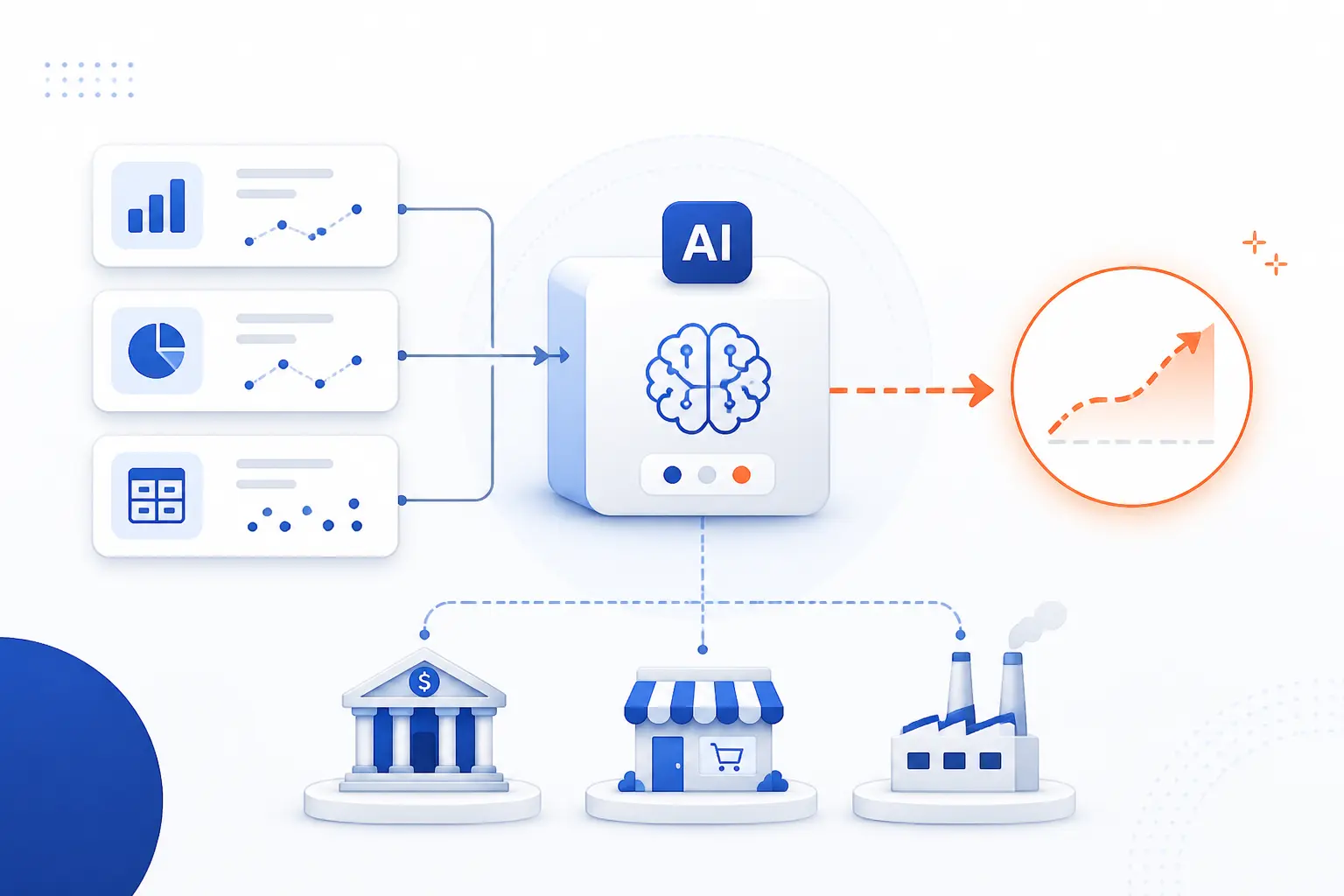
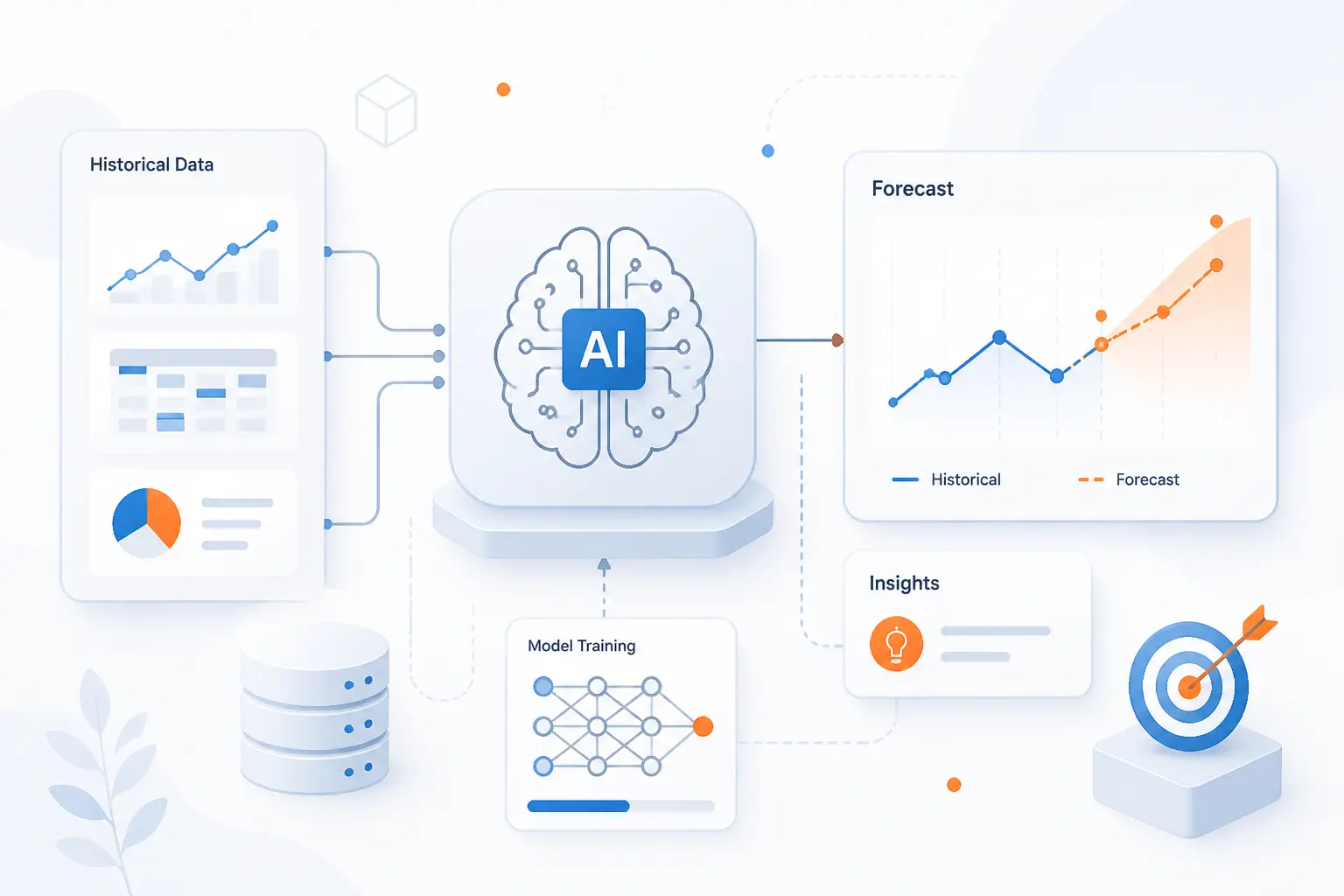
Predictive AI is a type of artificial intelligence that forecasts future events by finding patterns in historical and real-time data. It answers questions such as “What will probably happen?” or “How likely is this outcome?” A bank may use it to estimate credit risk, a retailer may use it to forecast demand, and a healthcare team may use it to flag patient risk. The core idea is simple: if enough relevant data is available, a model can learn relationships that humans may miss.
The “predictive” part matters. These systems do not know the future. They estimate it from signals. A churn model, for example, may learn that support complaints, lower product usage, and failed payment attempts often appear before cancellation. A demand model may learn that weather, seasonality, promotions, and local events affect sales.
We see predictive AI as decision support, not decision replacement. It should help people prioritize action. A sales team can call the highest-risk accounts first. A fraud team can review the riskiest transactions first. An operations team can inspect equipment before failure becomes expensive.
The business pull is real because many companies already use artificial intelligence in daily operations. In IBM’s Global AI Adoption Index 2023, 42% of IT professionals at large organizations reported active deployment, with automation, analytics, security, and fraud detection among the named use cases. That does not mean every model is mature. It does mean predictive systems have moved from lab talk to boardroom planning.
FURTHER READING: |
| 1. What Is the Dead Internet Theory and Why It Matters |
| 2. What Is Pandas DataFrame in Python for Data Analysis |
| 3. What Are AI Tokens and How Do They Affect AI Use |
How Predictive AI Works
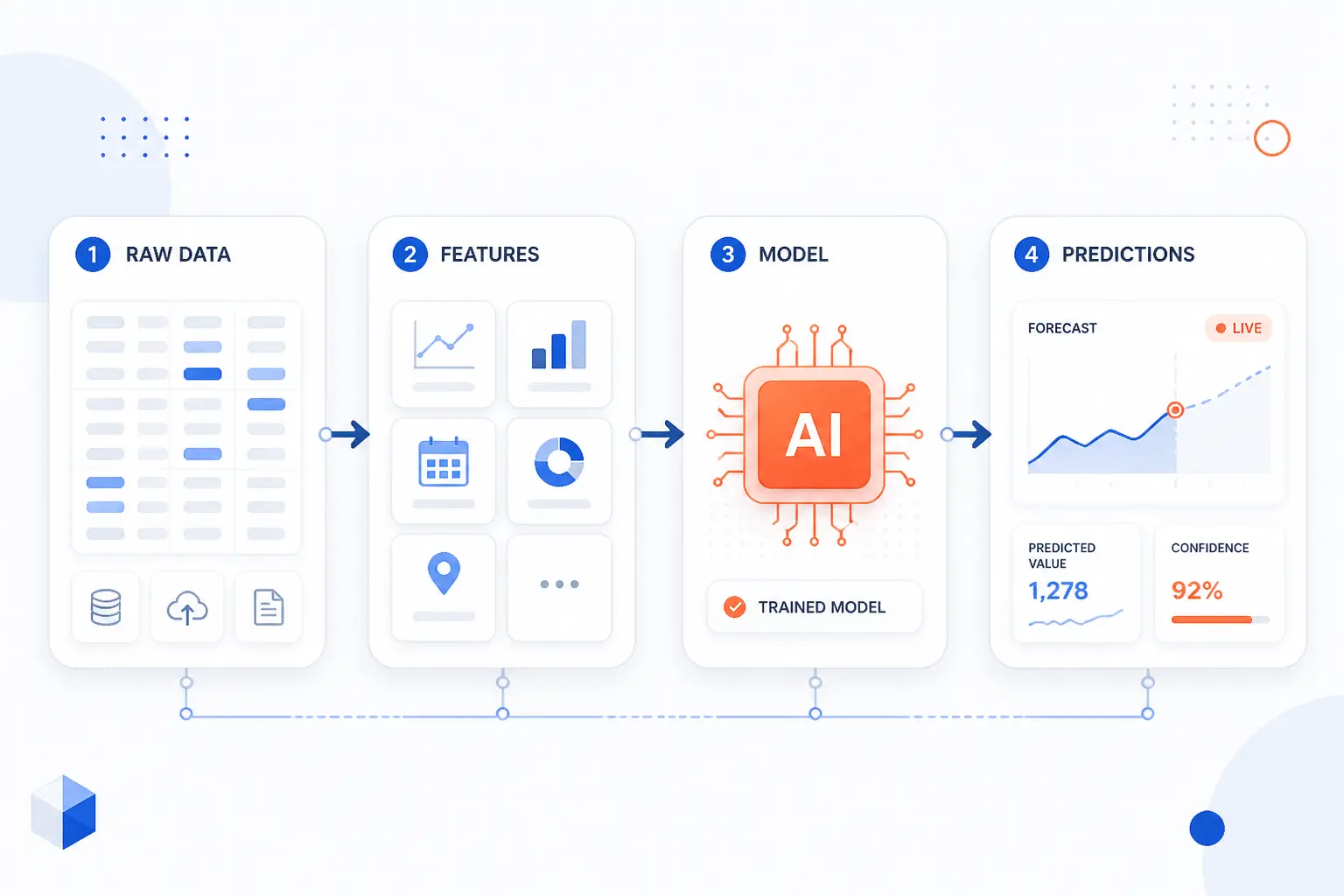
Predictive AI works by collecting relevant data, preparing it, training a model, testing that model, and then using it in production to generate forecasts. The system learns from examples where the answer is already known, then applies those learned patterns to new cases. A useful workflow has four main stages: data preparation, feature design, model training, and continuous monitoring. If one stage is weak, the final forecast will be weak too.
Data Collection and Preparation
Predictive AI starts with data that describes both the situation and the outcome you want to forecast. For churn, that may include logins, support tickets, billing history, contract age, and whether the customer later canceled. For fraud, it may include transaction value, location, device type, account age, and chargeback history. The model needs examples that connect causes, context, and results.
Preparation is where many projects win or lose. Teams remove duplicate records, fix missing values, normalize formats, and check whether the data actually represents the problem. A model trained on last year’s premium customers may perform poorly on this year’s small-business customers. That gap is not a math problem. It is a data problem wearing a math hat.
We usually advise teams to begin with a clear question. “Predict sales” is too vague. “Forecast weekly demand for each product by region” is useful. The second version tells the team what data to gather, how often to update it, and how to judge the result.
Feature Engineering and Data Transformation
Feature engineering turns raw data into useful signals a model can learn from. A raw timestamp may become “day of week,” “holiday period,” or “days since last purchase.” A list of support tickets may become “ticket count in the past month” or “number of unresolved issues.” These transformed inputs often matter more than the algorithm itself.
Good features capture context. A payment of $500 may be normal for one customer and strange for another. A sudden drop in product usage may mean churn risk for a software company, while a sudden spike in failed logins may mean account abuse. The model needs those signals in a shape it can compare.
Transformation also helps models handle different data types. Numeric values may be scaled. Categories may be encoded. Text may be converted into counts, embeddings, or labels. None of this is glamorous, but it is where forecasting becomes grounded instead of magical.
Model Training and Validation
Model training teaches the system to map input data to a target outcome. The model sees many examples, adjusts its internal parameters, and tries to reduce prediction error. In a credit model, the target may be default. In a demand model, it may be units sold next week. In a maintenance model, it may be failure within a service window.
Validation checks whether the model performs well on data it did not memorize. This matters because a model can look brilliant on training data and fail badly in the real world. The scikit-learn documentation warns that testing on the same data used for learning is a methodological mistake and recommends holding out part of the available data for evaluation. That principle is basic, but it saves projects from false confidence.
Teams also choose metrics that match the business risk. Accuracy may be fine for balanced problems. Fraud detection may need precision, recall, or cost-based scoring because false positives annoy customers and false negatives lose money. In healthcare, a missed high-risk patient may matter more than an extra review.
Deployment, Monitoring, and Refinement
Deployment puts the trained model where people or systems can use its forecasts. It may run inside a dashboard, trigger alerts, score new transactions, rank support tickets, or feed an inventory planning system. The output should be simple enough to act on. A probability, risk score, confidence band, or ranked list is often better than a black-box verdict.
Monitoring keeps the model honest after launch. Real-world data changes. Customers behave differently. Fraud tactics evolve. Supply chains shift. A model that performed well during training can decay when the environment changes.
Production systems should track data quality, prediction quality, latency, bias indicators, and drift. AWS guidance describes post-deployment monitoring as a cycle that captures data, compares it with the training set, defines rules, and alerts teams about data quality and drift checks. In our view, this is where predictive AI becomes a living system rather than a one-time analytics project.
Models and Methods Behind the Forecasts
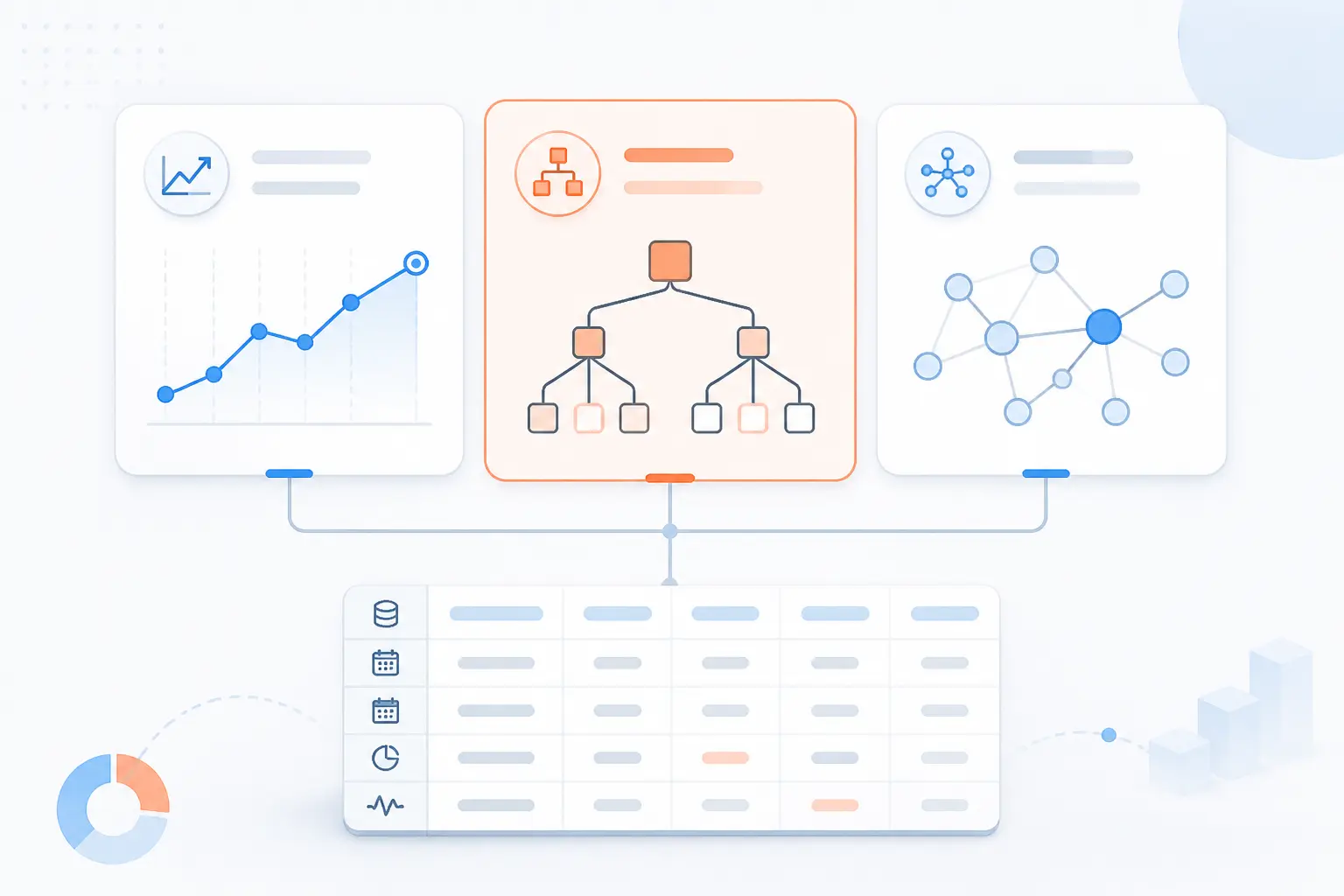
Predictive AI can use many model types, and the right choice depends on the data, the question, and the cost of being wrong. Regression models are often clear and fast. Tree-based methods are flexible and strong on tabular business data. Neural networks can handle complex patterns, especially in images, language, and large-scale signals. Other methods help group behavior, spot unusual activity, or forecast time-based trends.
| Method | Best fit | Common output |
|---|---|---|
| Regression | Estimating numeric values or probabilities | Price, demand, risk score |
| Trees and forests | Tabular business data with mixed signals | Class, score, ranked risk |
| Neural networks | Large or complex datasets | Forecast, classification, embedding |
| Time series and anomaly methods | Trends, seasonality, and unusual behavior | Forecast curve, alert, cluster |
Regression Models
Regression models estimate a continuous value or a probability from input variables. Linear regression may forecast monthly revenue from ad spend, season, and customer count. Logistic regression may estimate whether a customer will churn or whether a loan applicant may default. These models are popular because they are relatively easy to explain.
Regression is a good first tool when relationships are stable and the team needs interpretability. If price rises, demand may fall. If customer usage drops, churn risk may rise. The model can show the direction and approximate strength of those relationships.
Regression is not old-fashioned in a bad way. We often prefer starting with it because simple baselines expose whether the data has real signal. If a basic model performs nearly as well as a complex one, the simpler choice may be the wiser choice.
Decision Trees and Random Forests
Decision trees split data into branches so the model can make different forecasts for different conditions. A tree may learn that customers with low usage and several recent complaints are high risk. Another branch may show that high-usage customers with annual contracts are low risk. That branching structure feels natural to business teams because it resembles rule-based thinking.
Random forests improve on a single tree by training many trees and combining their outputs. This usually reduces the chance that one odd pattern dominates the forecast. Tree-based methods also work well when data contains a mix of numbers, categories, missing values, and nonlinear relationships.
The scikit-learn estimator families show how broad supervised and unsupervised methods have become, from linear models to ensembles and neural networks. That variety is useful, but it also tempts teams to overcomplicate things. We prefer choosing the simplest model that meets the accuracy, latency, and explanation requirements.
Neural Networks
Neural networks learn layered patterns from data and can model complex relationships. They are especially useful when signals are high-dimensional, such as images, audio, text, clickstreams, or very large time series. A neural network may detect subtle product demand patterns across regions, or it may classify medical images as part of a clinical workflow.
The tradeoff is complexity. Neural networks often need more data, more compute, and more tuning than simpler models. They can also be harder to explain. That does not make them bad. It means the business case must justify the extra weight.
We view neural networks as power tools. They are excellent when the problem is large and messy. They are excessive when a transparent model can do the job.
Clustering, Anomaly Detection, and Time Series Methods
Clustering, anomaly detection, and time series methods help predictive AI understand groups, unusual events, and changing patterns over time. Clustering groups similar customers, transactions, or machines without needing a predefined label. Anomaly detection flags activity that looks unlike normal behavior. Time series methods forecast values that move by hour, day, week, or season.
These methods often appear together in real systems. A retailer may cluster stores by demand behavior, use time series forecasting for inventory, and flag unusual sales spikes as potential data errors or local events. A security team may cluster normal network behavior, then detect unusual traffic patterns.
Time matters because yesterday’s signal may not mean the same thing next month. Holiday shopping, interest rates, weather, product launches, and competitor moves can change the pattern. Predictive AI works best when time is treated as part of the problem, not background noise.
Where Predictive AI Delivers Business Value
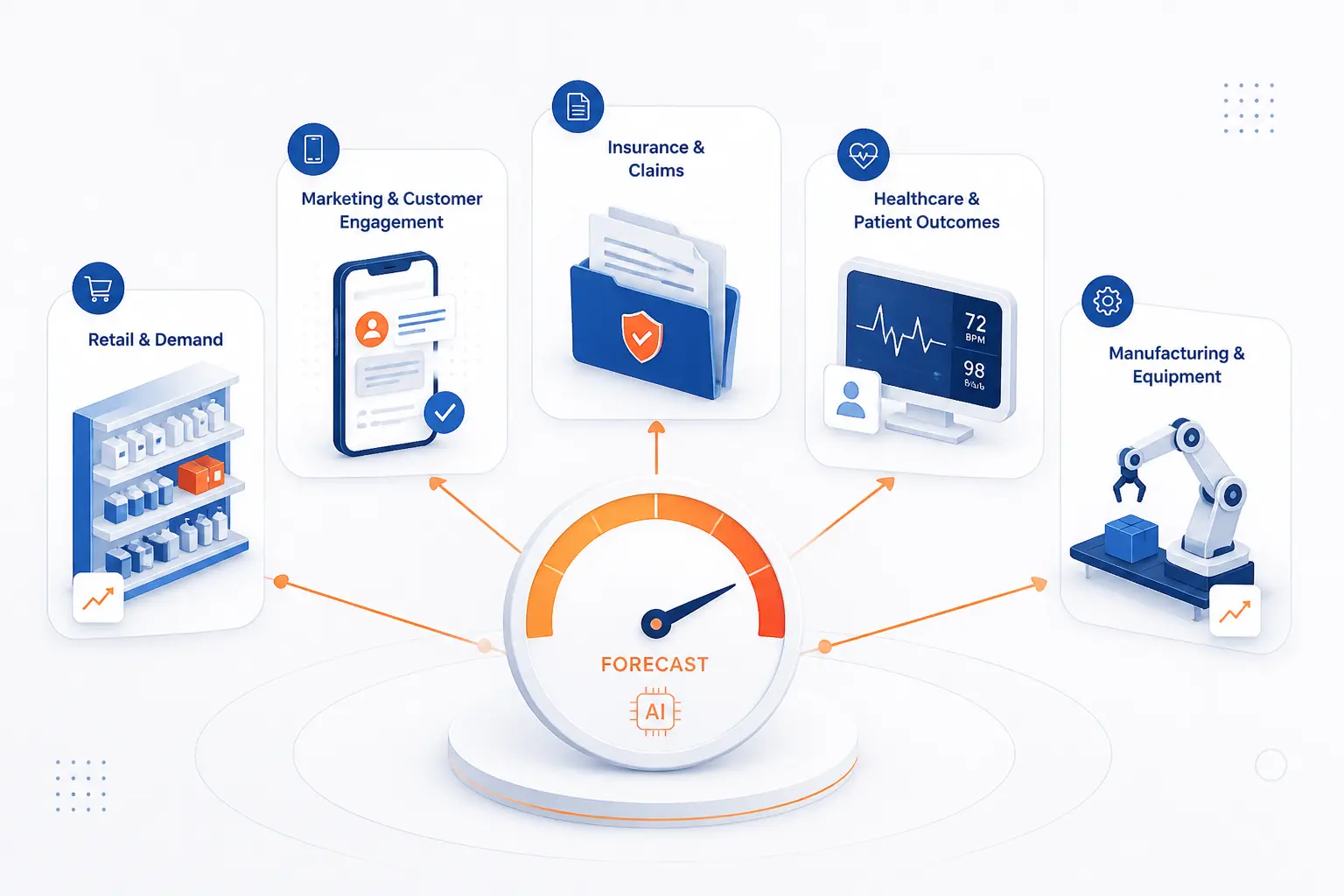
Predictive AI delivers business value where better timing, ranking, or risk scoring changes an action. It is useful when teams must decide what to stock, who to contact, which claim to review, which patient to monitor, or which machine to inspect. The value comes from acting before the outcome happens. These are the areas where we see the clearest return.
| Use case | What gets forecast | Action it supports |
|---|---|---|
| Customer growth | Churn, interest, next best offer | Retention and recommendations |
| Supply chain | Demand, shortages, delays | Inventory and purchasing |
| Finance and insurance | Fraud, default, claim risk | Review and pricing |
| Healthcare and operations | Patient risk, equipment failure | Intervention and maintenance |
Customer Churn, Personalization, and Recommendations
Predictive AI helps customer teams identify who may leave, what they may want, and when to engage. A churn model can rank accounts by cancellation risk. A recommendation system can estimate which product, video, article, or plan a user is most likely to choose. The output is usually a score or ranked list.
Personalization works because behavior leaves clues. Pages viewed, products purchased, time since last login, cart abandonment, support history, and discount response can all become model inputs. The system does not need to “understand” the customer like a person. It only needs to find patterns that improve the next decision.
We prefer using these systems with restraint. A helpful recommendation feels timely. An aggressive one feels creepy. The line is crossed when the business optimizes short-term clicks while ignoring trust.
Demand Forecasting, Inventory, and Supply Chains
Predictive AI helps supply chain teams estimate what will be needed, where it will be needed, and when. Demand forecasting can reduce stockouts, lower excess inventory, and guide purchasing. It can also help teams place goods closer to buyers before orders arrive.
Amazon’s supply chain example shows the scale of this problem. Its SCOT system helps forecast demand for more than 400 million products each day, using deep learning and large datasets to decide which products to stock and where. Most businesses do not operate at that size, of course. The lesson still applies: better forecasts change physical decisions.
For a small retailer, the same idea may be weekly inventory planning. For a manufacturer, it may be raw material purchasing. For a cloud team, it may be capacity planning. Different domain, same pattern: predict demand early enough to prepare.
Fraud Detection, Credit Risk, and Insurance
Predictive AI helps finance and insurance teams rank risk before money moves or claims are paid. Fraud models look for unusual transaction behavior, device signals, velocity patterns, location mismatches, and account history. Credit models estimate repayment risk. Insurance models estimate claim likelihood, claim cost, or suspicious activity.
The main benefit is prioritization. A fraud team cannot manually inspect every transaction. A lender cannot treat every applicant as identical. A model can score cases so humans and automated rules focus attention where risk is highest.
Still, this is a high-stakes area. Bad models can unfairly block customers, deny access, or create hidden discrimination. We believe risk models need careful testing, appeal paths, and human review for sensitive decisions.
Healthcare Risk Scoring and Patient Outcomes
Predictive AI helps healthcare teams estimate patient risk so clinicians can intervene earlier. A model may flag patients at risk of sepsis, readmission, deterioration, or treatment complications. The output should support clinical judgment, not replace it.
Healthcare is one of the clearest examples of why validation and governance matter. The FDA maintains a public list of devices that have met applicable premarket requirements and are authorized for marketing in the United States. That review context matters because a wrong forecast can affect patient safety.
In our view, medical predictive systems should be conservative, transparent, and tightly monitored. A useful alert can help a clinician look sooner. A noisy alert can create fatigue. A biased alert can harm the very people it was meant to protect.
Predictive Maintenance and Operations
Predictive AI helps operations teams estimate when equipment, vehicles, systems, or infrastructure may fail. Inputs may include sensor readings, error logs, vibration, temperature, pressure, service history, and usage patterns. The model looks for early warning signs before a breakdown occurs.
Logistics gives us a concrete example of operations intelligence. A U.S. Federal Highway Administration compendium describes UPS’s ORION route system as software used to reduce miles traveled by 100 million annually. That example is route optimization rather than a pure maintenance model, but it shows the same operational principle: predictions and algorithms become valuable when they change movement, fuel, time, and cost.
For cloud operations, the equivalent might be forecasting storage growth, traffic spikes, error rates, or resource saturation. A prediction that arrives after an outage is trivia. A prediction that arrives early enough to act is useful.
Why Businesses Use Predictive AI
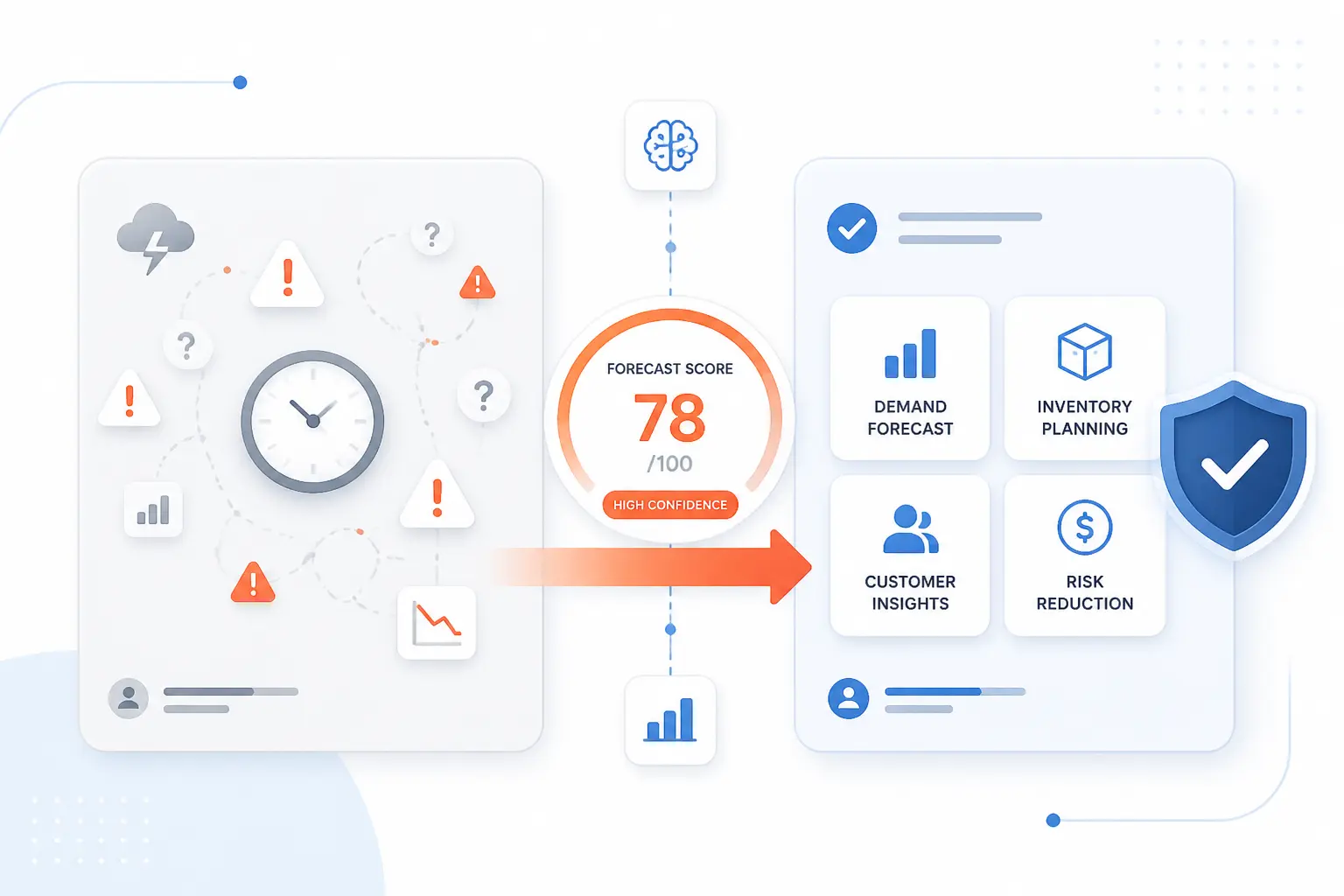
Businesses use predictive AI because it improves decisions that depend on uncertainty. It helps teams plan earlier, allocate resources better, and manage risk before damage is visible. The strongest use cases have a clear action tied to the forecast. If no one knows what to do with the score, the model is just decoration.
Better Decisions and Faster Planning
Predictive AI gives teams a structured way to plan under uncertainty. Instead of asking “What happened last quarter?” teams can ask “What is likely to happen next?” That shift changes the meeting. People stop arguing only from hindsight and start comparing scenarios.
A sales leader can plan renewals by churn risk. A finance team can forecast cash flow by payment behavior. A cloud operations team can estimate capacity pressure before customers feel it. The model does not remove judgment, but it sharpens the conversation.
We also like that predictive systems make assumptions visible. If the forecast is wrong, teams can inspect the data, features, and logic. That is healthier than relying on gut feel that cannot be tested.
Higher Efficiency and Lower Costs
Predictive AI lowers costs when it helps people act on the right cases first. A support team can prioritize tickets likely to breach service targets. A warehouse can stock fast-moving items in better locations. A maintenance crew can inspect assets with rising failure risk.
The savings come from fewer wasted actions. Teams do not need to contact every customer, inspect every machine, or overstock every product “just in case.” They can focus on the cases where the expected value is highest.
That said, cost reduction should not be the only goal. If a model saves money while frustrating customers or staff, the math is incomplete. We prefer measuring operational gain alongside trust, error rates, and customer impact.
Stronger Risk Management and Resilience
Predictive AI strengthens risk management by giving earlier warnings. Fraud spikes, supplier delays, patient deterioration, demand shocks, and system failures all have signals. A good model notices those signals before a dashboard turns red.
Resilience is about recovery and preparation. Predictive systems help teams prepare by simulating likely stress points and ranking vulnerable areas. They also help after disruption by updating forecasts as new data arrives.
We do not think predictive AI makes a business bulletproof. Nothing does. It does, however, reduce the number of surprises that should have been obvious in the data.
Limits, Accuracy, and Trust in Predictive Systems
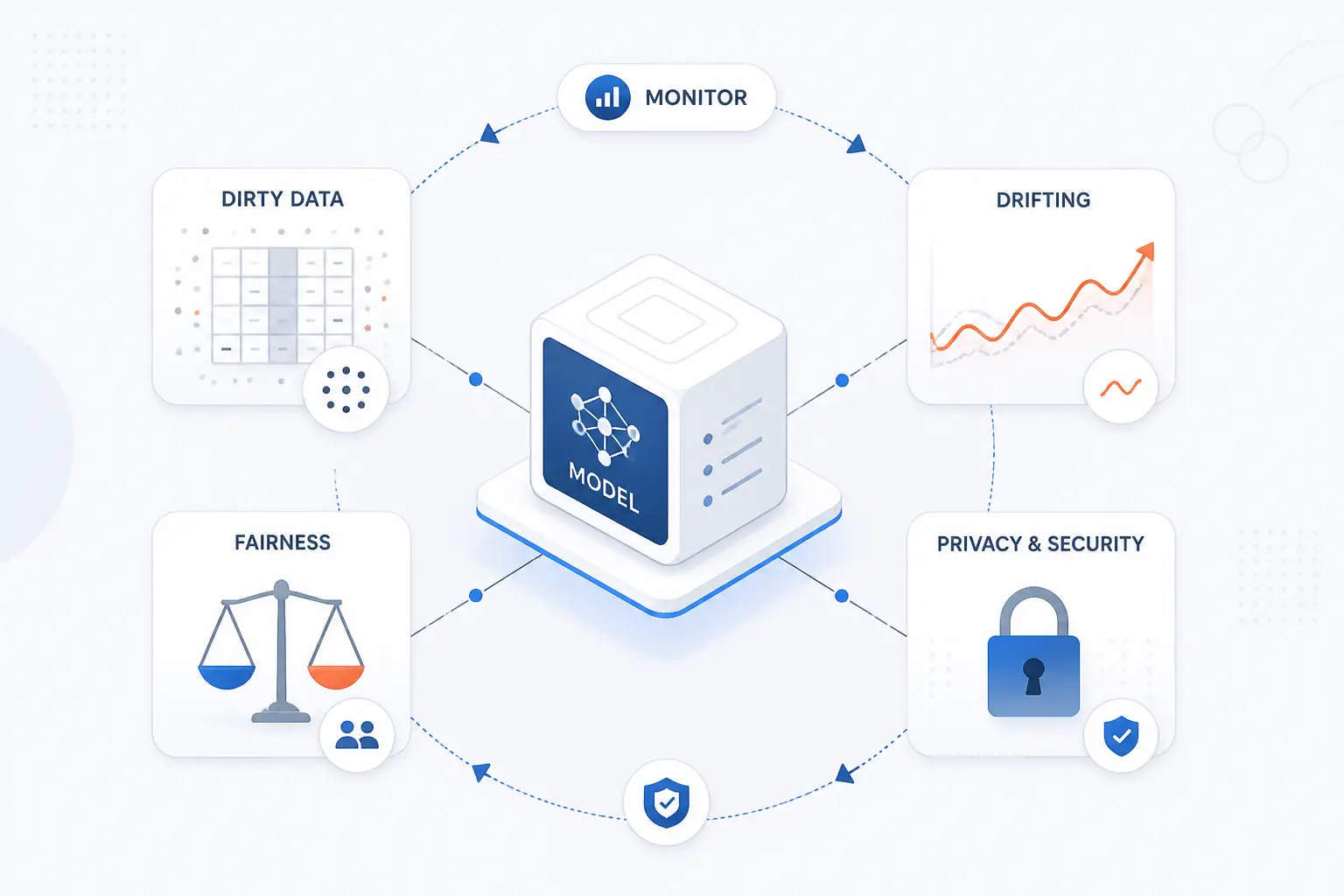
Predictive AI has limits because forecasts depend on data quality, model design, changing conditions, and human use. A model can be accurate in testing and wrong in production. It can also be statistically strong while unfair, confusing, or insecure. Trust comes from measurement, monitoring, documentation, and accountability, not from calling a system intelligent.
Why Data Quality and Diversity Matter
Predictive AI is only as reliable as the data it learns from. If the data is incomplete, outdated, biased, duplicated, or poorly labeled, the model will inherit those weaknesses. A clean algorithm cannot rescue a dirty dataset.
Diversity matters because real users, patients, customers, and transactions vary. If a healthcare model is trained mostly on one population, it may perform worse on another. If a fraud model lacks examples from new regions, it may overreact or miss real threats.
We recommend checking data slices, not just overall accuracy. A model that performs well on average may fail for a smaller group. That is where harm often hides.
Overfitting, Underfitting, and Model Drift
Overfitting happens when a model memorizes training data instead of learning patterns that generalize. It may perform beautifully during development and poorly on new data. Underfitting is the opposite problem. The model is too simple to capture the real relationships.
Model drift happens when the real world changes after deployment. Customer behavior may shift. Fraud patterns may evolve. A product may enter a new market. Economic conditions may change. The original training data then becomes less representative.
This is why predictive AI needs lifecycle management. Teams should monitor inputs, outputs, errors, and business outcomes. They should retrain or replace models when the data proves the old pattern no longer holds.
Bias, Explainability, and Accountability
Bias in predictive AI occurs when a system produces unfair or harmful outcomes for certain groups or cases. Bias may come from historical data, missing data, proxy variables, labeling choices, or deployment decisions. Removing one sensitive field does not automatically remove bias, because other fields may act as proxies.
Explainability helps people understand why a model made a forecast. That may involve feature importance, reason codes, local explanations, or simpler model choices. Accountability means someone owns the system’s behavior, monitors it, and can correct it.
We believe explainability should match the stakes. A movie recommendation can be loosely explained. A credit denial, medical alert, or fraud block needs much clearer reasoning and a path for review.
Governance, Security, and Compliance
Governance defines who can build, approve, deploy, monitor, and change predictive AI systems. It also defines what evidence is required before a model is trusted in production. Without governance, models spread quietly across a company and no one knows which ones are safe.
Security matters because models depend on sensitive data and may influence high-value decisions. Teams should protect training data, inference inputs, model artifacts, logs, and access credentials. They should also watch for data leakage, tampering, and unauthorized use.
NIST frames responsible system management as a lifecycle issue, with guidance for organizations that design, develop, deploy, or use these systems to manage the many risks and promote trustworthy development. We agree with that stance. Predictive AI is not just a data science asset. It is a business control.
Predictive AI vs Generative AI
Predictive AI forecasts likely outcomes, while generative AI creates new content. Predictive systems usually produce scores, classifications, rankings, or time-based forecasts. Generative systems produce text, images, code, audio, summaries, or synthetic examples. Both use machine learning, but they serve different jobs.
| Category | Predictive AI | Generative AI |
|---|---|---|
| Main goal | Forecast what may happen | Create new content |
| Typical input | Historical records and signals | Prompts, files, context, examples |
| Typical output | Risk score, probability, forecast | Text, image, code, summary |
| Best question | What is likely next? | What can be created from this? |
Different Goals, Inputs, and Outputs
Predictive AI and generative AI differ most clearly in their outputs. Predictive models produce estimates. Generative models produce content. A churn model may output a 78% cancellation risk, while a generative model may draft the retention email.
The inputs also differ. Predictive systems depend heavily on structured historical data, labels, and measurable outcomes. Generative systems often start from prompts, documents, images, or other context. They may use patterns learned from huge training datasets to produce new material.
The confusion is understandable because both can sit inside the same product. A customer platform may predict churn, then use a generative tool to write a suggested response. The first part forecasts. The second part creates.
When Predictive Models Are the Better Fit
Predictive models are the better fit when the business question requires a forecast, ranking, probability, or risk score. If the question is “Which invoices may be late?” or “Which machines may fail?” predictive AI is the natural tool. If the question is “Write a policy draft,” generative AI is better.
Predictive systems also tend to be better when evaluation can be tied to measurable outcomes. Did the customer churn? Did the payment default? Did the part fail? Did demand exceed supply? These answers let teams test the model against reality.
We would not use a chatbot as a demand planner by itself. We would use forecasting models for the numbers, then perhaps use a generative assistant to explain the forecast to a manager. Right tool, right job.
How Predictive and Generative AI Can Work Together
Predictive and generative AI work well together when forecasts need explanation, communication, or action. A predictive model can rank customers by churn risk. A generative model can help draft a tailored outreach message based on approved context. A predictive model can forecast capacity pressure. A generative model can summarize the incident plan.
Generative tools can also help analysts explore data, write documentation, or turn model outputs into plain-language reports. The danger is letting generated text sound more certain than the forecast supports. If the prediction is uncertain, the explanation should say so.
In our work around cloud infrastructure and digital services, we find the pairing most useful when boundaries are clear. Let the forecast engine calculate. Let the content engine explain. Keep humans in charge of the final decision when the stakes are high.
FAQ
Predictive AI raises practical questions because the term sounds broader than it really is. The short answer is that it forecasts outcomes from data. It is useful, but it is not fortune-telling. These quick answers clear up the questions we hear most often.
Is ChatGPT Predictive AI or Generative AI?
ChatGPT is primarily generative AI because it creates responses, explanations, code, and other content from user prompts. OpenAI’s help material describes ChatGPT as being trained to produce text, which is the key generative behavior. It does use prediction internally at the language-model level, but its user-facing purpose is content generation, not business forecasting.
How Accurate Is Predictive AI?
Predictive AI is only as accurate as the data, model design, validation method, and production environment allow. Accuracy varies widely by use case, because forecasting tomorrow’s temperature, next month’s demand, and rare fraud events are very different problems. A responsible team measures performance with the right metric and keeps checking it after deployment.
What Types of Data Does Predictive AI Use?
Predictive AI can use structured data, time series data, text, images, sensor readings, logs, transactions, and customer behavior data. The best data depends on the outcome being forecast. For example, churn models often use product activity and billing history, while maintenance models often use sensor and service data.






Conclusion
Predictive AI is best understood as a forecasting engine for business, technical, and operational decisions. It studies past and current signals, learns patterns, and estimates what may happen next. The value is not in sounding futuristic. The value is in helping people act earlier and smarter.
We think the most successful projects start with one clear question, one measurable outcome, and one decision that will change if the forecast is useful. The model should be tested, monitored, explained, and governed. If it cannot be acted on, it is probably not worth building yet.
For beginners, the next step is simple: choose one recurring decision in your organization that depends on uncertainty. Then ask what data you already have, what outcome you can measure, and what action a forecast would trigger. That is where predictive AI starts to become real.