

- What is Pseudocode in computer science and algorithm design
- Why use pseudocode benefits for programmers students and teams
- Where pseudocode is used in practice
- Pseudocode syntax: flexible conventions with no single standard
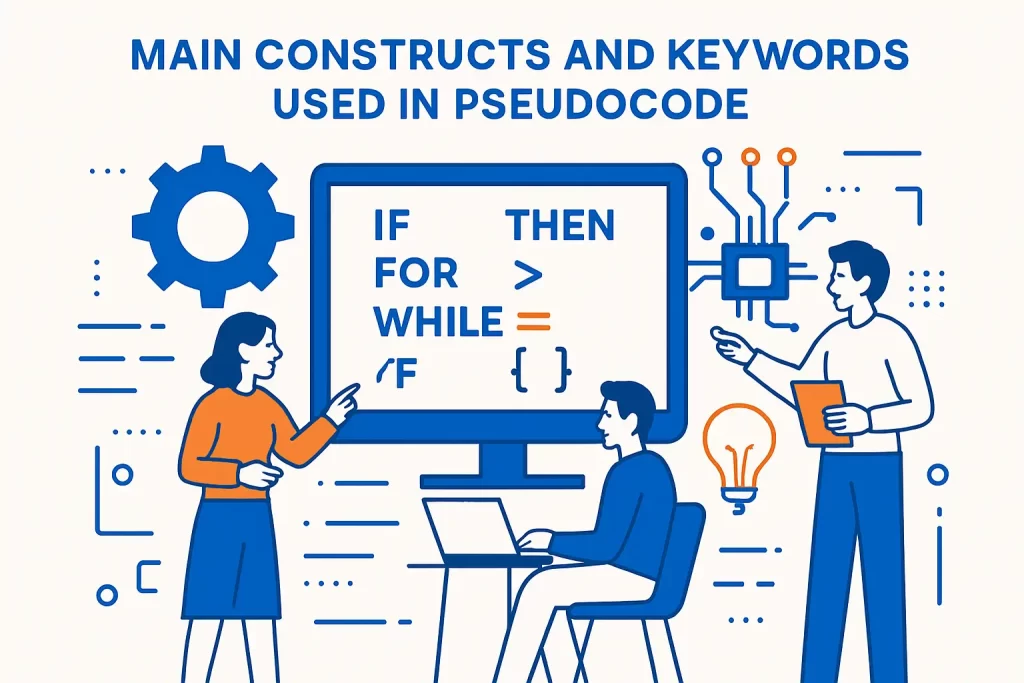
- Main constructs and keywords used in pseudocode
- How to write pseudocode guidelines that improve clarity
- Pseudocode formats and examples from simple steps to mathematical notation
- How 1Byte helps you move from pseudocode to a live project on the cloud
- Conclusion: using what is pseudocode to bridge ideas and working code
At 1Byte, we live in the space between ideas and production. We register the domain, lock down TLS, spin up the hosting, wire the CI pipeline, and then—if we did our job right—your application behaves the way you meant it to behave. Yet the most expensive bugs we see rarely come from a missing semicolon or a bad import. Instead, they come from fuzzy thinking: a team starts building before it agrees on what “done” even means.
In our world of cloud deployments, that fuzziness scales faster than the infrastructure. Gartner forecasts worldwide public cloud end-user spending to total $723.4 billion in 2025, which is a polite way of saying that more organizations than ever are shipping software as a core business capability—not a side project.
What is Pseudocode in computer science and algorithm design
McKinsey goes one step further and estimates $3 trillion of EBITDA value up for grabs by 2030, and we read that as a reminder: velocity matters, but correctness matters more. Pseudocode—done well—is one of the simplest, most underpriced tools for turning messy intent into disciplined execution.
1. Human readable steps for describing an algorithm
Pseudocode is how we write an algorithm in a form that respects human attention. Instead of wrestling with the syntax rules of a specific language, we describe the steps the computer would take, using structured English and familiar control flow. In practice, it’s the “shape” of the solution—inputs, decisions, loops, outputs—without the scaffolding of compilation.
From a systems perspective, we treat pseudocode as a portable mental model. A backend engineer can sketch a rate-limiting policy, a data engineer can outline an ETL flow, and a security reviewer can follow the logic without needing to run anything. When the logic is legible, critique becomes cheap.
What we mean by “human readable” in real teams
Readable does not mean informal. Clarity often comes from naming things the way the business names them: “customer,” “invoice,” “trial,” “flagged transaction,” “blocked IP.” When pseudocode uses domain language, it becomes a bridge between product intent and technical design, which is exactly where misunderstandings like to hide.
2. Not intended for machine execution and often omits implementation details
Pseudocode is not “code that forgot to compile.” Its job is to preserve the algorithmic truth while omitting incidental complexity: variable declarations, memory management, framework glue, and vendor-specific SDK calls. The point is to isolate logic from mechanics.
That omission is a feature, not a flaw. Consider an authentication flow: in real code, you will see HTTP libraries, JSON parsing, JWT validation helpers, and caching layers. In pseudocode, we can collapse that into a step like “validate token and required claims” and then focus on the decisions that matter: what happens on failure, what gets logged, and how authorization is derived.
Where we still insist on precision
Some details are not “incidental” because they change correctness. If the algorithm depends on ordering, concurrency, idempotency, or time windows, we make those explicit. When an operation must be atomic, pseudocode should say so. If a retry policy must avoid duplicate side effects, pseudocode should state “only if safe to retry,” because that single phrase often separates a reliable service from a revenue-leaking one.
3. A communication focused way to capture the core essence of a solution
Pseudocode is fundamentally social. It is a tool for aligning minds, not just machines. In a mixed team—say, Java on the core services, Python for data jobs, JavaScript for the frontend—pseudocode becomes a neutral meeting ground that prevents the loudest language from “winning” by default.
Inside 1Byte projects, we often use pseudocode as a pre-commit artifact: a lightweight design contract that can be reviewed asynchronously. Engineers can disagree on style, but they can’t hide from the logic when it’s written in plain steps. Product stakeholders can also validate behavior early, which reduces the odds of discovering a “requirements mismatch” after the infrastructure is already provisioned and the calendar is already angry.
Why use pseudocode benefits for programmers students and teams
1. Plan the solution before coding and reduce logical errors early
Planning in pseudocode forces a small but powerful discipline: we must decide what happens first, what happens next, and what stops the process. That sounds obvious until we watch a team implement a feature that “mostly works” while silently failing on edge cases—empty inputs, partial states, retries, timeouts, and missing permissions.
Early pseudocode is where we catch contradictions like “we delete the record, then we audit it,” or “we require a field that doesn’t exist until later.” In algorithmic terms, pseudocode is where invariants get a chance to breathe. In business terms, it’s where we avoid building a system that accidentally bills customers twice or locks out an admin during an incident.
Why this matters in cloud environments
Cloud infrastructure makes it easy to scale mistakes. A flawed loop, a bad batching strategy, or an unbounded retry can turn into a noisy neighbor event, a surprise bill, or a cascading outage. When we sketch the control flow first, we can ask uncomfortable questions before runtime asks them for us.
2. Make logic easier to understand across different programming language backgrounds
Language ecosystems have their own accents. A Go developer thinks in explicit error returns; a Python developer may lean on exceptions; a functional programmer may prefer pure transformations. Pseudocode lets us express intent without forcing everyone to think in the same idioms.
Cross-language clarity becomes especially valuable when teams are distributed. In our hosting and cloud support work, we routinely see architectures that span multiple runtimes: a CMS on one stack, a custom API on another, a background worker in a third. When the integration logic is described in pseudocode, the team can reason about interfaces and contracts without prematurely arguing about frameworks.
One small pattern we recommend
We like to write pseudocode at the level of “messages and responsibilities.” Instead of “call method X on class Y,” we write “send event ‘OrderPaid’ to billing worker” or “persist invoice with status ‘pending’.” That makes the logic portable across languages and even across architectural styles.
3. Support documentation and faster bug detection before writing real code
Pseudocode doubles as documentation that stays relevant longer than code comments. Comments rot because they describe local implementation details that change. Pseudocode, when written as a behavioral outline, tends to survive refactors because the intended behavior remains the same even when the plumbing evolves.
Bug detection improves because the team can review the algorithm without the noise of syntax. A reviewer who doesn’t know the codebase can still ask, “Where do we handle duplicates?” or “What happens if the third-party provider is down?” That kind of question is often more valuable than a style nitpick.
Our favorite workflow: pseudocode as a review gate
For higher-risk changes—authentication, billing, data deletion—we like to see pseudocode reviewed before implementation begins. The goal is not bureaucracy; it is to prevent the team from “debugging requirements” in production. When logic is right on paper, debugging becomes a technical exercise instead of a philosophical one.
Where pseudocode is used in practice
1. Textbooks and scientific publications for algorithms and numerical computation
Academic writing uses pseudocode because it offers a shared representation of an algorithm independent of the reader’s favorite language. Researchers need to express control flow, mathematical operations, and data structure behavior in a compact, reviewable form.
That same habit shows up in industry research and engineering blogs. When teams publish how they improved a caching strategy, balanced work queues, or implemented a consensus approach, pseudocode is often the only way to communicate the essence without dragging readers into a codebase they don’t have.
Why academics and operators converge on the same tool
Both groups care about correctness and reproducibility. In science, reproducibility is the heart of credibility. In operations, reproducibility is what gets you through on-call without improvising under stress. Pseudocode helps in both settings because it makes the “why it works” visible.
2. Top down development from pseudocode sketch to executable code
Top-down development begins with an outline of behavior and then progressively fills in detail. Pseudocode is the natural first layer: the control flow and decision logic, written in a way that invites critique. After that, teams translate steps into functions, modules, and service boundaries.
We often see this pattern when a customer migrates from a monolith to services. The first problem is not Dockerfiles or VPCs; it’s identifying the seams in the logic. Pseudocode makes seams visible. It turns “the monolith does everything” into named responsibilities, which then become deployable units.
Pseudocode as a map for test design
Another practical use is test planning. If a pseudocode step says “reject request if user lacks permission,” then there must be a test for that branch. When a step says “retry if transient error,” there must be a test for retry safety. In our experience, good pseudocode quietly manufactures good test cases.
3. Standardization and specifications such as formal C like pseudocode in MPEG
Standards bodies use pseudocode to describe behavior precisely while remaining implementation-neutral. Video and audio standards, network protocols, and cryptographic specifications often include normative algorithm descriptions that look “C-like” but are not tied to a particular compiler.
MPEG standardization work, for example, is an ecosystem where implementers across devices and platforms need consistent decoding and processing behavior. The standard documents often rely on algorithmic descriptions and reference models so that two independent implementations can still produce compatible results. The reason is simple: interoperability is a logic problem before it’s a performance problem.
What businesses can learn from standards culture
When we build cloud systems that integrate with payment gateways, identity providers, or media pipelines, we are effectively participating in a private “standard” of our own making. Pseudocode helps teams write down those expectations explicitly, which reduces accidental divergence between services maintained by different people.
Pseudocode syntax: flexible conventions with no single standard
1. Often borrows control structures from real languages but stays language independent
Pseudocode tends to borrow familiar constructs—IF, ELSE, WHILE, FOR—because familiarity reduces cognitive load. The trick is to borrow the idea of the construct, not the quirks. We want readers to recognize flow instantly without tripping over language-specific punctuation.
In our internal design reviews, we encourage a “least surprise” style. A loop should look like a loop. A branch should look like a branch. If the pseudocode forces the reader to decode cleverness, it has already failed its primary function.
Language independence is a design constraint
Teams sometimes write pseudocode that is secretly Java or secretly Python. That defeats the purpose. A good check is to ask: could a competent engineer from another ecosystem implement this without asking what framework we use? If the answer is no, the pseudocode is too concrete.
2. Common simplifications like omitting variable declarations and replacing blocks with concise descriptions
Simplification is where pseudocode earns its keep. We omit boilerplate declarations, skip constructors, and avoid precise data typing unless type constraints affect logic. A step like “parse request payload” is often enough in pseudocode, because the algorithm we’re describing usually begins after parsing succeeds.
We also compress complex operations into intention-revealing steps: “normalize input,” “deduplicate records,” “validate policy,” “persist state,” “emit event.” Each step can later expand into real code, but the pseudocode remains a stable outline even if the implementation changes.
When to expand a block instead of compressing it
If a block contains business rules, we expand it. Pricing logic, eligibility logic, security policy, and data retention rules are rarely “details.” Whenever a block is likely to cause stakeholder disagreement, that block belongs in the open—written as explicit pseudocode steps that can be reviewed line by line.
3. Readable structure using indentation and clear block boundaries
Indentation is the quiet hero of pseudocode. Humans read structure visually, and indentation communicates nesting without punctuation. Clear block boundaries—END IF, END WHILE, END FOR—prevent ambiguity, especially in longer algorithms.
From a hosting provider’s viewpoint, indentation also has an operational parallel: systems that are easy to reason about are easier to run. When logic is structured, it becomes easier to observe, alert on, and debug. A messy algorithm becomes a messy incident, and we would rather not meet it at midnight.
One rule we apply: blocks must tell a story
Each nested block should answer a question: “What condition are we handling?” or “What are we repeating and why?” If nesting exists only because we kept adding patches, pseudocode is a chance to refactor the story before code calcifies the chaos.
Main constructs and keywords used in pseudocode
1. Six foundational constructs: sequence, case, while, repeat until, for, if then else
Most pseudocode can be built from a small set of constructs. We treat them as the grammar of algorithm design: a sequence of steps, branching decisions, and repetition with clear stopping conditions. Once that grammar is stable, we can express everything from simple input validation to complex scheduling logic.
How we explain each construct in plain language
- Sequence: do these steps in order, because the next step depends on the previous one.
- If then else: choose a path based on a condition, and state what happens otherwise.
- Case (or switch): select one of many paths based on a value, with a default outcome.
- While: repeat while a condition remains true, and ensure the condition can change.
- Repeat until: execute at least once, then stop when a condition becomes true.
- For: iterate over a collection or a range of work items in a controlled way.
In business systems, those constructs map cleanly to workflows: onboarding, billing, fulfillment, retries, and compensating actions. When we can express a workflow with these primitives, we can also test it, monitor it, and evolve it with less drama.
2. Common additions like call for functions and exception related constructs
Real systems need more than basic flow. We often add “CALL” to represent invoking another procedure, service, or dependency. We also add “RETURN” to make exits explicit, especially when different branches terminate early.
Exception-related constructs are another pragmatic addition. Even when the implementation language handles errors differently, pseudocode benefits from describing failure behavior clearly: “ON ERROR,” “RAISE,” “CATCH,” or “FAIL FAST.” What matters is not the keyword; what matters is that the reader can see how the algorithm behaves when the world refuses to cooperate.
Failure behavior is not an edge case in the cloud
Network calls fail. DNS can wobble. Credentials expire. Storage can throttle. Pseudocode that only describes the happy path is a fairy tale, and fairy tales make bad runbooks. When we sketch error flow early, we make room for resilience patterns like backoff, idempotency keys, and dead-letter handling—without locking ourselves into a specific library.
3. Reserved keywords and control flow patterns for clarity such as if else, for, while
Keyword consistency is the difference between pseudocode that feels professional and pseudocode that feels like a rushed chat message. We prefer a small vocabulary used repeatedly. If the algorithm uses IF/ELSE, it should not suddenly switch to “when” or “in the case that” unless there is a reason.
Control flow patterns also benefit from naming conventions. A condition should read like a question: “user is authorized,” “cache contains entry,” “queue is empty.” A loop condition should hint at progress: “while work remains,” “while next page exists.” Those small phrasing choices make the logic feel inevitable rather than accidental.
A clarity trick we borrow from security reviews
Whenever a branch changes privileges, visibility, or money, we label it. Pseudocode can include short tags like “SECURITY CRITICAL” or “BILLING RELEVANT.” This is not about scaring readers; it’s about directing attention to the parts where correctness is non-negotiable.
How to write pseudocode guidelines that improve clarity
1. Define the goal, organize tasks logically, and write steps in sequence
We start by stating the goal in one sentence: what the algorithm must accomplish, for whom, and under what constraints. That goal becomes the north star for every step that follows. Without it, pseudocode turns into a list of actions with no obvious purpose.
Next, we organize tasks into a logical flow: validate inputs, establish state, perform the main transformation, produce outputs, and handle failure. That ordering is not mandatory, but it is a strong default because it mirrors how systems actually behave under load. When we write steps in sequence, we also reveal hidden dependencies—like needing an id before we can create related records.
Our favorite prompt: “What must be true next?”
After each step, we ask what must be true for the next step to make sense. If we cannot answer, the algorithm likely needs an additional step (or the earlier step needs to be split). This is how pseudocode turns vague intent into a dependable plan.
2. Formatting rules like one statement per line, consistent indentation, and capitalized keywords
Formatting is not cosmetic; it is part of meaning. One statement per line allows reviewers to point at a specific action and discuss it without confusion. Consistent indentation exposes structure immediately. Capitalized keywords help the eye scan for control flow.
We also recommend short lines and clear names. If a step needs a paragraph to explain, it should probably be decomposed into sub-steps. If a variable name needs a footnote, it’s the wrong name. Pseudocode is a readability artifact first; it becomes implementable only after it becomes understandable.
How we keep formatting consistent across teams
Inside a project, we treat pseudocode style like code style: agree once, apply everywhere. A simple template in a shared doc goes a long way. When every design sketch uses the same conventions, reviewers spend their energy on logic rather than deciphering layout.
3. Style checks: keep it complete, finite, easy to understand, and avoid real programming syntax
Complete means every meaningful branch is accounted for: success, failure, and “nothing to do.” Finite means loops have clear exit conditions and progress indicators. Easy to understand means a new team member can follow the algorithm without tribal knowledge.
Avoiding real programming syntax is the hardest discipline for experienced engineers. We have muscle memory. Still, the moment pseudocode becomes indistinguishable from a specific language, we lose audience and we lose the ability to reason at the right level. The goal is not to impress; the goal is to communicate.
A practical review checklist we use
- Ambiguity check: could two readers implement this differently and both believe they are correct?
- Edge-case check: what happens with empty input, missing permissions, and partial state?
- Failure check: what happens when dependencies fail or return unexpected results?
- Observability check: where would we log, measure, or trace key decisions?
Pseudocode formats and examples from simple steps to mathematical notation

1. Common formats: code like structure with English, regular sentences, numbered steps, and diagrams
Pseudocode has multiple “dial settings.” Sometimes we want a code-like structure with English phrases. Other times, regular sentences are better because the audience includes non-engineers. Numbered steps can be useful for operational runbooks. Diagrams—like flowcharts—often complement pseudocode when there are many branches.
In cloud projects, we often combine formats. A short paragraph may state the goal and constraints, a pseudocode block may outline the algorithm, and a diagram may show service boundaries. Each format supports a different kind of understanding, and good architecture rarely fits in a single representation.
Choosing a format by audience
For engineers implementing a function, code-like pseudocode is efficient. For stakeholders approving behavior, sentence-based pseudocode is easier to validate. For incident response, step-based pseudocode doubles as a playbook. The format choice is not aesthetic; it is strategic communication.
2. Classic examples: fizz buzz, binary search pseudocode, and quicksort pseudocode
Classic exercises endure because they demonstrate control flow without distracting domain complexity. We like them as “calibration tools” in interviews, onboarding, and team practice—not because production systems look like these problems, but because the same constructs power real systems.
Fizz buzz (pseudocode)
FOR EACH number IN sequence IF number is divisible by THREE AND number is divisible by FIVE THEN OUTPUT "FizzBuzz" ELSE IF number is divisible by THREE THEN OUTPUT "Fizz" ELSE IF number is divisible by FIVE THEN OUTPUT "Buzz" ELSE OUTPUT number END IFEND FORWhat we care about here is branch ordering and mutually exclusive conditions. In business logic, the equivalent is rules precedence: which discounts apply first, which eligibility check overrides another, and what the default behavior is.
Binary search (pseudocode)
INPUT sorted_list, targetSET low TO first_positionSET high TO last_positionWHILE low is not past high SET mid TO midpoint between low and high IF sorted_list[mid] equals target THEN RETURN mid ELSE IF sorted_list[mid] is less than target THEN MOVE low to the position after mid ELSE MOVE high to the position before mid END IFEND WHILERETURN NOT_FOUNDBinary search illustrates a pattern we love in operational work: tight invariants. The algorithm maintains the truth that the target, if present, must be within the current bounds. In cloud troubleshooting, we do something similar by narrowing possibilities with each check instead of guessing.
Quicksort (pseudocode)
PROCEDURE quicksort(list) IF list has zero or one element THEN RETURN list END IF CHOOSE pivot from list SET less TO elements smaller than pivot SET equal TO elements equal to pivot SET greater TO elements larger than pivot RETURN quicksort(less) + equal + quicksort(greater)END PROCEDUREQuicksort’s lesson is decomposition: solve smaller problems and combine results. That same decomposition mindset is how we approach scaling applications—split responsibilities, define contracts, and let each component do one job well.
3. Mathematical style pseudocode and machine compilation of pseudocode style languages
Some pseudocode leans toward mathematics: concise symbols, functional transformations, and emphasis on invariants. That style can be powerful in algorithm-heavy domains like optimization, graphics, cryptography, and data science, where the algorithm is naturally described as transformations over sets, vectors, or distributions.
On the other end of the spectrum, some teams adopt pseudocode-like notations that are close enough to execute after translation. In practice, these sit near domain-specific languages: configuration languages, workflow definitions, and pipeline specs. Although those are not “pseudocode” in the classic sense, the design goal is similar—express intent at a higher level than a general-purpose language.
Our take: the real value is intermediate representations
Businesses benefit when they create a stable intermediate representation of logic. Pseudocode can be that representation. So can a workflow diagram, a policy document, or an executable specification. The best choice depends on the team, but the principle remains: write the behavior down in a form that can be reviewed before it becomes expensive to change.
How 1Byte helps you move from pseudocode to a live project on the cloud
1. Domain registration and SSL certificates for secure launches
Shipping software starts with identity and trust: a domain that customers can find and certificates that protect traffic. From our side at 1Byte, we treat those as foundational, not optional. When a team hands us a pseudocode sketch for a checkout flow or a login process, we already know that the eventual production system must be secure-by-default.
Good pseudocode supports that security posture. If the algorithm explicitly describes session handling, authorization checks, and failure behavior, we can help you translate it into real deployment requirements: redirect rules, secure headers, WAF policies, and certificate management practices that match the intended behavior.
Turning pseudocode into security requirements
A simple step like “reject unauthorized request” expands into practical questions: where is the auth boundary, what is logged, and what information is returned to the client. When those questions are answered in pseudocode, the move to HTTPS enforcement and secure deployment is smoother, because the desired behavior is already explicit.
2. WordPress hosting and shared hosting for sites and prototypes
Not every idea starts as a microservice architecture. Many start as a prototype, a landing page, a content hub, or a lightweight customer portal. In those cases, WordPress hosting or shared hosting can be the fastest path to learning.
Pseudocode still matters even in “simple” builds. A team might sketch the logic for a signup form, a content approval flow, or a support request intake. When we see those steps written clearly, we can recommend the right hosting plan, caching approach, and plugin strategy—because we understand the behavior the site must support, not just the technology stack it happens to use today.
Prototype responsibly, then harden intentionally
We encourage teams to prototype with urgency and then harden with discipline. Pseudocode helps with that transition: the algorithmic intent stays stable while the implementation evolves from quick scaffolding to production-grade code, better monitoring, and cleaner separation of concerns.
3. Cloud hosting and cloud servers backed by our AWS Partner expertise
When a project grows beyond a single host, the conversation shifts to deployment topologies, scaling behavior, and operational guardrails. Cloud hosting and cloud servers are where pseudocode becomes a design accelerant: it gives you a clear target behavior that we can map onto infrastructure choices.
In practical terms, we help teams translate algorithm steps into architecture decisions. A pseudocode step like “process messages until queue is empty” implies a worker model, concurrency controls, and backpressure strategy. A step like “store file and return URL” suggests object storage, CDN integration, and access policy decisions. When those implications are visible early, we can build a cloud environment that supports the logic instead of fighting it.
From pseudocode to delivery: the pipeline mindset
We like to treat the path from pseudocode to production as a pipeline: define behavior, implement incrementally, test against the branches, deploy with observability, then iterate. That pipeline reduces the risk of “big bang” releases and makes it easier to change course when real users teach you something new.
Conclusion: using what is pseudocode to bridge ideas and working code
1. Use pseudocode to align on logic first, then translate into executable instructions
Pseudocode is the simplest way we know to make logic reviewable before it becomes expensive. When teams align on steps, branches, and failure behavior first, implementation becomes a translation exercise rather than a discovery process conducted in production.
From our vantage point at 1Byte, that alignment is not academic. It is the difference between a launch that feels predictable and a launch that feels like improvisation. Cloud platforms give you immense leverage, but they also amplify ambiguity. Pseudocode shrinks that ambiguity to something your team can hold in its hands.







2. Choose the level of detail that supports understanding without locking into a specific syntax
The best pseudocode sits at the right altitude. Too vague, and it becomes motivational prose. Too detailed, and it becomes code with fewer guarantees. We aim for a level where a reviewer can implement the algorithm in any reasonable language and still produce the same behavior.
So here’s our practical next step: pick one feature you plan to ship—something that touches money, identity, or data integrity—and write its pseudocode as if you were handing it to a teammate you respect but cannot interrupt. Once you can read it end-to-end without questions, what would stop you from turning that clarity into a build plan and taking it live?