

- What is isp in computer and the ISP full form
- What an ISP does internet access plus extra services
- Common ISP connection technologies for homes and businesses
- ISP classifications: access, mailbox, hosting, transit, and more
- ISP tiers and interconnection: upstream providers, peering, and IXPs
- Internet speed and performance: plans, data caps, and reliability
- Security and policy: net neutrality, monitoring, and affordability
- 1Byte cloud computing and web hosting services as an AWS Partner
- Conclusion: key takeaways about ISPs in computer networking
At 1Byte, we build cloud infrastructure and web hosting that only feels “instant” when the network underneath it is doing thousands of quiet, disciplined things correctly. When a website loads fast, an API call returns cleanly, or a remote desktop session doesn’t stutter, the credit usually goes to the app or the cloud. Yet the unsung middle layer—the Internet Service Provider (ISP)—is often the decisive factor.
In our day-to-day work, we see ISPs from both sides: as a business buying upstream connectivity into data centers, and as a provider helping customers whose sites and services “mysteriously” slow down because a last-mile link, a congested neighborhood segment, or a peering path is taking the scenic route. Put differently, the internet is not a single network; it’s a negotiated alliance of networks, stitched together by contracts, routing policies, and physical interconnection points.
That’s also why the ISP conversation matters more than ever. Gartner’s latest forecast puts worldwide public cloud end-user spending at $723.4 billion in 2025, and we read that as a direct signal that more business workflows will depend on stable connectivity, not just “fast speeds.” Consider a retailer moving inventory operations into a SaaS suite or a clinic shifting patient intake to browser-based systems: when the ISP misbehaves, the business experience misbehaves.
What follows is our field-guide view: what an ISP is in computer networking, what it actually does, how it connects homes and enterprises, how ISPs interconnect behind the scenes, what to look for in performance and reliability, and why policy and security issues keep showing up in boardrooms—even when the topic sounds “technical.”
What is isp in computer and the ISP full form
1. ISP meaning as an organization that provides services for accessing and using the internet
ISP is short for Internet Service Provider, and in computer networking terms it’s the organization that sells you the practical ability to reach the wider internet. That sounds simple until we name what “reach” really means: your device must be able to send packets beyond your local network, get them routed across multiple independent networks, and receive the responses reliably enough that applications remain usable.
Inside enterprises, we often hear “the internet is down” as if the internet were one thing. In reality, a user is buying (or a business is contracting for) a bundle of capabilities: physical access, authentication, address assignment, routing, DNS reachability, and usually some support and policy enforcement. Even “basic internet” is already a layered product.
From our hosting perspective, the ISP is also a trust boundary. It is the first network outside your premises that can influence your latency, your path selection, and—depending on jurisdiction and policy—your privacy expectations. Treating the ISP as just a monthly bill is like treating electricity as “just a plug”; it ignores the grid, the transformer, and the circuit breakers that determine whether your workloads behave like a business service or a gamble.
2. ISP as a gateway connecting computers, phones, and other devices to the online world
An ISP functions as the gateway between your local network and everyone else’s. For a home, that gateway often looks like a modem and a Wi-Fi router. For a business, it might be a fiber handoff into a firewall, an SD-WAN appliance, or a dedicated router with multiple circuits.
Conceptually, the gateway idea matters because it clarifies responsibilities. Your laptop can be perfectly healthy while your “internet” fails because the gateway has lost signal, misrouted traffic, or is applying a shaping policy you didn’t anticipate. Conversely, the ISP can deliver a clean handoff while your own router is overheating, your Ethernet is mis-negotiating, or your Wi-Fi is saturated by interference. Diagnosing connectivity becomes dramatically easier once we stop blending “local network” and “ISP network” into one foggy concept.
Practically, ISPs also act as a gateway at the business level. They negotiate interconnection with upstream carriers, they choose where to peer, and they decide how to engineer their capacity. Those choices determine whether your traffic reaches your cloud provider through a short, well-peered path—or takes a longer route that adds jitter and latency at exactly the wrong time, like during a live payment authorization burst.
3. Common ISP ownership and operating models including commercial, community-owned, non-profit, and privately owned
Not all ISPs are built alike, and ownership models shape priorities in ways that customers can feel. Commercial incumbents tend to optimize for scale, standardized operations, and predictable margins. That can be good—mature processes and broad coverage—but it can also mean slower upgrades in areas where the business case is weak.
Community-owned networks and municipal broadband projects often form where residents or local governments refuse to accept “good enough” coverage. Chattanooga’s EPB is a frequently cited example of a city treating connectivity as civic infrastructure rather than a luxury product. In our experience, these networks can be excellent partners for small businesses and remote workers because their incentives align with regional economic development.
Non-profit and cooperative models show up in rural electrification-style approaches to broadband, while privately owned local providers—sometimes family-run, sometimes backed by private equity—may behave like “special forces”: smaller footprint, faster decisions, and very hands-on service. The tradeoff is that smaller operators may have fewer interconnection options and less bargaining power for upstream pricing, which can influence performance under heavy load unless they engineer carefully.
What an ISP does internet access plus extra services
1. Providing internet connectivity through multiple network technologies
ISPs deliver connectivity through an access technology stack: cable, fiber, DSL, fixed wireless, mobile broadband, or satellite. Each technology has its own physics, economics, and failure modes. Fiber tends to provide the most headroom and the best latency characteristics, while older copper-based methods may degrade with distance or environmental noise.
From a customer’s point of view, “internet service” is one product. From an engineer’s point of view, it’s a pipeline with a specific medium, a termination device, and a provisioning model. When we design hosting for customers who are geographically distributed, we factor this in: the access method influences how aggressive we can be with real-time features, how much caching we should rely on, and how to set expectations for VoIP, video calls, and interactive dashboards.
When an ISP supports multiple access technologies, it’s also managing multiple operational toolchains: plant maintenance, spectrum planning, field service dispatch, and inventory for customer-premises equipment. That operational complexity is one reason ISP quality varies by neighborhood even within the same brand.
2. Routing online data and operating the infrastructure needed to keep users connected
An ISP runs the network that moves your data. That includes aggregation switches, edge routers, core routers, and the operational systems that monitor and manage them. In the background, routing protocols decide which paths traffic should take to reach a destination network, and those decisions can change dynamically as links saturate or fail.
Routing as policy, not just math
Many people imagine routing as the “shortest path.” In real ISP operations, routing is also business policy. A provider may prefer certain upstream links because they are cheaper, or may steer traffic toward peers where the exchange is settlement-free. During congestion, those policy choices can show up as “the site is slow” even though nothing is wrong with the site itself.
Why infrastructure discipline matters to application performance
At 1Byte, we see a direct relationship between ISP engineering maturity and the stability of modern application stacks. Microservices, continuous deployment, and cloud storage all assume the network is boring—in the best sense. When an ISP’s backbone has limited redundancy or poorly planned maintenance windows, the “boring network” assumption breaks, and everything above it becomes brittle.
3. IP address allocation and basic network services
ISPs assign IP addresses to customers, either dynamically (common in consumer plans) or statically (common in business plans and essential for some server use-cases). Address assignment is only one piece of the puzzle; customers also depend on supporting services such as DNS resolvers, DHCP for local provisioning, and sometimes carrier-grade NAT behavior that affects inbound connectivity.
In enterprise contexts, IP allocation intersects with security and compliance. A business might require a fixed address to whitelist access to a cloud admin console or to lock down remote access rules. In other cases, a company may need a provider that supports modern addressing approaches for long-term growth, especially as connected devices proliferate.
From our hosting lens, IP behavior influences deliverability and reputation. If customers share address pools with bad actors, they can experience collateral damage like email deliverability issues or rate limits on external services. That’s not “the customer’s fault,” yet it becomes the customer’s problem unless the ISP manages its allocations responsibly.
4. Customer support and technical troubleshooting for connectivity problems
Support is where the ISP stops being an abstract network and becomes a human system. The best providers don’t just read scripts; they understand the difference between Wi-Fi issues, local router faults, upstream congestion, and genuine outages.
In our experience, fast escalation paths and transparent outage communication matter as much as raw bandwidth. When a business is down, it doesn’t care about marketing claims; it cares whether the provider can isolate the fault domain, communicate a realistic restoration timeline, and offer workarounds such as temporary reroutes or backup links.
Good ISPs also invest in self-service diagnostics—signal level checks, modem health stats, and maintenance notifications—because customer time is expensive. For a small business owner, an hour on hold is not just annoying; it is lost revenue.
5. Extra services that may be bundled such as email, domain registration, web hosting, and colocation
Many ISPs bundle services that live “above” connectivity: email hosting, domain registration, web hosting, and even colocation. Historically, this made sense because the ISP already had the customer relationship and could provide a one-stop shop.
Today, bundling creates a strategic choice. On the upside, fewer vendors can mean simpler billing and fewer integration points. On the downside, bundling can create lock-in: moving your internet service might also mean migrating email, DNS, or hosted sites, which adds friction and risk.
At 1Byte, we generally prefer separating concerns: let the ISP do what it does best—connect you reliably—while specialized providers handle domains, hosting, and cloud infrastructure with clearer SLAs and more purpose-built tooling. Still, in some regions, a local ISP’s bundled colocation offering can be a pragmatic bridge for businesses that need nearby rack space and hands-on support.
6. Bundled offerings that can include internet, television, telephone, and streaming services
Consumer ISPs often sell “triple-play” or similar bundles: internet plus television plus telephone, and now sometimes streaming subscriptions. The business logic is simple: higher average revenue per customer and lower churn because leaving the ISP means changing multiple services.
From a network standpoint, these bundles can influence how the provider engineers capacity. Video delivery is bandwidth-hungry, latency-tolerant, and often cacheable. Interactive services like gaming, video conferencing, and cloud desktops are different: they are sensitive to jitter and packet loss. A provider optimizing primarily for video may still deliver impressive “speed test” numbers while underperforming for real-time workloads.
For businesses, the key lesson is that plan marketing doesn’t reveal traffic engineering priorities. Asking how the ISP handles congestion, how it peers with major content networks, and what redundancy exists in the local plant is often more predictive than bundle packaging.
Common ISP connection technologies for homes and businesses
1. Dial-up connections and legacy access methods
Dial-up is largely a legacy method, but it remains an instructive baseline because it reminds us that “internet access” is not synonymous with “broadband.” Dial-up uses voice-grade telephone infrastructure and is constrained by the physics and signaling of that medium.
Even when dial-up is not in use, its spirit persists in certain fallback scenarios: remote telemetry lines, out-of-band management paths, and “just enough” connectivity for emergency access. In operations, we sometimes see businesses maintain a minimal backup channel precisely because primary broadband failures tend to happen at the worst time.
Legacy access also includes older fixed wireless implementations and early-generation cellular data plans. These older technologies can still be relevant where modern infrastructure hasn’t reached, but they require realistic expectations about latency, stability, and the ability to run cloud-first tooling.
2. DSL internet delivered over telephone lines
DSL delivers internet over copper telephone lines, typically by using frequencies above the voice band. Its practical performance depends heavily on line quality and distance from the provider’s equipment. That distance sensitivity is one reason two neighbors can have very different experiences if their copper pairs take different routes or have different levels of degradation.
Businesses on DSL often experience a particular pain: upload constraints. Modern work patterns—cloud backups, video calls, sending large design files, pushing code artifacts—are upload-heavy. When upstream capacity is limited or inconsistent, productivity suffers in a way that “download speed” marketing rarely communicates.
Still, DSL can be stable when properly provisioned, and in some regions it is the only wired option. For reliability, we often recommend pairing it with a secondary link such as mobile broadband failover, especially for POS systems and essential communications.
3. Cable broadband and the impact of shared neighborhood usage
Cable broadband commonly uses a shared access segment in neighborhoods. That shared nature is not inherently bad; well-engineered cable networks can be fast and reliable. The operational reality, however, is that congestion patterns often correlate with local usage peaks—people arriving home, streaming video, and jumping on calls.
From our hosting standpoint, cable users often report “the cloud is slow” when the real issue is last-mile contention and queueing delay. The application is fine; the path to it is noisy. In these cases, performance tuning at the server level can’t fully compensate because the bottleneck is before the traffic even reaches the wider internet.
One practical business takeaway is to ask about oversubscription management and neighborhood upgrade cadence. If the ISP is investing in node splits and capacity increases, shared usage becomes less of a risk over time.
4. Fiber optics and fiber to the home high-speed connectivity
Fiber is the access technology we most often associate with “future-proofing.” Its bandwidth potential is high, its latency characteristics are typically excellent, and it is far less vulnerable to electromagnetic interference than copper. For cloud-first organizations, fiber often turns the internet from a constraint into a utility: it simply works, and that changes how confidently teams adopt SaaS, voice/video, and offsite backups.
Another advantage is symmetry. While not every fiber plan is symmetric, fiber networks more commonly support strong upstream performance, which is increasingly essential for remote work and for small offices running hybrid workflows with cloud storage and collaboration platforms.
Yet fiber is not magic. Provider core engineering still matters: peering choices, backbone capacity, and operational discipline determine whether fiber’s last-mile excellence translates into consistently good experiences across the broader internet.
5. Wireless options including mobile broadband and wireless mesh style access
Wireless access spans several categories: mobile broadband delivered by cellular networks, fixed wireless delivered from local towers, and mesh-style community deployments that route traffic across multiple nodes. Each can be the “best available” option depending on geography and economics.
Mobile broadband is especially valuable as a secondary path. In our own operations, we think of backup connectivity as a form of insurance. A failover link can keep essential services reachable even when the primary circuit is cut by construction or disrupted by a local outage.
Mesh-style access, including community projects, is a reminder that the internet can be built bottom-up. In some cities, grassroots mesh networks provide connectivity where incumbents are slow to invest. For small businesses, these can be useful supplemental links, though they require careful assessment of uptime, backhaul quality, and support maturity.
6. Satellite connectivity for remote locations
Satellite internet has historically been associated with higher latency and strict usage policies. Modern low-earth-orbit systems have improved the experience dramatically, making satellite a more realistic option for remote work, field operations, maritime use-cases, and rural businesses.
Even so, satellite remains sensitive to weather, obstructions, and the dynamics of a shared constellation. For cloud workloads that depend on consistent interactive performance—remote desktops, voice, live operations dashboards—satellite can be workable but requires more careful planning around jitter tolerance and application resilience.
When customers ask us whether satellite is “good enough,” we usually turn the question around: which workflows are mission-critical, and which can tolerate delay? That framing leads to smarter architecture choices such as local caching, queued uploads, and scheduling heavy transfers off-peak.
7. ISP vs WiFi provider: wired internet delivery vs local wireless access
Confusing the ISP with Wi-Fi is one of the most common troubleshooting traps. The ISP delivers internet to your premises; Wi-Fi distributes connectivity inside your premises. A fast ISP plan cannot fix a congested Wi-Fi environment, just as perfect Wi-Fi cannot fix an ISP outage.
In practice, a “bad internet” complaint often turns out to be a Wi-Fi design problem: poor access point placement, interference from neighboring networks, or consumer-grade routers pushed beyond their comfort zone by dozens of devices. Businesses feel this sharply in offices, cafés, and warehouses where both coverage and device density matter.
From 1Byte’s perspective, separating these layers is empowering. Once a team tests via wired Ethernet at the edge router, it becomes obvious whether the issue is local wireless, local routing, or upstream ISP behavior. That clarity saves hours of guesswork and turns network support into a methodical process rather than folklore.
ISP classifications: access, mailbox, hosting, transit, and more
1. Access providers that deliver internet directly to consumers and businesses
Access providers are what most people mean when they say “my ISP.” These are the companies that run last-mile infrastructure and sell plans to homes, small businesses, and enterprises. Their defining job is to connect end users to the rest of the internet.
Access providers vary widely in footprint and capability. Some are national brands with extensive backbone connectivity; others are regional or local operators with fewer upstream options. That difference affects routing diversity, outage impact radius, and the provider’s ability to negotiate favorable interconnection terms.
For business customers, the access provider is also the first place where service level expectations should be explicit: restoration targets, escalation contacts, and whether the provider offers proactive monitoring rather than waiting for the customer to complain.
2. Mailbox providers that host email domains and operate email servers
Mailbox providers host email for individuals and organizations. While many businesses now use specialized email platforms, mailbox-style ISP offerings still exist, especially where the ISP historically bundled email accounts with consumer access.
Email hosting looks simple until deliverability and abuse controls enter the picture. Operating mail servers responsibly means handling spam filtering, authentication standards, rate limiting, and incident response when accounts are compromised. Providers that treat email as a “free add-on” often underinvest in these details, and the customer experiences that as missing mail, false positives, or domain reputation damage.
When we advise businesses, we usually recommend treating email as mission-critical infrastructure. Whether it lives with a dedicated email provider or a hosting vendor, it should not be an afterthought attached to an internet bill.
3. Hosting ISPs offering email, web hosting, online storage, virtual servers, and cloud services
Hosting ISPs provide services that live in data centers: shared web hosting, virtual servers, managed storage, and cloud-like offerings. Some access ISPs also operate hosting divisions, while other companies focus almost entirely on hosting and connectivity in data centers.
At 1Byte, we live in this category while also collaborating with access ISPs. Hosting and access are complementary: the access provider connects the user, and the hosting provider serves the workload. When both sides do their jobs well, the user sees a smooth experience; when either side falters, the application gets blamed anyway.
One practical distinction is operational posture. Hosting providers tend to think in terms of uptime, patching, isolation, and incident response. Access providers tend to think in terms of plant maintenance, signal levels, and subscriber provisioning. The best end-to-end outcomes happen when those mindsets meet in the middle, especially around DDoS mitigation and routing stability.
4. Transit ISPs providing upstream connectivity and large amounts of bandwidth to other ISPs
Transit ISPs sell upstream connectivity: they carry traffic from one network to many others and provide global reachability. Smaller ISPs and enterprises buy transit so their users can reach the broader internet beyond direct peers.
In our world, transit is where the internet becomes an ecosystem rather than a product. Transit relationships determine how quickly your traffic can reach major cloud providers, how resilient your paths are when a fiber cut happens, and whether congestion appears at key choke points.
Transit providers also influence performance indirectly through their backbone design and their peering philosophy. Two ISPs can sell “the internet” and still deliver dramatically different experiences because their upstream paths differ.
5. Virtual ISPs that resell services using infrastructure owned by a wholesale ISP
Virtual ISPs resell service while relying on a wholesale provider’s physical infrastructure. This model can increase competition and customer choice, particularly in markets where building parallel last-mile networks is prohibitively expensive.
From a customer standpoint, the key question is: who owns the problem when something breaks? If the retail virtual ISP provides excellent front-line support but depends on a wholesale partner for field repairs, resolution time can become a coordination exercise.
That said, virtual ISPs sometimes differentiate through better customer experience, transparent billing, or specialized business support. In regions where incumbents are slow to modernize, a virtual provider can be a meaningful improvement—provided the wholesale network is engineered well.
6. Free ISPs supported by advertising or nonprofit community models
Free ISP models exist, but “free” usually means the economics are paid elsewhere: advertising, sponsorship, grants, or volunteer labor. Community wireless networks, library-funded hotspots, and nonprofit access initiatives fit here.
For individuals, these offerings can be a lifeline. For businesses, they are rarely a primary connection because uptime, bandwidth guarantees, and support are typically limited. Still, free access has an important role in digital inclusion, disaster recovery, and temporary connectivity.
From our perspective, free access also highlights an uncomfortable truth: connectivity is not evenly distributed, and the “internet economy” rewards those who can stay online continuously. Any serious discussion of ISPs eventually runs into affordability and access equity.
7. Wireless ISPs built around wireless networking
Wireless ISPs (WISPs) deliver last-mile access using wireless links rather than buried cable. They can be fast to deploy, cost-effective over challenging terrain, and particularly valuable in rural regions.
Engineering quality varies widely. A well-built WISP with good backhaul and careful spectrum planning can feel remarkably stable. A poorly built one can suffer from interference, oversubscription, and brittle tower dependencies.
For business customers considering a WISP, we recommend probing three areas: backhaul quality into the broader internet, redundancy plans for tower failures, and the provider’s transparency about contention and performance under peak load.
8. Altnets as localized broadband alternatives within a region
Altnets—alternative network providers—are localized broadband operators, often deploying fiber or fixed wireless in targeted regions. The term is especially common in discussions of competitive fiber buildouts, but the concept applies anywhere smaller providers challenge incumbents with focused investment.
In practice, altnets can be a breath of fresh air: faster deployment cycles, more responsive support, and modern network design choices. The risk is that smaller scale can mean fewer interconnection options unless the provider invests aggressively in peering and upstream diversity.
When we see an altnet succeed, it’s usually because it pairs strong last-mile engineering with smart interconnection strategy. That combination turns a “local network” into a globally competent ISP, and customers feel the difference immediately in cloud and SaaS responsiveness.
ISP tiers and interconnection: upstream providers, peering, and IXPs
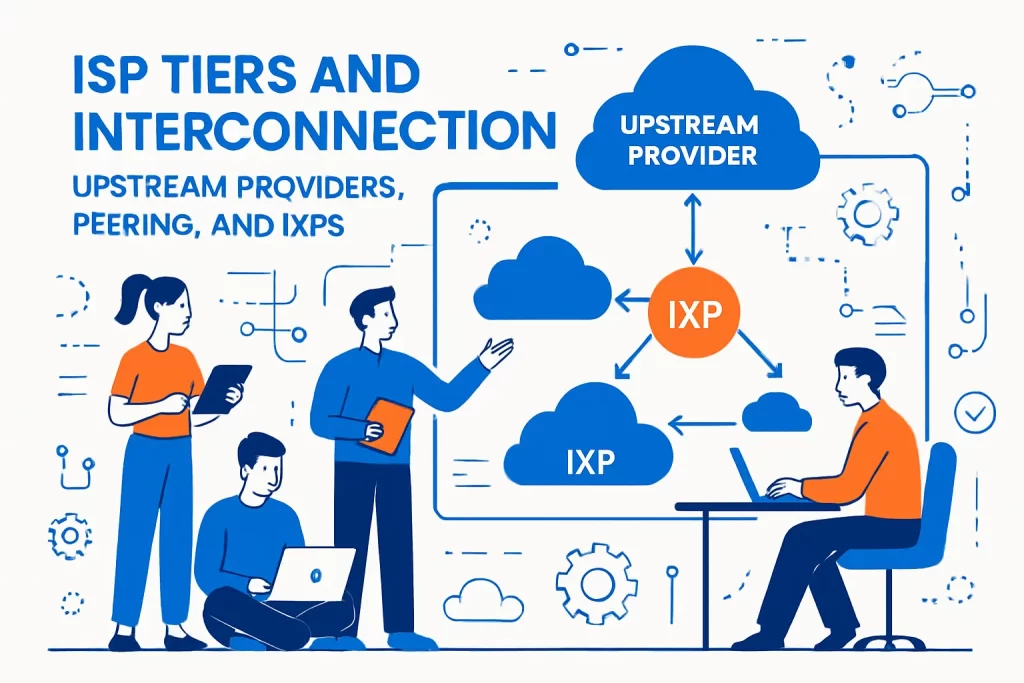
1. How ISPs buy upstream access and transit from larger networks
Most ISPs do not connect directly to every other network on earth. Instead, they buy upstream transit from larger networks that provide broad reachability. This is analogous to shipping logistics: a local carrier might be excellent at neighborhood delivery but still rely on national and international networks to move goods across continents.
Upstream purchasing is not only about bandwidth quantity; it’s about routing quality. Two upstreams can offer different path diversity to major destinations, and those differences show up as performance variation to popular clouds, streaming providers, and enterprise SaaS platforms.
In our experience, the best ISP designs treat upstream as a portfolio rather than a single dependency. Multi-upstream setups, combined with smart routing policies, reduce the risk that one provider’s congestion or outage becomes everyone’s outage.
2. Backbone bandwidth and the role of large backbone providers
Backbone providers operate high-capacity long-haul networks that connect regions and major interconnection hubs. They are the arterial system behind the consumer-facing ISPs. If last-mile networks are the neighborhood streets, backbones are the highways.
Backbone engineering choices influence not only speed but stability. Fast links with poor redundancy can be worse than slightly slower links with resilient rerouting. Modern applications care as much about consistency as about peak throughput; jitter and packet loss are the silent killers of video calls, trading systems, and remote operations tools.
For businesses, backbone relationships become visible during incidents. A widespread outage often traces back to a backbone disruption, a major routing leak, or an interconnection failure at a high-traffic hub.
3. Points of presence and using multiple upstream connections for resilience and reach
A Point of Presence (PoP) is where a network has equipment and can hand off traffic—often in a carrier hotel or data center. PoPs matter because geography shapes cost and performance. If your ISP has a PoP close to your region and peers well there, your traffic may reach major destinations with fewer hops and less opportunity for congestion.
Multiple upstream connections at diverse PoPs are a classic resilience strategy. When one upstream path degrades, traffic can be shifted. That shifting isn’t always instantaneous or perfect, but it often prevents a localized problem from becoming a complete outage.
At 1Byte, we pay close attention to PoP diversity when we choose where to deploy services and how to design network edge routing. A hosting platform that relies on a single upstream or a single facility is betting the business on one set of assumptions, and the internet rarely rewards that kind of certainty.
4. Tier 1 ISP infrastructure costs and why some regions appear monopolistic or oligopolistic
Top-tier networks—often called “Tier 1” in industry shorthand—are defined by their ability to reach the entire internet largely through peering rather than paying for upstream transit. Achieving that status requires enormous infrastructure investment, dense interconnection, and extensive operational capability.
Those costs help explain why some regions feel monopolistic or oligopolistic. Building parallel last-mile networks involves permits, rights-of-way, trenching, pole attachment agreements, and long payback horizons. The capital intensity discourages new entrants, especially where population density is low.
Policy and competition initiatives attempt to counterbalance this, but the physics of infrastructure remain. For businesses evaluating providers, the practical lesson is to look for redundancy options: secondary circuits, diverse paths, and providers that interconnect well with the networks your critical services live on.
5. Tier 3 ISPs that typically do not peer and focus on serving end customers
Access-focused providers—often labeled “Tier 3” in simplified discussions—primarily serve end customers and typically rely on upstream transit rather than extensive peering. This is not a criticism; it’s a role definition. Many such ISPs deliver excellent service because they concentrate on last-mile quality and customer experience.
The limitation appears when upstream choices are narrow. If an ISP buys transit from a single upstream, congestion or disputes beyond the ISP’s immediate control can affect customers. That’s why we encourage businesses to ask not just “what speeds do you sell” but “how do you connect to the rest of the internet, and what happens when one path fails?”
In day-to-day hosting support, we sometimes diagnose issues that only affect customers of a specific access provider. Those patterns are often explained by upstream routing decisions rather than the customer’s device or the destination server.
6. Internet exchange points enabling public peering between networks
Internet Exchange Points (IXPs) are facilities—often operated by neutral organizations—where networks interconnect to exchange traffic. Public peering at an IXP can reduce latency, lower transit costs, and improve performance by keeping traffic local rather than sending it through distant upstream paths.
From our operational viewpoint, IXPs are where “internet geography” becomes tangible. When a regional ISP peers at a local exchange, local businesses often see immediate improvements accessing regional clouds, CDNs, and services that also peer there.
IXPs also foster competition. When smaller networks can interconnect efficiently, they become more viable, and customers get more choices beyond the traditional incumbents.
7. Private peering and settlement-free data exchange agreements
Private peering is a direct connection between two networks, often used when traffic volumes are high or when performance needs justify dedicated capacity. Settlement-free arrangements exist where both parties view the exchange as mutually beneficial without payment.
These arrangements are not purely technical; they are business negotiations. Peering disputes can lead to congested links, and customers experience that as slow performance to certain destinations even when the rest of the internet works fine.
In hosting, we care about these dynamics because customer experience depends on the entire path. A beautifully optimized server stack cannot overcome a congested interconnection if packets are delayed before they ever reach the data center edge.
8. Data centers and meet-me rooms as common interconnection locations
Data centers are not just places where servers live; they are interconnection marketplaces. The meet-me room is the physical space where networks cross-connect with each other. If you’ve ever wondered how “the internet” is physically assembled, meet-me rooms are a big part of the answer.
For ISPs, colocating in major data centers provides access to peers, transit providers, and cloud on-ramps. For businesses, choosing a hosting provider in a well-connected facility can reduce latency and improve routing diversity because the hosting platform has more network options at its doorstep.
At 1Byte, we treat data center interconnection as a strategic asset. It’s one reason we can design for resilience: more nearby networks means more ways to keep traffic flowing when one path is impaired.
Internet speed and performance: plans, data caps, and reliability

1. Speed plans and how providers measure download and upload speeds in Mbps
ISPs sell speed plans using Mbps—megabits per second—typically separating download and upload rates. Download speed affects how quickly content arrives to you, while upload affects how quickly you send data out: backups, video calls, large attachments, and upstream streaming.
Speed marketing is seductive because it’s easy to compare on paper. Still, Mbps is only one axis of performance. Many cloud and business applications are limited by latency, packet loss, or jitter rather than raw throughput.
When customers ask us, “What speed do I need for hosting?” we answer differently: hosting lives in the data center; what you need is a reliable path to manage it, update it, and use it. That points back to stability, not just headline speeds.
2. Real-world speed factors including network congestion, distance to facilities, and access technology
Real-world performance is shaped by congestion, path selection, and the access medium. Congestion can happen in the neighborhood segment, in the ISP core, at interconnection points, or even inside the destination network. Distance also matters, not because data “slows down,” but because longer paths add propagation delay and more opportunities for queueing.
Access technology imposes its own constraints. Shared mediums can produce peak-time slowdowns, while distance-sensitive mediums can degrade gradually and unpredictably. Even fiber, often the gold standard, can suffer if upstream capacity planning is weak.
From our hosting support lens, the best troubleshooting step is to test from multiple vantage points: wired vs Wi-Fi, local speed tests vs destination-specific tests, and different times of day. Those comparisons reveal whether you’re seeing a local bottleneck, a provider bottleneck, or an interconnection bottleneck.
3. Choosing speed levels based on gaming, streaming, and work from home needs
Different activities stress different parts of the network. Streaming is throughput-heavy and often tolerant of buffering. Gaming is latency- and jitter-sensitive. Work-from-home is a blend: video conferencing needs stability, cloud storage needs upload consistency, and VPNs add overhead and sensitivity to packet loss.
For small businesses and remote teams, the most common mistake is underestimating upstream needs. Modern workflows generate outbound traffic continuously: file sync, backups, telemetry, and video calls. A plan that looks fine for “watching videos” can struggle with “running a business day.”
Our advice is to map your actual workflows and prioritize the ones that fail loudly when the network is inconsistent. Once you do that, you can evaluate plans in terms of fit rather than in terms of marketing.
4. Connection type availability by location as a key constraint in ISP choice
Location is the harsh constraint in ISP selection. In many areas, the question isn’t “Which provider is best?” but “Which providers exist at this address?” That scarcity shapes pricing, upgrade pace, and customer service incentives.
Businesses can sometimes improve their options by choosing office locations with better connectivity footprints. It sounds mundane, yet we’ve seen it become a strategic advantage: better internet enables better cloud adoption, better recruiting for hybrid roles, and fewer operational disruptions.
For home-based entrepreneurs, the realistic path is often redundancy rather than perfection. A primary wired provider plus a wireless backup can turn an unreliable environment into an acceptable one, especially when paired with smart failover routing.
5. Data caps, data limitations, and when unlimited plans matter
Data caps and throttling policies matter most when your usage is sustained and predictable: cloud backups, large media uploads, frequent software downloads, or always-on streaming and monitoring. “Unlimited” plans reduce the cognitive overhead of worrying whether normal business activity will trigger penalties.
In our experience, caps also create hidden risk for incident recovery. When a system restore requires downloading large snapshots or rehydrating backups, the last thing a business needs is a usage policy turning a crisis into a billing surprise.
Reading the fine print is tedious, but it is also a form of operational risk management. If the ISP won’t state policies clearly, that vagueness is itself a signal.
6. Reliability and performance checks using uptime history and customer reviews
Reliability is where ISP selection stops being theoretical. Uptime history, outage frequency, and time-to-repair are the metrics that decide whether a business has a normal day or a costly interruption.
Customer reviews should be interpreted carefully because they skew negative, but patterns matter. If many customers report evening slowdowns, poor support escalation, or chronic billing disputes, those issues often reflect systemic operational choices rather than isolated mistakes.
For businesses, we recommend asking the provider directly about redundancy, maintenance windows, and escalation procedures. The quality of the answer is often as informative as the answer itself.
7. Pricing and plan comparisons including fees, bundles, and contract terms
ISP pricing is rarely just the advertised rate. Fees, equipment rentals, installation costs, and contract terms can materially change total cost. Bundles can reduce the sticker price while increasing lock-in.
Contract terms matter because business needs change. A growing company may outgrow a plan quickly, and a long contract can turn that growth into friction. On the flip side, negotiated business contracts can provide better restoration commitments and prioritized support.
At 1Byte, we view pricing as part of reliability. If a provider is cheap because it underinvests in capacity or support, the true cost shows up as downtime, lost productivity, and damaged customer experience.
8. Customer support quality as a deciding factor for ongoing service
Support quality determines whether you can resolve issues quickly or whether you will be trapped in repetitive troubleshooting loops. For business customers, a dedicated account team or direct escalation path can be the difference between a short hiccup and an all-day outage.
Competent support also matters because networks are complex. A front-line agent must be able to distinguish between local router issues, line signal degradation, regional outages, and upstream routing anomalies. Without that skill, the customer becomes the diagnostic engine, and that’s not a role most businesses want.
When we evaluate connectivity partners, we ask: can they speak in engineering terms when needed, and can they translate those terms into action without delay?
9. Home network impact including ISP-provided modems and routers vs user equipment
The equipment at your edge—modem, router, firewall, access points—shapes your real experience. ISP-provided gear is often convenient and sometimes required for compatibility, but it may be limited in configurability or performance under heavy device loads.
User-owned equipment can improve coverage, stability, and security posture, especially when you need features like segmented networks, stronger firewall controls, or better Wi-Fi management. That said, user equipment adds responsibility: firmware updates, configuration hygiene, and troubleshooting become your job.
Our practical stance is balanced. For basic home use, ISP gear may be sufficient. For home offices and small businesses, investing in a proper router and access points can be one of the highest ROI upgrades—because it turns “internet problems” into solvable, local network problems.
Security and policy: net neutrality, monitoring, and affordability
1. ISP security features such as firewalls, antivirus protection, and anti-spam filtering
Many ISPs bundle security features: managed firewalls, basic antivirus, anti-spam filtering, and sometimes parental controls. These can be useful, especially for non-technical households and small businesses without dedicated IT staff.
Still, bundled security should be evaluated like any other security product. Does it provide transparency? Can you control it? Does it create new privacy concerns? Security that cannot be audited or tuned can become security theater—comforting but not necessarily protective.
At 1Byte, we generally encourage layered security: endpoint protection, strong identity controls, and network-level filtering where appropriate. ISP features can be one layer, but they should not be the only layer.
2. Network monitoring for suspicious activity and cooperation to address cyber threats
ISPs monitor networks for operational health and, in many cases, for abuse patterns: malware traffic, DDoS participation, or compromised devices generating suspicious outbound connections. This monitoring can protect the wider ecosystem, but it also raises questions about visibility and privacy.
Cooperation to address threats often involves abuse desks, automated takedowns, and coordination with other networks. When done well, it reduces harm and stabilizes the internet. When done poorly, it can produce false positives that disrupt legitimate businesses—such as blocking a customer’s email server after an automated system misclassifies traffic.
From our hosting side, we see the best outcomes when providers share clear abuse processes and provide remediation paths rather than simply blackholing traffic with no explanation.
3. Net neutrality debates including the concept of fast and slow broadband lanes
Net neutrality debates focus on whether ISPs should be allowed to block, throttle, or prioritize traffic based on content, service type, or commercial relationships—creating “fast lanes” for some and “slow lanes” for others. For businesses, the concern is not philosophical; it’s operational. If an ISP can degrade access to competing services or extract fees for normal performance, innovation gets taxed.
In the United States, the legal status of federal net neutrality rules has swung over multiple administrations and court decisions. In the most recent major federal appellate decision on the topic, the court set aside the FCC’s Safeguarding and Securing the Open Internet Order after concluding the agency lacked statutory authority to impose the regulatory classification used to support those rules, and that uncertainty affects how businesses assess long-term risk.
Our viewpoint at 1Byte is pragmatic: clear, enforceable rules can reduce uncertainty for builders. When policy is unstable, businesses hedge with redundancy, multi-provider strategies, and architectures that reduce dependency on any single access network behaving “fairly.”
4. Law enforcement and intelligence assistance obligations in some countries
ISPs operate under national laws, and in many countries they may be required to assist law enforcement with lawful interception, data retention, or access to subscriber information. The specifics vary widely by jurisdiction, and multinational businesses must treat these differences as part of their compliance and risk landscape.
For organizations with cross-border operations, the ISP is not just a technical vendor; it is part of the governance environment. That affects decisions about encryption, zero-trust access design, and where to place critical systems.
Our operational stance is consistent: encrypt sensitive traffic end-to-end, minimize data exposure, and design systems so that the compromise of any single intermediary reveals as little as possible. The ISP should not be a single point of privacy failure.
5. Affordability support such as the Affordable Connectivity Program discount structure
Affordability is not a side issue; it determines whether people can participate in education, employment, and modern commerce. In the U.S., the Affordable Connectivity Program (ACP) previously helped eligible households by providing $30 per month toward broadband service, and policy discussions continue about what should replace it at scale.
Enhanced support was available for qualifying households, including $75 per household on tribal lands, which recognized that connectivity challenges and affordability gaps are not evenly distributed.
Program design also intersects with fraud risk and consumer protection. The FCC has warned consumers that ACP’s monthly discount ended on June 1, 2024, and that reminder still matters because scams and outdated marketing can persist long after a benefit winds down.
6. Common risks and tradeoffs including dependence on the provider, restrictions, and blacklisting impacts
Every ISP relationship has tradeoffs. Dependence is the obvious one: if your provider is your only viable option, your negotiating power is limited. Restrictions are another: inbound port blocks, traffic shaping, or equipment limitations can quietly constrain what you can build.
Blacklisting and reputation impacts are less obvious but very real. Shared address pools can cause “guilt by association,” affecting email deliverability or access to third-party services. Meanwhile, aggressive abuse mitigation can block legitimate traffic if the provider lacks nuanced controls and responsive remediation.
At 1Byte, we think the antidote is architectural: use layered security, maintain backups and failover plans, and avoid putting all critical operations on a single path. The internet is resilient precisely because it is multi-path; businesses should borrow that philosophy rather than betting everything on one vendor behaving perfectly.
1Byte cloud computing and web hosting services as an AWS Partner
1. Domain registration and SSL certificates for trusted, secure online identities
Domains and certificates are where “being online” becomes “being trusted online.” A domain name anchors your brand identity, while SSL/TLS certificates help users and browsers verify they are talking to the right site, not an impersonator. In business terms, this is not cosmetic—it’s revenue protection and reputation defense.
At 1Byte, we treat domain registration and certificate management as operational hygiene. Misconfigured DNS, expired certificates, and inconsistent redirects are some of the most preventable causes of downtime and customer distrust. Since ISPs influence resolution paths and caching behavior, clean DNS practices also reduce the chance that a provider-side resolver issue turns into a user-visible outage.
From our field experience, the strongest pattern is simple: teams that automate renewals, enforce HTTPS everywhere, and keep DNS changes disciplined spend less time firefighting and more time building.
2. WordPress hosting and shared hosting for launching and managing websites
WordPress and shared hosting remain popular because they reduce time-to-launch. Many businesses do not need a complex microservices platform; they need a reliable site, predictable updates, and enough performance headroom to survive marketing spikes without collapsing.
In our work, the intersection with ISPs is practical. A well-cached site delivered through a CDN can “feel fast” even on mediocre access networks because content is served from closer edges. Conversely, an uncached, plugin-heavy site can feel slow even on excellent fiber because it spends too long on server-side processing.
We focus on balancing simplicity with operational safety: hardened configurations, routine patching, and performance basics like caching and image optimization. That approach respects the reality that the user experience is end-to-end, spanning the ISP, the browser, the server stack, and everything in between.
3. Cloud hosting and cloud servers for scalable infrastructure backed by an AWS Partner
Cloud hosting is where connectivity and compute truly fuse. As an AWS Partner, we design cloud servers and hosting architectures that can scale, integrate with modern services, and support security best practices—while still being understandable to the teams who must operate them at midnight during an incident.
What does an ISP have to do with cloud servers? More than most teams expect. The quality of the path from user to workload influences perceived application performance, support ticket volume, and even conversion rates. That is why we think in systems: edge optimization, CDN strategy, resilient DNS, and sane observability, paired with guidance for customers on connectivity choices and failover design.
Our personal viewpoint is blunt: cloud success is not only about picking the right instance type or database engine. It’s about building an experience that remains usable when networks wobble, when routes shift, and when the real world refuses to be as clean as a diagram.
Conclusion: key takeaways about ISPs in computer networking
1. ISP role summary: access provider plus optional services like email, domains, and hosting
An ISP, in computer networking terms, is the organization that connects your devices and networks to the wider internet and keeps that connection functional through routing, infrastructure operations, IP services, and support. Many providers also bundle “above the wire” offerings such as email, domains, hosting, and colocation, which can be convenient but can also increase lock-in.
From where we sit at 1Byte, ISPs are not background utilities; they are active participants in application performance. Their engineering choices, interconnection strategy, and operational maturity influence how cloud services feel to end users—even when the cloud itself is behaving perfectly.
Seeing the ISP as part of your technology stack is a mindset shift, and it pays dividends: you troubleshoot faster, you buy more intelligently, and you design systems that remain resilient when the network stops being “boring.”
2. Decision checklist: match connection type, speed needs, reliability, support, and plan limits
Choosing an ISP becomes easier when we treat it like a business risk decision rather than a consumer shopping choice. Here is the checklist we use when advising customers who depend on the network for revenue and operations:
- Connection type should match your workflow reality, not just your desired headline speeds.
- Reliability expectations should be explicit, especially if downtime has a direct financial cost.
- Support pathways should be tested mentally before you need them, including escalation options.
- Plan limits and policies should be understood upfront so surprises don’t appear during recovery events.
- Equipment choices should be intentional, separating ISP delivery from your internal Wi-Fi experience.
When these elements align, performance becomes predictable—and predictable is what businesses actually need.






3. Big-picture view: interconnection, tiers, and peering shape performance and availability
The biggest “aha” we wish more teams had is that the internet is an interconnection economy. Upstream transit, public peering at IXPs, private interconnects in meet-me rooms, and backbone engineering all shape the path your packets travel. Those paths determine latency, congestion exposure, and failure blast radius.
Once we internalize that, we stop asking only “How fast is the plan?” and start asking “How does this provider attach to the rest of the world?” That question is where real performance lives.
So here is our next-step suggestion: before renewing or switching your ISP, map your critical destinations—cloud consoles, payment gateways, collaboration tools, and your own hosted services—and test them from your current connection at different times. What does that end-to-end experience tell you about the network you’re betting your business on?