

- What is SaaS marketing and why it matters for subscription growth
- How saas marketing differs from digital marketing and traditional B2B marketing
- SaaS marketing funnel and lifecycle from first touch to renewal
- Buyer personas, positioning, and messaging that convert in saas marketing
- Content marketing and SEO foundations for SaaS discoverability
- Paid, social, email, and outbound channels to generate demand
- Conversion, retention, and analytics to optimize saas marketing performance
- How 1Byte supports SaaS businesses with cloud and hosting services
- Conclusion and next steps for a sustainable saas marketing plan
At 1Byte, we host the websites, landing pages, help centers, and app backends that SaaS teams depend on, so we end up seeing a blunt truth that slide decks politely avoid: SaaS marketing is not a campaign; it’s a system. Traffic arrives in bursts, sign-ups trickle in at odd hours, trial users ghost, power users evangelize, and renewals rise or fall based on what happened weeks ago inside the product. In that messiness, the marketers who win are the ones who treat growth like operations—instrumented, monitored, and continuously improved.
Market overview: Gartner forecasts worldwide public cloud end-user spending will total $723.4 billion in 2025, and the same macro tailwind keeps pressure on SaaS teams to compete on speed, trust, and differentiation in a crowded arena; meanwhile, McKinsey’s analysis of public SaaS companies found a median revenue growth rate of 22 percent, which is a sober reminder that “good enough” marketing rarely stays good enough for long.
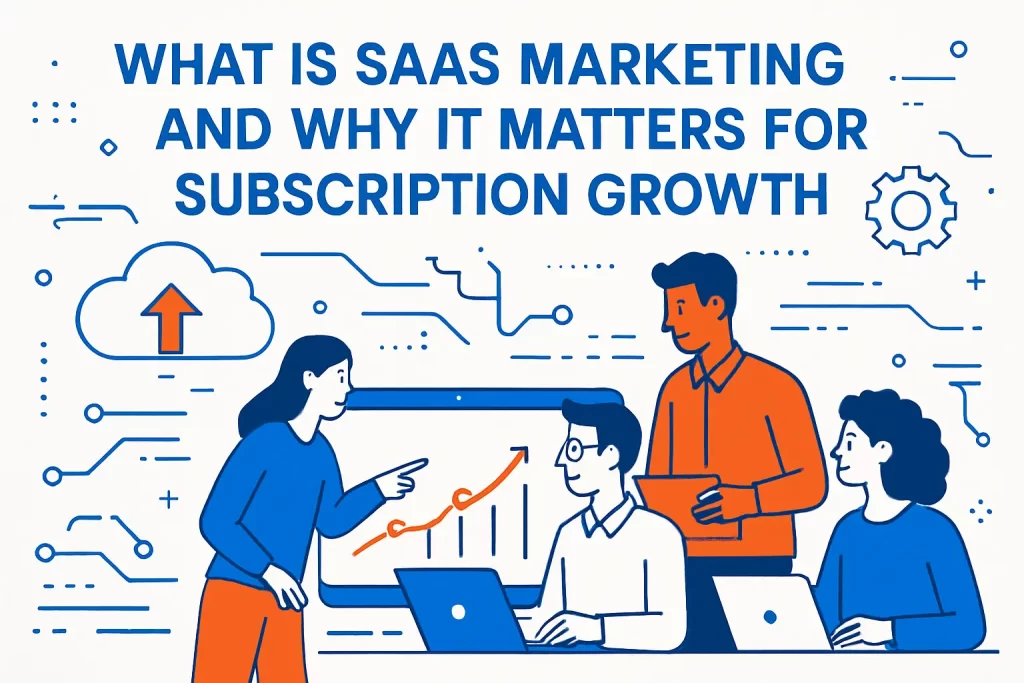
What is SaaS marketing and why it matters for subscription growth
Across real-world examples, the pattern stays consistent: Atlassian’s self-serve motion, HubSpot’s inbound engine, and Slack’s product virality each look different on the surface, yet all of them obsess over friction—friction to discover, friction to understand, friction to try, friction to adopt, and friction to pay. That’s the lens we’ll use in this guide, with the practical bias we’ve built at 1Byte: if it can’t be measured, deployed, secured, and scaled, it’s not a growth strategy—it’s a hope.
FURTHER READING: |
| 1. Protect Your Brand Reputation with These Digital Tactics |
| 2. Best Portfolio Website for Web Developer: 2026 Top Picks |
| 3. How to Write an About Me Page: 10 Tips with Real Examples |
1. SaaS marketing defined for cloud based subscription software
In SaaS, marketing is the discipline of creating predictable subscription growth by connecting the right audience to an experience that moves from awareness to ongoing usage. Unlike retail-style promotion, the “product” is a living service: the buyer’s perception changes with every login, every incident, and every new feature. That dynamic makes classic brand storytelling necessary but insufficient.
Under the hood, SaaS marketing blends messaging with systems thinking: acquisition channels, onboarding flows, pricing pages, documentation, email nurture, in-product prompts, and customer success all form one connected loop. From our seat at 1Byte, we define “good” SaaS marketing as the ability to create demand without breaking trust—because if your funnel grows faster than your reliability or support capacity, churn becomes your loudest channel.
2. Ongoing customer relationships instead of one time transactions
Subscription businesses don’t get “the sale” as a finish line; they get a start date. Every month, customers silently re-decide whether the product is still worth the cost, the learning curve, and the switching pain. That ongoing evaluation changes how we think about positioning: you’re not just convincing someone to buy—you’re helping them justify staying.
Practically, this shifts marketing from persuasion to enablement. Lifecycle emails, in-app education, release notes, and support content become marketing assets because they reduce anxiety and protect adoption. When we watch customer journeys across hosted properties, the strongest retention signals often correlate with boring fundamentals: clear docs, reliable login flows, and fast pages that don’t make users feel punished for returning.
3. Balancing acquisition with retention across the user lifecycle
Growth that ignores retention is like pouring water into a leaky bucket and celebrating the water bill. Acquisition still matters, yet the unit economics of SaaS depend on compounding value: the longer customers stay, the more time there is to expand usage, add seats, and deepen reliance. Retention is not a “post-sale” issue; it’s a promise your marketing made.
Operationally, we recommend treating retention inputs as first-class marketing work: product education, onboarding quality, expectations set on the website, and the stability of the platform itself. A healthy lifecycle strategy forces hard tradeoffs—should the next sprint fund more top-of-funnel traffic or reduce friction in activation? In our experience, the teams that win run both, but they measure them together rather than in separate departmental dashboards.
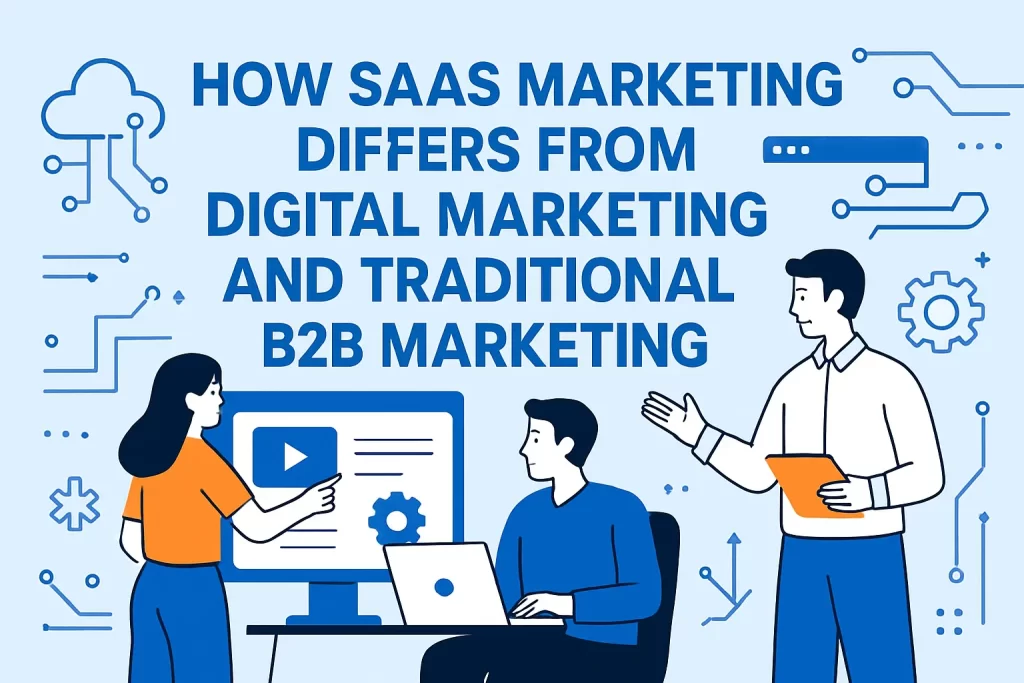
How saas marketing differs from digital marketing and traditional B2B marketing
1. Recurring revenue focus that elevates lifetime value and retention
Digital marketing can succeed with a short-term win: a click, a purchase, a lead form. SaaS marketing, by contrast, lives and dies by recurring outcomes—renewals, expansions, and sustained usage. That forces a different definition of “qualified”: the goal is not merely a person who can be persuaded, but a customer who can adopt and benefit.
Because recurring revenue compounds, the best SaaS marketers ask uncomfortable questions early. Does this segment churn after onboarding? Do they hit the “aha” moment quickly? Will they require heavy support to succeed? From our hosting perspective, the shift is visible in the tooling: analytics events, cohort reports, and product instrumentation become as central as ad platforms or SEO tools.
2. Intangible and multifaceted products require education and demonstrations
SaaS is invisible until it’s experienced. A buyer can’t hold it, test the material, or walk around it in a showroom; they need to imagine workflows, integrations, permissions, reliability, and the internal change required. Education becomes the bridge from curiosity to confidence, which is why demos, tutorials, and interactive sandboxes often outperform glossy slogans.
In practice, we see high-converting SaaS websites behaving like learning environments. Pages answer objections before they’re spoken: security posture, onboarding steps, migration paths, and the “what happens if we outgrow this?” question. From the infrastructure side, it’s worth stating plainly: if your demo environment is slow or flaky, your messaging is competing against your own runtime.
3. Tiered pricing, upgrades, and customer success shape go to market
Traditional B2B marketing often hands off to sales and moves on. SaaS go-to-market rarely stays that linear because pricing tiers and usage-based upgrades keep creating new “moments of truth” after the initial purchase. Every plan boundary is a narrative boundary: buyers must understand what they gain, what they lose, and why the next step is worth it.
Customer success therefore becomes part of marketing’s causal chain, even when it reports elsewhere. Implementation calls, health scores, QBRs, and renewal conversations all feed the story your customers tell internally. When that story is coherent, upgrades feel inevitable; when it’s muddled, even a strong acquisition engine will produce customers who never fully arrive.
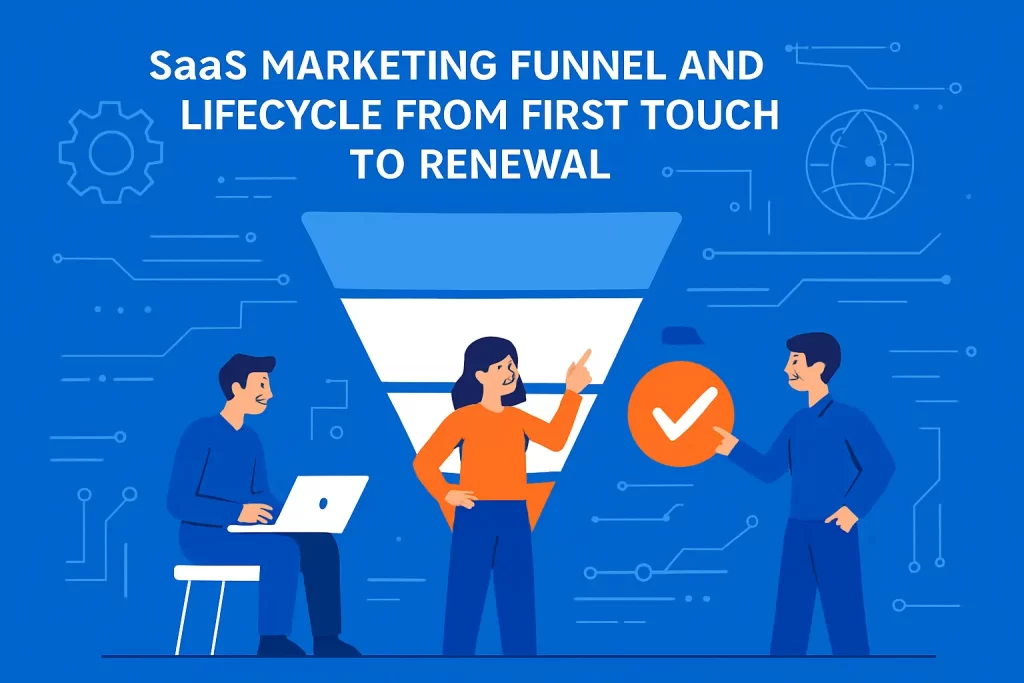
SaaS marketing funnel and lifecycle from first touch to renewal
1. Attracting leads, nurturing leads, retaining customers, enhancing revenue, tracking performance
A SaaS funnel is less a funnel than a loop: attract, educate, convert, activate, retain, and expand—then feed learnings back into acquisition. Each stage has its own failure modes. Awareness can be abundant and still worthless if visitors don’t understand the product in seconds; trials can be plentiful and still unprofitable if activation is slow; renewals can be fragile if expectations were oversold.
For teams building this lifecycle, we prefer to define stage transitions with observable behavior rather than vague labels. “Activated” should mean a user completed a meaningful workflow. “Retained” should mean they returned and created value again. When we help customers at 1Byte troubleshoot “marketing problems,” the root cause frequently sits in those definitions—because unclear stages produce dashboards that look busy while revenue stays stubborn.
2. Lead generation segments: active searchers, switchers, and dissatisfied customers
Not all leads arrive with the same intent. Active searchers are looking for a solution category and want a credible shortlist fast. Switchers already use a competitor and need proof that migration won’t be painful. Dissatisfied customers may not even know your product category well, but they do know what’s failing them—support, reliability, reporting, billing surprises, or missing features.
Messaging changes when we respect those segments. Searchers respond to comparison clarity and crisp positioning. Switchers need migration playbooks and integration reassurance. Dissatisfied customers need empathy and specificity: “Here is how we prevent the exact failure you’re living with.” In our experience, the most expensive mistake is writing a single homepage that pretends all three segments are the same person.
3. Off site demand generation and on site conversion assets working together
Off-site demand generation—SEO, paid media, communities, partnerships—creates attention, but attention only becomes revenue when on-site conversion assets do their job. That means landing pages, pricing pages, demo booking, documentation previews, trust centers, and support content must be designed as a coherent path, not as separate “web projects” owned by different teams.
From the hosting layer, we see a recurring anti-pattern: companies spend heavily to acquire clicks, then send that traffic to slow, generic pages with unclear next steps. Fixing that is rarely about rewriting every sentence; it’s about reducing friction. Faster pages, fewer form fields, clearer intent per page, and tight alignment between ad copy and landing content create the kind of compounding lift that feels like cheating—until you realize it’s just operational discipline.
4. Retention and expansion through upgrades, cross sell, and customer retention
Retention is won when customers build habits around your product. Expansion follows when the product becomes a platform for more work: more users, more integrations, broader use cases, or deeper governance. Marketing influences both by shaping adoption narratives—what the product is “for,” who should use it next, and which workflow to tackle after the first success.
Internally, that requires alignment between product, marketing, and success. A new feature launch is not merely an announcement; it is a behavior-change program. Likewise, a pricing change is not merely finance; it is messaging, packaging, and expectation-setting. When those teams share a single view of the customer journey, upgrades feel like progress rather than like pressure.
Buyer personas, positioning, and messaging that convert in saas marketing
1. Data driven buyer personas based on roles, challenges, motivations, and decision processes
Personas in SaaS should be built from reality, not from imagination. Roles matter—admins, operators, champions, finance approvers, security reviewers—but roles alone are not enough. Challenges reveal why change is needed. Motivations reveal why now. Decision processes reveal how risk is managed and who can say “no” at the last minute.
At 1Byte, we encourage teams to treat personas as living documents tied to evidence: call transcripts, support tickets, win/loss notes, and usage behavior. A persona that cannot predict objections is a poster, not a tool. Better personas also reduce content waste, because you stop writing “general SaaS advice” and start writing the specific guidance that your buyer will forward to their boss.
2. Jobs to be done framing: identify the pain and who has it
Demographics rarely explain SaaS purchases; circumstances do. The Jobs to Be Done Theory is a useful lens because it forces us to ask what progress the buyer is trying to make, what is pushing them away from the status quo, and what anxiety might pull them back. That framing keeps messaging grounded in outcomes rather than features.
In practical terms, JTBD improves everything downstream. It clarifies which objections to address on the pricing page. It shapes onboarding by emphasizing the “first win” that validates the purchase. It helps you avoid the trap of marketing to the user who loves tinkering, when the real economic buyer just wants the job done with minimal drama.
3. Clear unique selling proposition and easy to navigate conversion focused website
Positioning is the discipline of choosing what you will be known for—and what you will not. A unique selling proposition is not a list of features; it’s a claim that matters, is credible, and helps the buyer decide. SaaS buyers, especially in B2B, are often buying risk reduction as much as capability, so “trust” must be expressed in concrete terms: reliability practices, security posture, and operational maturity.
On the website, conversion focus means reducing cognitive load. Navigation should guide buyers into the path that matches their intent: learn, compare, validate, or start. At 1Byte, we frequently recommend a simple heuristic: each page should have one primary job. When pages try to educate, sell, recruit, and announce in the same breath, visitors do none of those things.
4. Use customer language and fast feedback to refine messaging
Customers tell us how to market to them, but they rarely do it in surveys. They do it in support tickets (“I expected X”), in sales calls (“We need Y”), and in churn reasons (“We couldn’t Z”). The fastest way to improve messaging is to capture those phrases, then mirror them back on pages and emails so the buyer feels understood rather than targeted.
Feedback loops must also be tight. Run lightweight tests: alternate hero copy, adjust onboarding emails, change a CTA label, or reorder pricing information. Then measure behavior, not opinions. In our work supporting SaaS sites, we’ve seen small clarity improvements outperform major design overhauls, simply because the improvements were anchored in what buyers already say when they are under time pressure.
Content marketing and SEO foundations for SaaS discoverability
1. Educational content that solves real problems and builds trust at scale
Educational content is the most scalable way to earn trust without begging for it. Instead of shouting “we’re the best,” content shows the buyer you understand their world: constraints, tradeoffs, and the messy reality of implementation. Done well, it also pre-qualifies leads by teaching them what good looks like, which makes “bad fit” prospects self-select out.
From our vantage at 1Byte, the highest-performing SaaS content often reads like internal enablement material: pragmatic, opinionated, and specific. Buyers reward specificity because it signals competence. They also reward honesty: acknowledging limitations and edge cases reduces skepticism, which is an invisible tax on conversion.
2. Content formats for different funnel stages: guides, case studies, webinars, videos, and more
Different stages require different formats because buyers have different questions over time. Early-stage visitors need conceptual clarity and category education. Mid-stage evaluators want proof: case studies, implementation notes, and comparisons. Late-stage decision-makers look for risk reducers: security answers, procurement readiness, and a clear path to rollout.
Format selection should follow buyer behavior rather than team preference. Guides work when the buyer is actively researching. Short videos work when attention is fragmented. Webinars work when you can teach a workflow and answer objections live. Case studies work when they tell a transformation story with constraints, not just a happy quote that could apply to any vendor.
3. SEO essentials: sitemaps, metadata, backlinks, and rank monitoring
SEO is a long game, but the fundamentals are operational. A site must be crawlable, indexable, and structured in a way that helps both humans and search engines understand what each page is about. For teams that publish consistently, a sitemap is a practical tool for discovery, and Google’s documentation on build and submit a sitemap is a straightforward reference for getting the basics right.
Beyond the technical layer, authority matters. Backlinks tend to follow usefulness: original research, genuinely helpful templates, and clear explanations earn citations from other sites. Rank monitoring then becomes your early-warning system, helping you catch when content decays, competitors leapfrog you, or search intent shifts under your feet.
4. FAQ driven content clusters built around real buyer questions
FAQ content works when it is driven by real objections rather than by vanity keywords. The goal is not to stuff answers into thin pages; it is to build clusters that map to a buyer’s journey: “What is this?”, “How does it work?”, “Is it safe?”, “Will it integrate?”, and “What happens if it fails?” Those questions are often the same ones asked in sales calls, which makes FAQ clusters a force multiplier for both SEO and enablement.
Structurally, we like a hub-and-spoke approach. One authoritative guide anchors the topic. Supporting pages answer narrow questions and link back. Over time, that cluster becomes your public knowledge base, and it reduces support load because customers can self-serve before they ever open a ticket.
Paid, social, email, and outbound channels to generate demand
1. Paid search and PPC ads to capture intent heavy SaaS keywords
Paid search is the closest thing to buying intent on demand, but it is also the fastest way to waste budget if your landing experience is weak. High-intent keywords usually signal evaluation behavior: “alternative,” “pricing,” “comparison,” “integration,” or “best for.” Those clicks are expensive because they convert—just not for teams that send them to generic homepages.
Operationally, we advise mapping each ad group to a specific intent and building a page that resolves that intent quickly. A comparison ad should land on a comparison page. An integration ad should land on an integration page with setup guidance. When those assets are paired with fast hosting and consistent tracking, paid search becomes a reliable lever rather than a black box.
2. Paid social and retargeting to support top funnel and mid funnel programs
Paid social is rarely pure intent; it’s interruption. That doesn’t make it ineffective—it makes it contextual. Social ads work best when they deliver a clear “why care” message to a well-defined audience and then move them into a nurture path: a guide, a webinar, or a product walkthrough that earns deeper attention.
Retargeting is where social often shines for SaaS. Someone who visited pricing and left is not “cold”; they are unconvinced or distracted. Showing them a case study, a migration checklist, or a concise demo can re-open the evaluation. From our side, the key is consistency: if you retarget with one promise and your site tells another story, you manufacture distrust at scale.
3. Email marketing as nurturing: newsletters plus automation
Email remains a quiet workhorse because it supports the full lifecycle: lead nurture, onboarding, activation, feature adoption, renewal reminders, and win-back. A healthy program blends editorial value (newsletters that teach) with behavioral automation (messages triggered by what the user did or didn’t do). That combination keeps email from becoming either spammy or irrelevant.
Compliance and trust matter, especially for SaaS brands that sell to regulated industries. The FTC’s CAN-SPAM Act compliance guide for business is a practical reminder that deliverability is not just technical; it’s also legal and reputational. Better still, a clean list and honest expectations improve performance because the audience actually wants your messages.
4. Influencer marketing and affiliate marketing to leverage trusted third parties
Influencers in SaaS are often practitioners, not celebrities: engineers, operators, analysts, educators, and niche community leaders. Their value is credibility. When they recommend a tool, they are lending their reputation to your product, so the collaboration must be rooted in truth. A shallow sponsorship that overpromises can backfire harder than a bad ad because it damages trust in a community that remembers.
Affiliate marketing can also work when the incentive aligns with customer success, not just sign-ups. The best affiliates teach implementation, share templates, or build integrations that make the product more valuable. In those cases, the affiliate channel becomes a partner ecosystem—and your job as marketers is to provide accurate messaging, strong onboarding, and tracking that doesn’t misattribute value.
Conversion, retention, and analytics to optimize saas marketing performance
1. Product trials and freemium strategies with conversion and cost modeling
Trials and freemium are not “free growth”; they are distribution strategies with real costs: infrastructure, support, fraud risk, and the opportunity cost of serving users who will never pay. The decision should follow your product’s time-to-value. If users can reach an “aha” moment quickly on their own, self-serve models shine. If value requires configuration, data migration, or approvals, guided trials often outperform.
From 1Byte’s infrastructure lens, capacity planning matters because growth experiments can cause sudden load. A viral template or a product launch can spike sign-ups, which can degrade performance right when prospects are judging you most. Pairing trial strategy with scalable hosting and clear guardrails keeps the free experience from turning into an accidental denial of service against your own business.
2. Conversion rate optimization: reduce friction from landing page to sign up to paid
CRO in SaaS is less about “button colors” and more about removing confusion. Every extra field, every ambiguous pricing sentence, every slow page load, and every unclear permission request adds friction. The compounding effect is brutal: small leaks across steps create big losses by the time you reach paid conversion.
Methodologically, we recommend diagnosing friction in layers. First, ensure technical performance is stable: pages should load quickly and reliably. Next, tighten information architecture: visitors should always know where to go next. Finally, align copy with the buyer’s mental model: use the words they use, not the jargon your team invented. When those layers improve together, conversion gains look “mysterious” to outsiders, even though the work is straightforward.
3. Churn reduction and customer success proof: testimonials, case studies, referrals
Churn reduction starts before the customer ever pays. Overpromising, vague onboarding, and weak expectation-setting produce customers who feel misled—even if the product is objectively capable. Clear positioning is therefore a retention tool. So is honest documentation. So is a support experience that doesn’t make customers feel guilty for needing help.
Social proof helps, but only when it is specific. Testimonials should describe the “before” and the “after” in concrete operational terms. Case studies should include constraints and how they were handled. Referrals should be engineered through customer success moments: when a user achieves a visible win, that is the time to ask for advocacy, not months later when the excitement has cooled.
4. Partnerships and integrations plus co marketing to expand reach and credibility
Integrations are marketing because they reduce adoption risk. Buyers want to know that your product fits into their stack without becoming another island. A good integration page is therefore not just a logo wall; it’s a practical explanation of what the integration enables, how it’s configured, and what happens when something breaks.
Co-marketing works when both sides bring real value. A webinar that teaches an end-to-end workflow can outperform a generic “partner announcement” because it gives prospects a mental simulation of success. From our hosting perspective, partner traffic can be spiky, so it’s wise to ensure landing pages and documentation can handle bursts without slowing down—credibility is fragile when performance stumbles.
5. ABM for high value accounts and long cycle B2B deals
Account-based marketing is the discipline of treating a defined set of accounts like markets of their own. The point is focus: instead of optimizing for volume, ABM optimizes for relevance. For complex B2B SaaS deals, relevance often means mapping stakeholders, tailoring proof, and reducing perceived risk across security, procurement, and implementation.
Execution-wise, ABM fails when it is just “personalized ads.” Strong programs align outbound, content, events, and sales enablement around the same account narrative. At 1Byte, we also see an overlooked technical lever: dedicated landing experiences that match the account’s industry language and compliance expectations. When those experiences are fast, clear, and credible, ABM stops feeling like stalking and starts feeling like service.
6. Core saas marketing metrics and KPIs: CAC, CLV, MRR, churn, NRR, NPS, sign up to paid
Metrics are not a scoreboard; they are a steering wheel. CAC tells you how expensive it is to buy growth. CLV tells you what that growth is worth over time. MRR and churn reveal whether the business is compounding or decaying. NRR exposes whether expansion can carry growth even when acquisition tightens. NPS signals sentiment, and “sign up to paid” shows how well your onboarding and product value story work in practice.
Healthy teams operationalize these metrics with shared definitions and shared accountability. Marketing owns channel quality, not just lead volume. Product owns activation, not just feature shipping. Success owns retention, not just ticket closure. When those owners align, metrics become a language for tradeoffs rather than a weapon for blame.
How 1Byte supports SaaS businesses with cloud and hosting services
1. Domain registration and SSL certificates for a secure brand and product presence
Brand trust begins at the address bar. A clean domain strategy prevents confusion between marketing sites, app subdomains, docs, and status pages. SSL is equally foundational because it’s not just encryption; it’s a visible signal that you take user trust seriously.
At 1Byte, we approach domains and certificates as part of go-to-market readiness. That means helping teams avoid common pitfalls: inconsistent subdomain patterns, expired certificates, and broken redirects that silently crush conversion. From the marketing side, the payoff is simple: when the site feels trustworthy and stable, visitors spend their skepticism on evaluating your product rather than questioning your legitimacy.
2. WordPress hosting and shared hosting for blogs, landing pages, and content programs
Content programs live on operational consistency: publishing cadence, site uptime, and page speed. WordPress remains a practical choice for many SaaS teams because it’s flexible, familiar, and supported by a huge ecosystem. Shared hosting can also be a sensible fit for early-stage teams that need reliable basics without over-engineering.
From our perspective, the hosting choice should match the marketing motion. If you rely on SEO, performance and technical hygiene deserve attention. If you rely on paid campaigns, landing-page stability matters during traffic spikes. A well-hosted blog and a clean landing-page workflow help marketing teams ship faster, test more, and keep the website from becoming a bottleneck that needs a sprint planning meeting to change a headline.
3. Cloud hosting and cloud servers from an AWS Partner for scalable infrastructure
SaaS marketing success can create infrastructure stress: sudden sign-up surges, onboarding bursts, webhook storms, and analytics pipelines that balloon. Cloud hosting helps because it lets teams scale capacity with demand, isolate workloads, and build resilience into the product experience that marketing is promising.
As an AWS Partner, we take a “reliability is marketing” stance and lean on the AWS Well-Architected Framework mindset to guide how we think about operational excellence, security, reliability, performance efficiency, cost optimization, and sustainability. That architecture discipline matters because a signup flow that times out is not just a technical issue; it’s a broken promise at the exact moment a prospect tries to believe you.
Conclusion and next steps for a sustainable saas marketing plan
1. Start with clear personas, positioning, and measurable goals
A sustainable plan begins with choices. Define who you serve, what you are uniquely good at, and what success means in observable terms. Then tie goals to behaviors you can influence: qualified traffic, activation milestones, retention signals, and expansion motions. When those foundations are clear, tactics stop feeling random and start feeling like execution.
From our 1Byte experience, clarity also prevents expensive rework. Teams with crisp positioning build better pages, write sharper content, and run cleaner experiments because they know what they are trying to prove. Without that clarity, every channel becomes a gamble.
2. Build a full funnel system that supports acquisition, retention, and expansion
Full-funnel thinking is how SaaS escapes the trap of “more leads” as the only growth idea. Acquisition should feed onboarding. Onboarding should feed adoption. Adoption should feed retention. Retention should feed expansion. Expansion should create stories that power acquisition again. That loop is the engine, and each part needs an owner and an instrument panel.
Technically, the system must be dependable. Fast websites, stable apps, accurate analytics, and secure customer data are not merely IT concerns; they are prerequisites for marketing credibility. When the underlying experience is strong, marketing can amplify it without fear.






3. Use experimentation, feedback loops, and consistent iteration to improve results
Iteration is where SaaS teams separate from everyone else. Launch small tests, learn quickly, and standardize what works. Feed qualitative feedback into quantitative measurement, and let support tickets and sales objections shape the next content sprint. Over time, those loops create a growth machine that feels calm rather than chaotic.
So here’s the practical next step we recommend: pick one lifecycle stage that is leaking—activation, retention, or conversion—and run a focused improvement cycle that includes messaging, UX, and infrastructure together. If we at 1Byte can help you make that system faster and more reliable, what part of your funnel would you tighten first?