

- What does SEO stand for and what is search engine optimization
- Why SEO is important and how people use search today
- SEO vs SEM vs PPC: understanding organic search, paid search, and search marketing
- How search engines work: crawling, rendering, indexing, and ranking signals
- Key components and types of SEO: technical, on-page content, and off-site authority
- On-page SEO checklist: titles, snippets, URLs, internal links, and images
- SEO strategy and maintenance: research, planning, monitoring, and reporting
- 1Byte cloud hosting and web services for SEO-ready websites
- Conclusion: sustainable SEO follows guidelines and adapts to change
As 1Byte, we spend our days close to the metal: DNS, TLS, caching layers, origin health checks, and the quiet-but-decisive milliseconds that separate a “fast enough” site from a site that bleeds conversions. Yet the moment a business asks, “Why aren’t we showing up on Google?” we’re no longer talking only about servers—we’re talking about SEO, the discipline that translates technical choices and editorial choices into discoverability.
What does SEO stand for and what is search engine optimization
Search has also become less monolithic than many teams assume. Alongside classic blue links, we now have AI-assisted discovery (from Google’s own AI surfaces to standalone AI search engines), and those systems increasingly summarize, select, and compress the web before a click ever happens. In fact, McKinsey frames the shift bluntly: AI-powered search stands to impact $750 billion in revenue by 2028 across industries, which is exactly why “just publish a blog post” is no longer a strategy.
Our view is simple: sustainable SEO is a systems problem. Content, architecture, performance, brand signals, and ongoing maintenance all have to work together—because search engines don’t reward effort, they reward outcomes. Let’s unpack what SEO stands for, how it works, and how to build an SEO-ready foundation that doesn’t crumble the next time the SERP changes shape.
SEO is one of those acronyms everyone recognizes, but fewer teams can define precisely. In practice, we treat it as an operational discipline: the ongoing work of making a site easy to discover, easy to understand, and genuinely worth ranking.
1. What does seo stand for in marketing and web publishing
SEO stands for search engine optimization. In marketing language, that sounds like a channel; in web publishing language, it’s closer to craft. The “optimization” part isn’t about gaming a system—it’s about removing friction between a search engine’s job (matching queries to pages) and a publisher’s job (delivering useful information and trustworthy experiences).
From our vantage point at 1Byte, SEO is also an accountability layer. It forces clarity on information architecture, forces discipline on performance budgets, and forces teams to answer a hard question: “If we removed rankings from the equation, would this page still deserve to exist?”
2. Search engine optimization definition: improving visibility and performance in SERPs
We define SEO as the structured process of improving a website’s visibility and outcomes from organic search results—where outcomes can mean leads, sales, sign-ups, qualified traffic, or even reduced support load through better self-serve documentation.
Importantly, SEO is measured in SERPs (search engine results pages). That means “performance” is not only rankings; it includes click-through behavior, snippet quality, brand recognition, and whether a result satisfies intent quickly enough that users stop searching.
3. SEO goals: more qualified organic traffic from unpaid search results
The common shorthand is “get more traffic,” but the mature goal is “get the right traffic.” A page that attracts the wrong audience can inflate vanity metrics while quietly hurting revenue—high bounce rates, low engagement, and weak conversion signals can become a long-term drag.
In our experience, the best SEO goals are mapped to business questions: “Which problems do customers try to solve before they buy?” and “Which comparisons do they make when they’re ready to switch?” When SEO targets those questions, organic traffic becomes a compounding asset rather than a fickle spike.
4. Where SEO applies: web, image, video, news, academic, vertical, and AI-assisted search
SEO isn’t confined to web pages. It applies to image search, video platforms, news surfaces, academic indexing, local/vertical search (think maps, marketplaces, and app stores), and increasingly AI-assisted discovery where engines assemble answers from multiple sources.
That’s why we prefer to treat “SEO” as an ecosystem capability. A product photo library, a documentation hub, a YouTube channel, and a newsroom can all be search assets—provided they’re technically accessible, semantically clear, and aligned with how users actually search.
Why SEO is important and how people use search today
SEO matters because search behavior expresses intent. Social media can create desire, but search reveals demand—and demand is where budgets get defended.
1. SEO as a critical marketing channel for reaching active searchers
Searchers often arrive with a mission: compare, learn, verify, buy, troubleshoot, or locate. That mission orientation changes everything. Instead of interrupting someone’s feed, SEO lets a business show up at the moment the customer is already leaning in.
One reason we keep emphasizing SEO to our hosting customers is durability. Paid campaigns can stop the moment the budget pauses; strong organic pages can keep earning attention—especially for evergreen topics like pricing questions, configuration guides, and “best tool for” comparisons.
2. Visibility, credibility, and trust signals from strong organic presence
Ranking well isn’t only about clicks; it’s about trust. When a brand appears consistently for related queries, users infer legitimacy, stability, and competence—even if they don’t click the first time.
Trust also comes from coherence. A site with clean navigation, consistent metadata, and helpful internal linking feels “real,” and that human perception tends to correlate with the signals search engines try to reward: clarity, authority, and usefulness.
3. Better user experience through improved structure, speed, and usability
Good SEO tends to make sites better. When teams optimize for crawlability, they usually also reduce broken navigation. When they optimize for performance, they typically reduce churn. When they optimize content for intent, they often reduce support tickets because answers become easier to find.
From the infrastructure side, our bias is that performance work should be user-driven, not tool-driven. A faster server response, smarter caching, and fewer fragile dependencies don’t just please a crawler—they reduce the odds that a customer abandons a checkout page mid-load.
4. SERP competition and search features that change what gets clicks
SERPs now include AI summaries, local packs, image blocks, video carousels, product modules, “people also ask” expansions, and more. Each feature changes what “winning” looks like because it shifts attention away from plain listings toward richer experiences.
Consequently, SEO strategy has to account for presentation. A page might rank well and still underperform if its title link is unclear, its snippet mismatches intent, or its content is ignored in favor of another surface like video or local results.
SEO vs SEM vs PPC: understanding organic search, paid search, and search marketing
Search marketing jargon gets messy fast, and we’ve watched that confusion cause budget fights and misaligned expectations. Clarity here saves teams months of friction.
1. SEM as the umbrella combining SEO and PPC activities
SEM (search engine marketing) is typically the umbrella term. Under SEM, SEO covers unpaid organic visibility, while PPC covers paid placements that appear in search results and partner networks.
When leadership says “we’re investing in search,” we like to ask: “Do you mean visibility, conversions, or both?” SEM can deliver both, but the levers—and the timelines—are different.
2. PPC basics: paid listings triggered by keyword bidding and clicks
PPC (pay-per-click) is a model where advertisers bid to show ads for queries, and costs accrue when users click. In practice, PPC can be the fastest route to validate demand, test messaging, and generate leads before organic pages mature.
Even so, PPC is not a substitute for site quality. If the landing page is slow, confusing, or thin, paid traffic becomes an expensive way to learn that the fundamentals are broken.
3. Organic results are not directly paid for but require time and investment
Organic rankings are not purchased in the direct sense. Google explicitly states that Google doesn’t accept payment to crawl a site more frequently or rank it higher, and that detail matters because it resets expectations: money alone can’t buy indexation or trust.
Still, organic results are not “free.” They require investment in content creation, engineering time, design, subject matter expertise, maintenance, and often brand-building work that happens outside the website itself.
4. How SEO and PPC can complement each other in a search strategy
We like SEO and PPC together because they inform each other. PPC can uncover which queries convert and which value propositions resonate; SEO can turn those learnings into durable pages that reduce cost-per-acquisition over time.
Meanwhile, SEO strengthens PPC performance indirectly. Better site speed, clearer information architecture, and higher trust signals tend to improve landing-page outcomes, which makes every paid click work harder.
How search engines work: crawling, rendering, indexing, and ranking signals
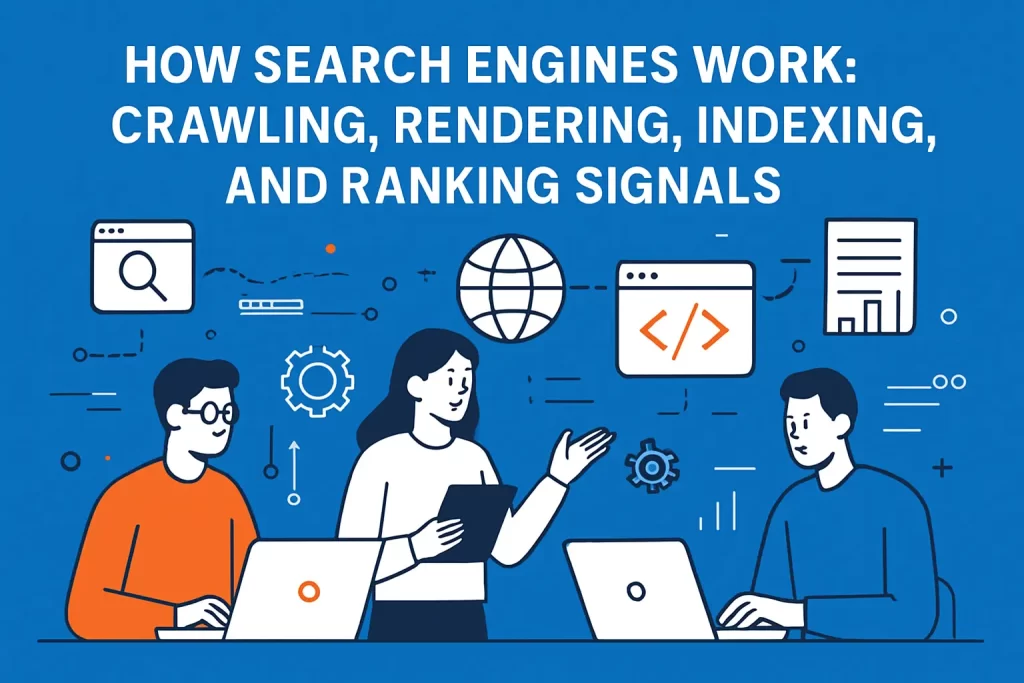
To understand SEO, we have to understand the pipeline that connects a URL on the web to a result in a SERP. We treat that pipeline as a production system: it has input constraints, failure modes, and bottlenecks.
1. Crawling: discovering pages by following links and using sitemaps
Crawling is the discovery process. Search engines find pages primarily through links and sitemaps, building an ever-expanding map of the web. If important pages aren’t linked internally, they often become “orphaned,” which is a polite way of saying they’re invisible.
Operationally, crawling is where infrastructure meets SEO. If a site throws errors, blocks bots accidentally, or responds slowly under load, crawlers back off—because nobody (human or robot) enjoys knocking on a door that never opens.
2. Rendering: processing HTML, JavaScript, and CSS to understand pages
Rendering is where things get modern and fragile. Many sites rely on JavaScript to assemble content, navigation, and even canonical tags after the initial response. Search engines can render many pages, but relying on rendering for core content adds risk and latency to interpretation.
From the hosting side, we see a recurring pattern: teams ship a beautiful application shell, then wonder why category pages don’t rank. The fix is often architectural—server-side rendering for critical content, stable internal links in the initial HTML, and fewer client-side surprises.
3. Indexing: analyzing content and metadata with no guarantee every page is indexed
Indexing is when a crawler tries to understand a page and decide whether to store it. A subtle but crucial point from Google’s own documentation is that there’s no guarantee a page will be crawled, indexed, or served even if it exists and follows best practices.
That uncertainty is why we urge teams to prioritize their “money pages” and make them unmistakably valuable. If a page is thin, duplicative, or confusing, it may never earn a stable place in the index.
4. Ranking: algorithms evaluate relevance and quality signals for user queries
Ranking is the sorting problem: for a given query, which pages are relevant, trustworthy, and useful? While the details are proprietary, the broad categories are familiar—content relevance, quality, usability, and external signals that suggest authority.
Our practical takeaway is that ranking is less about “tricks” and more about alignment. When a page answers the query cleanly, loads reliably, and is supported by credible signals, it tends to survive turbulence better than pages built purely to capture keywords.
5. Platform differences: optimizing for Google differs from other search surfaces
Different search platforms interpret the web through different constraints. Google has its own crawling behaviors and presentation formats, Bing has its own ecosystem and tooling, and AI-first engines may favor extractable, well-structured passages.
In other words, “SEO” isn’t one algorithm. It’s a set of interoperability practices—publishing in a way that multiple systems can fetch, parse, trust, and present without distortion.
Key components and types of SEO: technical, on-page content, and off-site authority
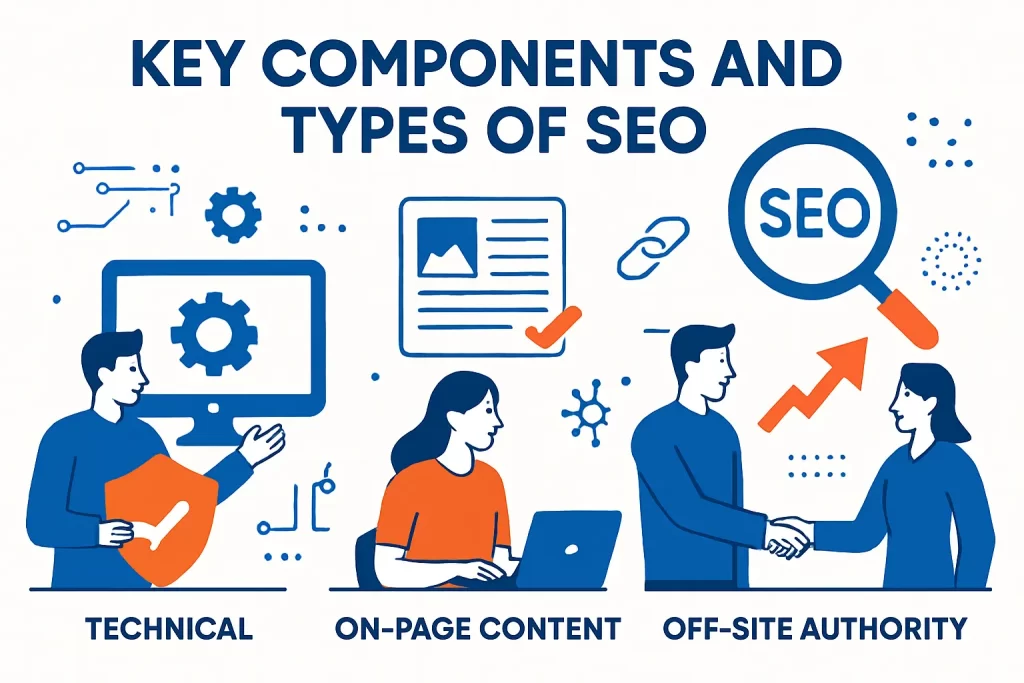
When SEO fails, teams tend to blame content or blame algorithms. In our experience, the real culprit is usually a missing leg of the stool: technical accessibility, on-page clarity, or off-site credibility.
1. Technical SEO foundations: crawlable architecture, internal linking, speed, mobile, and HTTPS
Technical SEO is the foundation that allows everything else to be seen. If crawlers can’t access key pages, or if the site serves inconsistent canonical signals, the best content in the world becomes a locked room.
At 1Byte, technical SEO often shows up as pragmatic engineering: sensible URL patterns, stable internal navigation, fast response times, secure delivery, and predictable behavior during traffic spikes so bots and humans see the same site.
What we watch at the infrastructure layer
- Origin reliability so crawlers don’t learn to “come back later” after repeated failures.
- Cache strategy that accelerates public pages while keeping personalized pages correct.
- TLS and modern security headers to reduce browser warnings and preserve user trust.
2. Content optimization: creating helpful, high-quality content for people and search engines
On-page content is where intent meets execution. Google’s own guidance emphasizes creating helpful, reliable, people-first content, and we agree with that framing because it aligns incentives: satisfy the user, and you usually satisfy the system.
Practically, content optimization means answering questions completely, using clear headings, adding original insight, and structuring pages so both skimmers and deep readers can succeed.
3. Off-site optimization: brand and authority building through external signals
Off-site SEO is the credibility layer. Links, mentions, reviews, citations, and brand searches all function as proxies for trust—imperfectly, but meaningfully. The safest approach is to earn those signals by being worth referencing, not by manufacturing “authority.”
We also take a conservative stance on link schemes. Bing’s own warnings about buying links and using link farms are old, but the principle is evergreen: shortcuts tend to create liabilities that surface later, right when a business least wants a surprise.
4. Specializations: local SEO, international SEO, and news SEO
SEO has specializations because search contexts differ. Local SEO hinges on consistent business information, reviews, and proximity relevance. News SEO is tied to freshness, publication workflows, and clean syndication signals. International SEO is a coordination problem across language, region, and infrastructure.
Each specialization adds operational demands. Local requires listing hygiene, news requires fast publishing and stable templates, and international requires careful content governance so translations don’t become duplicative noise.
5. International markets and regional search engines to consider in global SEO
Global SEO is never “set one language selector and call it done.” Regional engines, cultural conventions, and device realities all influence what ranks and what gets clicked. Even within the same language, spelling, terminology, and purchase behavior can vary sharply by region.
From our side, global SEO also means global delivery. If a site serves international audiences, latency and uptime become part of the SEO story—because poor performance can quietly suppress engagement signals and reduce the likelihood that users treat the brand as trustworthy.
On-page SEO checklist: titles, snippets, URLs, internal links, and images
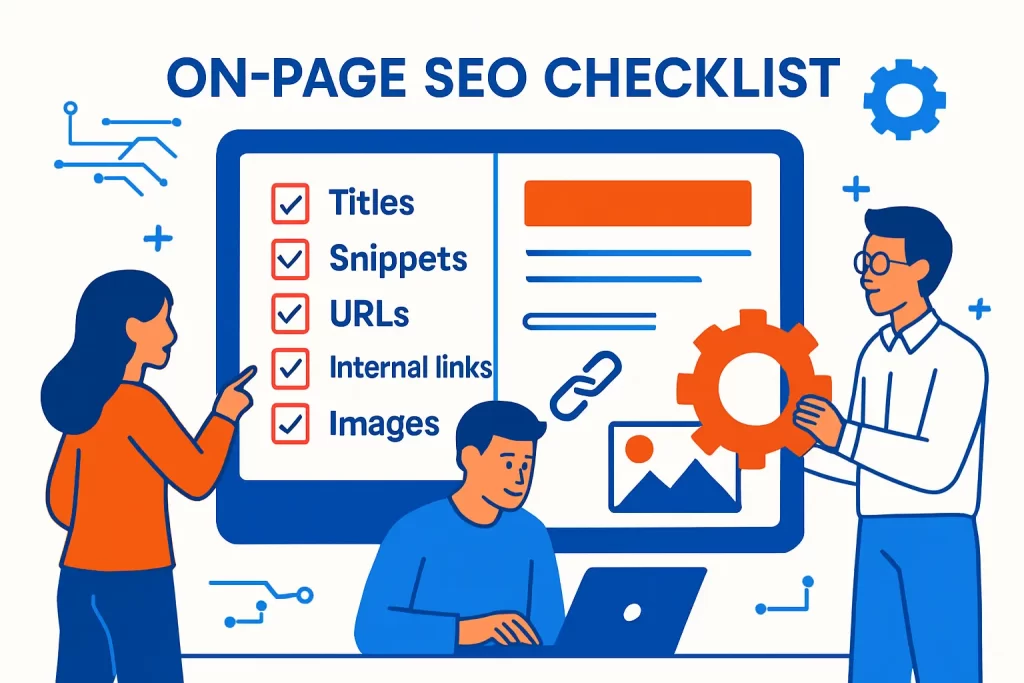
On-page SEO is where most teams feel productive, because it’s tangible: titles, headings, internal links, images, and copy. Still, “checklist” doesn’t mean “paint by numbers.” It means consistent execution on fundamentals.
1. Influence title links with strong title elements and page headings
Title links are your front door. Google explains that title links are generated algorithmically using on-page content and references across the web, which is a polite way of saying you influence them, but you don’t fully control them.
Our best practice is to make titles specific, human-readable, and aligned with the page’s main heading. When titles promise one thing and the page delivers another, rewrites become more likely—and conversion rates usually suffer even if rankings hold.
2. Control snippets with on-page content and well-crafted meta descriptions
Snippets act like a trailer for a movie: they help a searcher decide whether your page is the right click. Google notes that snippets are primarily created from page content, and meta descriptions may be used when they better describe the page, which is why we treat the visible first paragraphs as “snippet candidates,” not just introductions.
Meta descriptions still matter as a craft move. Even when engines rewrite them, the exercise forces clarity about who the page is for and what problem it solves.
3. Use descriptive URLs and breadcrumb-friendly structures for clarity
URL design is often underestimated. Google recommends a simple, descriptive URL structure that’s intelligible to humans, and that aligns with our experience: readable URLs reduce duplication, improve internal linking hygiene, and make analytics easier to interpret.
For businesses, clean URLs also help with trust. People share links in chat, email, and tickets; when the URL itself communicates context, it lowers friction long before the page loads.
4. Write good link text and build internal links that explain page relationships
Internal linking is one of the highest-leverage SEO activities because it shapes discovery and meaning at the same time. Google’s guidance on making links crawlable and writing descriptive anchor text reinforces a point we repeat to customers: navigation should not depend on fragile scripts or ambiguous “click here” text.
We like to think of internal links as the site’s argument. They communicate which pages matter, how topics connect, and what a reader should do next when they finish the page they came for.
5. Add and optimize images with clear visuals, relevant context, and alt text
Images can win visibility on their own, but they also influence comprehension and conversion on the page. Alt text is not just an accessibility checkbox; it’s also a way to describe an image in plain language, which helps systems interpret what’s being shown when the pixels alone aren’t enough.
From our hosting angle, image optimization is also performance optimization. Right-sizing, compressing appropriately, and serving modern formats can reduce payload dramatically—often the single biggest speed improvement a content-heavy site can make without touching code.
6. Organize content by grouping topically similar pages in directories
Information architecture is SEO’s quiet multiplier. Grouping related pages under consistent directory structures makes navigation clearer, makes breadcrumbs more meaningful, and creates natural hubs that strengthen internal linking.
We’ve seen this matter most for content libraries: documentation, learning centers, category pages, and guides. When a library is organized like a well-run warehouse, both crawlers and customers find what they need without wandering.
SEO strategy and maintenance: research, planning, monitoring, and reporting
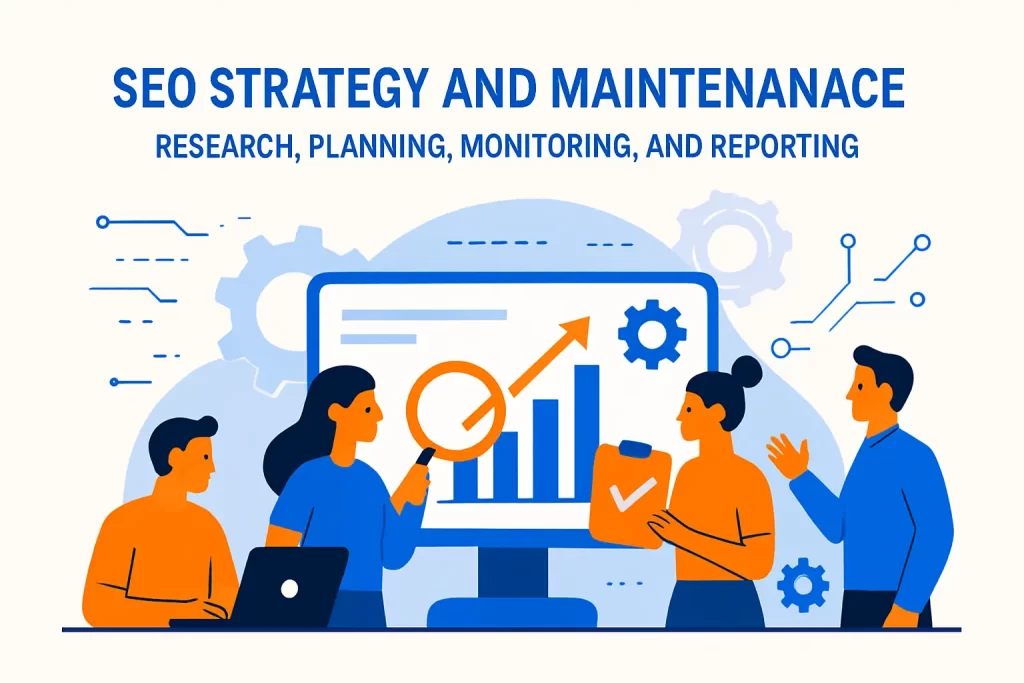
SEO is not a one-time project. It’s closer to site reliability engineering: a cycle of research, implementation, monitoring, and continuous improvement.
1. Research inputs: audience, keywords, competitors, website audits, and SERP intent analysis
Research starts with the audience, not the keyword tool. We ask: what vocabulary do buyers use, what objections appear repeatedly, and what “adjacent questions” show up after the first answer? Those adjacent questions often become the best supporting content because they mirror real decision-making.
Competitor research is useful, but we treat it as context rather than a blueprint. Copying competitor pages tends to produce generic content, and generic content is exactly what modern search systems are trying to compress into summaries.
2. Planning an SEO roadmap: goals, timelines, KPIs, tools, budgets, and stakeholders
A roadmap turns SEO into an organizational agreement. It defines what “done” means, who owns which dependencies, and how results will be measured. Without that alignment, SEO work becomes a pile of tickets that engineering resents and marketing can’t defend.
At 1Byte, we encourage teams to include infrastructure milestones in the roadmap: performance baselines, caching decisions, observability improvements, and release discipline. Those items don’t sound like “marketing,” but they often unlock the fastest SEO wins.
3. Creating and implementing: new content, upgrades to existing pages, and internal linking
Implementation should mix new creation with upgrades. Refreshing existing pages—improving clarity, adding missing sections, tightening internal links—often produces faster gains than publishing net-new pages into a site that’s already messy.
We also recommend publishing in clusters. A single standalone article can rank, but a coherent set of pages that link to each other tends to build topical authority that is harder for competitors to dislodge.
4. Monitoring and maintaining: traffic drops, slow pages, broken links, index issues, and outages
Maintenance is where most SEO programs fail, because it doesn’t feel creative. Yet search visibility is deeply sensitive to operational hygiene: broken templates, accidental noindex directives, misconfigured redirects, and performance regressions can erase months of work.
When something goes wrong, we like to diagnose in layers: server logs for crawl behavior, uptime and error trends for reliability, and platform tools for index coverage signals. That style of triage turns panic into process.
5. Measuring and reporting performance with analytics and search platform tools
Measurement should tie activity to business outcomes. Rankings can be directional, but they’re not the end. We care about qualified organic sessions, conversion paths, assisted conversions, and whether organic search is bringing the kinds of users who become customers—not just visitors.
On the platform side, the ability to inspect index status programmatically is underused. Google’s Search Console API documentation explains that the URL inspection tool provides insights into a URL’s index status, canonical selection, and rich result analysis, which is exactly the kind of data that helps teams debug at scale.
6. Common SEO myths to avoid: one-time SEO, keyword stuffing, and ignoring ongoing updates
Myth one is the belief that SEO is a one-time setup. Sites evolve, competitors publish, and SERPs change; “set and forget” becomes “set and decay.” Myth two is keyword stuffing, which usually makes pages worse for humans and less trustworthy for machines.
Another persistent myth is that technical SEO is optional for “small sites.” In reality, small sites often have fewer pages to audit, which means they can become technically excellent faster—if they treat SEO as a quality discipline, not a hack.
1Byte cloud hosting and web services for SEO-ready websites

We don’t pretend hosting is “SEO.” Hosting is the substrate that SEO depends on. If the substrate is unreliable, everything above it becomes a gamble.
1. Domain registration to secure your brand presence and manage DNS
Domains are where brands become navigable. A clean domain strategy reduces confusion, prevents duplicate-site problems, and makes it easier to build consistent signals across marketing channels.
DNS management also matters more than most SEO guides admit. Misconfigured records, inconsistent redirects, and scattered subdomain strategies can create accidental duplication that wastes crawl attention and dilutes authority across versions of the same site.
2. SSL certificates and HTTPS to protect users and support trusted experiences
HTTPS is table stakes for trust. Users notice browser warnings, and those warnings change behavior in a way no keyword tweak can fix. From our standpoint, SSL is also operational hygiene: certificate automation, renewal monitoring, and consistent deployment reduce the chance of an outage that quietly breaks both user journeys and crawler access.
When security is handled cleanly, teams get to focus on what actually moves the needle: content quality, information architecture, and product value.
3. WordPress hosting, shared hosting, cloud hosting, and cloud servers backed by an AWS Partner
Different sites need different runtime shapes. WordPress might be the right answer for a content-forward business, while cloud servers are better for application-heavy products that need more control over caching, rendering strategy, and deployment workflows.
As an AWS Partner, we think in terms of reliability patterns: sensible scaling, layered caching, observability, and operational discipline. Those aren’t flashy SEO talking points, but they reduce downtime risk, keep pages consistently fast, and make technical SEO fixes stick instead of slipping during the next release.
Conclusion: sustainable SEO follows guidelines and adapts to change
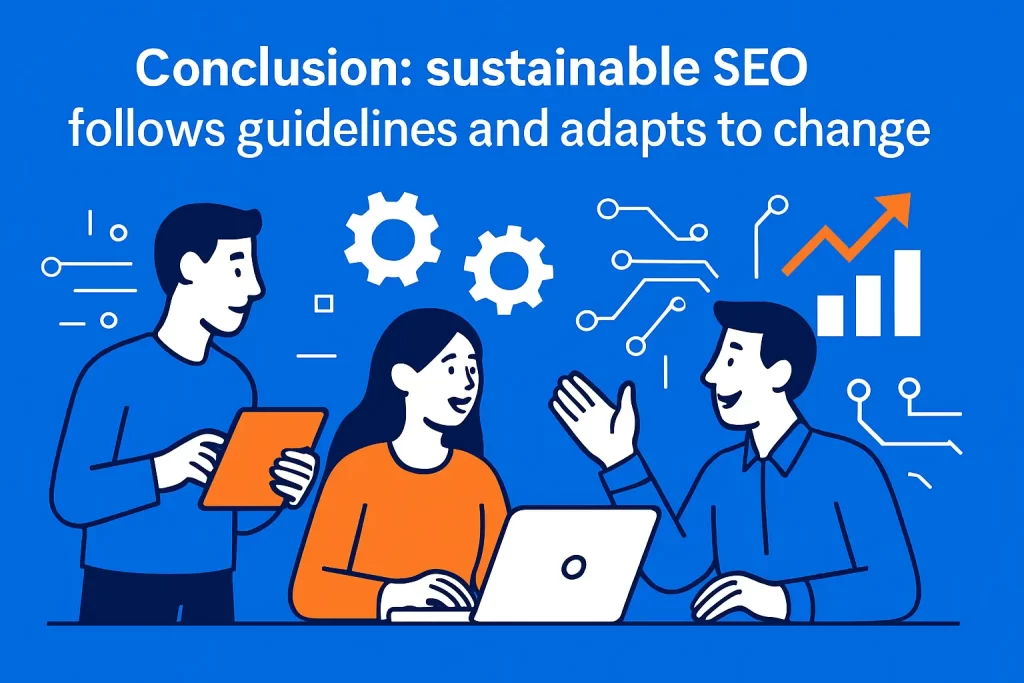
Sustainable SEO is less about chasing the algorithm and more about building a site that deserves to be recommended—by humans, by crawlers, and now by AI systems that compress the web into answers.
1. Prioritize white hat approaches that align with search engine guidelines and avoid deception
Our position is unapologetically conservative: if a tactic depends on deception, it’s technical debt with interest. White hat SEO is slower at the start, but it tends to compound because it improves the actual product: clearer pages, better navigation, stronger credibility, and fewer hidden liabilities.
When teams choose integrity over shortcuts, they also choose resilience. Updates become less terrifying, because the site isn’t balanced on a pile of brittle exploits.
2. Expect ongoing change from algorithm updates, new SERP experiences, and AI-driven discovery
Change is not an exception in search; it’s the environment. SERP layouts evolve, AI summaries reshape click behavior, and platform expectations for quality rise over time. Even engines themselves adjust how they treat links, content duplication, and spam patterns.
Because of that, we recommend treating SEO as continuous improvement with feedback loops. If you can measure, you can adapt—and if you can adapt, you can keep earning visibility while others complain that “SEO is dead.”






3. Keep iterating: there are no guaranteed shortcuts, but consistent best practices compound over time
Iteration is where compounding happens. Each technical fix makes crawling more reliable; each content upgrade improves satisfaction; each internal link strengthens understanding; each earned mention increases trust. Over time, the site becomes easier to rank because it becomes easier to believe.
If we were to suggest one next step, it would be this: pick one revenue-critical page, audit it end-to-end (intent, content, internal links, performance, indexing signals), and improve it like you’re preparing it for a customer you truly respect—what page would you start with?