

- How to understand the types of developers and role classifications
- Web application layers in the types of developers ecosystem
- Platform and low level types of developers: web, mobile, desktop, embedded, and systems
- Data and AI types of developers: data science, big data, and AI engineers
- Operations focused roles: cloud developers, DevOps developers, security developers, and SDET
- Specialized and creative developer roles: game, graphics, customization, and CRM
- Skills and career progression: from trainee developer to architect
- 1Byte cloud computing and web hosting support for developers
- Conclusion: choosing the right types of developers path
From inside 1Byte, we spend our days watching code collide with reality: browser quirks, database locks, CI pipelines that “worked yesterday,” and the occasional mystery outage that turns a calm sprint into a fire drill. In that messiness, one question keeps returning whenever a company hires, reorganizes, or modernizes: what type of developer do we actually need?
On paper, this looks like a tidy taxonomy problem. In practice, it’s a coordination problem—between product goals, risk tolerance, budgets, and the platforms we deploy onto. Market signals sharpen that urgency: Gartner forecasts public cloud end-user spending is forecast to total $723.4 billion in 2025, and Statista expects the developer population to reach 28.7 million people by 2024, meaning competition for skills and clarity is not easing up.
How to understand the types of developers and role classifications
So, we’re going to map the developer landscape the way we do when advising customers: not as a dictionary of titles, but as an ecosystem of responsibilities, constraints, and career arcs. Along the way, we’ll keep the lens practical—what businesses are buying when they “hire a developer,” and what teams must build internally to ship software that survives contact with users.

FURTHER READING: |
| 1. Best WordPress Site Examples for Design, UX, and Conversion Inspiration |
| 2. How to Build a WordPress Site Using Bricks Builder |
| 3. What Is Pseudocode and How to Write It |
1. What a developer does across software, websites, applications, and systems
At 1Byte, we define a “developer” less by language and more by outcomes: turning requirements into reliable behavior, repeatedly, under constraints. That behavior might live in a browser, on a server, in a mobile device, or deep inside a service mesh where no human ever sees it directly.
In business terms, developers translate organizational intent into operational capability. Some ship user-facing interfaces; others shape the invisible plumbing—identity, data models, event flows, observability. Because every layer influences cost and risk, a developer’s real job is rarely “write code”; it’s “reduce uncertainty until the system can be trusted.”
What we look for when systems hit production
Reliability shows up as habits: tight feedback loops, careful changes, and a bias toward instrumentation. Under load, the difference between “developer” and “professional developer” is often whether they designed for failure, not whether they memorized syntax.
2. Why titles overlap and there is no universally accepted classification of developer roles
Across the industry, titles overlap because companies optimize for different things: recruiting speed, compensation bands, prestige, or internal laddering. One organization’s “software engineer” is another’s “full stack developer,” and a third’s “platform engineer,” even when the day-to-day work is nearly identical.
History also muddies the water. Older companies inherited IT-centric naming, while cloud-native companies adopted product-centric naming, and regulated sectors added compliance-flavored titles. In our experience, the fastest way to resolve the overlap is to ask for a work sample: “Show us what you shipped, how you tested it, and how you operated it.”
3. Common ways to categorize types of developers by user input, platform, experience level, and software lifecycle
Instead of chasing universal labels, we categorize developers by the axis that matters to the decision at hand. Hiring a front end specialist is a different bet than hiring a data engineer, and choosing a developer for a legacy migration is different from choosing one for a greenfield prototype.
Practically, these are the classification lenses we use in architecture and staffing conversations:
- Interface-driven work: developers closest to user input, accessibility, UI state, and interaction design.
- Platform-driven work: developers who live inside a specific runtime, operating system, or device class.
- Lifecycle-driven work: developers who specialize in building, testing, releasing, or operating software.
- Experience-driven work: developers whose leverage comes from judgment, mentorship, and system-level thinking.
Across these lenses, the point is not to label people—it’s to make responsibilities explicit so that nothing essential is “owned by everyone,” which usually means owned by no one.
4. High level vs low level development based on proximity to hardware
Proximity to hardware changes the definition of “done.” High level development often optimizes for iteration speed, product discovery, and maintainable abstractions; low level development optimizes for determinism, performance, and tight control over memory, execution, and device behavior.
In the middle, real businesses blend both. A web application might be “high level,” yet still depend on low level realities like CPU saturation, kernel networking, or storage latency. From our hosting side, the most successful teams are the ones who can speak across the boundary: abstract when shipping features, then drop down a level when performance and reliability demand it.
Web application layers in the types of developers ecosystem
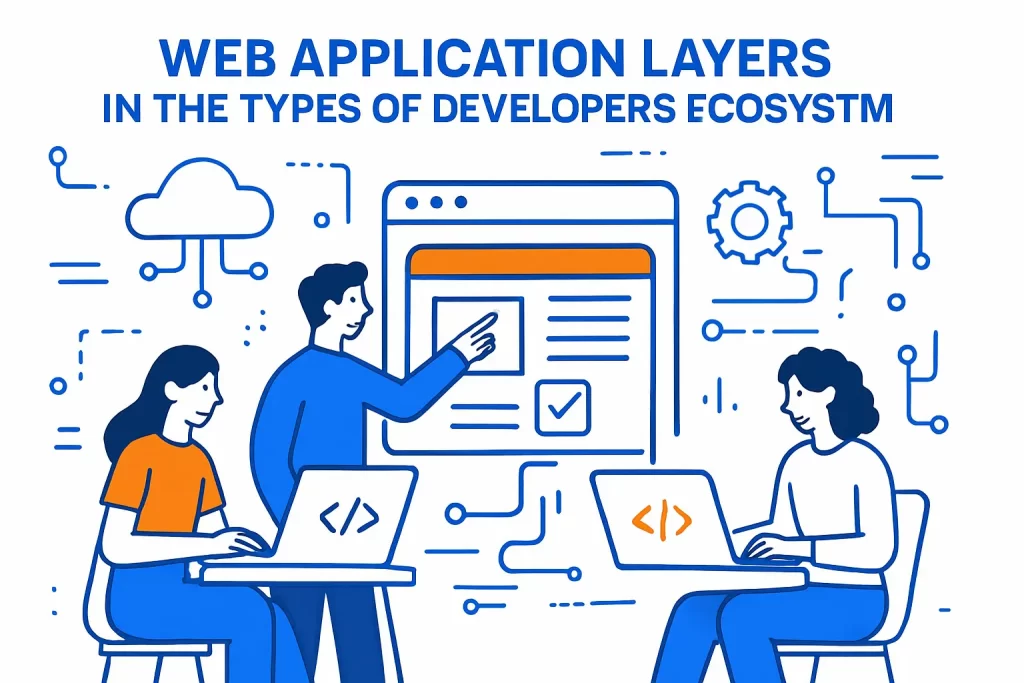
1. Front end developers focused on user interface, layout, and user experience
Front end developers own the part of the product that users actually experience: layout, interaction, responsiveness, accessibility, and the emotional texture of “this feels fast.” Their constraints are brutal in a special way—many environments, many devices, many edge cases, all while users judge quality in milliseconds.
From our vantage point, front end work is also “systems work,” just disguised. State management, caching strategies, rendering paths, and error recovery are architecture decisions with direct business impact: conversion rates, support tickets, and brand trust.
Where front end excellence shows up
Performance budgets, accessibility standards, and resilient UX flows are not polish; they’re risk control. When teams treat the UI as a “thin layer,” production incidents tend to turn into user incidents.
2. Back end server side developers focused on logic, databases, and APIs
Back end developers build the machinery: business rules, authentication and authorization, integrations, and the data pathways that let products behave consistently. Because back end services often centralize critical logic, mistakes here propagate widely and expensively.
In our day-to-day support work, we see back end maturity in how developers handle failure modes: retries that don’t stampede, idempotency where it matters, and APIs that communicate clearly. When back end teams choose predictable patterns—versioning, schema evolution, careful migrations—front end velocity rises and operations pain falls.
3. Full stack developers working across front end and back end responsibilities
Full stack developers are generalists with range: they can design a UI, wire an API, and reason about the data model without constantly throwing work over a wall. For smaller teams, that versatility is a superpower, especially during early product discovery.
However, “full stack” can become a trap if it means “on-call for everything forever.” In healthy organizations, full stack developers help bridge layers while still leaning on specialists for deep performance, security, or scale work. In our opinion, the best full stack practitioners are fluent in trade-offs, not just tools.
4. Middle tier developers building non UI code that connects browser logic and server functionality
Middle tier development is the connective tissue: application services, orchestration logic, background processing, workflow engines, and integration layers. This code often carries business complexity without the clarity of a UI or the strictness of a database, so it can rot quietly if teams aren’t disciplined.
In hosting environments, middle tier choices frequently determine operational stability. A well-designed job queue, a careful event-driven flow, or a thoughtfully bounded service can prevent a traffic spike from turning into a cascading failure. When we advise customers, we treat middle tier developers as “complexity managers” more than feature implementers.
5. Database developers specializing in data storage, queries, and database performance
Database developers live at the intersection of correctness and performance. Indexing, query plans, transaction boundaries, partitioning strategies, and schema design are their day-to-day tools, and those tools directly shape cost, latency, and incident frequency.
Because databases are often the sharpest bottleneck, this specialization matters more than many teams admit. In our experience, a single thoughtful database developer can unlock product velocity by making data access predictable, migrations safe, and performance measurable. When that role is missing, application teams tend to compensate with caching hacks and brittle workarounds.
Platform and low level types of developers: web, mobile, desktop, embedded, and systems
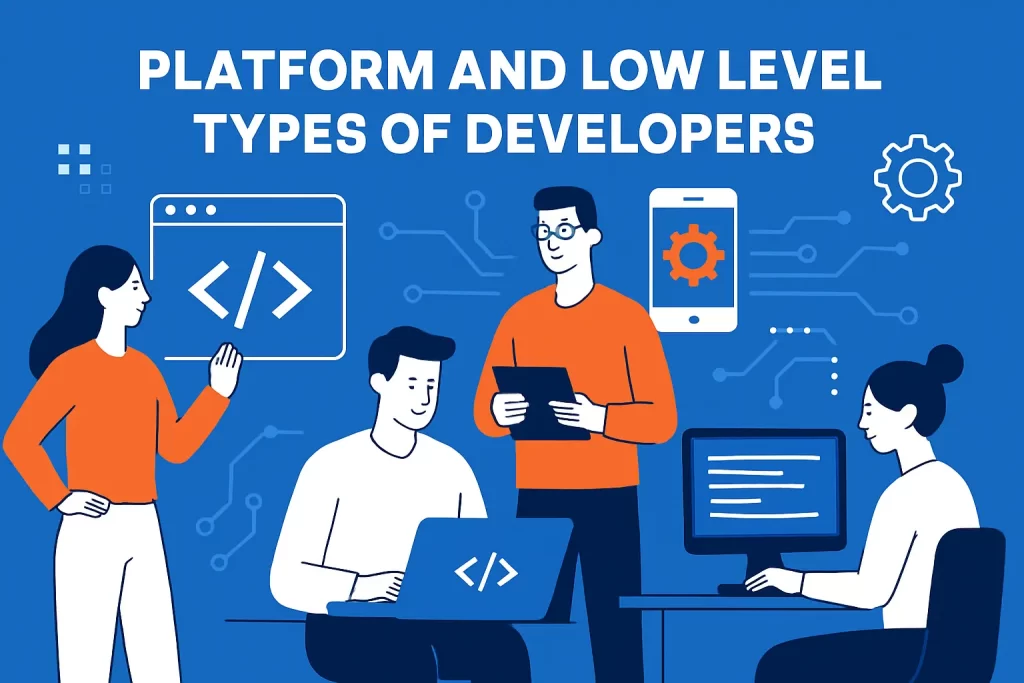
1. Web developers building and maintaining websites and web applications
Web developers span a wide range: content sites, commerce storefronts, SaaS dashboards, and internal tools. Some focus on frameworks and component systems, while others focus on CMS customization and deployment pipelines; both can be business-critical depending on context.
At 1Byte, we see web development maturity in how teams think about delivery: staging environments, rollback plans, and observability for user flows. When a web developer pairs shipping speed with operational sanity, organizations stop treating deployments like high-stakes ceremonies.
2. Mobile developers building applications for mobile operating systems
Mobile developers build for environments where constraints are more personal: battery, network variability, device permissions, and UI conventions that users have internalized. They also manage a unique release reality: app store reviews, phased rollouts, and device fragmentation that forces careful testing discipline.
From a business standpoint, mobile developers are often guardians of customer trust. Crashes, janky login flows, and sloppy offline behavior lead directly to churn, because the device is intimate and unforgiving. In our view, the strongest mobile teams integrate tightly with back end and security teams so authentication, telemetry, and data handling stay consistent.
3. Desktop developers creating installed applications for computers
Desktop development remains vital in industries where local performance, device access, or offline workflows dominate: creative tooling, enterprise productivity, manufacturing, and specialized operations. Installed applications can also provide deeper OS integration than web apps, at the cost of more complex packaging and update strategies.
When desktop teams do things well, users experience stability and speed that feels “native” in the best sense. Operationally, the hard part is distribution, compatibility, and support: version drift and dependency issues can become a hidden tax unless update channels and diagnostics are treated as first-class features.
4. Embedded developers working with microcontrollers, real time systems, IoT devices, and hardware drivers
Embedded developers build software that touches the physical world: sensors, actuators, industrial controllers, medical devices, consumer electronics. Here, “bugs” can become safety hazards, and debugging can mean oscilloscopes, serial consoles, and logs captured through narrow pipes.
On the cloud side, we often meet embedded teams when devices begin to “phone home.” Device identity, secure firmware updates, telemetry ingestion, and fleet management become as important as the firmware itself. In our opinion, the best embedded developers cultivate paranoia in a healthy way—assuming hostile networks, imperfect power, and long device lifecycles.
5. Systems, operating system, language and compiler, and hardware adjacent developer paths
Systems developers work close to the metal: operating system internals, networking stacks, runtimes, compilers, and performance-critical libraries. Their impact is often indirect but enormous, because improvements at this layer multiply across entire products and platforms.
Businesses typically feel systems work through outcomes like reduced infrastructure cost, lower latency, or safer isolation boundaries. In our hosting environment, the systems mindset shows up in careful profiling, disciplined memory management, and a comfort with long-lived complexity. When organizations invest here, they’re buying leverage that doesn’t always fit neatly into a sprint demo.
Data and AI types of developers: data science, big data, and AI engineers
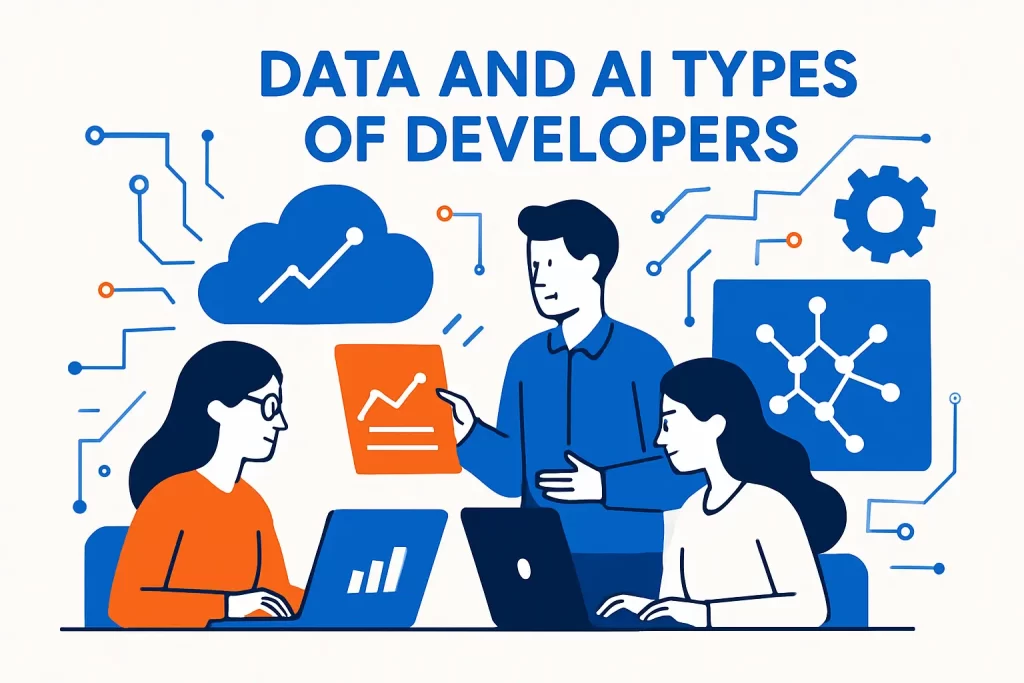
1. Data science developers applying data analysis workflows to product and business needs
Data science developers operate where statistics, domain intuition, and product goals intersect. They explore data, build models, design experiments, and translate findings into decisions that the business can act on, ideally without turning the work into a black box.
In our perspective, the most valuable data scientists are pragmatic communicators. A model that can’t be monitored, explained to stakeholders, or refreshed safely will drift into irrelevance. When data science teams collaborate closely with engineering, they turn insights into features rather than slide decks.
2. Big data developers building and maintaining systems for large scale datasets and cloud storage
Big data developers build the pipelines: ingestion, transformation, storage, governance, and retrieval. Their daily concerns include data quality, schema evolution, lineage, access control, and cost containment—especially in cloud environments where careless queries can turn into expensive surprises.
From the hosting side, we’ve learned that “big data” is less about volume than about discipline. Teams win when they automate validation, treat data contracts as real interfaces, and instrument pipelines like production services. When those practices are missing, analytics becomes fragile and trust in metrics quietly erodes.
3. AI engineers developing machine learning, natural language processing, and computer vision solutions
AI engineers productionize models: they turn research artifacts into services with SLAs, versioning, monitoring, and safe fallbacks. Compared with data science, the emphasis shifts from exploration to reliability—model behavior must be predictable enough to ship and accountable enough to audit.
Economically, AI work has moved from curiosity to board-level strategy. McKinsey estimates generative AI has the potential to generate $2.6 trillion to $4.4 trillion in value across industries, which explains why so many teams are suddenly hiring for MLOps, inference optimization, and model governance. In our view, the winners will be the organizations that treat AI as an engineering discipline, not as a demo.
Operations focused roles: cloud developers, DevOps developers, security developers, and SDET
1. Cloud developers and cloud engineers designing and managing cloud architectures and access
Cloud developers build with managed services in mind: identity boundaries, network segmentation, secrets handling, infrastructure-as-code, and cost-aware scaling patterns. Cloud engineers often extend that focus into operations: reliability, incident response, governance, and platform standardization.
Inside 1Byte, we treat cloud competence as a business multiplier. Teams that understand IAM design, observability, and deployment automation ship faster with fewer “mystery problems,” because their environments are reproducible and their failure modes are visible. When cloud roles are underspecified, costs spike and security gaps appear in the seams.
2. DevOps developers unifying development and IT workflows to automate delivery and reduce interruptions
DevOps developers reduce friction between writing code and running code. Tooling, pipelines, build systems, release automation, and operational feedback loops are their craft, and the goal is deceptively simple: make the safe path the easy path.
In practice, DevOps is cultural and technical at once. Automation without shared ownership becomes bureaucracy, while shared ownership without automation becomes burnout. From our experience supporting deployments, the best DevOps work creates calm: smaller changes, clearer rollbacks, and fewer late-night surprises.
What DevOps maturity feels like in production
Predictability is the key word. When a team can explain how changes move from commit to customer, incident response becomes a process instead of a panic.
3. Security developers protecting software from threats through secure design and testing processes
Security developers build defenses into the software lifecycle: threat modeling, secure defaults, dependency review practices, and testing that targets abuse cases, not just happy paths. They also help teams interpret requirements around privacy, compliance, and data handling into implementable controls.
Human behavior remains a central risk driver, and security developers design for that reality rather than pretending it away. Verizon’s DBIR reports 68% involved a non-malicious human element, which is exactly why secure-by-design matters: the system must be resilient to mistakes, not merely hardened against villains. From our viewpoint, security developers are most effective when they ship guardrails, not lectures.
4. Software Development Engineer in Test SDET roles building automated tests, tools, and quality systems
SDETs build confidence as an artifact: test frameworks, automation tooling, quality gates, and diagnostics that help teams detect regressions before customers do. Their work is not “extra testing”; it is an engineering approach to proving behavior under change.
In production hosting, quality failures are rarely isolated; they cascade. A weak test strategy creates brittle releases, which creates rollback fear, which creates slower shipping, which creates bigger releases, which creates bigger failures. Our opinion is blunt here: investing in SDET capabilities is often cheaper than paying the ongoing tax of fragile delivery.
Specialized and creative developer roles: game, graphics, customization, and CRM
1. Game developers building interactive experiences across console, PC, and mobile
Game developers blend engineering with experience design: real-time performance, input responsiveness, asset pipelines, networking, physics, and an obsessive focus on “feel.” The work also spans business realities like monetization design, live operations, and content updates that keep communities engaged.
Even when a company is not a game studio, game development patterns leak into mainstream software: real-time collaboration, immersive UI, and high-performance rendering. In our view, game developers teach the rest of the industry a useful lesson—users don’t separate “technical” from “emotional”; they just decide whether the product is fun or frustrating.
2. Graphics developers focusing on rendering, lighting, shadows, and scene effects for games and video
Graphics developers specialize in rendering pipelines, visual fidelity, and computational efficiency. Their challenges include balancing quality against performance budgets, choosing algorithms that scale across GPUs, and integrating art workflows into build systems without turning iteration into agony.
From the infrastructure side, graphics work increasingly intersects with cloud: rendering farms, asset storage, distributed builds, and collaborative tooling. When teams push graphical complexity, they also push operational requirements—fast artifact delivery, consistent environments, and careful caching—so the creative pipeline stays fluid.
3. Customization developers extending SaaS and platforms such as WordPress, Shopify, Magento, SAP, and Salesforce
Customization developers live in the ecosystem layer. They extend platforms with plugins, themes, workflows, integrations, and bespoke business logic, usually while staying inside constraints imposed by the vendor’s APIs, data models, and upgrade paths.
At 1Byte, we see this role as underrated business leverage. A good customization developer can turn a generic tool into a competitive advantage—without reinventing the entire stack. The risk, of course, is upgrade fragility: customization must be engineered like product code, with versioning discipline and test coverage that anticipates vendor change.
4. Customer relationship management CRM developers building and improving CRM systems for organizations
CRM developers shape the operational heartbeat of many organizations: customer records, workflows, automations, reporting, and integrations with marketing, billing, and support systems. Because CRM platforms often become “source of truth,” correctness and governance matter as much as velocity.
In our experience, CRM development succeeds when it respects both humans and systems. Sales teams need ergonomics and trust in data, while the business needs auditability, permissions, and clean integrations. When CRM is treated as a dumping ground, the organization pays with messy analytics and broken handoffs.
Skills and career progression: from trainee developer to architect
1. Essential skills across many types of developers: cloud computing, data structures and algorithms, Git, containers, IDEs, databases, and scripting
Skills that travel across roles are the ones that reduce coordination costs. Git fluency, debugging discipline, comfort with databases, and an ability to reason about latency and failure will serve developers whether they work in front end, back end, data, or systems.
In our view, cloud literacy has become part of that baseline. Even when a developer doesn’t manage infrastructure, they still deploy into it, so understanding environments, logs, and resource constraints makes collaboration smoother. Meanwhile, scripting remains the quiet superpower that turns repetitive work into automation and creates breathing room for deeper engineering.
2. Certifications to deepen knowledge and broaden job opportunities across regions and remote work markets
Certifications are not a substitute for shipping, yet they can help developers signal seriousness, especially in remote markets where first impressions are filtered through resumes. Cloud certifications, security fundamentals, and platform-specific credentials can also give structure to self-directed learning.
From the employer side, we treat certifications as a hint, not a verdict. The real value emerges when certification study translates into better decisions: safer IAM patterns, clearer incident response, more reliable deployments. When candidates pair credentials with small, well-documented projects, the combination is persuasive.
3. Developer levels: trainee, junior, mid level, senior, and leader
Experience levels are best understood as increasing scope of responsibility. Trainee and junior developers learn to deliver tasks predictably; mid-level developers own features end-to-end; senior developers own systems and guide trade-offs; leaders shape teams, strategy, and long-term technical direction.
At 1Byte, we notice that the step changes are rarely about raw coding speed. Judgment—what to simplify, what to measure, what to postpone, and what to standardize—becomes the differentiator. The most reliable signal of seniority is how calmly someone can navigate ambiguity without creating chaos for everyone else.
4. Leadership oriented roles: programmer, team lead, lead developer, and architect
Leadership roles come in flavors. Some leaders remain deeply hands-on, acting as force multipliers through reviews, pairing, and architectural guidance; others focus on delivery systems, alignment, and the health of the team’s workflow.
Architects, in particular, are often misunderstood. In our opinion, architecture is not about drawing boxes; it is about making irreversible decisions carefully and reversible decisions cheaply. When architects stay close to production feedback—performance data, incident reports, customer friction—they create designs that survive reality instead of collapsing under it.
5. Practical ways to enter the field: learn a language, build projects, pursue internships, and consider bootcamps
Entry paths succeed when they produce evidence of competence. A small project that runs reliably, is deployed cleanly, and is explained well can outperform a long list of tutorials, because it demonstrates follow-through and troubleshooting ability.
Hiring demand is real but selective, and the pipeline remains active. The BLS projects 129,200 openings for software developers, quality assurance analysts, and testers projected each year, so persistence matters: iterate on a portfolio, seek feedback, and learn to communicate trade-offs. From our hosting perspective, the most employable newcomers are the ones who can deploy their work and explain how they’d operate it.
1Byte cloud computing and web hosting support for developers
1. Domain registration and SSL certificates to launch and secure developer projects
Domain and SSL choices can feel like paperwork until the day they break a launch. In our experience, teams move faster when they treat naming, certificates, and renewal processes as part of engineering hygiene rather than an afterthought delegated to “someone in ops.”
At 1Byte, we like to make that hygiene boring in the best sense: consistent DNS management, predictable certificate workflows, and guardrails that prevent accidental exposure. When identity and encryption are handled cleanly, developers can focus on features instead of chasing warnings and trust issues.
Why this matters to business outcomes
Trust is cumulative. A secure, predictable entry point reduces support burden, improves conversion, and lowers the chance that a simple misconfiguration becomes a reputational event.
2. WordPress hosting and shared hosting to publish websites, portfolios, and content driven applications
Not every project needs a distributed system. Shared hosting and WordPress hosting remain pragmatic options for portfolios, marketing sites, documentation hubs, and content-driven applications where time-to-publish beats architectural purity.
From our viewpoint, the key is choosing the simplest platform that meets the operational bar. When developers can stage safely, update confidently, and recover quickly, even “simple hosting” becomes a professional environment. As projects grow, those same foundations make it easier to migrate without rewriting everything in a panic.
3. Cloud hosting and cloud servers supported by an AWS Partner for scalable deployment needs
Cloud hosting becomes compelling when teams need controlled scaling, isolation boundaries, and repeatable environments for multiple services. For those situations, we often support deployments that run on cloud servers and architectures designed with help from an AWS Partner, especially when customers want proven patterns around identity, networking, and observability.
In our day-to-day work, “scalable” rarely means infinite; it means predictable under change. Deployment automation, resource sizing discipline, and clear rollback paths matter more than heroic tuning. When teams pair cloud hosting with solid operational practices, they gain the freedom to iterate quickly without gambling the business on every release.
Conclusion: choosing the right types of developers path
1. Match role categories to your interests: user facing work, backend systems, data, cloud operations, or specialized domains
Choosing a developer path starts with an honest look at what energizes you. User-facing work rewards empathy and iteration; backend systems reward rigor and clarity; data roles reward curiosity and skepticism; cloud operations rewards calm under pressure; specialized domains reward deep craft and patience.
From our perspective at 1Byte, the “best” role is the one where your strengths reduce someone else’s pain. Teams thrive when developers pick domains that match their temperament, because consistency beats short bursts of motivation.
2. Build a focused skill set while keeping broad foundations for collaboration across teams
Focus creates depth, yet breadth creates collaboration. A front end developer who understands APIs ships better UIs, while a back end developer who understands UX constraints designs better interfaces; similarly, data teams who understand deployment build more trustworthy pipelines.
In our opinion, the healthiest career strategy is a T-shape: one specialty you can carry under pressure, plus enough cross-disciplinary fluency to communicate and coordinate. That combination also makes you resilient as technologies change and titles drift.







3. Use experience levels and role definitions to plan next steps in learning and career growth
Role definitions are most useful when they become a plan. A junior developer can aim to own a feature end-to-end; a mid-level developer can practice designing for failure; a senior developer can develop mentoring muscle and architectural restraint.
Next steps become easier when you pair learning with shipping: build something, deploy it, monitor it, then improve it based on what the system tells you. If you had to pick one direction to invest in this month—UI craft, API design, data reliability, or cloud operations—where would you place your next bet?