

- What “Rename Database” Really Means in phpMyAdmin
- Why This Task Still Shows Up So Often
- Pre-Rename Checklist (Do This First)
- Method A: Rename a Database in phpMyAdmin Using the UI (Copy/Move Flow)
- Method B: Rename a Database by Moving Tables with SQL (Fast, But Not Always Possible)
- Method C: Rename a Database via Export and Import (Most Portable)
- Post-Rename Tasks Most People Forget (But Your App Will Notice)
- Troubleshooting Common phpMyAdmin Rename Problems
- Security and Operational Best Practices for Renames
- FAQs on Renaming a Database in phpMyAdmin
- Conclusion
Renaming a database sounds simple, yet it can break your site if you change the name without updating users, privileges, and application settings. This guide shows the safest way to rename a database using phpMyAdmin, when to use cPanel tools instead, and how to verify everything works before you delete the old database.
Quick answer: If you are trying to rename a database in phpMyAdmin, the safest approach is usually a controlled “copy” workflow: create a new database, export the old database, import it into the new one, then update your app’s configuration to point to the new database. This keeps the change reversible and reduces breakage.
- If you are on shared hosting with cPanel: Use the cPanel database tools to create a new database and user, then export/import in phpMyAdmin.
- If you have SSH or full server access: Prefer export/import or a backup-driven migration flow unless you fully understand how your server stores database files.
- If this is WordPress: Plan for a config update and a quick verification checklist after the move.
What “Rename Database” Really Means in phpMyAdmin
Most people search for a rename button, but the safest result is not a one-step rename. What you usually want is a database with a new name that contains the same tables and data, while your site continues to function. That is best handled as a migration: copy data into a new database, then repoint the application.
This matters because your site does not only depend on the database name. It depends on a database user, privileges, and config values stored in your application. A clean migration keeps those pieces aligned and makes rollback possible if something fails.
Before you start:
- Confirm which database your site is currently using by checking your app config file.
- Make a full backup of your database export and store it outside your web root.
- Plan a short maintenance window if your site receives frequent writes.
- Ensure you have credentials for the hosting panel and phpMyAdmin access.
1. MySQL Does Not Offer a True Rename Database Command
Before you click anything, align on a key point: MySQL has no single statement to rename a database. So phpMyAdmin cannot “flip a name” the way you might rename a table.
Instead, phpMyAdmin typically creates a new database, moves or copies objects into it, and then removes the old database if you choose that option. That approach works, but it changes what you must verify afterward.
2. phpMyAdmin Supports Renaming, But It Still Must Handle Privileges
Even after you move objects, user access can break. That happens because MySQL does not adjust the original privileges relating to these objects on its own. phpMyAdmin can help, but only if you select the right options and you have enough rights to update the mysql system tables.
3. “Rename” Can Mean Copying, Moving, or Rebuilding
Most teams end up using one of these patterns:
- Copy database: You duplicate the data, test it, and then switch the app.
- Move tables: You move tables to a new schema name using SQL. This can run fast, but it has sharp edges.
- Export and import: You dump to SQL and restore. This works across servers and hosting plans, but it can take longer.
Why This Task Still Shows Up So Often

1. Developers Keep Using SQL and MySQL-Style Tools
Database work stays common because SQL remains a daily tool for many developers. The SQL (59%) usage figure from Stack Overflow’s survey press coverage highlights how often teams still touch relational databases.
2. Many People Still Learn on MySQL
Renaming also hits beginners and students. In Stack Overflow’s survey press coverage, those learning to code relied on MySQL at 45%, which helps explain why phpMyAdmin “rename database” questions keep coming up.
3. phpMyAdmin Continues to Evolve
Small UI and behavior changes affect rename flows. For example, phpMyAdmin 5.2.3 includes fixes that touch rename edge cases, such as databases that include views.
Pre-Rename Checklist (Do This First)
1. Decide What You Optimize For: Speed, Safety, or Hosting Limits
Start by choosing the method that fits your constraints:
- If you need the simplest rollback, copy the database and switch the app later.
- If you need speed and you can run SQL safely, move tables with RENAME TABLE.
- If you need to move across servers, export and import.
This decision drives everything else, so make it early.
2. Take a Backup You Can Restore
Backups reduce stress. So export the database from phpMyAdmin before you change anything. Store the SQL dump somewhere outside the server if you can. Then confirm the dump finishes without errors.
If your database is large, do not rely on a browser timeout. Use a server-side export option when possible, or use command-line tools if your host allows them.
3. Freeze Writes (If You Need Consistency)
If your application keeps writing during the copy, you can split data across the old and new databases. So plan a brief maintenance window when correctness matters.
For example, put your app in maintenance mode, pause background jobs, and stop workers that write to the database.
4. Inventory “Hidden” Objects That Break During a Move
Tables usually move fine. However, these objects can surprise you:
- Views that reference a schema name
- Triggers that block cross-database moves
- Stored procedures and functions that hardcode the database name
- Events (scheduled jobs inside the database)
When you know what exists, you can test the right things later.
Method A: Rename a Database in phpMyAdmin Using the UI (Copy/Move Flow)
1. Create the New Database First
Open phpMyAdmin and go to the home screen that lists databases. Create the new database with your desired name. Also pick the right collation and character set if phpMyAdmin asks.
Match what your old database uses. That way, you avoid subtle sorting and comparison differences after the rename.
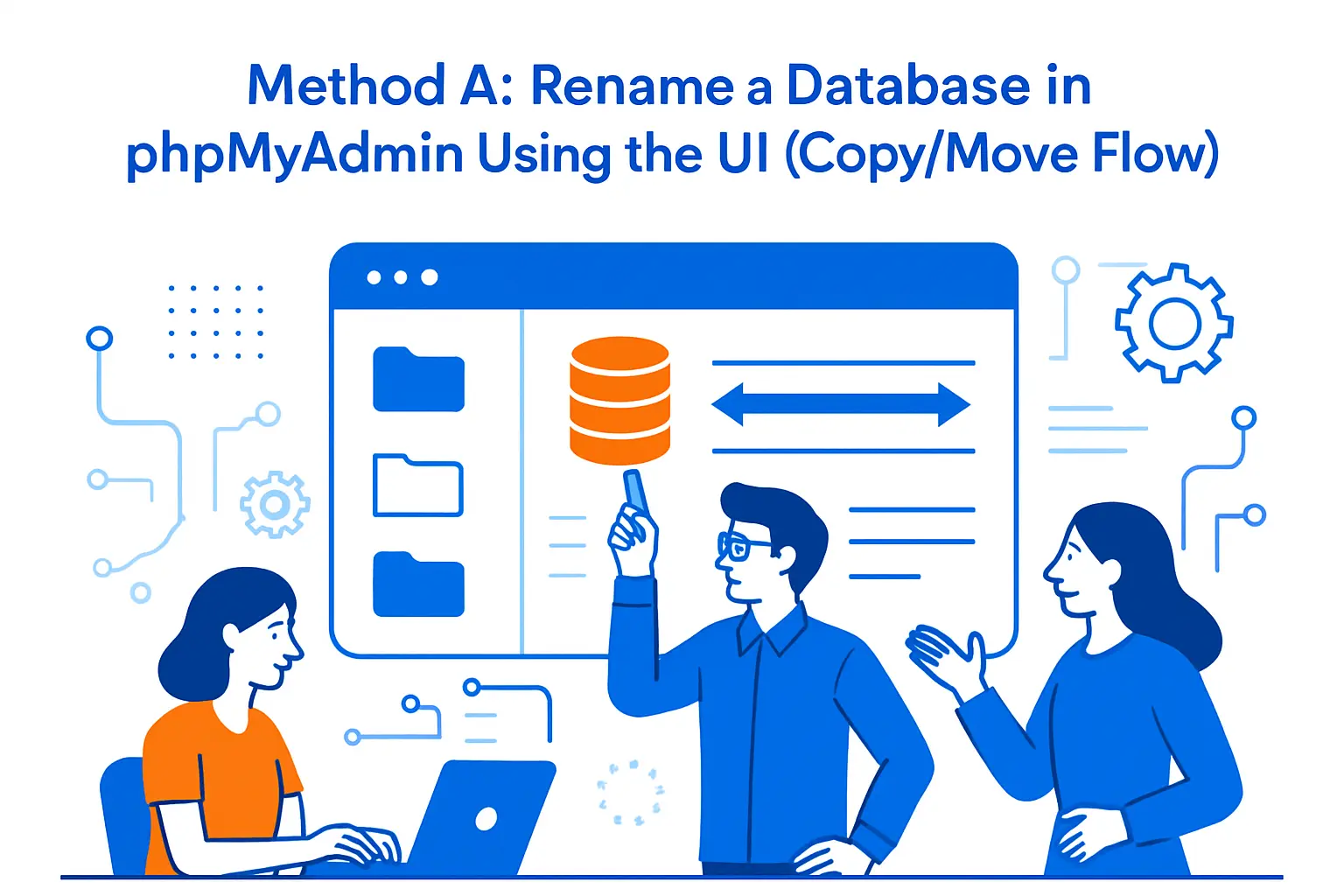
2. Use Database Operations to Copy Tables
Select the old database in the left navigation. Then open the Operations tab for that database.
Look for the section that lets you copy or move the database (wording varies by version and hosting). Choose the option that copies structure and data into the new database. If phpMyAdmin offers an “Adjust privileges” checkbox, enable it only when you understand the permissions impact and you have the rights to apply it.
3. Verify the New Database Before You Drop Anything
After phpMyAdmin finishes the operation, open the new database and check:
- Row counts look reasonable on key tables
- Views open without errors
- Routines exist if your app depends on them
Next, run a basic smoke test from your application. Login, create a record, and run the feature that uses the most critical tables.
4. Switch Your Application to the New Database Name
Now update the app configuration. Here are common examples:
- WordPress: update
DB_NAMEinwp-config.php - Laravel: update
DB_DATABASEin.env, then clear config cache - Symfony: update the database name in
DATABASE_URL
After you switch, restart workers and background jobs so they pick up the new setting.
5. Drop the Old Database Only After a Calm Verification
Dropping the old database removes your easiest fallback. So wait until you confirm:
- The app runs normally on the new database
- All cron jobs and queues run cleanly
- New writes appear in the new database
When you feel confident, drop the old database from the Operations tab. Then keep your backup for a while in case you need to investigate later.
Method B: Rename a Database by Moving Tables with SQL (Fast, But Not Always Possible)
1. Understand the Core Idea
This method creates a new database and then moves each table into it. The MySQL manual confirms you can move tables across databases via RENAME TABLE, and it also warns about limitations. In particular, attempts to rename a table into a different database fail when the table has triggers.
So this method works best for simpler schemas, or for cases where you can temporarily remove and recreate triggers.
2. Run the Steps Carefully
Use phpMyAdmin’s SQL tab, or use a MySQL client if you have one:
CREATE DATABASE new_db_name;RENAME TABLE old_db_name.table_a TO new_db_name.table_a;RENAME TABLE old_db_name.table_b TO new_db_name.table_b;RENAME TABLE old_db_name.table_c TO new_db_name.table_c;Continue until the old database has no tables left.
3. Handle Views, Triggers, and Routines Separately
Views often need a rebuild because they can embed the old schema name. Triggers can block the move entirely. Routines can reference the old schema name too.
So treat this method as “tables first.” Then script the rest as a second phase. If that sounds risky, use export/import instead.
4. Fix Privileges After the Move
After you move tables, your users may still have access rules tied to the old schema name. You can copy privileges manually by re-granting access on the new database. If phpMyAdmin can adjust privileges in your setup, it can reduce manual work. However, shared hosting often restricts those operations.
Method C: Rename a Database via Export and Import (Most Portable)

1. Export the Old Database to an SQL File
Select the old database and use the Export feature. Choose a format that includes both structure and data. Also include routines, triggers, and events if your app uses them.
If your export fails, reduce the load. For example, export table-by-table, or use a “custom” export and split the output.
2. Create the New Database and Import
Create the new database in phpMyAdmin. Then use Import to load the SQL file.
After import, run simple validation queries. For example, select a few rows from your main tables and confirm indexes exist in the Structure view.
3. This Method Works Even When Hosts Restrict Rename Options
Many shared hosts remove advanced actions inside phpMyAdmin. In that case, export/import still works because it looks like normal database usage.
If you use cPanel, note that renaming a database is no longer possible from the MySQL command line interface in their guidance, so hosting panels may steer you toward their own rename tools instead of raw SQL.
Post-Rename Tasks Most People Forget (But Your App Will Notice)

1. Update Connection Strings Everywhere
Apps rarely store a database name in only one place. So check:
- Primary app config files
- Environment variables in the runtime (containers, systemd, hosting UI)
- Worker processes and queue consumers
- Reporting tools and BI connectors
Then restart processes that cache configuration.
2. Recheck Database Users and Grants
After the rename, sign in with the application’s database user and confirm it can:
- Read the tables it needs
- Write to tables where it creates records
- Run migrations if your deployment does that
If you hit permission errors, re-grant on the new database name. Do not “fix” it by switching the app to a superuser long-term.
3. Validate Views, Triggers, and Scheduled Events
Next, test features that depend on views or triggers. If a view breaks, it often fails with a clear error that references the old schema. Recreate the view in the new database, and update the schema name inside the definition.
If you run MariaDB, keep in mind that there is no RENAME DATABASE statement, so you still rely on move or rebuild workflows.
4. Watch for Hardcoded Schema Names in Application SQL
Some teams fully qualify tables like old_db.table inside queries. That style breaks immediately after a rename. So search your codebase for the old database name and update it.
This step matters even more for older apps and quick scripts that never used an ORM.
Troubleshooting Common phpMyAdmin Rename Problems
1. phpMyAdmin Shows No “Operations” Options
Hosting providers often ship a restricted phpMyAdmin build. They may hide user management, rename features, or privilege changes. When that happens, switch to export/import or use the hosting panel’s database tools.
2. “Access Denied” When Copying or Adjusting Privileges
This usually means your MySQL user lacks permission to create databases, drop databases, or edit privilege tables. Ask your DBA or host for a user with the required rights, or pick a method that stays within your allowed actions.
3. Views Fail After the Rename
Views can store references to the old schema name. Recreate the view under the new database. Then run the query the view uses to confirm it works.
If you rely heavily on views, plan extra test time. Views fail loudly, but they fail late if nobody hits them during a quick smoke test.
4. Triggers Block Table Moves
If you tried the RENAME TABLE approach and it failed, triggers likely caused it. In that case, export/import usually gives you the cleanest path. It also helps you recreate triggers in a controlled order.
Security and Operational Best Practices for Renames
1. Reduce Risk with a “Copy, Switch, Keep” Pattern
When you can afford it, copy the database, switch the app, and keep the old database for a short time. This pattern gives you a fast rollback. It also helps you compare data if something looks off.
2. Avoid Renames as a Habit
Frequent renames often signal a naming problem. So standardize database names early. Use environment-based names that match your deployment process, such as consistent prefixes for staging and production.
3. Document the Change Like a Deployment
Write down what you changed and where. Include the new database name, the user grants you applied, and the exact moment you switched the application. This habit saves hours later when you debug a “random” permission error.
FAQs on Renaming a Database in phpMyAdmin
Can I rename a database directly in phpMyAdmin? Many hosting setups do not present a simple rename option. The most reliable approach is to create a new database, export/import, then update your application settings.
Will renaming the database break my website? It can if your app still points to the old database name or if privileges are missing. A migration workflow reduces risk because you validate the new database before removing the old one.
Do I need to change anything besides the database name? Yes. Confirm the database user, password, and privileges match the new database, then verify your application configuration reflects those values.
I updated the config but the site shows an error. What should I check first? Start with typos in database name and credentials, confirm the user has access to the new database, then clear cache layers that might be serving an old error response.







Conclusion
You can rename a database in phpMyAdmin, but you do it through a controlled move or rebuild, not a magic rename command. Start with a backup, pick the method that matches your constraints, and then verify the parts that break most often: privileges, views, triggers, and app configs. When you follow that flow, the rename feels boring—and boring is the goal for database work.