

- 1. Make your WordPress site visible and indexable in search engines
- 2. Build a strong SEO foundation hosting theme SSL and one SEO plugin
- 3. Keyword research and search intent mapping for seo tips for wordpress
- 4. Create content that earns rankings through depth readability and consistency
- 5. Improve click through rate with titles meta descriptions excerpts and social previews
- 6. SEO friendly permalinks and information architecture for users and bots
- 7. Technical WordPress SEO checklist performance images sitemaps crawl rules and redirects
- 8. How 1Byte helps you implement seo tips for wordpress with cloud hosting and support
- 9. Conclusion: turn WordPress SEO improvements into an ongoing process
SEO Tips for WordPress: A Practical Checklist to Improve Rankings and TrafficAt 1Byte, we tend to treat WordPress SEO as a systems problem, not a bag of hacks. Rankings do come from content and links, but the “boring” layers—indexability, crawl paths, canonical signals, TLS, latency, theme bloat, plugin conflicts, and internal architecture—quietly decide whether great writing ever gets a fair audition in search.
From our seat as a cloud provider, we see SEO failures arrive in patterns: the site that looks beautiful but blocks bots; the blog that publishes weekly but ships five different sitemap sources that disagree; the store that moved domains and never stitched redirects; the team that “did SEO” by installing every plugin that promised it. None of these issues are mysterious, yet they can keep a business invisible for months.
Market context matters because budgets follow gravity. Gartner forecasts worldwide public cloud end-user spending to total $723.4 billion in 2025, and that macro shift shows up downstream in SEO: more sites, more competition, and more pressure to turn organic traffic into predictable pipeline.
Organic remains worth that effort because it keeps paying after the ad spend stops. BrightEdge’s channel research puts the Organic Search figure at 53%, which matches what we observe in our own customer dashboards when tracking steady, compounding acquisition. Meanwhile, WordPress continues to be the default publishing engine for a huge slice of the web—W3Techs reports WordPress is used by 42.8% of all the websites—so learning to do WordPress SEO well is, in practice, learning to compete on the modern web.
Below is our practical checklist—written the way we’d brief our own teams and customers—so you can move from “we hope Google finds this” to “we know what Google can crawl, understand, and reward.”
1. Make your WordPress site visible and indexable in search engines
1. Confirm site visibility settings and avoid discouraging indexing
Before we chase keywords, we verify that the site is allowed to exist in search. On WordPress, that means checking the visibility setting that can discourage search engines, then confirming we’re not accidentally emitting “noindex” on whole templates. Sometimes it’s a staging plugin left active; other times it’s a theme option that flags thin pages as “private.”
Operationally, we like to validate three layers: the page source (for meta robots directives), HTTP headers (for X-Robots-Tag rules), and the canonical tag (to ensure the page is pointing at itself unless there’s a deliberate reason not to). When those signals conflict, crawlers usually take the conservative route—meaning your content loses the chance to rank even if it’s excellent.
2. Understand indexing vs ranking and typical discovery timelines for new sites
Indexing is not ranking, and we’ve seen teams waste weeks “optimizing” pages that aren’t even discovered yet. Indexing is the act of a search engine storing your URL and content; ranking is where you appear for a query. A page can be indexed and still never rank, and a page can also take time to be indexed even if everything is technically correct.
In practice, discovery speed depends on your crawl demand (links and brand signals), your crawl accessibility (robots, sitemaps, internal links), and your server behavior (fast, consistent responses that don’t look flaky). New domains often need time to earn trust signals, so we set expectations: ship clean architecture now, then iterate on content and internal linking once Google is reliably crawling the site.
3. Verify ownership with Google Search Console and other search engines
Search Console is our first diagnostic cockpit because it turns vague SEO anxiety into concrete engineering tasks. Coverage issues, sitemap status, manual actions, and indexing feedback all live there, and the URL Inspection tool helps us tell the difference between “Google didn’t like it” and “Google hasn’t seen it.”
Beyond Google, we also recommend verifying the site in Bing’s tooling, especially for businesses that sell to demographics where Microsoft defaults matter. The point isn’t to manage two separate strategies; it’s to make sure both ecosystems can read your canonical URLs, fetch your resources, and process your structured data without friction.
4. Use a custom domain to support indexing for WordPress.com plugin enabled sites
When a business is serious about SEO, a custom domain is not vanity; it’s identity. On WordPress.com sites that support plugins, a custom domain helps consolidate authority, avoid confusion between subdomain variants, and present clean, stable URLs across marketing channels.
From our experience migrating blogs off temporary or platform-branded addresses, the biggest win is governance: you control DNS, you can standardize redirects, and you can keep the address consistent even if you change hosting later. That durability is what turns content into an asset instead of a campaign artifact.
2. Build a strong SEO foundation hosting theme SSL and one SEO plugin

1. Choose a reputable host that is fast secure and stable
Hosting is an SEO input because Google’s crawlers are users too: they fetch, render, and evaluate whether a site behaves reliably. Slow Time to First Byte, frequent throttling, and unpredictable downtime create a crawl tax that compounds over thousands of URLs.
At 1Byte, we’re opinionated here: stable infrastructure, sane resource isolation, and observability matter more than headline “speed” claims. When we audit an underperforming site, we look for CPU contention, database latency, cache hit ratios, and noisy neighbor effects. Once those are fixed, content improvements start “sticking” because crawlers can finally consume the site at scale.
2. Pick an SEO friendly responsive theme with clean code
A theme is a bundle of UX decisions and technical debt. The most common SEO failure we see in themes is excessive JavaScript and CSS that delays rendering, bloats the DOM, or injects duplicate headings and broken schema.
Instead of choosing a theme by screenshots, we recommend choosing it by behavior: semantic HTML, accessible navigation, predictable heading hierarchy, and minimal dependencies. Responsiveness is non-negotiable, but performance is where many “responsive” themes quietly fail—especially when they ship heavy sliders, multiple icon libraries, and page-builder artifacts that you never use.
3. Install one SEO plugin and avoid running multiple SEO plugins at once
Running multiple SEO plugins is like letting two people steer the same car. The result is conflicting canonicals, duplicated Open Graph tags, redundant sitemaps, and confusing schema graphs. Search engines won’t “average” your signals; they’ll pick the most consistent interpretation, and that interpretation may not be the one you intended.
Our approach is simple: pick one reputable SEO plugin, configure it deliberately, and then keep the rest of the stack lean. If you need specialized features—local SEO, e-commerce schema, multilingual handling—prefer extensions that integrate into your primary plugin’s output rather than parallel systems that generate competing metadata.
4. Enable HTTPS with an SSL certificate and keep basic security protections in place
HTTPS is table stakes for trust, but the SEO angle is broader than “secure is better.” Mixed-content warnings can block resources that Google needs for rendering, and insecure forms can depress user behavior signals that indirectly affect performance.
Security also protects SEO equity. A hacked WordPress site can become a spam host overnight, which leads to index pollution, warnings in browser and search results, and a long cleanup cycle. Basic protections—strong authentication, updated plugins, a Web Application Firewall where appropriate, and backups you can actually restore—keep your search presence from becoming collateral damage.
3. Keyword research and search intent mapping for seo tips for wordpress
1. Research target keywords and evaluate searches competition and intent
Keyword research is less about finding “high volume” phrases and more about mapping intent to a page type you can credibly satisfy. When we evaluate a keyword, we look at the live SERP and ask: is Google rewarding guides, category pages, tools, definitions, comparisons, or local results?
Competition is often misunderstood. A small business can outrank big brands when the query is specific, the content is uniquely helpful, and the page experience is clean. Conversely, some queries are effectively “owned” by entrenched domains, and the smarter move is to go narrower, earn topical authority, and expand outward once you’ve proven traction.
2. Create topics and plan the pages your site needs before writing
We plan before we publish because WordPress makes it easy to create pages and just as easy to create a mess. Topic planning means defining the handful of pillar themes your business can win, then deciding what supporting pages will answer the follow-on questions real users ask.
In a hosting context, for example, a “WordPress speed” pillar naturally spawns subtopics: caching basics, image handling, database cleanup, and plugin hygiene. Planning those relationships early helps you build internal links with intention rather than retrofitting structure after you have dozens of posts fighting for the same query.
3. Incorporate keywords naturally in titles headings content and URLs without forcing them
Keyword placement should feel like clarity, not repetition. A strong title states the promise; headings break the promise into steps; body content fulfills it with evidence, examples, and decisions. When you do that well, keywords appear because the topic demands them.
URLs should be readable and stable. We aim for short slugs that reflect the topic in plain language, then we resist the urge to “optimize” them later. Changing URLs is expensive: it introduces redirects, risks broken links, and can fragment signals if internal links aren’t updated with discipline.
4. Create content that earns rankings through depth readability and consistency

1. Develop useful comprehensive well written pages that match what visitors need
Search engines increasingly reward the page that resolves the user’s task, not the page that repeats the query the most. That pushes us toward content that is concrete: definitions with boundaries, step-by-step procedures with prerequisites, and troubleshooting paths that anticipate real failure modes.
When we write from the 1Byte perspective, we don’t hide the sharp edges. If a performance fix depends on server caching, we say so; if a plugin choice creates trade-offs, we lay them out. Readers trust you when you acknowledge complexity, and that trust often shows up later as backlinks, brand searches, and repeat visits.
2. Publish new content regularly and maintain a realistic posting cadence
Consistency beats intensity. We would rather see a team publish at a pace they can sustain—while keeping quality high—than sprint for a month and disappear for a quarter. SEO momentum is partly about your own operational rhythm: ideation, drafting, review, updating, and internal linking.
From a technical standpoint, regular publishing also gives crawlers reasons to come back. Fresh internal links, updated sitemaps, and new URLs can increase crawl activity, which shortens the feedback loop between “we shipped a page” and “we learned whether it performs.”
3. Use pillar pages and cornerstone content to organize topic clusters
Pillar pages are your internal map of authority. A good pillar is not a bloated glossary; it’s a navigable, comprehensive entry point that links outward to narrower pages and receives links back from them. That bidirectional structure is how you teach both users and bots what matters most on your site.
On WordPress, we like to formalize cornerstones with a consistent template: a clear above-the-fold summary, a table of contents, strong internal links, and periodic refreshes. Over time, those pages become stable landing pages for sales conversations, support tickets, and partner references.
4. Encourage genuine comments and prevent spam to protect authority and performance
Comments can be an asset when they add context, questions, and real-world edge cases. They can also become a liability when spam turns your site into a link farm, bloats HTML output, and degrades perceived quality.
We recommend moderation defaults that favor trust: approve first-time commenters, throttle suspicious patterns, and close comments on posts that consistently attract spam. When businesses want community without the mess, we’ve seen success by moving discussion to owned channels (newsletters, customer portals) while keeping the blog focused on durable, reference-quality content.
5. Improve click through rate with titles meta descriptions excerpts and social previews
1. Optimize page titles and keep title tags within recommended length limits
Ranking is only half the battle; clicks are the paycheck. A title tag should read like a promise you can keep, not a list of keywords. We look for specificity (“what you’ll learn”), immediacy (“what to do next”), and fit (“who it’s for”).
Length guidance matters because titles can be truncated, but we treat it as a UX constraint rather than a rigid rule. If the title communicates the value clearly at the start, truncation is less damaging. When we test titles for customers, we compare impressions to clicks in Search Console and iterate like product teams iterate on onboarding screens.
2. Write unique meta descriptions with target keywords and clear value in 150 to 160 characters
Meta descriptions are your ad copy for organic search, even when Google rewrites them. Our practice is to write descriptions that mirror search intent: the problem, the approach, and the payoff. A good description makes the page feel like the obvious next click for the right user.
Uniqueness is crucial on WordPress because archives and templates can accidentally duplicate descriptions across dozens of URLs. We’d rather omit a description than ship the same generic sentence everywhere. When the snippet is distinctive, it pre-qualifies visitors and reduces pogo-sticking, which helps the page build a healthier engagement history.
3. Use post excerpts to influence meta descriptions on WordPress.com
On WordPress.com, excerpts often influence what shows up in previews and can shape how your content is represented across surfaces. We treat excerpts as micro-summaries: they should stand alone, avoid “Welcome to my blog” filler, and preview the key value without spoilers.
In practice, excerpts also help when your theme displays post cards on category pages. A strong excerpt keeps archive pages from looking like a wall of similar headlines, and it nudges users deeper into the site—creating more internal navigation signals and more chances for your cornerstone pages to earn attention.
4. Optimize Open Graph and Twitter sharing settings for better social snippets
Social previews are not “SEO” in the narrow sense, yet they influence discovery, links, and brand searches. When an article is shared in Slack, X, LinkedIn, or a group chat, the preview image and description decide whether anyone clicks.
We recommend setting a consistent Open Graph image strategy: readable typography, brand consistency, and images that still make sense when cropped. From our hosting support lens, we also watch file sizes and formats because oversized social images can degrade performance if they get reused as on-page assets.
6. SEO friendly permalinks and information architecture for users and bots

1. Use post name permalinks and short lowercase URL slugs
Readable permalinks make your site easier to crawl and easier to trust. We prefer “post name” structures for most content sites because they avoid query-string chaos, keep URLs stable across category changes, and communicate topic at a glance.
Slug discipline matters more than people admit. Short, lowercase slugs reduce the chance of inconsistent linking and accidental duplicates. When we inherit a site with messy slugs, the cleanup is rarely worth aggressive changes; instead, we standardize going forward and reserve redirects for truly broken structures.
2. Choose WWW or non WWW and keep one consistent site address
Canonical consistency is a quiet ranking factor because it controls dilution. If your site is accessible at multiple hostnames, you’re effectively splitting your signals unless you consolidate them with redirects and canonical tags.
From our infrastructure side, we align DNS, TLS certificates, and redirect rules so every alternate version resolves cleanly to the preferred address. Once that decision is made, we enforce it everywhere: internal links, sitemap URLs, and marketing campaigns. Consistency is not glamorous, yet it prevents years of low-grade SEO leakage.
3. Use categories and tags properly to clarify site structure
Categories should describe your main content areas; tags should describe cross-cutting attributes. When both are used as “anything goes,” WordPress generates a forest of thin archive pages that compete with your real content.
We treat taxonomy as navigation design. A small set of categories can become your primary internal linking framework, while tags can support discovery when they’re curated and meaningful. If tag archives are not curated, we often recommend noindexing them to avoid having search results filled with low-value pages.
4. Enable breadcrumbs to strengthen hierarchy and help crawlers navigate
Breadcrumbs do two jobs at once: they help users orient themselves and they encode hierarchy for crawlers. On content-heavy WordPress sites, breadcrumbs can reduce bounce by offering a clear “up one level” path without requiring the user to hunt through menus.
Implementation matters because breadcrumbs are easy to do poorly. We want consistent markup, meaningful category paths, and no circular logic. When breadcrumbs match your information architecture, they reinforce your topic clusters and help search engines understand which pages are parent concepts versus supporting detail.
7. Technical WordPress SEO checklist performance images sitemaps crawl rules and redirects
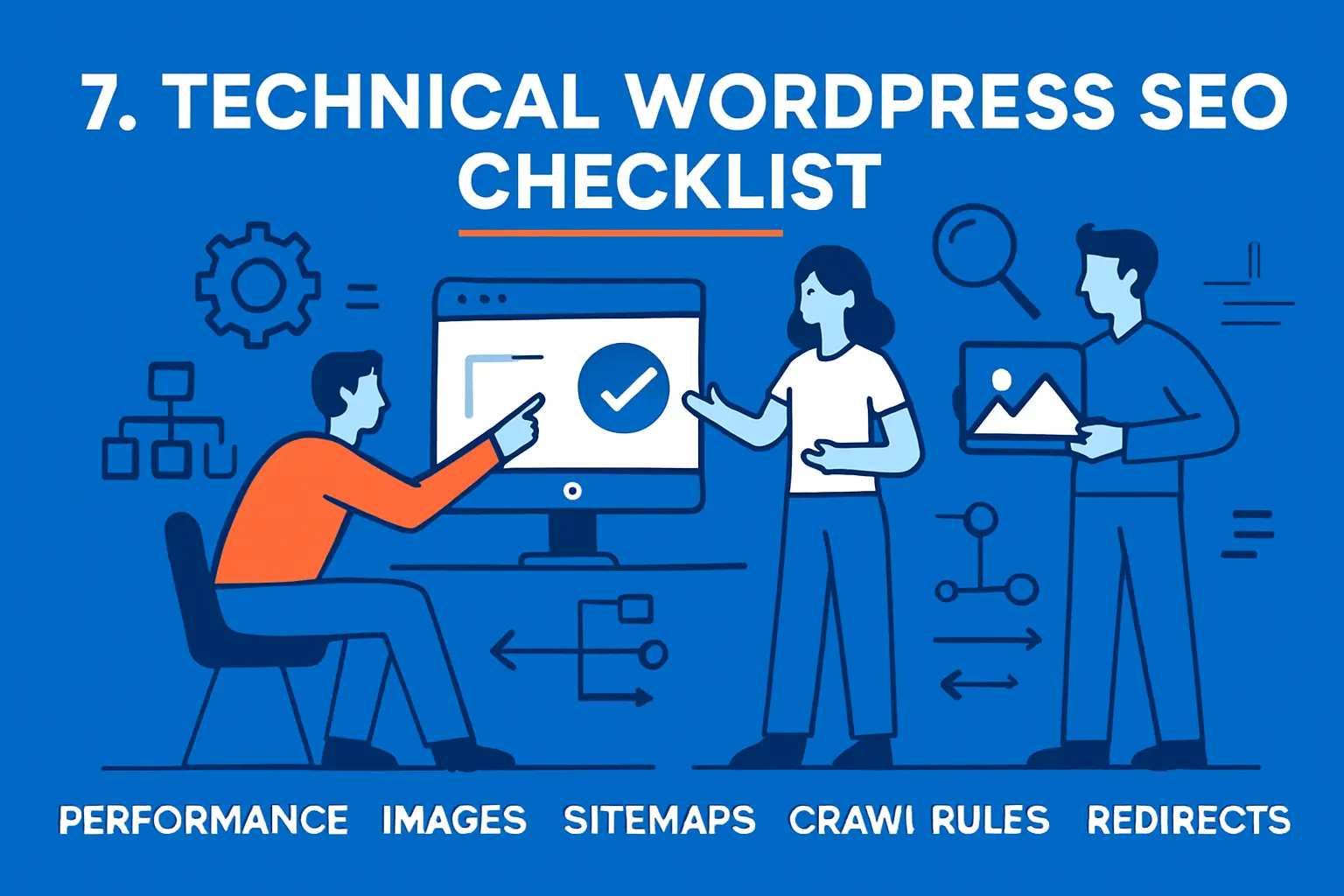
1. Improve speed and Core Web Vitals with caching compression and code optimizations
Performance is where hosting, theme choices, and editorial habits collide. Server-level caching, object caching, and page caching can dramatically reduce latency, but only when they’re configured to respect logged-in behavior, cart pages, and personalized content.
Google’s guidance for Largest Contentful Paint is a helpful north star: sites should strive for 2.5 seconds or less. After we pick that target once, we focus on the levers that consistently move it—faster backends, fewer render-blocking assets, smaller above-the-fold payloads, and less client-side thrash from bloated builders.
2. Optimize images with compression and lazy loading to reduce load time
Images are often the heaviest “content” on a WordPress page, and they’re also the easiest to mishandle. We recommend uploading properly sized originals, using modern formats where compatible, and letting WordPress generate responsive variants so mobile devices aren’t forced to download desktop assets.
Lazy loading helps, but it’s not magic. If your hero image is lazy-loaded, you can sabotage perceived speed. In our audits, we treat the above-the-fold image as a performance-critical resource and treat below-the-fold galleries as candidates for deferred loading. The goal is not just a good score; it’s a page that feels instant.
3. Generate and submit an XML sitemap to help search engines find important URLs
Sitemaps are a discovery tool, not a ranking trick. Their job is to tell crawlers which URLs you consider important, when they changed, and how your site is shaped. In WordPress, the common failure mode is generating multiple competing sitemaps—one from the SEO plugin, another from a caching plugin, and a third from a theme function.
We prefer a single sitemap source, submitted in Search Console, and kept aligned with your canonical URLs. If you deprecate a page, remove it from the sitemap and redirect it appropriately. When sitemaps stay clean, crawl budgets go toward content that can actually win.
4. Optimize robots.txt and use noindex rules for pages that should not appear in search
Robots.txt controls crawling, while “noindex” controls indexing. Mixing those up is how sites accidentally trap pages in limbo: blocked from crawling but still indexed based on stale signals. We prefer to allow crawling of pages you want evaluated and use noindex on pages you don’t want surfaced.
In WordPress ecosystems, typical candidates for exclusion include internal search results, admin paths, and thin archive variants. For non-HTML files, header-based rules can be useful, but we implement them carefully because global directives can have unintended consequences when plugins generate assets in unexpected locations.
5. Fix broken links and 404 errors with 301 redirects and redirect management
Broken links are more than a minor UX annoyance; they fracture your internal link graph and waste crawl effort. When we take over a site, we run a crawl, map broken URLs to their best equivalents, and then implement permanent redirects where the intent is clear.
Redirect management is as much process as technology. Editorial teams need a simple rule: do not delete a page that has links or traffic without deciding where its value should flow next. If you treat redirects as a living ledger of content decisions, you protect authority through redesigns, migrations, and product pivots.
8. How 1Byte helps you implement seo tips for wordpress with cloud hosting and support
1. Domain registration for launching on a custom domain and managing site addresses
Domains are where brand, SEO, and operations meet. When customers register and manage domains through 1Byte, our goal is to make the “boring” parts reliable: DNS that’s easy to reason about, records that don’t drift, and clear support paths when propagation or verification gets confusing.
From an SEO standpoint, domain hygiene is how you avoid split identities. We help teams standardize the primary hostname, enforce consistent redirects, and keep site addresses aligned across WordPress settings, CDN configuration, and analytics. When those layers agree, every link you earn compounds into the same asset.
2. SSL certificates to enable HTTPS and improve trust signals
We think of SSL as part of uptime, not a checkbox. A misconfigured certificate can cause intermittent failures that look like “random SEO drops,” even though the root cause is simply that bots and users can’t fetch pages consistently.
Our operational stance is to keep certificate issuance and renewal predictable, then pair it with sensible security defaults: hardened TLS configuration, optional WAF protection, and guidance on avoiding mixed content in WordPress. Once HTTPS is stable, you can focus on content and architecture instead of firefighting warnings.
3. WordPress hosting shared hosting cloud hosting and cloud servers from an AWS Partner
Different WordPress sites need different shapes of infrastructure. A personal blog might thrive on shared hosting with good caching, while an e-commerce store or a high-traffic editorial site may need cloud hosting that isolates resources, scales cleanly, and supports performance tuning under load.
As 1Byte, we like to meet customers where they are, then give them an upgrade path that doesn’t break URLs or workflows. Our cloud servers—delivered as an AWS Partner offering—are built for teams that need predictable performance, better observability, and a support team that can talk about PHP workers, database bottlenecks, cache layers, and deployment hygiene in the same breath.
9. Conclusion: turn WordPress SEO improvements into an ongoing process
1. Measure results with regular audits SEO analysis Google Search Console and analytics
SEO becomes manageable when measurement becomes routine. We recommend lightweight monthly checks for indexing anomalies, traffic shifts, and query changes, then deeper quarterly audits that review templates, internal linking, page experience, and crawl behavior.
In our own operations, we treat Search Console like error telemetry and analytics like product analytics. Rankings matter, but so do outcomes: qualified visits, engaged sessions, and conversions that match the intent your pages promise. When measurement is consistent, SEO stops being superstition and starts being engineering.






2. Review and refresh older content metadata internal links and technical settings over time
Content ages, products evolve, and SERPs change shape. A page that ranked last year may slip because competitors added depth, because Google now prefers a different format, or because your own site architecture drifted as new posts piled up without internal links.
Refreshing old content is often the highest-leverage work you can do: tighten the title promise, improve the first screen, update screenshots, fix broken links, and connect the page into your newer clusters. If we at 1Byte had to leave you with a single next step, it would be this: choose one cornerstone page, audit it end-to-end, and ship a meaningful update—then ask yourself, what would happen if you repeated that habit every month?